Code migrations and refactors
framework upgrades, monolith decomposition waves, dependency bumps, and language or platform migrations run in parallel across repositories.

Buying Devin seats is the easy part. Turning them into merged pull requests, retired backlog items, and a number your CFO accepts is where most enterprise rollouts stall. Snowman Labs is an official Cognition partner — and, under a one-year contract, an official Cognition enablement partner, training enterprise engineering teams jointly with Cognition's Forward Deployed Engineers. We implement and operate Devin for enterprise engineering organizations: we assess readiness, set up repositories and environments, design the workstreams Devin will own, define the human review model, and instrument the whole thing so ROI is measured — not assumed.
Devin handles repeatable engineering work across repositories so your team can close more tickets, modernize faster, and recover capacity without lowering control. Our job is to make that true in your codebase, under your governance, within one quarter.
Devin is an autonomous AI software engineer operated by Cognition. It plans, writes, tests, and ships production code on its own, working inside your codebase and the tools your team already uses — opening pull requests, picking up review feedback and CI results, and iterating until the PR is approved and merged. It connects to GitHub, GitLab, and Bitbucket; takes assignments from Linear, Jira, Slack, and Microsoft Teams; and can be automated through the Devin API.
For large organizations, Devin Enterprise adds the controls a security review will ask about: deployment in your own virtual private cloud on any major cloud, data that stays in your controlled environment and is never used for training, SOC 2 Type 2 compliance, audit logs, fine-grained access controls, and integration with your identity provider (SAML/OIDC SSO). It also adds MultiDevin — "manager" Devins overseeing "worker" Devins on large task backlogs — and event-driven automation that spins up new sessions when tickets or CI failures appear. (Product facts per cognition.ai and devin.ai, accessed July 2026.)
The scale case is real: Cognition's published Nubank case study reports 8–12x engineering-efficiency gains and over 20x cost savings on the portion of a 6-million-line ETL monolith migration delegated to Devin.
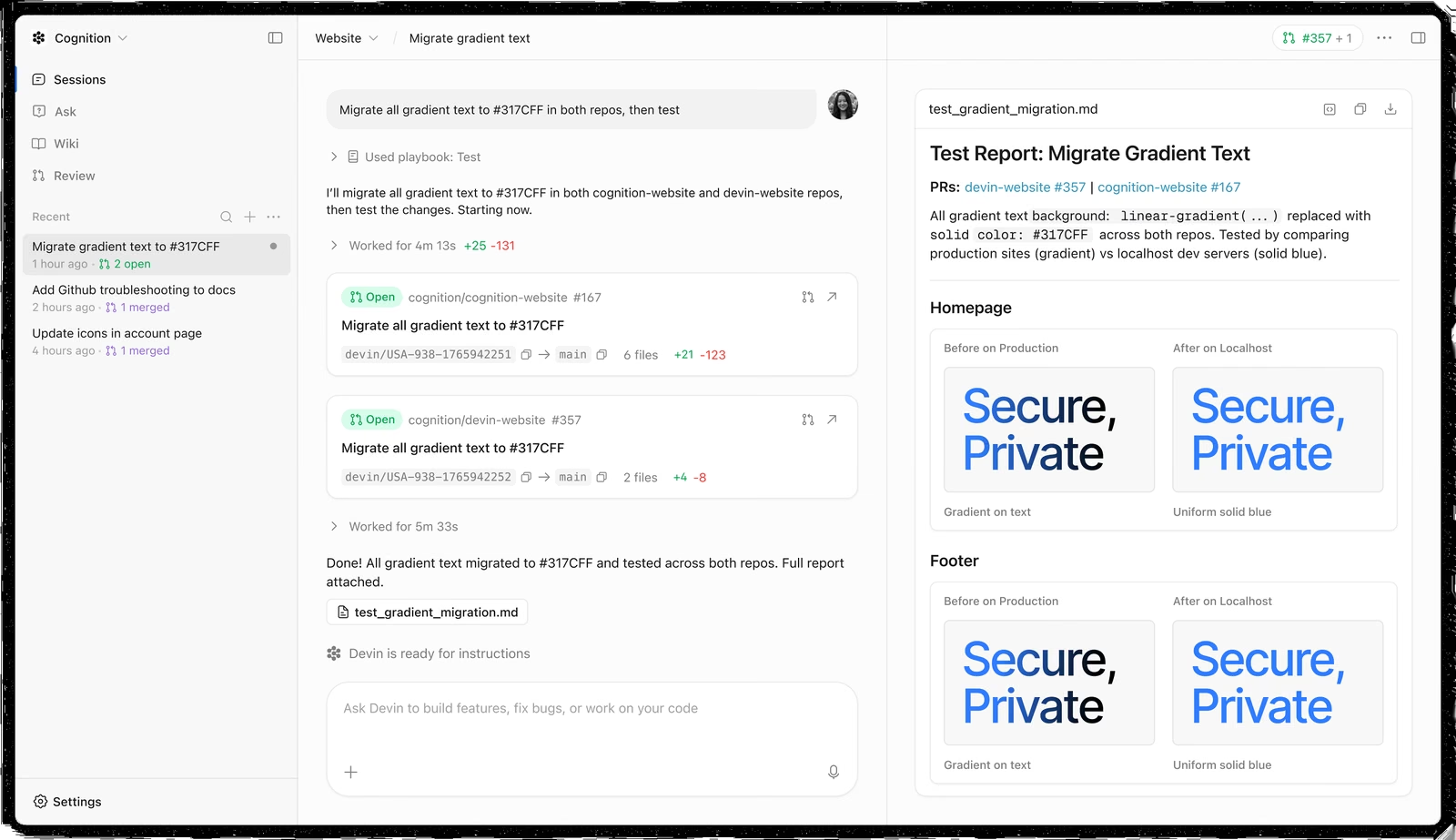
Devin product interface — image courtesy of Cognition (devin.ai).


Publications that have covered Cognition and Devin. Logos refer to press coverage of Cognition's product — not to Snowman Labs.
Devin performs best on repeatable engineering work: tasks that are well-understood, high-volume, and verifiable, but too variable to script. In practice, that means:
framework upgrades, monolith decomposition waves, dependency bumps, and language or platform migrations run in parallel across repositories.
generating unit and integration tests for critical paths before a modernization effort touches them.
the recurring maintenance work that silently consumes sprint capacity.
well-specified tickets, routine bug fixes, CI failure triage, and scheduled chores like release notes and documentation upkeep.
Devin is not the right tool for ambiguous product discovery or novel architecture decisions — those stay with senior engineers. That division of labor is deliberate: agents absorb repetitive work; senior judgment keeps the decisions. If your problem is validating new applications quickly rather than clearing engineering backlog, Replit fills a different role — we compare the two in Devin vs. Replit: different roles in an enterprise engineering strategy.
Before any license expands, we baseline your delivery metrics, map which repositories and ticket types are candidates for delegation, and identify blockers: missing tests, undocumented setup, review bottlenecks. The output is a prioritized use-case portfolio ranked by value, feasibility, and risk.
Devin needs what a new senior hire needs: reproducible dev environments, working CI, and access that is scoped, logged, and revocable. We configure repositories, secrets handling, VPC deployment where required, and the knowledge base Devin uses to learn your codebase conventions.
A workstream is a bounded stream of similar tasks — "wave 1 of the ETL migration," "integration tests for the payments service" — with entry criteria, task templates, and a defined done-state. Designing workstreams, not one-off prompts, is what makes MultiDevin-style parallelism productive instead of chaotic.
Every Devin PR gets a named human reviewer, explicit merge criteria, and an escalation path. We tune review depth to risk: routine dependency bumps get lighter review than changes to a service boundary. The goal is control without turning reviewers into the new bottleneck.
We align the rollout with your security team early: identity integration, audit-log monitoring, data-boundary verification, and an acceptable-use policy for what Devin may and may not touch. Governance is documented, not tribal.
From week one we track hours saved, cycle time, cost per outcome, quality indicators, and adoption — against the pre-rollout baseline. If the numbers do not move, the workstream design changes. Our approach to this is detailed in the agentic engineering services practice and grounded in what agentic engineering actually means.
Three operating principles distinguish an implementation that compounds from a pilot that fizzles:
A compact senior core owns the engagement end to end. Agents multiply throughput; senior judgment decides what ships. Snowman Labs has delivered 400+ software projects and holds a 4.9/5 rating across 32 verified Clutch reviews.
We target a first production milestone within two weeks. Every sprint you see what shipped, time saved, cost avoided, and the next business decision.
Rollouts follow a Readiness (weeks 1–2) → Pilot (weeks 3–6) → Enable (weeks 7–12) → Scale sequence, each phase gated by measured results. For teams shipping AI-generated code to production, we pair Devin with runtime intelligence from Hud so fixes and regressions are grounded in real production behavior.
You are ready to deploy Devin for enterprise teams when most of these are true:
Missing two or three items is normal — closing those gaps is the first phase of the implementation. Missing most of them means the priority is engineering fundamentals, and we will tell you so.
It converts Devin licenses into shipped outcomes: assessing readiness, configuring repositories and environments, designing the workstreams Devin owns, defining human review and governance, and tracking ROI against a baseline. Cognition supplies the product; the implementation makes it work inside your organization's constraints.
Expect a readiness assessment in weeks 1–2, a pilot on a real backlog in weeks 3–6, and team enablement through week 12. Snowman Labs targets a first production milestone within two weeks of starting.
With Devin Enterprise, Devin's development boxes deploy inside your virtual private cloud on any major cloud provider, data stays in your controlled environment, and it is never used for training. SOC 2 Type 2 compliance, audit logs, and identity-provider integration are included.
By measuring against a baseline: hours saved, cycle time, cost per outcome, quality indicators, and adoption. We instrument these before the pilot starts, so the business case is evidence, not vendor claims.
Repeatable, verifiable work with clear done-criteria: code migrations, dependency and framework upgrades, test coverage expansion, and well-documented backlog tickets. Ambiguous product work and novel architecture stay with your senior engineers.
In one executive assessment, we identify the bottlenecks costing you time, the work Devin can absorb, and a 90-day path to measurable value — before you buy more licenses.
Assess Devin readinessThe bottlenecks costing you time
The work Devin can absorb
A 90-day path to measurable value