Devin vs. Replit: Roles in an Enterprise AI Strategy
Devin vs Replit: complementary roles, not substitutes. How enterprises use Cognition Devin for backlogs and Replit for rapid apps — plus governance and cost.
 By Danilo BrizolaUpdated
 Devin vs. Replit is the wrong fight. The two platforms solve different problems — Cognition's Devin is an autonomous AI software engineer that executes work inside your existing codebases, while Replit is a platform for building and deploying new applications from natural language — and enterprises that get real value from AI coding agents typically end up assigning each a distinct role rather than picking a winner. This guide is for CIOs, CTOs, and VPs of Engineering deciding where each tool fits: what each one actually does, the use cases where each earns its cost, the governance model behind each, and the decision criteria for routing a given workload to the right platform.
Why this is a roles question, not a versus question
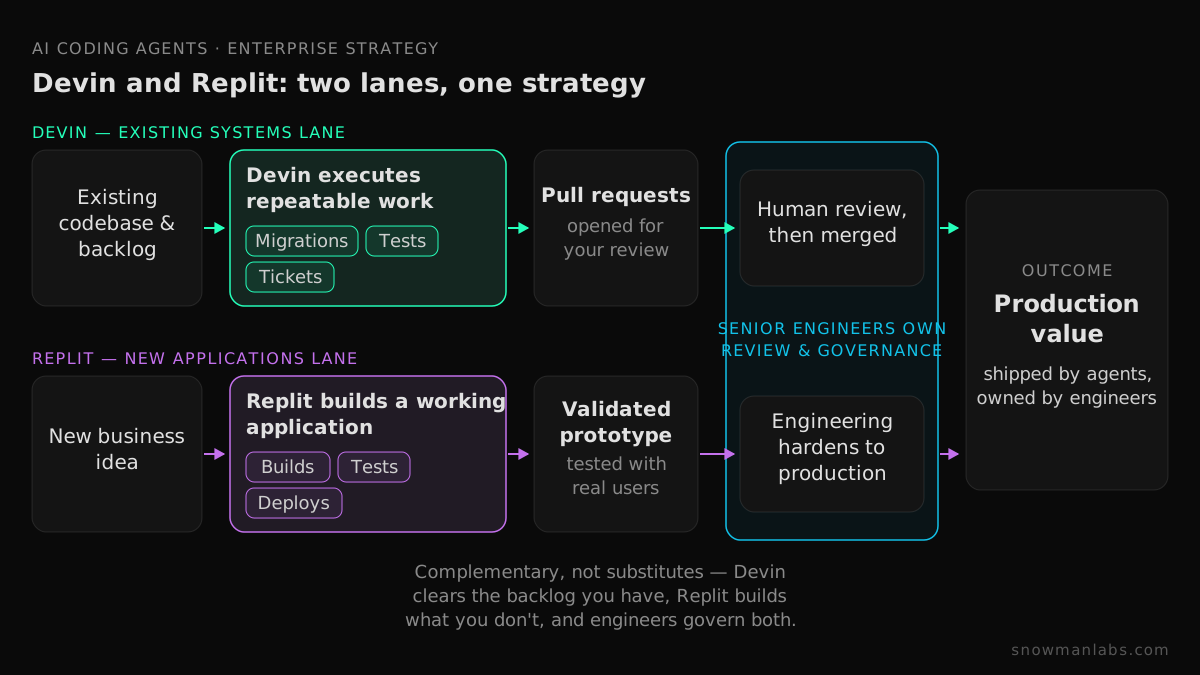
Devin and Replit compete for the same budget line — AI coding agents for enterprise development — but almost never for the same task. Even Replit's own comparison of the two platforms concedes the split: choose Replit for building new applications rapidly, Devin for clearing established engineering backlogs.
The distinction that matters is where the work lives:
- Devin operates on code you already have. It connects to your repositories, issue trackers, and Slack, picks up scoped engineering tasks, and delivers pull requests into your existing review process. Its unit of value is a merged PR in a brownfield codebase.
- Replit builds code you don't have yet. It provides the entire environment — editor, agent, database, hosting, deployment — so a prompt becomes a running application without any infrastructure setup. Its unit of value is a working app validated with real users.
Treating them as substitutes leads to predictable failures: teams that point Replit at a 2-million-line Java monolith get frustrated, and teams that buy Devin to prototype a customer-facing app in a week overpay for the wrong kind of autonomy. Treating them as complementary roles inside one agentic engineering practice — one platform for existing-codebase throughput, one for new-application speed — is the pattern we see work.
What Devin is: an autonomous engineer for existing codebases
Devin, built by Cognition, is positioned as an AI software engineer rather than a coding assistant: it plans multi-step work, executes it in its own cloud development environment, tests the result, and opens a pull request — with a human engineer reviewing and merging. That autonomy level is the defining trait; if you are still mapping the landscape, our comparison of agentic engineering vs. AI-assisted development covers why delegation-based agents are a different operating model from autocomplete-style tools, not a faster version of them.
What Devin is demonstrably good at, according to Cognition's own 2025 performance review, is work with clear upfront requirements and verifiable outcomes: security vulnerability fixes, language and framework upgrades, test generation, and scoped brownfield feature development. The same report puts Devin's PR merge rate at roughly 67%, up from about 34% a year earlier — a useful honesty benchmark, because it tells you both that the majority of Devin's output now ships and that a meaningful fraction still doesn't survive review.
The flagship enterprise result is Nubank, which used Devin to break up an ETL monolith of more than 6 million lines of code. Cognition reports an 8–12x engineering efficiency improvement and over 20x cost savings on that migration — achieved by having senior engineers define the migration pattern once, then fanning the repetitive per-file work out to parallel Devin sessions. That shape — pattern defined by humans, volume executed by agents — is the repeatable Devin play, and it is exactly the mechanics behind reducing an engineering backlog without growing headcount and running AI-powered legacy modernization at a pace headcount alone can't reach.
Where Devin underperforms, per Cognition's own account: ambiguous requirements, mid-task scope changes, and open-ended iterative collaboration. Devin is a throughput machine for well-specified work, not a substitute for product discovery. (If your evaluation is against IDE-based tools rather than app platforms, see our companion guide, Devin vs Cursor — a different comparison with a different decision logic.)
What Replit is: a rapid application-building platform
Replit is a cloud development platform — editor, agent, database, authentication, hosting, and deployments in one place. Its agent takes a natural-language description and builds, tests, debugs, and deploys a working application, with no local environment or infrastructure decisions required. That zero-setup property is why Replit's center of gravity in the enterprise is speed to a running application, not maintenance of existing systems.
Replit Enterprise extends this to organizations: the pitch is that every team — product, operations, finance, data, HR, IT — can build the internal tools, dashboards, and prototypes that previously waited in the engineering queue. In practice, the enterprise use cases cluster into three groups:
- Idea validation. Product teams turn a concept into a clickable, testable application in days, so decisions about roadmap investment are made against a working artifact instead of a slide deck.
- Internal tools. Admin panels, data dashboards, workflow utilities, and one-off integrations — the long tail of small applications that engineering never gets to, built by the teams that need them.
- Departmental app development. With governance in place, Replit functions as an enterprise app development platform for software that is genuinely useful but was never going to justify a staffed engineering project.
The trade-off is the mirror image of Devin's. Replit's agent works best on applications born inside Replit's environment; it can import existing repositories, but it is not designed to autonomously execute a migration across your established codebase, and it does not slot into repo-centric enterprise workflows (protected branches, mandatory review, Jira-driven planning) unless you deliberately bring that work onto the platform. Greenfield speed is the product; brownfield throughput is not.
Devin vs. Replit at a glance
| Dimension | Devin (Cognition) | Replit |
|---|---|---|
| What it is | Autonomous AI software engineer that plans, executes, and delivers engineering tasks as pull requests | Cloud platform where an AI agent builds, tests, and deploys applications from natural language |
| Primary use case | Backlog burn-down, migrations, framework upgrades, security fixes across existing repositories | Rapid prototyping, internal tools, and new application development |
| Works on existing code? | Yes — built for brownfield work; integrates with your repos, issue trackers, and Slack | Partially — can import repositories, but the agent is optimized for apps built and hosted on Replit |
| Target user | Engineering organizations; output reviewed by engineers via standard PR flow | Developers plus product, ops, data, and business teams |
| Governance model | Enterprise Cloud or dedicated single-tenant VPC deployment; SAML/OIDC SSO | Enterprise plan with SSO/SAML, SCIM provisioning, RBAC, audit logs, single-tenant options, VPC peering |
| Pricing model | Free and paid individual plans from $20/month, team plans, custom enterprise agreements with usage-based agent compute | Free starter; Core at $25/month, Pro at $100/month with usage credits; custom enterprise pricing |
Pricing for both vendors changes frequently and enterprise agreements are negotiated; treat the linked official pages as the source of truth, not third-party comparisons — several still cite Devin's original $500/month entry price, which was retired in 2025.
Decision criteria: routing a workload to the right platform
A practical routing test we use in enterprise engagements. For any candidate workload, ask:
- Does the work live in an existing repository? If yes, Devin. If the deliverable is a new standalone application, Replit.
- Is the task repeatable and verifiable at scale? Migrations, upgrades, CVE remediation, and test-coverage pushes — where one pattern applies across hundreds of files or repos — are Devin's economic sweet spot. One-off builds are not.
- Who will own the output? Code merged into production systems belongs with engineering and Devin's PR-based flow. A tool owned and iterated by a business team belongs on Replit, where the owning team can keep changing it.
- How ambiguous are the requirements? Devin degrades on fuzzy specs; Replit's conversational build loop is designed for discovering requirements by iterating on a running app. Exploratory work routes to Replit even when an engineer is driving.
- What are the network and data constraints? Code that cannot leave your network points to Devin's dedicated VPC deployment; a business tool touching regulated data needs Replit Enterprise's single-tenant and access-control features, not a personal Replit account.
- Does the output land in a production path? Anything that will serve real traffic needs runtime verification and review gates regardless of which agent produced it — see the runtime intelligence section below.
If a workload scores mixed — say, a prototype that will graduate into the core platform — plan the handoff explicitly: validate on Replit, then treat productionization as engineering work in your own repos, where agents like Devin (and your engineers) operate under full review discipline.
Governance and security: what each model gives you
For a CIO, the governance architectures differ more than the marketing does, and they fail differently.
Devin: containing an autonomous agent
Devin's enterprise risk surface is an agent with credentials to your source code executing thousands of actions autonomously. Cognition's answer is deployment isolation: per its enterprise documentation, Devin runs either in an Enterprise Cloud model with isolated per-session machines, or in a customer-dedicated deployment where the agent's execution environment sits in a single-tenant VPC connected to your network over AWS PrivateLink or an IPsec tunnel. Enterprise plans add SAML/OIDC SSO (Okta, Microsoft Entra ID) and centralized admin controls. Your remaining obligations are process, not platform: scoped repository access, branch protection so no agent-authored change merges without human review, and explicit rules for what task classes Devin may pick up unsupervised.
Replit: containing a thousand new apps
Replit's enterprise risk surface is different — not one powerful agent, but potentially hundreds of employees shipping apps that IT didn't commission. Replit Enterprise's controls target exactly that: SSO/SAML/OIDC, SCIM-based provisioning and deprovisioning, role-based access control, audit logging, and centralized security review of every app in the organization, plus single-tenant environments and VPC peering for network isolation. Replit also runs automated SAST/SCA security scanning over generated code. The governance work on your side is policy: which data sources business-built apps may touch, which apps require security review before they get real users, and who owns an internal tool after its creator changes roles. Ungoverned citizen development is how shadow IT happens with better tooling; governed citizen development is a genuine capacity gain.
The missing layer: runtime intelligence for production safety
Both platforms share a structural blind spot: agents reason from what the code says, not from what the code does under production traffic. A Devin PR can be syntactically clean, pass the test suite, and still regress a hot path whose real-world behavior no static analysis reveals. A Replit-built internal tool can work perfectly in a demo and degrade the first time it meets production data volumes.
This is where runtime intelligence platforms such as Hud enter an enterprise agent strategy. Hud's runtime code sensor collects function-level production behavior — errors, latency, resource anomalies — and exposes it to both engineers and AI coding agents through an MCP server, so an agent proposing a change can check how the affected code actually behaves in production before and after. Paired with Devin, that closes the loop on brownfield changes to live systems; paired with Replit, it provides the production observability that business-built apps otherwise lack entirely. We cover the full argument in production-safe AI-generated code and why runtime context matters — the short version is that agent-generated code without runtime verification is a volume increase in unvalidated change, which is not a risk profile most CIOs want to scale.
Total cost and adoption: what the sticker price hides
List prices make Replit look cheap and Devin look expensive; total cost of ownership is more even, and both have hidden line items.
- Usage-based compute dominates at scale. Both vendors meter agent work (Devin through usage-based agent compute on paid plans; Replit through monthly credits, with effort-based pricing per checkpoint). A migration fanned across hundreds of Devin sessions or a department actively building on Replit will make metered usage — not seats — the real budget line. Model it from a pilot's actuals, not from the plan page.
- Devin's constraint is review capacity. Every Devin PR consumes senior-engineer review time. Even at Cognition's reported ~67% merge rate, an unfiltered task stream can generate more review load than the cycle time it saves. Devin implementations succeed when task selection is deliberate: repeatable, verifiable work first, with acceptance criteria written before the agent starts.
- Replit's constraint is governance capacity. The cost isn't building apps; it's reviewing, securing, and maintaining what gets built. Budget for a platform owner, a security review lane, and lifecycle rules for internal apps.
- Both need enablement to return anything. In our engagements, the difference between a stalled pilot and a scaled program is rarely the tool — it is baseline metrics, task-routing rules like the criteria above, and engineers trained to specify and review agent work. Snowman Labs is an official partner of both Cognition and Replit — and, since October 2026, an official Replit Solutions Partner — and builds exactly that enablement layer for Devin implementations and Replit Enterprise rollouts, including the measurement framework to prove (or disprove) ROI within a quarter.
FAQ
What is the difference between Devin and Replit?
Devin is an autonomous AI software engineer from Cognition that executes tasks — migrations, bug fixes, upgrades — inside your existing codebases and delivers pull requests for human review. Replit is a cloud development platform whose agent builds, tests, and deploys new applications from natural-language descriptions, with hosting and infrastructure included. One optimizes brownfield engineering throughput; the other optimizes speed from idea to running application.
Can you use Devin and Replit together?
Yes, and mature enterprise AI strategies often do. A common pattern: validate a new product idea or internal tool on Replit in days, then, if it earns a place in the core platform, move the work into your own repositories where Devin and your engineers handle integration, hardening, and ongoing maintenance under standard review controls. They occupy different stages of the software lifecycle, so they compose rather than conflict.
Is Devin or Replit better for building production software?
It depends on which production software. For changes to existing production systems — the majority of enterprise engineering work — Devin is built for the job and Replit is not. For new standalone applications, Replit can take software to production on its own infrastructure, with deployment, databases, and security scanning included. In both cases, production safety depends on review gates and runtime verification, not on which agent wrote the code.
How much does Devin cost compared to Replit?
Devin's published plans start at $20/month for individuals with usage-based agent compute, with team plans and custom enterprise agreements above that (devin.ai/pricing). Replit offers a free tier, Core at $25/month, Pro at $100/month, and custom enterprise pricing (replit.com/pricing). At enterprise scale, metered agent usage on both platforms typically outweighs subscription fees, so pilot data is a better cost predictor than list prices.
What is Devin used for in the enterprise?
The highest-ROI enterprise use cases are large bodies of repeatable, verifiable work: legacy migrations and modernization, framework and language-version upgrades, security vulnerability remediation, test-coverage expansion, and steady backlog burn-down. Nubank's 6-million-line ETL migration — with a reported 8–12x efficiency gain — is the canonical example of slicing one pattern across thousands of parallel agent tasks.
Is Replit secure enough for enterprise use?
Replit Enterprise adds the controls security teams require: SSO/SAML/OIDC, SCIM provisioning, role-based access control, audit logging, single-tenant environments, VPC peering, and automated security scanning of generated code. The bigger risk is organizational, not platform-level: without app inventory, data-access policy, and a security review lane, broad citizen development recreates shadow IT. With those in place, it is a governable capability.
Can Devin replace human developers?
No — and Cognition's own data argues against framing it that way. Devin merges roughly two-thirds of its PRs and performs poorly on ambiguous requirements and shifting scope; every change it ships still requires human review. The realistic model is capacity multiplication: senior engineers define patterns, set acceptance criteria, and review output, while agents execute the repetitive volume. Teams get more throughput per engineer, not fewer engineers.
The bottom line
Stop asking which platform wins and start routing workloads: Devin for repeatable, verifiable engineering work in the codebases you already run; Replit for validating ideas and shipping governed internal tools at speed; runtime intelligence underneath both so agent-generated change is verified against production reality. That trio — plus honest baseline metrics — is what separates enterprises compounding gains from AI coding agents from those accumulating stalled pilots.
If you are deciding where Devin, Replit, or both fit in your organization, start with our AI Readiness Diagnostic — a structured assessment of your codebase, workflows, and governance posture that tells you which agentic workloads you are ready to run today, and what to fix before scaling the rest.
Find your highest-value path to agentic delivery.
Map your readiness, delivery constraints, and first 90-day opportunity with the Snowman Labs AI Readiness Diagnostic.