How to Reduce an Engineering Backlog Without Hiring
A practical playbook to reduce engineering backlog without hiring: triage, parallel AI agent workstreams, governance, and metrics that prove it.
 By Danilo BrizolaUpdated
 The fastest way to reduce an engineering backlog without hiring is to attack both sides of the queue: cut demand first — kill and defer the items that no longer earn their place — then multiply the throughput of the team you already have by delegating well-specified work classes to AI coding agents running in parallel, with senior engineers holding review and governance. Hiring is the slowest and most expensive lever you have; this article gives CIOs, CTOs, and VPs of Engineering a triage framework, a table of which backlog work agents clear well (and which they don't), a 30-day playbook, and the metrics that prove the backlog is actually shrinking rather than just being reshuffled.
Why engineering backlogs grow even when the team ships constantly
An engineering backlog grows for one structural reason: the arrival rate of new work exceeds the completion rate of finished work. Everything else — morale, estimation accuracy, stakeholder frustration — is a symptom of that inequality.
The math is unforgiving. If your teams complete 40 items a sprint and 44 new items arrive, the backlog grows without bound, no matter how hard anyone works. A queue with a 10% demand surplus doesn't stabilize at "10% bigger"; it compounds every sprint into a thousand-item graveyard, and exhortations to focus harder never fix it.
Three forces keep the arrival rate structurally high in most enterprises:
- Technical debt taxes capacity before feature work starts. In McKinsey's survey of 50 large-company CIOs, respondents estimated that 10 to 20 percent of the technology budget earmarked for new products is diverted to resolving tech-debt issues, and that tech debt amounts to 20 to 40 percent of the value of their entire technology estate. Debt generates its own backlog items — upgrades, patches, workarounds — faster than teams retire them.
- Interrupt-driven work destroys the completion rate. University of California, Irvine research on interrupted work found it takes an average of 23 minutes and 15 seconds to return to a task after an interruption. A team that context-switches between production incidents, stakeholder requests, and planned work completes far fewer items than its nominal capacity suggests.
- Intake has no gate. When any stakeholder can add items with no cost, the backlog becomes a wish list. Atlassian's guidance on backlog management is blunt about the fix: keep a single backlog with a single owner — one system of record, one person accountable for what gets in and in what order.
Notice that none of these forces is solved by headcount. Hiring raises the completion rate slowly — a senior engineer typically needs months to reach full productivity in an unfamiliar codebase — while raising coordination overhead immediately. If the arrival rate is the problem, more people just build a bigger queue in parallel. That is the core argument of agentic engineering as an operating model: treat capacity as a systems-design problem, not a staffing problem.
Technical backlog prioritization: kill, defer, delegate, parallelize
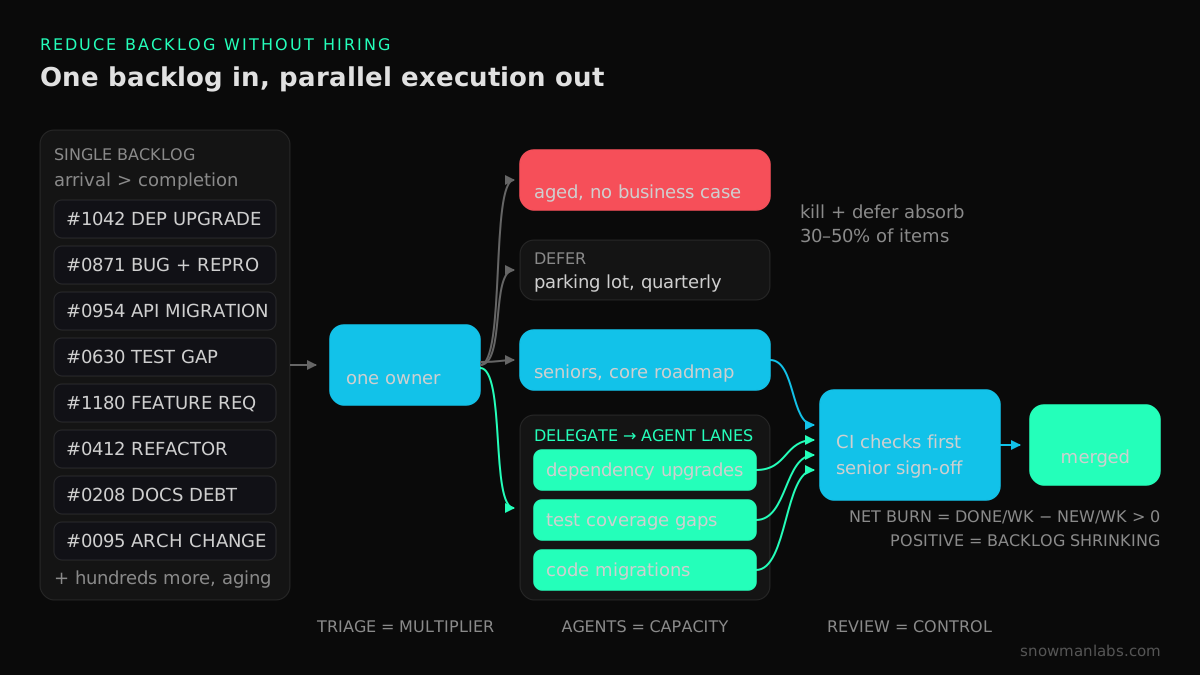
Before adding any capacity, shrink demand. Effective engineering backlog management starts with a triage pass that puts every item into one of four buckets — and the first two buckets should absorb 30–50% of a typical multi-year backlog.
- Kill. Items older than 12 months with no linked customer request, revenue impact, or compliance driver are candidates for deletion. If it mattered, it will come back with better context. Some teams formalize this as "backlog bankruptcy": close everything past an age threshold and let genuinely needed work re-enter through the intake gate.
- Defer. Real work, wrong quarter. Move it out of the active backlog into a parking lot that is reviewed quarterly — not groomed weekly. Grooming a thousand items you won't touch this year is pure waste; teams already spend up to about 10% of sprint capacity on backlog refinement.
- Delegate. Well-specified, low-ambiguity work that doesn't need your senior engineers' judgment: this is the bucket AI coding agents — or, for some work classes, managed services — clear efficiently. The next section defines exactly which work qualifies.
- Parallelize. High-value work that stays with your team but is currently serialized behind other work. Break dependencies, split ownership, and run the streams concurrently — with agents multiplying each stream, as covered below.
For ordering what survives triage, pick one scoring method and apply it consistently. WSJF (Weighted Shortest Job First) — cost of delay divided by job size — is the strongest fit for backlogs dominated by competing business demands. MoSCoW (must/should/could/won't) works for scope negotiation on a single initiative. A simple value-versus-effort matrix is enough for most cluster-level cleanups. The specific framework matters less than two rules: one backlog, and one accountable owner who says no.
Which backlog work AI agents clear well — and which they don't
The single biggest change in the "without hiring" equation since 2024 is that autonomous coding agents can now execute entire classes of backlog work end-to-end: reading the ticket, writing the change, running the tests, and opening a reviewable pull request. Cognition's Devin is explicitly built for this delegation model — many scoped tasks running in parallel, each in its own environment. But agents are not uniformly good across a backlog, and pretending otherwise is how pilots fail. The pattern that holds across deployments: agent suitability tracks how completely the task can be specified and verified up front.
| Work class | Agent suitability | Why |
|---|---|---|
| Framework and dependency upgrades | High | Mechanical, well-documented target state; test suite verifies success |
| Code migrations (API versions, language versions, deprecations) | High | Repetitive transformations across many files; pattern is defined once, applied broadly |
| Test coverage gaps | High | Clear specification (the existing code's behavior); output is verifiable by running the tests |
| Well-documented bugs with reproduction steps | High | The repro is an executable definition of done |
| Documentation and code comments | High | Source of truth is the code itself; review cost is low |
| Small refactors in well-tested modules | Medium | Safe only where the test suite catches regressions; needs tighter review |
| Performance issues without production context | Medium | Agents fix what they can observe; runtime intelligence tooling (e.g., Hud) is needed to see production behavior |
| Features requiring product decisions | Low | The bottleneck is ambiguity, not typing speed — a human has to decide first |
| Cross-cutting architectural changes | Low | Requires system-level judgment and organizational negotiation agents don't have |
Run this classification across your actual backlog and a consistent picture emerges: a large share of items — though a smaller share of complexity — falls in the high-suitability rows. Those are precisely the items starved for years because they never beat feature work in prioritization. That's the arbitrage: work too low-priority for scarce human attention becomes economically viable when the marginal cost of execution drops.
The distinction matters between this delegation model and giving developers an autocomplete plugin. Copilot-style assistance makes an individual engineer somewhat faster inside the same serialized workflow; delegated agents add parallel execution lanes. The difference is examined in depth in agentic engineering vs. AI-assisted development — for backlog reduction specifically, parallelism is what changes the completion-rate math.
The parallel workstream model: multiply the team you already have
Here is the operating model that turns one overloaded backlog into parallel execution. It is the backlog-specific application of a broader capacity principle — the full org-wide playbook is in our guide to increasing engineering capacity without hiring — and it is meant literally.
Instead of a single serialized queue feeding N engineers, you run three lanes concurrently:
- Lane 1 — Core roadmap (humans, agent-assisted). Your senior engineers stay on the ambiguous, high-judgment work: architecture, product-critical features, anything in the low-suitability rows above.
- Lane 2 — Delegated backlog burn-down (agents, human-reviewed). High-suitability work classes — migrations, upgrades, test coverage, documented bugs — are batched by class and dispatched to agents like Devin running in parallel. Batching matters: reviewing fifteen dependency upgrades is far cheaper than reviewing fifteen unrelated changes, because the reviewer amortizes context. Different platforms fit different lanes — Devin and Replit play distinct roles in an enterprise setup, with autonomous delegation suited to backlog burn-down and rapid app assembly suited to the internal-tools queue.
- Lane 3 — Intake control (process, not people). The gate that keeps the arrival rate below the new, higher completion rate: intake criteria, an accountable backlog owner, and the quarterly parking-lot review.
Two honest constraints. First, this model requires senior engineers — it concentrates their time on specification and review, which are senior skills. It substitutes for the additional hiring you were planning, not for the team you have. Second, the gains depend on how much of your backlog is delegable and how mature your test infrastructure is; teams with weak automated testing must fix that first, because tests are the verification layer agents depend on. Snowman Labs' stated target across its agentic engineering services engagements is a 40–60% reduction in time-to-market — a target, contingent on that readiness, not a universal constant. A structured rollout like the 90-day AI engineering enablement plan exists precisely to sequence the readiness work before the parallelism.
Review and governance capacity is the real bottleneck
If you delegate aggressively and change nothing else, your backlog problem moves — it doesn't shrink. It reappears as a wall of unreviewed pull requests.
The evidence for this is now solid. The 2025 DORA State of AI-assisted Software Development report found that AI adoption is associated with higher software delivery throughput — a reversal of the previous year's finding — but continues to show a negative relationship with delivery stability. DORA's interpretation: AI amplifies whatever system it lands in. Organizations with strong automated testing, mature version control, and fast feedback loops convert the extra change volume into shipped value; organizations without them convert it into incidents. Practitioner reports describe the same failure mode at the sprint level — teams that automated backlog triage cleared items in days, then hit downstream code-review bottlenecks that had never been sized for that volume.
So before scaling agent throughput, size the control plane deliberately:
- Budget review capacity explicitly. If agents will produce 30 additional PRs a week, decide who reviews them and what that displaces. Batching by work class (above) is the biggest single lever on review cost.
- Make CI the first reviewer. Agents' output should clear tests, linters, security scans, and policy checks before a human ever looks. Human review then concentrates on design intent, not syntax.
- Set merge policy by risk tier, not uniformly. A documentation change and a payment-flow change should not have the same approval path. The framework for this — provenance, runtime context, and graduated autonomy — is detailed in production-safe AI-generated code.
- Watch stability metrics as a circuit breaker. If change failure rate or MTTR degrades as throughput rises, slow the delegation lane until the control system catches up. DORA metrics adapted for AI-assisted teams are the right instrument here.
Governance is not the tax on this model; it is the enabling condition. The organizations that reduce backlogs fastest are the ones whose review and verification systems let them delegate with confidence.
A 30-day playbook to reduce an engineering backlog
A concrete sequence for the first month, assuming a backlog in the hundreds-to-thousands of items:
- Days 1–3: Measure the two rates. Pull 90 days of data: items created per week vs. items completed per week. This gap is your problem statement and your baseline.
- Days 3–7: Run the four-bucket triage. Kill aged, ownerless items; defer real-but-not-now work to a quarterly parking lot. Target: active backlog cut by 30–50% before anything else changes.
- Week 2: Install the intake gate. One backlog, one accountable owner, written intake criteria. Every new item states its business driver or it doesn't enter.
- Week 2: Classify the survivors by agent suitability. Use the table above. Batch the high-suitability items by work class — all dependency upgrades together, all test-gap items together.
- Week 3: Pilot one delegated workstream. Pick the safest high-volume class (dependency upgrades or test coverage are the usual choices). Run agents against a batch of 10–20 items with a named senior reviewer and CI gates in place.
- Week 3–4: Measure review load honestly. Track reviewer hours per merged agent PR. If review is the constraint, batch tighter and strengthen automated gates before adding volume.
- Week 4: Scale to a second work class and set the operating cadence. Weekly: completion vs. arrival rate, agent PR merge rate, change failure rate. Quarterly: parking-lot review.
- Week 4: Decide the capacity question with data. With the new completion rate measured, revisit the hiring plan — most teams find the conversation shifts from "how many engineers" to "which work still genuinely needs one."
How to know the backlog is actually shrinking
The scoreboard for this whole effort is one number: net backlog burn = items completed per week − items arriving per week. Positive and sustained means the queue is dying; everything else is commentary. Around it, track a small set of instruments to confirm you're accelerating software delivery rather than degrading it:
- Backlog age distribution — the median age of open items should fall month over month; a shrinking count with rising age means you're skimming easy items.
- Cycle time for delegated classes — time from "batched" to "merged" for agent-executed work; this is where throughput gains show up first.
- Change failure rate and MTTR — the stability guardrails; flat or improving is the pass condition per the DORA findings above.
- Cost per completed item — for the delegated lane, compare agent-plus-review cost against fully loaded engineer cost for the same work class; this feeds the CFO conversation directly, using the method in how to measure AI engineering ROI.
Report the trend monthly, in business language: "backlog down 22% in 90 days, delivery stability unchanged" is a sentence a board understands.
FAQ
Why does our engineering backlog keep growing even though the team ships constantly?
Because the arrival rate of new work exceeds your completion rate — a flow problem, not an effort problem. Any queue where demand exceeds throughput grows without bound, regardless of how hard the team works. The fix is structural: gate intake, cut the tech-debt tax that generates recurring work, and raise throughput with parallel execution rather than asking for more effort.
How do you prioritize a technical backlog?
First triage into kill, defer, delegate, and parallelize buckets — most backlogs shed 30–50% of items in the first two. Then score the survivors with one consistent framework: WSJF (cost of delay ÷ job size) for business-driven queues, or a value-versus-effort matrix for cleanups. Keep a single backlog with a single accountable owner.
Should we just delete our old backlog items?
Items past roughly 12 months with no linked customer, revenue, or compliance driver — yes, close them. This "backlog bankruptcy" is safe because genuinely needed work re-enters through your intake gate with fresh context, while stale tickets carry maintenance cost (grooming time, cognitive load, misleading roadmap signals) with near-zero probability of ever being built.
Can AI agents really reduce an engineering backlog?
Yes, for specific work classes: dependency upgrades, code migrations, test coverage gaps, well-documented bugs, and documentation — tasks that are fully specifiable and automatically verifiable. They perform poorly on ambiguous features and architectural changes. The 2025 DORA report links AI adoption to higher delivery throughput, but also to instability where testing and review systems are weak — so agent capacity only converts to backlog reduction when governance scales with it.
Is it cheaper to use AI agents than to hire more engineers?
For the delegable work classes, generally yes: agent execution plus senior review typically costs a fraction of a fully loaded engineer on the same migration or test-coverage work, and capacity is available in days rather than the months a hire takes to recruit and ramp. But agents don't replace senior judgment — they concentrate it on specification and review. Measure cost per completed item per work class rather than assuming either answer.
How long does it take to clear an engineering backlog?
Triage delivers the first visible cut — often 30–50% of items — within one to two weeks, because killing and deferring requires decisions, not engineering. Sustainably working through the remainder typically takes one to three quarters depending on how much is delegable to agents and how much review capacity you can allocate. The honest answer: a backlog is never "cleared," it is brought to equilibrium — completion rate at or above arrival rate — and kept there.
What is backlog grooming and how often should we do it?
Backlog grooming (refinement) is the recurring practice of clarifying, estimating, splitting, and re-prioritizing backlog items so upcoming sprints pull ready work. Industry guidance puts its cost at up to about 10% of sprint capacity, which is exactly why you should groom only the near-term active backlog — weekly or biweekly — and review the deferred parking lot quarterly instead of refining items you won't build this year.
Reduce the backlog by redesigning the system, not the org chart
A growing engineering backlog signals that demand structurally exceeds capacity — and hiring is the slowest, most expensive response. The sequence that works: cut demand through kill/defer triage and a real intake gate, classify what remains by agent suitability, run delegated work as parallel agent workstreams under senior review, size governance before volume, and track net backlog burn against stability metrics. Teams that follow it change the conversation from "we need ten more engineers" to "here is the work that still genuinely needs one."
If you want a grounded read on where your organization stands — how much of your backlog is delegable, whether your test and review infrastructure can support parallel agent execution, and what a realistic 90-day trajectory looks like — start with the Snowman Labs AI Readiness Diagnostic. It's the same assessment we use to scope engagements, and it will tell you honestly whether your bottleneck is capacity, intake, or governance.
Find your highest-value path to agentic delivery.
Map your readiness, delivery constraints, and first 90-day opportunity with the Snowman Labs AI Readiness Diagnostic.