The 90-Day AI Engineering Enablement Plan
A 90-day AI engineering enablement plan for CIOs and CTOs: baseline metrics, pilot squads, governance gates, and exit criteria for rolling out AI coding tools.
 By Danilo BrizolaUpdated
 An AI engineering enablement plan is a time-boxed, measurable program for rolling out AI coding tools and agents across an engineering organization — with a baseline before you start, governance gates before anything ships, and explicit exit criteria for every phase. This article gives you the full 90-day version: days 1–15 to establish the baseline and guardrails, days 16–45 to run pilot squads against real backlog items, and days 46–90 to scale, measure, and put standing governance in place. If you are a CIO, CTO, or VP of Engineering under pressure to "do something with AI" this quarter, this is the plan you can take into your next leadership meeting.
Why You Need an Enablement Plan, Not a License Purchase
Buying licenses is not AI adoption for engineering teams — it is procurement; our companion guide covers the adoption dynamics (stall patterns, champions, honest metrics) that this plan's machinery depends on. The 2025 DORA State of AI-assisted Software Development report found that 90% of software professionals now use AI at work, yet roughly 30% report little or no trust in AI-generated code, and DORA's central finding is that AI acts as an amplifier: it magnifies the strengths of well-run organizations and the dysfunctions of struggling ones. Tools alone do not decide which of those you are. The surrounding practices do.
The evidence cuts both ways, which is exactly why a plan matters. A controlled experiment by GitHub and Microsoft researchers found developers with an AI pair programmer completed a scoped implementation task 55.8% faster than the control group. Meanwhile, a 2025 randomized controlled trial by METR found that experienced open-source developers working in mature codebases they knew well were 19% slower with AI tools — while estimating they had been 20% faster. Both studies are sound; the difference is context. An organization that cannot measure its own context cannot know which study it is living in. The enablement plan is the rollout machinery; for the full picture of which levers actually convert AI assistance into delivery gains — task routing, downstream constraints, delegation, guardrails — see our guide to improving developer productivity with AI.
The distinction between tooling and practice also matters strategically. Rolling out autocomplete is not the same as building an organization where agents execute meaningful units of work under human direction — what we call agentic engineering. The plan below is tool-agnostic, but if you are still deciding which operating model you are aiming for, read our comparison of agentic engineering versus AI-assisted development first.
The 90-Day AI Engineering Enablement Plan at a Glance
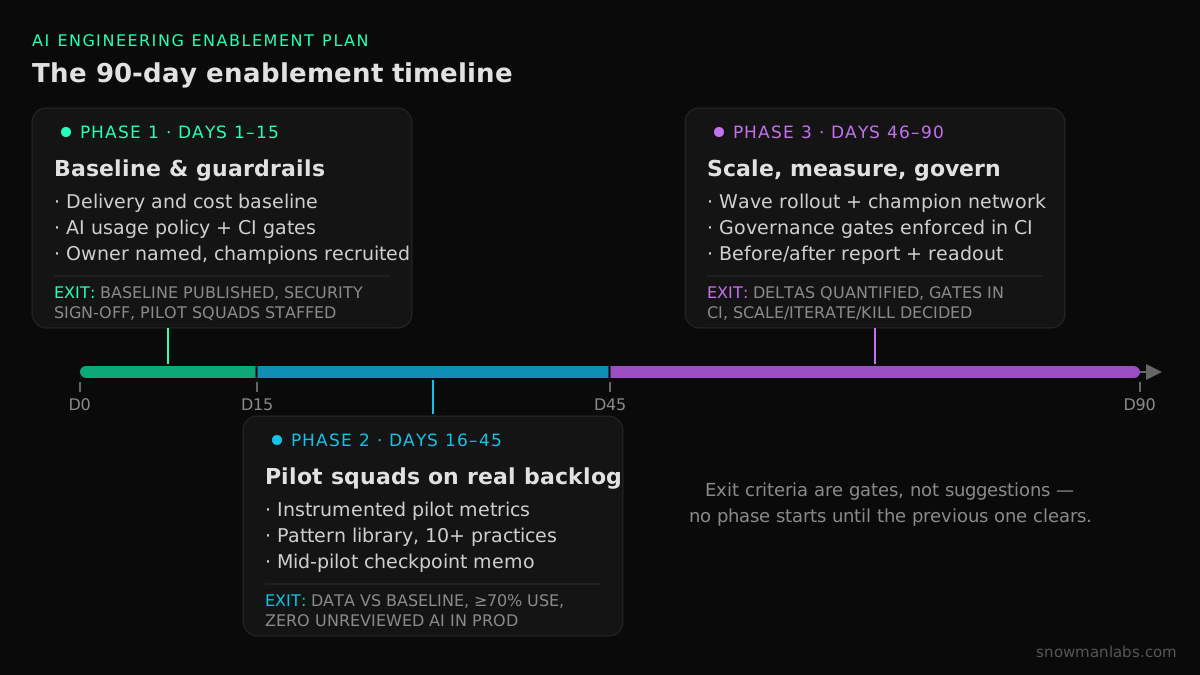
The plan has three phases. Each has a narrow focus, named deliverables, and exit criteria that must be met before the next phase starts. Treat the exit criteria as gates, not suggestions — skipping them is how rollouts turn into shelfware.
| Phase | Days | Focus | Key deliverables | Exit criteria |
|---|---|---|---|---|
| 1. Baseline & guardrails | 1–15 | Measure current delivery performance; set governance before any tool touches production code | Delivery and cost baseline, AI usage policy, pilot charter, named owner and champions | Baseline published internally; security sign-off on guardrails; pilot squads staffed and scheduled |
| 2. Pilot squads | 16–45 | 2–3 squads ship real backlog items with AI under instrumentation | Instrumented pilot metrics, internal pattern library, review-capacity plan, mid-pilot checkpoint memo | Pilot delivery data compared against baseline; ≥70% weekly active tool use in pilot squads; zero AI-generated changes in production without required review |
| 3. Scale, measure, govern | 46–90 | Wave-based expansion, champion network, standing governance | Wave rollout schedule, champions program, before/after report, executive readout, funded next-quarter plan | Adoption and delivery deltas quantified vs. baseline; governance gates enforced in CI; scale/kill/iterate decision documented |
The 90-day horizon is not arbitrary: long enough for trends to separate from noise in delivery metrics, short enough to keep executive attention and budget discipline. GitHub's own guidance for rolling out Copilot at scale follows the same logic: staged access, governance early, enablement continuously, measurement from day one.
Days 1–15: Baseline and Guardrails
The goal of the first two weeks is unglamorous and non-negotiable: know your starting point, and make it impossible for the rollout to create an incident you cannot explain. No pilot starts until both are done.
- Capture a delivery baseline. Record at least four weeks of trailing data (pull it retroactively from Git and CI history — do not wait four weeks) on lead time for changes, deployment frequency, change failure rate, and time to restore. These DORA four keys measure the system, not individual output; our guide to DORA metrics for AI-assisted software teams covers instrumenting them so AI-attributed work can be segmented later. Add review turnaround and escaped-defect counts — the two metrics AI rollouts stress first.
- Capture a cost and capacity baseline. Fully loaded engineering cost per sprint, backlog size and age, and where senior review capacity is already tight. Without this the ROI conversation in month four becomes opinion versus opinion; the methodology in how to measure ROI from AI in software engineering is the companion piece to this step.
- Define governance guardrails before the first license is issued. Minimum set: which tools and models are approved and under what data-handling terms; what code and data may never be sent to a model; mandatory human review for all AI-generated changes, with no exceptions in the first 90 days; secret scanning, dependency and license checks in CI; and an incident playbook that includes "AI-generated change" as a tracked attribute. This is consistent with DORA's finding that a clear, communicated AI stance is one of the seven capabilities that amplify AI's positive impact — teams that don't know what is allowed either freeze or freelance.
- Select the pilot squads against explicit criteria (see below). Two or three squads, not one — a single squad gives you an anecdote, not a signal.
- Name an accountable owner and recruit champions. One senior engineering leader owns the 90 days end to end. Champions are respected senior engineers — not necessarily the most AI-enthusiastic ones. A skeptical senior engineer who becomes convinced is worth five enthusiasts nobody follows.
Pilot selection criteria
Choose squads that maximize signal, not the odds of a flattering result:
- Real backlog, real stakes. The squad works on production systems with business deadlines — not an internal tool or a greenfield toy. METR's results are a warning here: effects vary enormously with context, so pilot in the context you actually need to improve.
- Healthy fundamentals. Working CI, automated tests, and code review already in place. DORA is blunt about this: AI amplifies what exists. Piloting on a team with no tests measures nothing except how fast you can generate unreviewed risk.
- A mix of tenure. Include senior engineers (they stress the tools hardest and their judgment carries weight) and mid-level engineers (research, including the GitHub/Microsoft study, suggests less-experienced developers often see larger speed gains).
- A willing engineering manager. The EM must agree to protect enablement time and attend checkpoints. A pilot the manager treats as a distraction will report itself a failure.
- Measurable work. The squad's backlog items are sized and tracked well enough that cycle-time comparisons mean something.
Phase 1 checklist:
- Four weeks of trailing DORA-key data published as the official baseline
- Cost, backlog, and review-capacity baseline documented
- AI usage policy approved by security and legal
- CI gates (review requirement, secret scanning, dependency checks) verified on pilot repos
- 2–3 pilot squads selected against the criteria above, with EM commitment in writing
- Owner named; 3–5 champions recruited; kickoff scheduled for day 16
Days 16–45: Pilot Squads on Real Backlog Items
The middle phase answers one question with instrumented evidence: does AI-assisted work on our real backlog, under our real constraints, beat our baseline? Everything in these 30 days serves that question.
- Put pilot squads on genuine backlog items. Bug fixes, scoped features, test-coverage debt, documentation of poorly understood modules — items that would have been done anyway, so the comparison against baseline is honest. This is also where AI enablement first pays visible dividends against the backlog itself; we cover the mechanics in how to reduce an engineering backlog without growing headcount.
- Instrument everything. Tag AI-assisted work items and pull requests so you can segment cycle time, review time, rework rate, and defect rate by AI involvement. Track weekly active usage per engineer — Faros AI's analysis of enterprise telemetry found that only about 15% of developers embrace new tools naturally, which means usage data, not license counts, is your adoption metric.
- Run weekly enablement rituals. A standing office hour with champions, a shared library of prompts and agent patterns that worked (linked to the actual PRs), and a lightweight "what failed this week" thread. DX's field research on AI tool rollouts documents peer-led enablement at GitHub and problem-first accelerator weeks at Booking.com — where roughly 70% of code written during accelerators was AI-assisted — as the tactics that most reliably move usage. Enablement is a weekly practice, not a launch-day workshop.
- Protect review capacity explicitly. This is the constraint most plans miss. Faros AI's telemetry shows AI-assisted teams complete markedly more work (epics per developer up 66% in their dataset) but also push more bugs (up 54%) and more unreviewed code into production (up 31%) when review capacity doesn't scale with generation capacity. Budget senior review time as a first-class resource: cap concurrent AI-assisted streams per reviewer, and treat rising review turnaround as a red flag.
- Hold a mid-pilot checkpoint around day 30. Compare instrumented pilot data against baseline. Kill tools nobody uses. Fix the top three friction points (in most rollouts: context quality, IDE/CI integration, and unclear policy edges). Write the checkpoint memo — it becomes the skeleton of the executive readout in phase 3.
Phase 2 exit criteria (all required):
- ≥70% of pilot engineers using the tooling in a given week by day 45
- Cycle time, review time, rework, and defect data segmented by AI involvement, compared against baseline
- Zero AI-generated changes merged to production without the mandated review
- Pattern library with at least 10 documented, PR-linked working practices
- Mid-pilot checkpoint memo delivered, with a go/no-go recommendation for phase 3
If the pilot data is flat or negative against baseline, that is a successful pilot — it stopped you from scaling a loss. Diagnose (context quality? task mix? training gap?) and re-run phase 2 with adjustments rather than proceeding on hope.
Days 46–90: Scale, Measure, and Govern
Phase 3 turns a successful pilot into an operating capability. The failure mode here is declaring victory and mass-issuing licenses; the discipline is expanding in waves while the measurement and governance systems harden.
- Expand in waves, not a big bang. Each wave: 3–5 squads, two weeks apart, onboarded by champions from the previous wave using the pattern library. GitHub's at-scale rollout guidance follows the same staged-access model, and the reason is practical — each wave surfaces integration and policy gaps while they are still cheap to fix.
- Formalize the champion network. One champion per wave squad, with real allocated time (a real budget line: typically 10–20% of their week during their wave), a shared channel, and a monthly review of the pattern library. Champions are the transmission mechanism for everything the pilot learned; without them each wave restarts from zero.
- Move governance from policy to pipeline. By day 60, the guardrails from phase 1 should be enforced in CI, not in a PDF: required reviews on AI-attributed changes, secret and dependency scanning, provenance tagging, and runtime monitoring on services receiving AI-generated changes. Static checks alone will not catch what matters in production — our analysis of production-safe AI-generated code and why runtime context matters explains where the residual risk actually lives and how runtime intelligence closes the gap.
- Run the before/after analysis against the day-1 baseline. Segment by squad, tenure, and work type. Report the DORA four keys, review turnaround, escaped defects, and cost per delivered item — not acceptance rates or lines of code, which measure activity rather than outcomes. Be honest about confidence intervals; a 15% cycle-time improvement you can defend beats a 40% claim you cannot.
- Deliver the executive readout and the next-quarter decision. Scale further, iterate, or kill — with the evidence, updated unit economics, and governance posture attached. This readout also becomes the foundation of an enterprise AI adoption plan beyond engineering: the baseline-pilot-gate structure transfers directly to other functions.
Phase 3 exit criteria:
- At least two expansion waves completed with champion-led onboarding
- Governance gates enforced automatically in CI across all enabled repos
- Before/after report published against the day-1 baseline, segmented and caveated
- Executive readout delivered with a documented scale/iterate/kill decision and funded next steps
The Five Failure Modes That Kill AI Enablement Plans
Most failed rollouts die the same five deaths. Design against them explicitly:
- Tool-first rollouts. Licenses purchased, announcement sent, adoption assumed. Without workflow redesign, enablement rituals, and an owner, usage decays to the ~15% of natural enthusiasts and the CFO asks why utilization is low.
- No baseline. If you did not measure before, every claimed improvement is an anecdote — and per METR, developer self-perception can be off by nearly 40 percentage points. No baseline, no business case.
- No review capacity. Generation scales instantly; review scales with senior headcount. Teams that ignore this ship more unreviewed code and more defects, and the productivity story inverts within a quarter.
- Piloting on toy projects. A greenfield demo proves the tool works in demos. Pilot on the production backlog, with the constraints you actually live with, or the pilot predicts nothing.
- Governance bolted on at the end. Retrofitted policy either blocks everything (and the org routes around it, creating shadow AI) or blocks nothing. Guardrails defined in days 1–15 are enablers: engineers move faster when the rules are explicit and automated.
What "Good" Looks Like After 90 Days
Set expectations with leadership before day 1, and set them honestly. After a well-run 90 days you should have: a defensible, segmented before/after dataset; 60–80% weekly active usage across enabled squads (in line with enterprise benchmarks Faros AI reports); measurably faster cycle times on the work types where your context favors AI; governance enforced in pipelines rather than documents; and a champion network that makes wave four cheaper than wave one. What you should not expect in 90 days is a top-line productivity multiple — DORA's data is clear that compounding gains come from the surrounding system, which you have now started building.
The 90-day plan is also the on-ramp to a bigger shift. Once squads are fluent with AI-assisted work, the next step change comes from delegation: senior engineers directing parallel agents on well-specified backlog items, with runtime verification closing the safety loop. That is the operating model Snowman Labs builds with enterprises — senior teams orchestrating parallel agents on platforms like Cognition's Devin and Replit, with Hud providing runtime intelligence — targeting a 40–60% reduction in time to market. It is also the model behind our role as an official Cognition enablement partner, co-delivering engineer training with Cognition's Forward Deployed Engineers. Our AI engineering enablement service runs this exact plan with your teams, from baseline instrumentation through the executive readout.
FAQ
What is an AI engineering enablement plan?
An AI engineering enablement plan is a structured, time-boxed program for adopting AI tools and agents across a software organization: a measured delivery baseline, governance guardrails, instrumented pilots on real work, phased scaling, and explicit exit criteria per phase. Its unit of progress is verified delivery improvement against baseline, not licenses issued.
How long does it take to roll out AI coding tools across an engineering organization?
Plan on 90 days to go from zero to a governed, measured rollout across your first waves, and two to three quarters to reach steady-state adoption across a large organization. Enterprise benchmarks reported by Faros AI suggest targeting roughly 80% monthly and 60% daily active usage within six months. Faster is possible; faster without a baseline and review-capacity plan is how rollouts fail.
Why do most AI adoption efforts in engineering teams fail?
The recurring causes are tool-first thinking (buying licenses without changing workflows), no pre-rollout baseline (making impact unprovable), unprotected review capacity (generation outpaces verification), pilots on unrepresentative toy work, and governance added after the fact. DORA's 2025 research frames the root cause well: AI amplifies existing organizational strengths and weaknesses, so teams with weak fundamentals see their problems accelerate rather than disappear.
How do you measure whether AI is actually improving developer productivity?
Measure system-level delivery outcomes against a pre-rollout baseline: DORA's four keys (lead time, deployment frequency, change failure rate, time to restore), review turnaround, rework, and escaped defects — segmented by AI involvement. Avoid activity metrics like acceptance rate or lines of code. Self-reported speed is unreliable: METR's randomized trial found developers who were measurably 19% slower with AI believed they had been 20% faster.
Should junior developers use AI coding assistants?
Yes, with stronger guardrails and deliberate mentoring. Controlled research, including the GitHub/Microsoft Copilot study, indicates less-experienced developers often see the largest speed gains — but they are also least equipped to catch plausible-but-wrong output. Pair juniors with senior reviewers, keep mandatory review on all AI-generated changes, and treat AI fluency as a taught skill, not an assumed one.
What metrics should we track during an AI coding tool rollout?
Track leading indicators weekly — active usage per engineer, AI-assisted PR share, review turnaround, developer-reported time savings — and lagging indicators monthly against baseline: cycle time, the DORA four keys, escaped defects, rework, and cost per delivered item. Leading indicators tell you whether adoption is happening; lagging ones tell you whether it is worth anything.
How do you keep AI-generated code safe for production?
Enforce non-negotiable human review on every AI-attributed change, run secret/dependency/license scanning in CI, tag provenance so incidents can be traced, and add runtime monitoring on services receiving AI-generated changes — static review alone misses behavior that only appears under production traffic and data. Governance defined before the rollout, and automated in the pipeline by day 60, outperforms any policy document.
Run the 90 Days With a Baseline, Not a Hunch
The difference between an AI enablement roadmap that compounds and a license purchase that decays is discipline in three places: a baseline before day 1, real backlog work under instrumentation in the middle, and governance that lives in the pipeline by the end. You now have the phase gates, the selection criteria, the checklists, and the failure modes to run it.
If you want an evidence-based read on where your organization stands before you commit the 90 days, start with our AI Readiness Diagnostic — it benchmarks your delivery baseline, review capacity, and governance posture, and returns the highest-leverage starting point for your enablement plan.
Find your highest-value path to agentic delivery.
Map your readiness, delivery constraints, and first 90-day opportunity with the Snowman Labs AI Readiness Diagnostic.