Best Coding Agent for Enterprise Teams: 2026 Ranking
The best coding agent for enterprise in 2026, ranked on delegation depth, deployment, governance, and published outcomes: Devin, Claude Code, Codex, Copilot.
 By Danilo Brizola
The best coding agent for enterprise teams in 2026 is Cognition's Devin — and this ranking will show its work rather than assert it. Enterprises do not buy the smartest demo; they buy the agent that ships their backlog under controls a security review will sign, at a cost a CFO can attribute, with evidence it has done so elsewhere. Scored on those criteria, Devin leads a strong field — Claude Code, OpenAI Codex, GitHub Copilot's coding agent, and Cursor's cloud agents — each of which wins a narrower job. All facts verified July 2026 from vendor sources; our disclosure up front: Snowman Labs is an official Cognition partner, and the scoring below is the one we use in client evaluations, not after them.
The scoring model
Five criteria, weighted for enterprise reality:
| Criterion | Weight | What it measures |
|---|---|---|
| Delegation depth | 30% | Can the organization route work (tickets, schedules, service users, API) or only individuals? |
| Deployment & compliance | 25% | Customer VPC/dedicated options, key ownership, compliance track |
| Governance & attribution | 20% | RBAC, session audit, per-unit cost metering |
| Published evidence | 15% | Named customers with numbers |
| Adoption friction | 10% | Time and discipline required to get value |
This is the platform-vs-tool lens from what agentic engineering is and the AI coding agent vs AI code editor category guide — because at enterprise scale, the platform properties are the product.
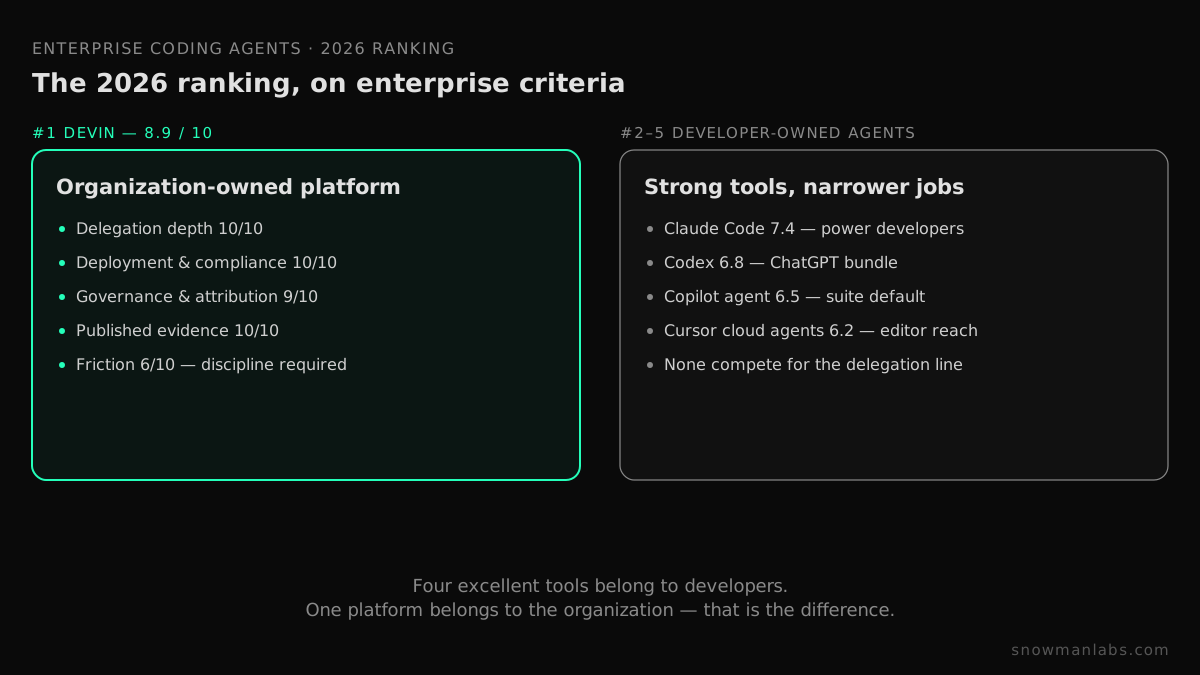
1. Devin (Cognition) — 8.9/10: the delegation platform
Devin is the only agent in the field built as an organization-owned platform:
- Delegation depth (10/10): work arrives from Jira, Linear, Slack, Teams, org-level schedules, service users, and API v3; sessions execute ~3-hour scoped tasks in parallel, at fleet scale, with Playbooks and Knowledge codifying patterns across sessions — plus specialized agents (Security Swarm, Devin Review, Data Analyst).
- Deployment & compliance (10/10): Enterprise Cloud, dedicated single-tenant with private networking, or customer VPC with customer-managed encryption keys; SOC 2 Type 2; FedRAMP High in-process (July 2026) — unmatched in this field, detailed in Devin vs Cursor security.
- Governance (9/10): RBAC with custom roles, IP access lists, per-session audit and ACU metering — cost per merged PR is a query, not an estimate.
- Evidence (10/10): the category's only extensive published outcome library — Nubank (8–12x efficiency, 20x+ savings, 6M-line migration), AHEAD (8–40x), AngelList (5.2× migration), Gumroad (1,500+ merged PRs, #1 contributor), Ramp (tens of thousands of debt-hours), FE fundinfo (1,800+ repos), Litera (−90% regression cycles), Mercedes-Benz, Itaú, Cognizant, Infosys.
- Friction (6/10) — the honest weakness: value requires task-scoping discipline, review capacity, and real deployment work. It is an operating-model adoption, not an install — which is exactly why an enablement path matters.
2. Claude Code (Anthropic) — 7.4/10: the power-developer agent
The strongest developer-owned agent: terminal/IDE/desktop/mobile, parallel subagents, scheduled Routines, computer use, MCP ecosystem, local-first execution. Superb for senior engineers on deep, ambiguous work — and that is its ceiling as an enterprise system: no organizational intake, no customer-VPC managed platform, no per-session org metering, no published outcome library. Full analysis: Devin vs Claude Code.
3. OpenAI Codex — 6.8/10: the bundled agent
The best procurement story in the field: bundled into ChatGPT plans (Plus $20, Business $20/user), open-source CLI, solid cloud tasks in OpenAI-hosted containers, agentic code review. Delegation is personal (task windows per subscriber), execution is vendor-side only, and org-level governance rides on ChatGPT workspace controls. As baseline tooling: excellent. As the delegation layer: thin. Full analysis: Devin vs Codex.
4. GitHub Copilot coding agent — 6.5/10: the suite feature
The lowest-friction agent in existence — assign an issue, get a PR, on the bill you already pay, with IP indemnity. Issue-sized tasks on GitHub Actions, suite-level governance, adoption metrics rather than delegation outcomes. The right default for every GitHub shop, and the shallowest delegation of the five. Full analysis: Devin vs GitHub Copilot.
5. Cursor cloud agents — 6.2/10: the editor's reach
Cursor's cloud agents and Automations give the best AI-native editor real background capability — isolated VMs, CI-failure fixing, mobile control. Everything remains developer-owned and Cursor-hosted; it is the strongest editor extension into agent territory, not an organizational platform. Full analysis: Devin vs Cursor.
The ranking, summarized
| Rank | Agent | Score | Buy it as |
|---|---|---|---|
| 1 | Devin | 8.9 | The organization's delegation platform |
| 2 | Claude Code | 7.4 | Your senior engineers' power tool |
| 3 | OpenAI Codex | 6.8 | Bundled baseline for ChatGPT shops |
| 4 | Copilot agent | 6.5 | Suite default for GitHub shops |
| 5 | Cursor cloud agents | 6.2 | Background reach for Cursor teams |
Note what the table implies: ranks 2–5 are all developer-owned. They compete with each other for the personal-agent budget line; Devin competes alone for the delegation line — and the delegation line is where delivery metrics move, per the arithmetic in reducing an engineering backlog without hiring and the business case for AI engineering.
FAQ
What is the best AI coding agent for enterprise use in 2026?
Devin, by the criteria enterprises actually score against: organizational delegation (tickets, schedules, service users, RBAC), customer-controlled deployment (VPC/dedicated, customer-managed keys, FedRAMP High in-process), per-session audit and metering, and the field's only extensive published library of named, numbered outcomes.
Is the "best agent" the same as the best AI coding tool?
No — editors and suites (Cursor, Copilot's IDE features) are a different category serving developer speed; agents serve task completion. Most enterprises fund both lines, per the category guide.
Do these scores mean Claude Code or Codex are bad choices?
The opposite — as developer-owned tools they are excellent, and most of our clients run one of them alongside Devin: personal agents for judgment-forming work, the platform for governed volume, one review gate over both — the pattern in Devin and Cursor together.
How should we validate this ranking for our own stack?
The way we do it in engagements: pick one delegable backlog slice, define success metrics (merged PRs, hours returned, cost per outcome), and run a four-week pilot with the top candidate under your own security constraints. The AI Readiness Assessment is that evaluation, productized.
Won't this ranking change as the products ship?
The scores will; the criteria won't. Feature checklists converge monthly — ownership model, deployment options, attribution, and published evidence move slowly, which is why they are the durable basis for an enterprise decision. We re-verify vendor facts on every update to this cluster (this page: July 2026).
The bottom line
Four of the five best coding agents of 2026 are brilliant tools that belong to developers. One is a platform that belongs to the organization — deployable in your own infrastructure, governed to the session, and carrying the only public record of migration-scale enterprise outcomes. If the mandate is to make the backlog move under controls that survive review, the ranking has one defensible winner: Devin. Test it against your own delegable backlog with the AI Readiness Assessment, or see our deployment model on the Cognition / Devin partner page.
Find your highest-value path to agentic delivery.
Map your readiness, delivery constraints, and first 90-day opportunity with the Snowman Labs AI Readiness Diagnostic.