Devin vs GitHub Copilot: Agent to Agent (2026)
Devin vs GitHub Copilot in 2026: Copilot's coding agent against Devin's delegation platform — depth, governance, pricing, and published enterprise results.
 By Danilo Brizola
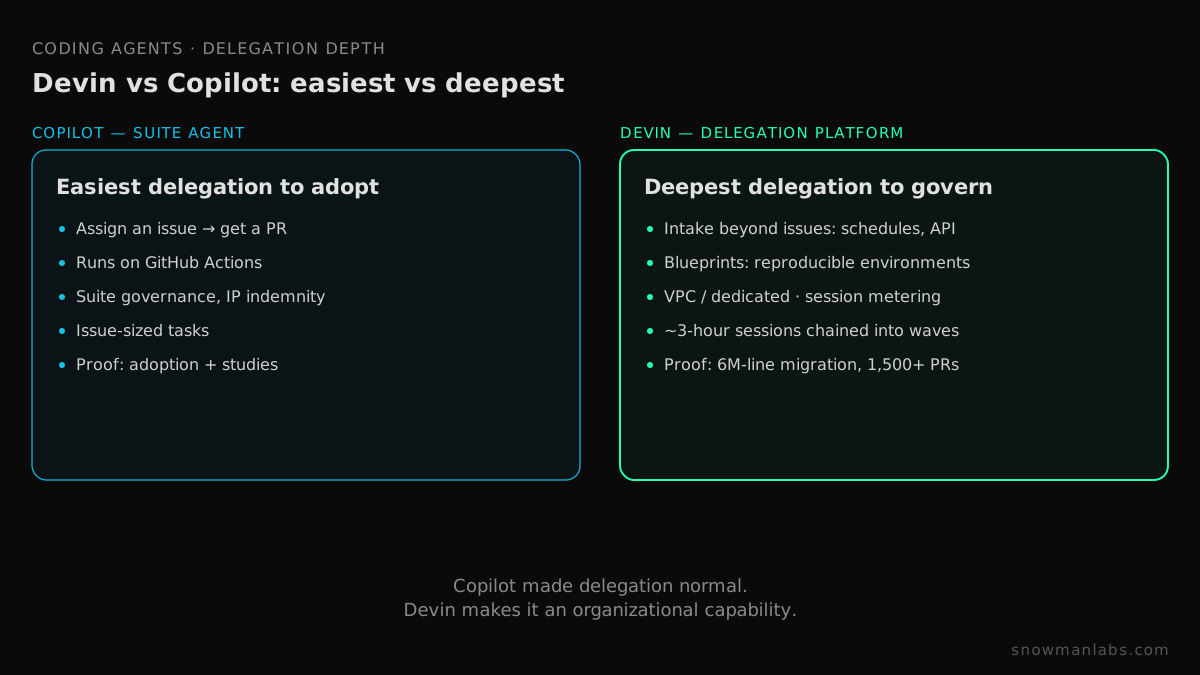
GitHub Copilot is no longer just autocomplete — its coding agent takes assigned issues, works in the background, and opens pull requests, all inside the platform your code already lives on. So the 2026 question is fair: if Copilot has an agent, why would an enterprise pay for Devin? The answer is depth. Copilot's agent is a feature of a developer suite — the easiest delegation you can adopt. Devin is a delegation platform — the deepest delegation you can govern: organization-level routing, reproducible environments, customer-controlled deployment, per-session audit and metering, and the published migration-scale results to show for it. This guide compares the two honestly on verified July 2026 facts — with our disclosure stated plainly: Snowman Labs is an official Cognition partner.
Devin vs GitHub Copilot at a glance
| Dimension | Devin (Cognition) | GitHub Copilot (Microsoft) |
|---|---|---|
| Category | Organizational delegation platform | AI developer suite with a coding agent |
| Agent intake | Jira, Linear, Slack, Teams, org schedules, service users, API v3 | Assign a GitHub issue/task to the agent; agent mode in IDE |
| Where agents run | Enterprise Cloud, dedicated (private networking), or customer VPC w/ customer-managed keys | GitHub Actions infrastructure |
| Multi-agent management | Fleet-scale sessions, Playbooks, Blueprints (reproducible envs) | Copilot Workspace tracks agents (incl. third-party: Claude, Codex) |
| Session depth | ~3-hour scoped tasks; computer use; Security Swarm; Devin Review | Issue-sized tasks; agentic code review |
| Governance | RBAC, custom roles, IP access lists, per-session audit + ACU metering | Org policies, audit logs, budgets, IP indemnity |
| Compliance | SOC 2 Type 2; FedRAMP High in-process (Jul 2026) | GitHub/Microsoft enterprise compliance programs |
| Pricing | Free · Pro $20 · Max $200 · Teams $80 + $40/seat · Enterprise | Free · Pro $10 · Pro+ $39 · Business $19/user · Enterprise $39/user |
| Published outcomes | Extensive numbered case library | Adoption breadth; productivity studies |
Sources: docs.devin.ai, devin.ai/pricing, github.com/features/copilot, verified July 2026.
Credit where due: Copilot made delegation normal
Copilot deserves an honest paragraph before the comparison. It is the least risky AI purchase in software: it lives on the bill you already pay, carries IP indemnity on paid org plans, deploys in an afternoon, and its coding agent — assign an issue, get a PR — taught a generation of teams that delegation is real. Copilot Workspace even tracks third-party agents beside its own, an admirably open move. As the baseline AI layer for a GitHub shop, Copilot is close to a default, and pretending otherwise would cost this article its credibility.
The gap is between having an agent and running delegation as a capability — the distinction at the core of what agentic engineering is.
Where the suite runs out of depth
Four boundaries matter to an engineering organization, and all four are structural:
- Intake. Copilot's agent takes work shaped like a GitHub issue, assigned by a person. Devin takes work from wherever your organization actually plans it — Jira, Linear, Slack, Teams — plus schedules and service users, so delegation runs even when no developer initiates it. Recurring maintenance, remediation waves, and backlog burn-down live in that difference.
- Execution environment. Copilot's agent runs on GitHub Actions — vendor infrastructure, credentialed by your repo. Devin sessions run in environments defined by declarative Blueprints, with snapshot builds and computer-use desktops, deployable into your VPC with customer-managed keys or a dedicated private-network tenancy — the controls that decide regulated reviews, per Devin vs Cursor security.
- Task depth. Issue-sized tasks suit Copilot's agent well. Devin sessions are built for the ~3-hour scoped unit and for chaining those units into waves — the shape of migrations and modernization programs, per Devin vs Cursor for large codebases.
- Attribution. Copilot gives org policies, budgets, and audit logs at suite level. Devin meters every session (ACUs per org/user/session) and logs it individually — so "what did this migration cost per merged module" is a query, not an estimate.
The published-outcome asymmetry
Microsoft publishes adoption numbers and controlled productivity studies for Copilot — credible for what they claim, which is developer acceleration. What a delegation decision needs is delegation evidence, and that library exists on one side. Per Cognition's published case studies: Nubank — 8–12x efficiency, 20x+ cost savings on a 6M-line ETL migration; AHEAD — 8–40x faster engineering; AngelList — 5.2× faster data-platform migration; Gumroad — 1,500+ merged PRs, the repo's #1 contributor; Ramp — tens of thousands of technical-debt hours; FE fundinfo — 1,800+ repositories; Litera — 90% fewer regression cycles; named deployments at Mercedes-Benz, Itaú, Cognizant, Infosys. That is what "the backlog moved" looks like in public.
The pragmatic enterprise answer: baseline + platform
This comparison rarely ends in a rip-and-replace. Copilot stays as the suite baseline — completions, chat, review, issue-sized agent tasks, IP indemnity. Devin comes in as the delegation platform for the work that defines quarters: migrations, upgrade waves, remediation, debt burn-down — governed by one review gate and one CI bar, the two-layer pattern from Devin and Cursor together with the suite in the editor seat. What changes with Devin is not that developers get help; it is that the organization gets a second production line whose output is measured, audited, and deployable inside your own walls.
FAQ
Is Devin better than GitHub Copilot?
They are different layers. As a developer suite, Copilot is the low-friction default for GitHub shops. As a delegation platform — organizational intake, VPC/dedicated execution, reproducible environments, per-session audit/metering, migration-scale published results — Devin is the deeper and, for that job, superior system.
Copilot's coding agent also opens PRs — what does Devin add?
Depth on four axes: intake beyond developer-assigned issues (schedules, service users, Jira/Linear/Slack/Teams), execution in customer-controlled infrastructure, longer governed sessions with reproducible environments, and per-session cost attribution. Plus specialized fleet agents (Security Swarm, Devin Review) and the published case library.
Should we replace Copilot with Devin?
Usually no — keep Copilot as baseline, add Devin as the delegation layer. Replace only if consolidation or security policy forces a single vendor; then weigh Devin Desktop plus Devin Cloud against the suite.
Is Copilot's IP indemnity a reason to prefer it?
It is a genuine procurement advantage for suggestion-level usage. For delegated work, the sharper risk questions are containment, provenance, and auditability of agent-produced changes — platform properties where Devin leads, per our governance framework.
What do they cost, comparably?
Copilot Business is $19/user, Enterprise $39/user. Devin Teams is $80/month plus $40 per seat, with usage metered in ACUs. On sticker price Copilot wins; on cost per delegated outcome — the number that matters once agents do real work — Devin's per-session metering is the one you can actually compute, per the business case framework.
The bottom line
Copilot normalized AI in the developer workflow and put a competent agent one issue-assignment away — as the baseline, keep it. But when delegation becomes a capability your organization runs — routed, governed, isolated, metered, and accountable for migration-scale outcomes — the suite feature yields to the platform, and the platform with the published record is Devin. Size the delegable share of your backlog with the AI Readiness Assessment, or see our deployment model on the Cognition / Devin partner page.
Find your highest-value path to agentic delivery.
Map your readiness, delivery constraints, and first 90-day opportunity with the Snowman Labs AI Readiness Diagnostic.