Devin vs Cursor for Large Codebases and Migrations
Devin vs Cursor on large codebases: multi-repo delegation, migration waves, and published results — 1,800+ repos, 6M-line monoliths — compared for CTOs.
 By Danilo Brizola
For large codebases, the Devin vs Cursor question stops being about developer experience and becomes about arithmetic. Cursor helps each developer navigate a big codebase faster; Devin executes work across the codebase — and across hundreds of repositories — in parallel, without consuming developer hours per task. When the job is a six-million-line monolith migration or a framework upgrade across 1,800 repos, that difference is not a preference: it is the difference between a project measured in years and one measured in months. This guide compares both tools on the workloads that define enterprise-scale engineering — migrations, upgrades, test-coverage waves, technical-debt burn-down — using verified July 2026 product facts and Cognition's published results.
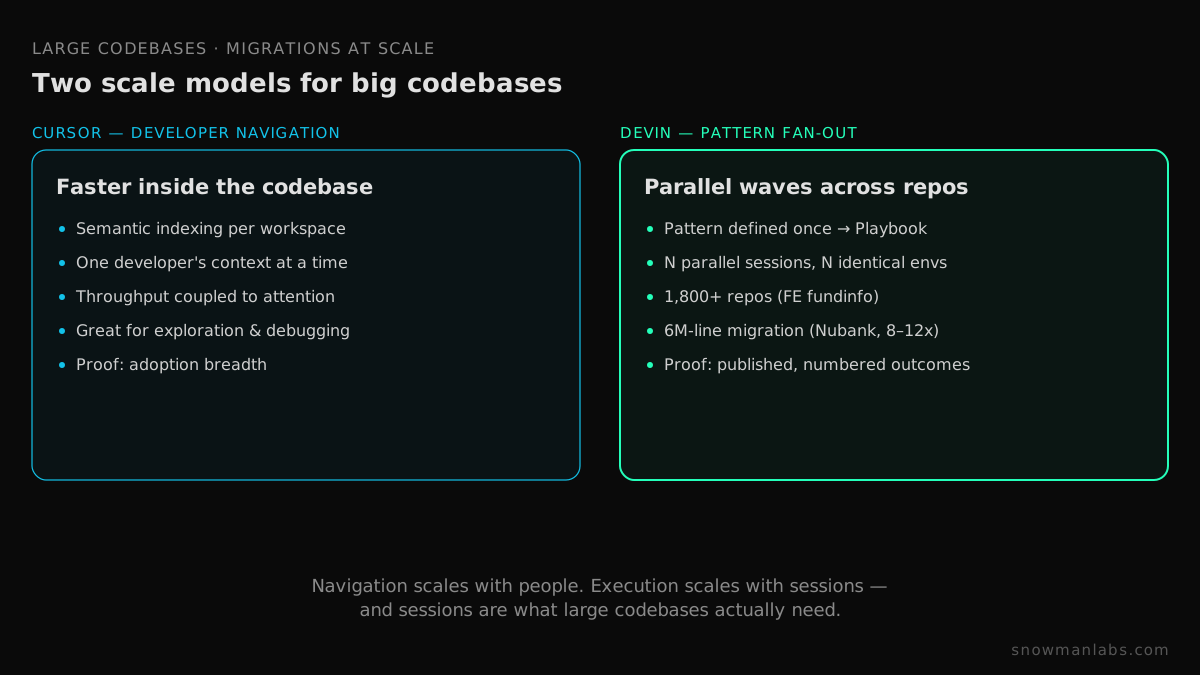
The at-scale comparison
| Dimension | Devin (Cognition) | Cursor (Anysphere) |
|---|---|---|
| Scale unit | Sessions across repos — fan a pattern out N times in parallel | A developer inside one working context at a time |
| Multi-repo work | Native: sessions target GitHub, GitLab, Bitbucket, Azure DevOps, self-hosted | Developer opens what they work on; cloud agents per task |
| Long-running work | Sessions sized for ~3-hour scoped tasks, chained into waves via schedules and API | Agent runs bounded by a developer's supervision span |
| Codebase understanding | DeepWiki architecture docs, Knowledge, AGENTS.md, Playbooks — org-level, reusable | Semantic indexing per workspace — excellent, developer-local |
| Environment reproducibility | Blueprints: declarative YAML environments, snapshot builds | Local/dev container setups per developer |
| Published scale proof | Nubank 6M lines; FE fundinfo 1,800+ repos; AngelList 5.2× migration | Adoption breadth (half the Fortune 500 use the editor) |
The pattern behind the left column is the one we describe in the Devin vs Cursor decision guide: Devin is organization-owned delegation. Large codebases are where that ownership model pays hardest, because the work is high-volume, repeatable, and verifiable — the exact profile autonomous sessions absorb.
What the published numbers say about scale
All results below are per Cognition's published case studies — and note how every one is a scale story, not a demo:
- Nubank broke up an ETL monolith of more than 6 million lines: senior engineers defined the migration pattern once, then fanned per-file execution out to parallel Devin sessions — 8–12x engineering-efficiency gains, 20x+ cost savings, 100,000+ datasets migrated.
- FE fundinfo scaled engineering capacity across 1,800+ repositories — the multi-repo long tail no staffing plan covers.
- AngelList ran a Redshift-to-Snowflake migration 5.2× faster.
- Ramp burned down tens of thousands of hours of technical debt.
- Gumroad merged 1,500+ Devin pull requests, making Devin the repository's #1 contributor.
There is no equivalent public library of numbered, at-scale outcomes for editor-based agents. Editors are not accountable for outcomes; platforms are. That asymmetry is the evidence a CTO can take to a budget meeting — and the mechanics behind it are the same ones we use in AI-powered legacy modernization.
Why editors hit a ceiling on big-codebase work
Cursor is genuinely good in a large codebase — its semantic indexing and Tab model are best-in-class for a developer moving through unfamiliar territory, and its cloud agents can take scoped background tasks. The ceiling is structural, not qualitative:
- Throughput is coupled to attention. Every Cursor workflow — including cloud agents and Automations — is orchestrated by a developer. A 2,000-module migration decomposes into 2,000 supervised interactions, and supervision does not parallelize.
- Context is developer-local. Cursor indexes what a developer opens. Devin's Knowledge, Playbooks, and DeepWiki make codebase understanding an organizational asset: the pattern learned migrating module 1 is codified and reused on modules 2 through 2,000.
- Environments do not reproduce themselves. At migration scale, "works on my machine" becomes the bottleneck. Devin's Blueprints define environments declaratively with snapshot builds, so 50 parallel sessions run in 50 identical, disposable workspaces.
- The backlog is not staffed anyway. The honest reality of large-codebase work: most of it — upgrades, test gaps, dead code, documentation — never gets scheduled, because no leader can justify senior time on it. Delegation changes the economics, which is the entire argument of reducing an engineering backlog without hiring.
Where Cursor still earns its seat in a big codebase
Being fair sharpens the recommendation: hands-on work inside a large system — architectural spikes, cross-service debugging, pattern-forming refactors — should stay human-driven, and if your developers are standardized on Cursor, that is a fine home for it (Devin Desktop covers the same ground with Cascade, Tab, and DeepWiki in the editor). Two caveats keep the seat honest. First, the understanding half of big-codebase exploration is a Devin advantage, not an editor one: Ask Devin answers implementation and architecture questions across your repositories from DeepWiki's index, and converts the discovery into ready-to-run session plans or tickets. Second, the mistake to avoid is asking editor-anchored tooling to do wave execution: you pay senior attention prices for mechanical work. The strongest teams pair the layers — the division of labor in Devin and Cursor together.
Running migration waves with Devin: the operating pattern
The repeatable enterprise play, from Cognition's case studies and our own deployments as an official Cognition partner:
- Map and slice. Dependency analysis (Devin sessions + DeepWiki) turns the monolith into bounded slices with explicit interfaces — evidence, not tribal memory.
- Define the pattern once. Senior engineers migrate a reference slice by hand (often in their editor — this is Cursor-appropriate work) and codify the result as a Playbook.
- Fan out. Parallel Devin sessions execute the pattern across slices; every change lands as a pull request with tests, behind a human review gate.
- Verify with exit criteria. Generated test suites green, production error rates and latency matching baseline, rollback exercised — the wave discipline we describe in modernizing legacy systems without a big-bang rewrite.
Cost scales with sessions, not with headcount; progress is measured in merged PRs per wave, not developer-months.
FAQ
Can Devin handle a monorepo or a very large codebase?
Yes — and the published evidence is unusually specific: Nubank's 6-million-line ETL monolith (8–12x efficiency, per Cognition's case study) and FE fundinfo's 1,800+ repositories. Sessions attach to your repo host (GitHub, GitLab, Bitbucket, Azure DevOps, self-hosted), and org-level Knowledge and Playbooks carry context across sessions.
Is Cursor good for large codebases?
For a developer working inside one, genuinely yes — semantic indexing and Tab make navigation and local change fast. The limitation is throughput: everything is orchestrated by individual developers, so codebase-wide work scales with attention, not with compute.
How does Devin keep 50 parallel sessions consistent?
Three mechanisms: Playbooks (the codified task pattern), Blueprints (declarative, snapshot-built environments so every session runs identically), and the human review gate — every session ends in a pull request a senior engineer approves.
What migrations fit Devin best?
High-volume, pattern-based, verifiable work: framework and language upgrades, data platform migrations (AngelList's Redshift→Snowflake, 5.2× faster), test-coverage expansion, dependency waves, ETL decomposition. Ambiguous architectural decomposition stays with senior engineers — they define the pattern; Devin executes it at volume.
What does this cost compared to staffing the migration?
Model cost per merged unit (module, dataset, repo), not per seat. Nubank's published 20x+ cost savings came from replacing senior-hours-per-file with sessions-per-file. Our business case framework for AI engineering walks through the arithmetic.
The bottom line
In a large codebase, Cursor makes your developers better navigators; Devin makes your organization capable of executing codebase-scale work it could never staff. The published record — 6M lines, 1,800 repos, 5.2× migrations, 1,500+ merged PRs — all sits on one side of this comparison. If a migration, upgrade wave, or debt burn-down is stuck on your roadmap, size it against delegation economics with the AI Readiness Assessment, or see how we run these waves on our Cognition / Devin partner page.
Find your highest-value path to agentic delivery.
Map your readiness, delivery constraints, and first 90-day opportunity with the Snowman Labs AI Readiness Diagnostic.