How to Build the Business Case for AI Engineering
How to build the business case for AI in software engineering: a CFO-ready framework for total cost of ownership, three-scenario ROI, payback, and risk.
 By Danilo BrizolaUpdated
 The business case for AI in software engineering is the document that turns "our engineers want AI tools" into a funded, measurable investment your CFO will approve — a single use case with its full cost of ownership, a three-scenario ROI model, a payback timeline, and named risks with mitigations. Most fail for one reason: they justify the technology instead of a specific outcome. This guide gives CIOs, CTOs, and VPs of Engineering a CFO-ready framework — what finance actually evaluates, how to cost the full program rather than the license, how to quantify value without inventing numbers, and how to make the business case a live scorecard instead of a slide you never revisit.
Why most AI engineering business cases fail
A business case gets rejected when it argues for a capability instead of a result. "We should adopt AI coding tools" is not a business case; "we will cut the change-request backlog in our payments platform by delegating migration and test-coverage work to coding agents, at this cost, returning this much by quarter three" is. Finance leaders are explicit about this: the fastest path to funding is a single use case with clear costs and a multi-year return model, and a business case that justifies the technology rather than the use case is the most common failure mode (Vantage Point, Battery Ventures).
The pressure is real and time-boxed. A large share of CFOs say they will cut AI funding if it does not show measurable return within a year (CIO.com). That is not hostility to AI — it is standard capital discipline applied to a line item that, in most 2026 budgets, is no longer small. Your job is to meet that discipline on its own terms.
What your CFO actually evaluates
Before writing anything, understand the lens. Finance does not score your business case on enthusiasm or benchmark headlines; it scores it on four questions:
| CFO question | What it means | What you must supply |
|---|---|---|
| What does it cost, fully loaded? | Not the license — the total cost of ownership | A TCO breakdown with contingency |
| When does it pay back? | Time to break even, discounted | A payback month under a conservative scenario |
| How confident are the returns? | Risk-adjusted, not a single number | Three scenarios with explicit assumptions |
| What could go wrong? | Named risks, not silence | A risk register with mitigations |
Two of these deserve emphasis because engineering leaders routinely miss them. First, finance discounts future cash flows — a dollar returned in year three is worth less than a dollar spent in year one, evaluated through net present value (NPV) and internal rate of return (IRR). Second, a single ROI number is a red flag: three scenarios with stated assumptions signal financial discipline; one confident percentage signals that you have not thought about downside (alicelabs).
The anatomy of the business case
A complete AI engineering business case has seven sections. Keep it short — a CFO reads the model, not the prose.
| Section | The question it answers |
|---|---|
| 1. The use case | What specific engineering outcome are we buying? |
| 2. The baseline | Where does delivery stand today, in numbers? |
| 3. Total cost of ownership | What does the whole program cost over three years? |
| 4. Value model | What does the outcome return, across four value pillars? |
| 5. Three-scenario ROI | Conservative, base, optimistic — with payback |
| 6. Risk register | What could go wrong, and how we mitigate it |
| 7. Measurement plan | How we will prove the numbers after funding |
The rest of this guide walks the sections that engineering leaders get wrong most often.
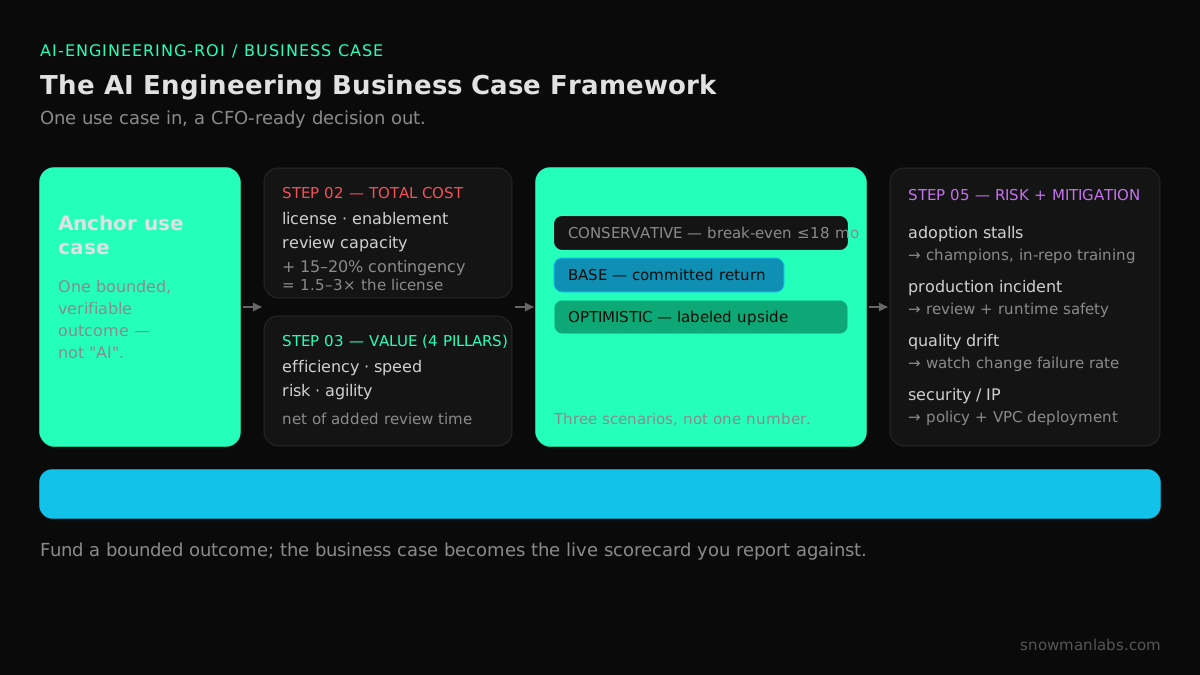
Step 1: Anchor to one use case, not "AI"
Pick a single, bounded engineering outcome where the work is repeatable, verifiable, and currently expensive — the profile agents clear best. Strong first use cases: clearing a defined migration backlog, raising test coverage on a critical service before a modernization wave, or absorbing routine ticket volume so senior engineers return to roadmap work. The logic of routing the right work to agents while humans keep review is covered in how to reduce an engineering backlog without hiring; the operating model underneath it is agentic engineering.
A bounded use case is what makes every later number defensible. "AI across engineering" has no baseline and no payback; "the payments-platform migration backlog" has both.
Step 2: Cost the full TCO, not the license
The single biggest error in engineering business cases is quoting the tool's per-seat price as the cost. Enablement, integration, and review capacity dominate the real number. Industry guidance puts total implementation at 1.5–3x the platform licensing cost (Chrono). For what each tool actually costs in 2026 — and how to compute the effective cost of the licenses you already own — see our tool-by-tool audit of AI coding tools ROI.
| Cost component | Frequently missed because… |
|---|---|
| Platform licensing / usage | The one line everyone remembers — and it meters with scale, not seats |
| Enablement & training | Adoption is a change program, not a switch; budget cohort training |
| Integration & environment setup | Repos, CI, security review, VPC/SSO configuration |
| Added review capacity | Agents multiply pull-request volume; senior review is the real bottleneck |
| Governance & runtime safety | Policy, monitoring, and production-safety tooling |
| Contingency (15–20%) | A business case with no contingency reads as naïve |
That review-capacity line is the one finance will not have heard from other vendors, and it is where credibility is won — it shows you understand that throughput without review is not delivery. It is also why enablement, not licensing, is where the program succeeds or stalls, as laid out in the 90-day AI engineering enablement plan.
Step 3: Quantify value across four pillars
Value is more than saved hours. Quantify it across four pillars, and convert each to a currency figure with a stated assumption:
- Efficiency — capacity recovered on delegable work (the hours agents absorb, valued at loaded cost, minus the added review time). Be conservative and net, not gross. If the efficiency pillar is the one your CFO cares most about, the broader cost-side levers — scope discipline, debt paydown, pipeline automation — are ranked in our playbook on how to reduce software development costs.
- Speed to value — revenue or savings pulled forward because features ship sooner. Snowman Labs designs engagements around a 40–60% target reduction in time-to-market, measured against the client's pre-engagement baseline — a target to validate per engagement, never a guarantee to book in a model.
- Risk mitigation — fewer escaped defects, faster modernization of fragile systems, reduced key-person risk on legacy code.
- Business agility — the option value of turning ideas into working software faster.
Lead the model with efficiency and speed to value, because they are the two you can measure directly against a baseline. Treat risk mitigation and agility as real but secondary — name them, size them cautiously, and do not let them carry the case.
A note on benchmarks: vendor and analyst reports circulate headline figures — a commonly cited one is roughly $3.70 returned per $1 invested in production-scale AI (IDC, via Microsoft). Use these to frame plausibility, never as your projection. Controlled studies show why: a GitHub and Microsoft experiment measured a 55.8% speed-up on a scoped task, while a 2025 METR randomized trial found experienced developers on familiar codebases were 19% slower with AI — yet believed they were faster. The lesson for your CFO: the only number that survives scrutiny is one measured against your baseline. That is the entire argument of our pillar on how to measure ROI from AI in software engineering.
Step 4: Model three scenarios and a payback line
Replace the single number with three. Each scenario states its adoption rate, its efficiency assumption, and its resulting payback month.
| Scenario | Assumption posture | What finance looks for |
|---|---|---|
| Conservative | Low adoption, modest efficiency, full costs | Break-even within ~18 months — the threshold most boards apply |
| Base | Expected adoption and efficiency | The realistic return you commit to |
| Optimistic | High adoption, compounding gains | The upside, clearly labeled as upside |
Target your conservative scenario to break even within roughly 18 months; that is the bar most enterprise boards apply to AI approval (alicelabs). Present a three-year model: year-one investment, year-two adoption, year-three compounding. If the conservative case does not clear the bar, the use case is wrong — go back to Step 1 rather than inflating assumptions.
Step 5: Name the risks and your mitigations
A business case with zero acknowledged risks gets rejected — silence reads as naïveté. Name the real ones and pair each with a mitigation:
- Adoption stalls after the pilot. Mitigation: champion network, in-repo training, and phased rollout rather than a big-bang license drop.
- AI-generated code causes a production incident. Mitigation: mandatory human review, staged rollout, and runtime monitoring — see production-safe AI-generated code.
- Quality erodes while throughput rises. Mitigation: watch change failure rate as the early-warning metric, per DORA metrics for AI-assisted teams.
- Security and IP exposure. Mitigation: approved-tool policy, data-handling terms, and private/VPC deployment.
Step 6: Turn the business case into a live scorecard
The section that separates a funded pilot from a renewed program is the measurement plan. The same metrics you projected in the model become the ones you report against after funding — a baseline captured before the first agent session, then delivery throughput, cycle time, change failure rate, and cost per outcome tracked per sprint. The instrumentation is covered in our ROI measurement pillar and its DORA companion. Commit to reporting these to finance on a fixed cadence; a business case you never revisit is the one that gets defunded at the one-year mark.
Common mistakes to avoid
- Quoting the license as the cost. Real TCO is 1.5–3x that; the review-capacity line is the one that proves you understand delivery.
- A single ROI number. Three scenarios with assumptions; one confident percentage is a red flag.
- Booking headline benchmarks as your return. Use them for plausibility; project from your baseline.
- No baseline. Without a before-number, every after-number is opinion.
- No risks. A clean-looking case with no downside gets rejected on sight.
- Justifying "AI" instead of one use case. Fund a bounded outcome; expand after it pays.
FAQ
What is a business case for AI in software engineering?
It is the decision document that justifies investing in AI coding tools and agents for a specific engineering outcome — stating the use case, the total cost of ownership, a risk-adjusted ROI model with payback, and the risks and mitigations. It exists to get funding approved and to hold the program accountable afterward.
How do you calculate the ROI of AI coding tools?
Measure a delivery baseline before adoption, then compare post-adoption throughput, cycle time, quality, and cost per outcome against it — net of added review time. Convert the deltas to currency, discount them over three years, and express payback as a month. Avoid gross "hours saved" claims; use net, baseline-relative figures. The full method is in our ROI measurement guide.
What should the business case include for a CFO?
One use case, a fully loaded TCO with contingency, a three-scenario ROI model (conservative, base, optimistic) with payback, a risk register with mitigations, and a measurement plan. CFOs evaluate with NPV and IRR, so present multi-year discounted cash flows, not a single percentage.
How long until AI coding tools pay back?
Target break-even within about 18 months under your conservative scenario — the threshold most enterprise boards apply. Many finance leaders will reconsider funding if there is no measurable return within a year, so a bounded first use case that shows movement quickly matters more than a large, diffuse rollout.
Why do most AI business cases get rejected?
Because they justify the technology rather than a specific outcome, quote the license instead of the full cost, present a single ROI number with no downside scenario, and omit risks. Each of those reads to finance as a lack of rigor.
Should we run a pilot before building the full business case?
Ideally the pilot is part of the case: a bounded pilot on real backlog items produces the baseline-relative data that makes the three-year model credible. The 90-day enablement plan is structured to generate exactly that evidence.
Build the case on real numbers
A business case for AI in software engineering wins funding when it reads like every other capital decision your CFO approves: one clear outcome, honest costs, risk-adjusted returns, named risks, and a commitment to measure. The differentiator is not a better benchmark — it is a real baseline and the discipline to report against it. Anchor every figure to a metric you already collect: a number you cannot trace to a system of record is an assumption wearing a suit.
If you want the baseline and the model built on your actual delivery data, that is what Snowman Labs' AI software engineering ROI practice does, and the fastest start is the AI Readiness Diagnostic — it establishes your delivery baseline and the highest-ROI first use case to anchor the business case on.
Find your highest-value path to agentic delivery.
Map your readiness, delivery constraints, and first 90-day opportunity with the Snowman Labs AI Readiness Diagnostic.