Production-Safe AI Code: Why Runtime Context Matters
Production-safe AI-generated code requires runtime context. Failure taxonomy, safety checklist, and governance for enterprise engineering leaders.
 By Danilo BrizolaUpdated
 Production-safe AI-generated code is code that behaves correctly under real traffic, real data shapes, and real failure conditions — not code that merely compiles, passes tests, and survives review. The gap between those two standards is where most AI coding programs get hurt: coding agents generate changes with no knowledge of how the system actually behaves in production, and pre-deploy controls verify against the same assumptions the agent made. This article gives CIOs, CTOs, and engineering leaders a failure taxonomy for AI-generated code, an argument for runtime intelligence as the missing feedback loop, a production-safety checklist, and a governance structure that scales with agent throughput.
The core problem: agents write code without production context
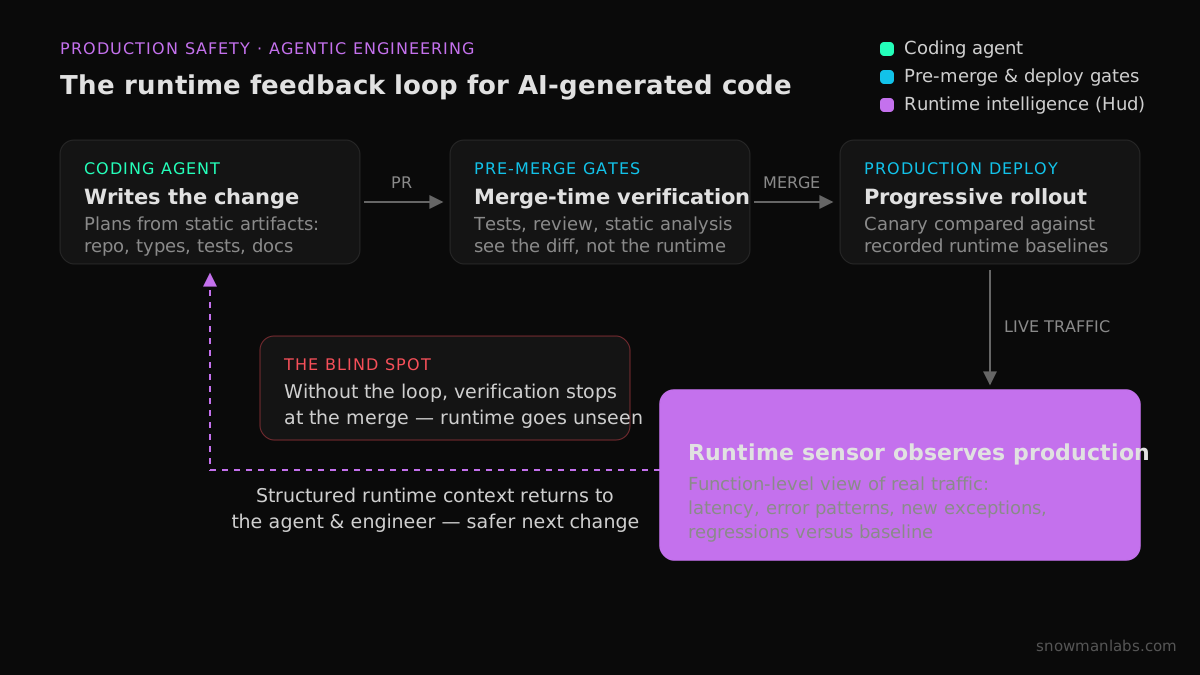
A coding agent sees your repository. It does not see your runtime. It has no visibility into which functions sit on the hot path, what your real request payloads look like, which error patterns are normal versus novel, how a dependency behaves under load, or what happens downstream when a retry policy changes. Every line it writes is an inference from static artifacts — source code, types, tests, documentation — about a system whose actual behavior is defined at runtime.
Human engineers close this gap with accumulated production experience: they remember that the batch job spikes at 2 a.m., that one customer sends malformed CSVs, that the payments endpoint cannot tolerate an extra 40 ms. An agent starts every task without that memory. As Hud — the runtime code sensor company — puts it: before trying to make agents smarter, make sure they can actually see the system they're changing.
This matters more in an agentic engineering operating model than in casual copilot usage. When agents work as delegated executors producing complete changes in parallel, the volume of production-bound code that was written without production context grows by an order of magnitude. The result is a specific and now well-documented failure signature: code that looks correct, passes review, passes tests — and misbehaves only when it meets reality.
Security researchers call this the "illusion of correctness": AI-generated code is polished and confident, which lowers reviewer suspicion precisely when scrutiny should increase. Working code and safe-to-ship code are not the same thing, and the difference is invisible in a diff.
What the data says about AI code quality in production
The published evidence is consistent across independent sources: AI-assisted development increases output while degrading the properties that keep production stable — unless teams add compensating controls.
Security. Veracode's 2025 GenAI Code Security research, which tested over 100 large language models across four languages and four common vulnerability classes, found that roughly 45% of AI-generated code failed security checks. Failure rates varied sharply by vulnerability type — models handled SQL injection relatively well but failed cross-site scripting checks about 86% of the time and log-injection checks about 88% of the time — and by language, with Java the weakest performer. The pattern is instructive: models do well where secure patterns are heavily represented in training data and poorly where safety depends on context the model cannot see.
Structural quality. GitClear's AI code quality research, analyzing 211 million changed lines of code from 2020 through 2024, found that copy/pasted lines rose from 8.3% to 12.3% of all changes while moved (refactored) lines collapsed from roughly a quarter of changes to under 10% — the first period on record where duplication exceeded refactoring. GitClear also documented a near-doubling of code churn: the share of new code revised or reverted within two weeks of being committed. Duplicated, rapidly churning code is exactly the kind of code that produces surprising production behavior later.
Delivery stability. DORA's research found in 2024 that a 25% increase in AI adoption was associated with an estimated 7.2% reduction in delivery stability, and its 2025 follow-up continued to find a negative relationship between AI adoption and stability even as throughput improved. DORA's interpretation is the right one: AI accelerates change volume, and higher change volume exposes every weakness in an organization's testing, deployment, and feedback infrastructure. We covered how to instrument this in DORA metrics for AI-assisted software teams.
Adoption without visibility. Cycode's 2026 State of Product Security report found 97% of organizations using or piloting AI coding assistants while 81% lack visibility into how and where AI is used across their SDLC. Enterprises are scaling generation faster than verification.
None of this argues against AI-generated code. It argues that controls built for human-speed development do not automatically cover agent-speed development.
A failure taxonomy for AI-generated code in production
Treating "AI code risk" as one undifferentiated problem leads to one undifferentiated answer ("review it harder"), which does not work. The failure modes are distinct, have distinct causes, and are caught by distinct controls.
| Failure class | Typical cause | Primary control |
|---|---|---|
| Security vulnerabilities (XSS, injection, weak crypto, log injection) | Insecure patterns in training data; missing threat-model context | SAST/SCA gates on every PR; security policy in agent context; targeted human review |
| Hallucinated or deprecated APIs and dependencies | Model invents plausible interfaces; stale training data | Compilation/type checks, dependency verification, package allowlists |
| Logic drift and edge-case errors | Agent infers business rules from code, not from intent; specs "almost match" | Executable specifications, property-based tests, domain-owner review |
| Performance regressions (N+1 queries, hot-path allocation, sync-over-async) | No knowledge of call frequency, data volume, or latency budgets | Runtime intelligence with function-level baselines; canary analysis on latency percentiles |
| Data-shape mismatches | Agent assumes clean, typed inputs; production data is messier | Contract tests against sampled production payloads; schema validation at boundaries |
| Error-handling gaps and retry storms | Happy-path bias; no visibility into real failure patterns | Fault-injection tests; runtime error-pattern baselines; circuit-breaker standards |
| Duplication and structural debt | Cheapest token path is to copy, not refactor | Churn and duplication tracking (GitClear-style metrics); refactoring budgets |
| Cross-service ripple effects | Agent's context window is one repo; the blast radius isn't | Dependency mapping, staged rollout, org-level change intelligence |
Two things stand out here. First, only the top three rows are meaningfully addressed by static analysis and code review — performance, data shapes, error patterns, and ripple effects are runtime phenomena that no pre-merge inspection reveals. Second, most public discussion of AI-generated code risks focuses almost exclusively on the security row: necessary, but nowhere near sufficient.
Why static review isn't enough at agent throughput
The standard enterprise answer — "a human reviews everything the AI writes" — fails quietly as agent throughput grows, for four compounding reasons.
- The math doesn't hold. A senior engineer supervising several parallel agents can generate in a day what they used to write in weeks. Review capacity does not scale the same way. Either review becomes the bottleneck that erases the throughput gain, or review depth degrades — and most organizations silently choose the second.
- Reviewers verify against the same assumptions the agent made. A reviewer checks a diff against their mental model of the system. But the failure modes that matter — the hot path, the malformed payload, the downstream timeout — live outside any mental model that isn't continuously refreshed by production data.
- Tests encode the author's assumptions too. Agent-written tests validate agent-written code against the agent's own understanding of the requirements — useful regression armor, nearly useless as an independent check on whether that understanding was correct.
- Polish suppresses suspicion. Reviewers calibrate scrutiny to surface signals — naming, structure, idiom — and AI-generated code scores high on all of them, which is why practitioner surveys keep finding that AI-generated changes pass QA and still require manual production debugging afterward.
This is a core operational difference between AI-assisted development and agentic engineering, which we unpack in agentic engineering vs. AI-assisted development: at copilot scale, human review is a plausible control; at agent scale, verification has to become a systems property — automated gates before deploy, and a runtime feedback loop after.
Runtime intelligence: the feedback loop coding agents are missing
Runtime intelligence for coding agents is the practice of capturing how code actually behaves in production — at function level — and feeding that context back into the systems that generate and verify code. It is the control that addresses the middle of the failure taxonomy, the part static analysis structurally cannot reach.
The category is best exemplified by Hud's runtime code sensor, which installs as a lightweight runtime layer alongside production code and continuously captures function-level behavior — invocation frequency, latency baselines, error and exception patterns, execution flows, parameter shapes — without requiring manual instrumentation, logs, or traces. That data is exposed to coding agents and IDEs (via MCP integration with tools like Cursor and Copilot), so the agent writing a change can query what the code it is modifying actually does when it runs.
Runtime intelligence is not observability
The distinction matters for anyone budgeting this. Traditional observability — dashboards, traces, alerts — was built for humans operating systems: it assumes a person will interpret a signal and decide what to do. (Watching the agents themselves — session traces, cost metering, provenance, output evaluations — is the adjacent discipline, covered in our guide to AI coding agent observability.) Hud's framing is blunt: "Observability was built for humans. Runtime intelligence was built for coding agents." An agent cannot browse Grafana. It needs structured, code-level answers to specific questions: How often is this function called? What does its input actually look like? What error patterns are baseline versus new? What broke after the last deploy, and which change caused it?
Concretely, a runtime feedback loop changes agent behavior at three points:
- Before generation — the agent grounds its plan in production reality: this endpoint serves 3,000 requests per minute with a p95 of 120 ms, so a synchronous external call is off the table; this "unused" function is invoked by a monthly billing job, so it is not dead code.
- At deployment — canary analysis compares new function-level behavior against the recorded baseline and catches regressions (new exception types, latency shifts, error-rate increases) that no test asserted, because nobody knew to assert them.
- After incidents — when something does break, forensic runtime context (execution flow, parameters, code path) goes back to the agent to generate a fix grounded in what actually happened, instead of a plausible guess — closing the loop that makes the next generation better.
This is why Snowman Labs is an official Hud partner and embeds it in our delivery model: our position, stated on our site, is that "AI writes code faster. Hud keeps it grounded in production reality." Senior engineers direct parallel agents; the runtime sensor is what keeps that speed safe. Details of the integration are on our Hud runtime intelligence partner page.
The production-safety checklist for AI-generated code
A practical gate list, ordered by the lifecycle of a change. Teams running agents in production should be able to answer "yes" to each item — and know which system enforces it.
- Provenance is recorded. Every change is labeled agent-generated, agent-assisted, or human-written at commit or PR level. Without provenance you cannot measure differential failure rates, and the rest of your governance program is guesswork.
- Static gates run on every PR. SAST, SCA, secrets detection, and IaC scanning are blocking, not advisory, calibrated to the vulnerability classes AI is empirically worst at (XSS, log injection, cryptographic misuse).
- Dependencies are verified. Any new package or API introduced by an agent is checked against an allowlist and for existence — hallucinated dependencies are both a correctness bug and a supply-chain attack surface (slopsquatting).
- Tests are independent of the author. Agent-generated code is validated by tests derived from specifications or written/reviewed by someone (or some agent) other than the author, including contract tests built from sampled production payloads — not just the agent grading its own homework.
- Risk-tiered human review is enforced. Review depth matches blast radius: auth, payments, data migration, and PII-touching paths get mandatory senior review; low-risk internal changes flow through automated gates. Uniform review policies fail at agent throughput.
- Every agent change ships behind a progressive rollout. Canary or percentage-based deploys with automated comparison against runtime baselines — error rates, latency percentiles, new exception types — not just "did it 500."
- Rollback is one action and rehearsed. If reverting takes a meeting, you don't have a rollback capability; you have a recovery project. Feature flags de-risk the riskiest paths.
- A runtime sensor watches the post-deploy window. Function-level monitoring compares behavior against pre-deploy baselines for hours-to-days after release, because data-shape and load-dependent failures don't show up in the first five minutes.
- Runtime findings feed back into agent context. Incidents, regressions, and baseline data are made available to agents for future tasks. This is the difference between a monitoring program and a feedback loop.
- Stability metrics are tracked alongside throughput. Change failure rate, rework rate, and time-to-restore, segmented by provenance — so you can prove whether your AI program is compounding value or accumulating risk, using the approach in how to measure ROI from AI in software engineering.
Don't attempt all ten at once. Rollout is a program with dependencies — provenance and static gates first, progressive delivery and runtime intelligence next, feedback loops last — and it maps cleanly onto the phases of our 90-day AI engineering enablement plan.
Governance: the policy structure that makes it stick
Checklists decay without ownership. Enterprise AI coding governance is the policy layer that makes production safety durable — and auditable — as tools and models change underneath you. A workable policy has five parts:
- Scope and autonomy tiers. Define explicitly what agents may do autonomously (test generation, documentation, dependency bumps in non-critical services), what requires human review (production business logic), and what is off-limits without senior sign-off (auth, cryptography, data deletion, payments). Tier by blast radius, not team preference.
- Tooling allowlist and data boundaries. Which models and agents are approved, what code and data may enter prompts and context windows, and how secrets are kept out of both. Cycode's finding that 81% of organizations can't see where AI is used in their SDLC is a governance failure before it is a security one — inventory comes first.
- Verification standards per tier. The checklist above, encoded as pipeline policy: which gates block, which thresholds trigger rollback, what the post-deploy verification window is for each risk tier.
- Accountability. A named human owner for every agent-generated change — the engineer who directed and merged it. "The AI wrote it" is not an incident-review category, and your policy should say so.
- Measurement and revision cadence. Provenance-segmented DORA metrics reviewed quarterly, with the policy adjusted as the data comes in. Governance that never changes is governance nobody is reading.
This structure is the core of our enterprise AI coding governance service, where we implement the policy, the pipeline enforcement, and the runtime feedback loop as one system rather than three disconnected initiatives.
FAQ
Is AI-generated code safe to use in production?
It can be, but it is not safe by default. AI-generated code fails production-specific conditions — real traffic, data shapes, failure patterns — that it was generated without knowledge of. It becomes production-safe when wrapped in controls: static security gates, independent tests, progressive rollout, runtime monitoring against behavioral baselines, and fast rollback.
What percentage of AI-generated code contains vulnerabilities?
Veracode's 2025 research across 100+ LLMs found roughly 45% of AI-generated code failed security tests, with failure rates as high as ~86–88% for cross-site scripting and log injection. Other studies report different figures depending on task and methodology, but no rigorous study has found AI-generated code to be consistently secure without additional controls.
Can you trust AI-generated code?
Trust should be earned by verification, not extended by default. Treat agent output as untrusted input to a verification pipeline: the code is innocent of malice but blind to impact. Teams that operationalize this — gates, canaries, runtime baselines, provenance tracking — can ship agent-written code to production routinely; teams that rely on "it looks right" accumulate invisible risk.
How do you review AI-generated code before production?
Triage by blast radius rather than reviewing everything identically: automated security and dependency gates on every change, senior human review on high-risk paths (auth, payments, data migrations), automated-gate-only flow for low-risk changes. Critically, pair pre-merge review with post-deploy verification — review alone cannot catch runtime-assumption failures.
What is runtime intelligence for coding agents?
Runtime intelligence is function-level data about how code actually behaves in production — call frequency, latency baselines, error patterns, execution flows, parameter shapes — captured by a sensor running with the code and fed to coding agents in a machine-consumable form. It lets an agent ground its changes in real system behavior instead of inferring behavior from source code alone.
How is runtime intelligence different from observability?
Observability (dashboards, traces, alerts) was designed for humans to interpret; its unit of analysis is the service or request. Runtime intelligence is designed for agents to consume; its unit of analysis is the function, and its output is structured context an agent can query before writing code and use to verify behavior after deploying it.
Does AI-generated code increase technical debt?
The empirical signal says yes, absent counter-pressure: GitClear's analysis of 211 million changed lines found duplication rising sharply while refactoring fell to historic lows, and churn nearly doubled. Debt is not inevitable — but it must be managed with duplication metrics, refactoring budgets, and structural review, because the cheapest path for a generator is to copy, not consolidate.
Who is responsible when AI-generated code causes a production incident?
The organization that shipped it — and, within it, the named engineer who directed and merged the change. Effective governance assigns a human owner to every agent-generated change and treats "the AI wrote it" as an unacceptable root cause. Incident reviews should examine the verification pipeline that let the failure through, not just the code that failed.
Conclusion: speed is a solved problem — safety is the differentiator
Coding agents have made code generation cheap. What separates enterprises that compound that advantage from those that convert it into incidents is everything wrapped around generation: gates, rollout discipline, a runtime feedback loop, and governance enforced at agent throughput. The data is unambiguous — throughput up, stability down — unless verification scales with generation. Runtime context is the piece most programs are missing, because it is the piece that mattered least at human speed.
If you are scaling AI-generated code toward production and want an honest read on where your controls stand — provenance, gates, rollout, runtime feedback, governance — take the AI Readiness Diagnostic. It benchmarks your current delivery pipeline against the production-safety model in this article and returns a prioritized gap list you can act on in the next quarter.
Find your highest-value path to agentic delivery.
Map your readiness, delivery constraints, and first 90-day opportunity with the Snowman Labs AI Readiness Diagnostic.