Devin vs Cursor vs Copilot: Three Models Compared
Devin vs Cursor vs GitHub Copilot in 2026: delegation platform, AI-native editor, and developer suite compared — with a decision framework and evidence.
 By Danilo Brizola
Devin, Cursor, and GitHub Copilot are the three names on almost every enterprise AI-coding shortlist — and they are three different kinds of product. Copilot is a developer suite (the low-friction baseline inside GitHub). Cursor is an AI-native editor that grew developer-owned agents. Devin is a delegation platform — the only one of the three built so an organization, not a developer, owns the agents. Most three-way comparisons rank them as if they competed for one job; they compete for three different budget lines, and the fastest way to choose well is to know which line you are funding. Here is the July 2026 state of all three, verified from vendor sources, with the decision framework we use as an official Cognition partner — and a clear answer on which tool wins the column that changes delivery numbers.
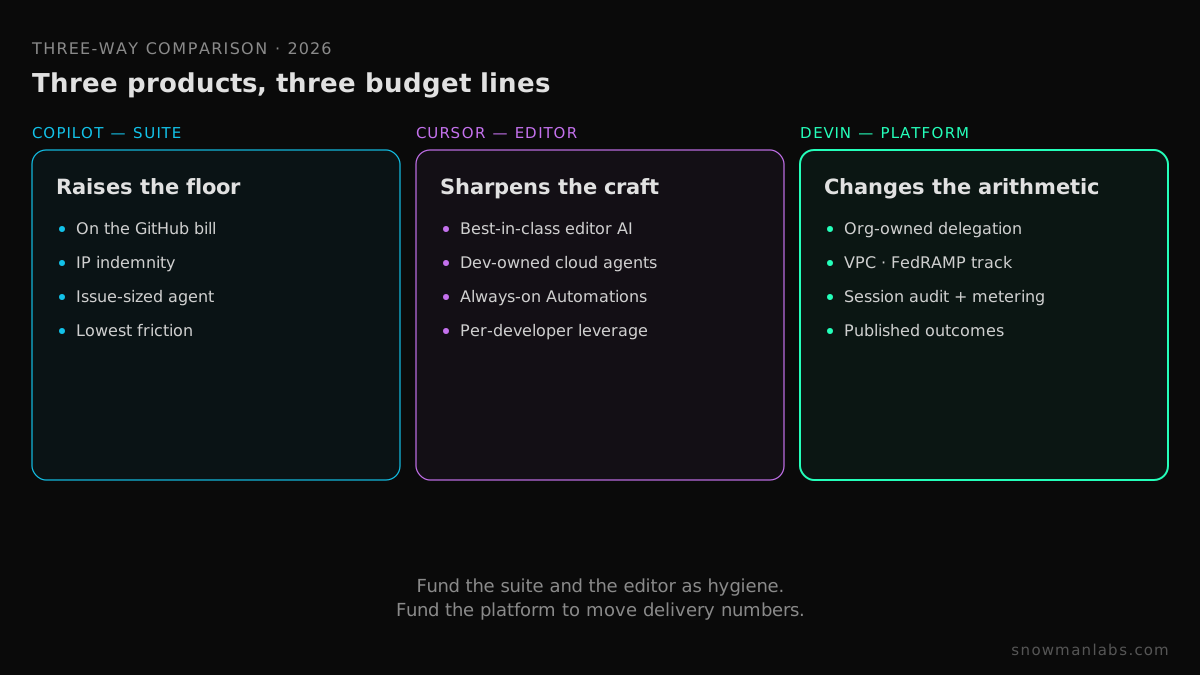
The three-way table
| Dimension | Devin | Cursor | GitHub Copilot |
|---|---|---|---|
| Product category | Autonomous AI engineer — delegation platform | AI-native code editor + agent features | AI developer suite in GitHub |
| Agent owner | The organization | The developer | The developer / the suite |
| Agent intake | Jira, Linear, Slack, Teams, schedules, service users, API | Developer-triggered: editor, cloud agents, Automations | Assigned GitHub issues; agent mode |
| Where agents execute | Enterprise Cloud, dedicated, or customer VPC (customer-managed keys) | Cursor-managed isolated VMs | GitHub Actions |
| Compliance posture | SOC 2 Type 2; FedRAMP High in-process | SOC 2 | Microsoft/GitHub enterprise programs; IP indemnity |
| Cost attribution | Per-session ACU metering | Plan + consumption | Suite budgets/credits |
| Entry pricing | Free · $20 Pro · Teams $80 + $40/seat | Free · $20 · Teams $40/user | Free · $10 Pro · Business $19 · Enterprise $39 |
| Published enterprise outcomes | Named, numbered case library | Adoption breadth | Adoption + productivity studies |
| Best at | Backlog waves, migrations, remediation at scale | Interactive coding; developer-owned background tasks | Baseline AI for GitHub shops |
Facts verified July 2026: devin.ai/pricing · cursor.com/features · github.com/features/copilot. Deep dives: Devin vs Cursor · Devin vs GitHub Copilot · Devin vs Claude Code.
Three products, three theories of leverage
Copilot bets on ubiquity. AI in every developer's existing workflow, on the existing bill, with IP indemnity — the suite theory. It makes the average developer meaningfully faster and asks nothing of your operating model. Its coding agent handles issue-sized tasks competently on GitHub's infrastructure.
Cursor bets on the editor. If developers live in the editor, put the best AI there — the craft theory. In 2026 that includes real agent surface: Composer-powered in-editor agents, cloud agents in isolated VMs, always-on Automations, Bugbot review. Everything, however, is orchestrated by an individual developer; leverage compounds per person.
Devin bets on delegation. Most enterprise engineering work is not craft — it is well-scoped, repeatable, verifiable volume: migrations, upgrades, tests, remediation, tickets. Devin's theory is that this work should be routed to governed agent sessions the way work is routed to teams: through tickets and schedules, under RBAC, with per-session audit and cost metering, in infrastructure you control. That is the theory of agentic engineering, and it is the only theory of the three that changes organizational throughput rather than individual speed — the mechanism behind backlog reduction without hiring.
The column that decides: evidence
Buy the tool whose published record matches the job you are funding. For developer acceleration, Copilot and Cursor have credible adoption stories. For delegation, one column has receipts — per Cognition's published case studies:
- Nubank: 8–12x efficiency, 20x+ cost savings, 6M-line ETL migration
- AHEAD: 8–40x faster engineering
- AngelList: 5.2× faster Redshift→Snowflake migration
- Gumroad: 1,500+ merged PRs — the repo's #1 contributor
- Ramp: tens of thousands of technical-debt hours cleared
- FE fundinfo: 1,800+ repositories covered
- Litera: 90% reduction in regression cycles
- Named deployments: Mercedes-Benz, Itaú, Cognizant, Infosys, Hippo, Evinova
Neither Cursor nor Copilot publishes an equivalent library of named, numbered delegation outcomes. If the budget line is "make the backlog move," the evidence is one-sided.
The decision framework
Answer three questions; the framework routes itself. (In practice many enterprises fund all three lines at different weights — the layering logic in Devin and Cursor together.)
- Which number must move this year? Developer satisfaction/velocity per person → editor or suite. Backlog burn-down, cycle time, cost per outcome → delegation platform. Only delegation produces the attributable numbers a CFO-grade business case needs.
- What does security require of agents? Suite-level policies suffice for suggestions. The moment agents act on regulated code, deployment isolation (VPC, customer-managed keys), RBAC, and session-level audit become pass/fail — the analysis in Devin vs Cursor security, where only one of the three has a FedRAMP-track answer.
- Do you have review capacity? All three multiply change volume. If senior review cannot absorb agent PRs within a business day, fix that first — no tool choice rescues a blocked gate.
FAQ
Which is best overall: Devin, Cursor, or Copilot?
Wrong axis — they compete for different budget lines. Copilot is the best suite baseline for GitHub shops; Cursor is the best AI-native editor; Devin is the best (and effectively only) organization-owned delegation platform of the three, and the only one with a published library of migration-scale outcomes.
Can one of the three replace the other two?
Not cleanly. Cursor's agents and Copilot's agent cover developer-initiated background tasks, but neither offers organizational intake, customer-VPC execution, or per-session attribution; Devin Desktop covers hands-on editing, but teams attached to their editor usually keep it. Mature stacks converge on baseline + editor + delegation platform.
What does the combined stack cost?
Illustrative list-price math for 100 developers: Copilot Business ~$1,900/month; Cursor Teams ~$4,000/month; a Devin Teams deployment $80 + $40/seat for delegating engineers plus metered ACUs sized to the backlog slice. The delegation line is the only one whose return is directly computable per merged unit — which is why it survives budget review.
Where do Claude Code and Codex fit in this comparison?
Both are strong developer-owned agents — Claude Code the power-user's choice, Codex the ChatGPT-bundled default. Neither is an organizational delegation platform; see Devin vs Claude Code and Devin vs Codex.
What should an enterprise pilot first?
Pilot against the constraint that has executive attention. If that is delivery throughput, run a four-week Devin pilot on a scoped backlog slice with success metrics defined up front — the structure of our AI Readiness Assessment.
The bottom line
Copilot raises the floor. Cursor sharpens the craft. Devin changes the arithmetic — it is the only product of the three built for organization-owned delegation, the only one deployable inside your own infrastructure on a FedRAMP-track posture, and the only one with named, numbered enterprise outcomes to its name. Fund the baseline and the editor as hygiene; fund the delegation platform to move the numbers you are accountable for. Start by sizing your delegable backlog with the AI Readiness Assessment — or see how we deploy Devin on our Cognition / Devin partner page.
Find your highest-value path to agentic delivery.
Map your readiness, delivery constraints, and first 90-day opportunity with the Snowman Labs AI Readiness Diagnostic.