Devin vs Claude Code: Which Ships Your Backlog?
Devin vs Claude Code for enterprise teams: delegation platform vs developer agent — deployment, governance, pricing, and published results compared for 2026.
 By Danilo Brizola
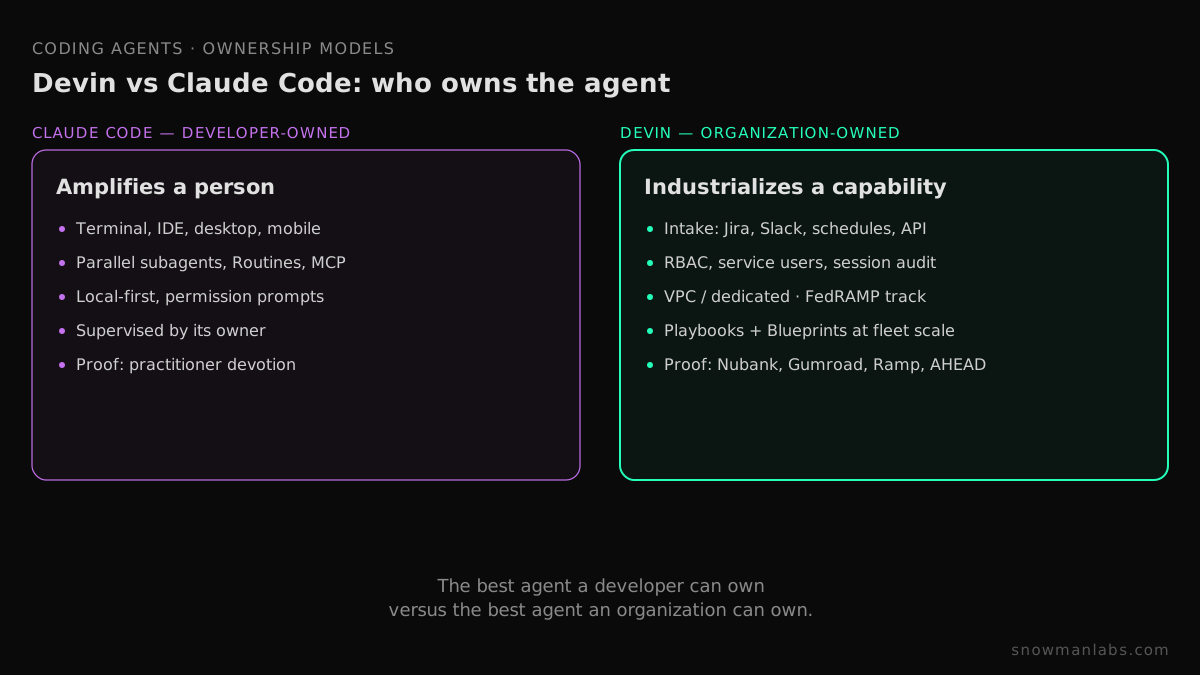
Devin and Claude Code are the two most serious autonomous coding agents an enterprise can buy in 2026 — and they embody opposite theories of who the agent works for. Claude Code is a developer's agent: it runs where the developer is (terminal, IDE, desktop, phone), multiplies what one skilled person can supervise, and is beloved by senior engineers for exactly that. Devin is an organization's agent: a delegation platform that takes work from tickets, schedules, and APIs, executes it in governed cloud sessions, and returns reviewed pull requests with per-session audit and cost attribution. If the question is "which makes my best engineers more powerful," it is genuinely close. If the question is "which ships my backlog and survives my security review" — the question this guide answers — the evidence favors Devin, and we say that with the disclosure it deserves: we are an official Cognition partner, and the July 2026 facts below are verified from both vendors' own documentation.
Devin vs Claude Code at a glance
| Dimension | Devin (Cognition) | Claude Code (Anthropic) |
|---|---|---|
| Category | Autonomous AI engineer — organizational delegation platform | Agentic coding tool — developer-owned agent |
| Runs | Cloud sessions (isolated workspaces w/ IDE, shell, browser, computer use); Devin Desktop; CLI; API v3 | Terminal, VS Code/JetBrains, web, desktop, iOS/Android — local-first |
| Work intake | Jira, Linear, Slack, Teams, org schedules, service users, API | The developer types a prompt (plus personal Routines/triggers) |
| Parallelism | Fleet-scale sessions across repos | "10s to 100s" of subagents — supervised by their owner |
| Governance | RBAC, custom roles, IP access lists, per-session audit + ACU metering | Permission prompts, local execution; org admin via plans |
| Deployment | Enterprise Cloud, dedicated (private networking), customer VPC w/ customer-managed keys; FedRAMP High in-process | Developer machines + Anthropic API (or cloud-provider gateways) |
| Pricing | Free · Pro $20 · Max $200 · Teams $80 + $40/seat · Enterprise | Pro $17–20 · Max $100/$200 · Team/Enterprise; API metering |
| Published outcomes | Extensive numbered case library | Strong practitioner reputation; no comparable outcome library |
Sources: docs.devin.ai, devin.ai/pricing, claude.com/claude-code, verified July 2026.
Same autonomy, different owner
Both tools genuinely plan, edit multiple files, run tests, and iterate — the agentic loop we define in what agentic engineering is. The divergence is structural:
Claude Code amplifies a person. Its best features — parallel subagents, scheduled Routines, computer use, MCP extensibility — are force multipliers wired to one developer's judgment and machine. That produces spectacular individual leverage, and honest observers should say so plainly: for a staff engineer untangling a gnarly refactor, Claude Code is elite company. It is worth noting the company it keeps: Devin Desktop's Cascade covers the same hands-on agentic ground inside a full IDE, and Ask Devin adds a discovery layer — codebase Q&A across repositories, grounded in DeepWiki's index, ending in ready-to-run session plans — that a terminal agent does not have.
Devin industrializes a capability. Its best features are boring and organizational: service users so a system can assign work; schedules so maintenance runs without a human remembering; Playbooks and Knowledge so the pattern learned once is executed by every session; Blueprints so 50 parallel workspaces are identical; RBAC and per-session ACU metering so security and finance both get answers. None of that makes a developer feel powerful. All of it makes a backlog move — the mechanics of reducing an engineering backlog without hiring.
The consequence shows up at scale. A hundred Claude Code power users are a hundred individually-supervised agent fleets — brilliant, and ungovernable as a unit. A Devin deployment is one platform with one policy surface, which is why the governance conversation lands so differently between the two.
The evidence gap
Per Cognition's published case studies: Nubank delegated a 6-million-line ETL migration at 8–12x efficiency and 20x+ cost savings; AHEAD reports 8–40x faster engineering; Gumroad has merged 1,500+ Devin PRs, making it the repository's #1 contributor; Ramp burned down tens of thousands of hours of technical debt; FE fundinfo scaled across 1,800+ repositories; Litera cut regression cycles 90%. Named, numbered, delegation-shaped outcomes.
Claude Code's public proof is different in kind: developer devotion, benchmark leadership, and ubiquity in engineering discourse. Real signals — but when a CFO asks "what did organizations like ours ship with this," one product has a published answer sheet and one does not. For an enterprise evaluation, that asymmetry is not a detail; it is the deciding column, and it is why Devin also tops our ranking of Cursor alternatives for enterprise.
Security and deployment: local-first vs platform-isolated
Claude Code's security story is genuinely attractive at the individual level: it runs on the developer's machine, asks permission before file changes and commands, and requires no remote code indexing. For organizations restricted from vendor clouds, that matters.
But enterprise security economics reward containment you can prove, not just locality. Devin Enterprise executes in isolated sessions inside infrastructure you control — customer VPC with customer-managed encryption keys, or a dedicated deployment with private networking — with IP access lists, RBAC, and an audit trail per session. Add the FedRAMP High in-process status (announced July 13, 2026) and the two products are simply on different compliance trajectories. The full control-by-control treatment is in Devin vs Cursor security — the Devin column applies unchanged here.
Where Claude Code is the right choice
- Senior engineers doing deep, ambiguous work. Exploration, novel architecture, cross-cutting debugging — judgment-forming work belongs with a developer-owned agent.
- Local-only environments. If code cannot leave developer machines at all, Claude Code fits where any cloud platform (Devin included) must first clear deployment review.
- The lab half of the loop. Many teams we work with use a developer agent to invent the pattern, then codify it as a Devin Playbook and fan it out — the same editor-and-platform pairing we describe in Devin and Cursor together, with the terminal in place of the editor.
What Claude Code should not be asked to do is impersonate a delegation platform: routing a department's backlog through individually-owned agent sessions scales supervision, not delivery.
FAQ
Is Devin better than Claude Code?
For organization-owned delegation — routing scoped backlog work to governed, audited, parallel sessions with enterprise deployment options — yes, that is what Devin is built as, and it carries the published outcome library. For individual developer leverage on complex, ambiguous work, Claude Code is arguably the strongest tool available. Different owners, different jobs.
Can Claude Code do what Devin does?
Partially, in skilled hands: subagents and Routines can emulate parallel delegation for one person. What it lacks is the organizational layer — service users, org schedules, RBAC, per-session cost attribution, VPC/dedicated deployment — and the accountability trail enterprises audit against.
Can we use Devin and Claude Code together?
Yes, and strong teams do: developer agents for judgment-forming work, Devin for volume execution behind one review gate. The two-layer governance model in our governance framework applies directly.
Which is cheaper?
Entry pricing is nearly identical (~$20/month). At scale, compare cost per outcome: Devin's per-session ACU metering makes cost-per-merged-PR directly computable — the arithmetic our AI engineering business case framework is built on. Claude Code's costs ride on plan tiers and API consumption per developer.
Which should we pilot first?
Pilot against your constraint: if the number that must move is backlog burn-down or cycle time, pilot Devin on a scoped slice with success metrics; if it is senior-engineer throughput on hard problems, trial Claude Code with your staff engineers. The AI Readiness Assessment sizes both in one pass.
The bottom line
Claude Code is the best agent a developer can own. Devin is the best agent an organization can own — and enterprises buy outcomes, governance, and deployment guarantees, which is where Devin's platform primitives, FedRAMP-track posture, and published case library are unmatched in this pairing. Map which share of your backlog is delegable — and what it would return — with the AI Readiness Assessment, or see our deployment model on the Cognition / Devin partner page.
Find your highest-value path to agentic delivery.
Map your readiness, delivery constraints, and first 90-day opportunity with the Snowman Labs AI Readiness Diagnostic.