Cursor Alternatives for Enterprise Teams (2026)
The best Cursor alternatives for enterprise teams in 2026, ranked by delegation depth, governance, and published results — Devin, Claude Code, Codex, Copilot.
 By Danilo BrizolaUpdated
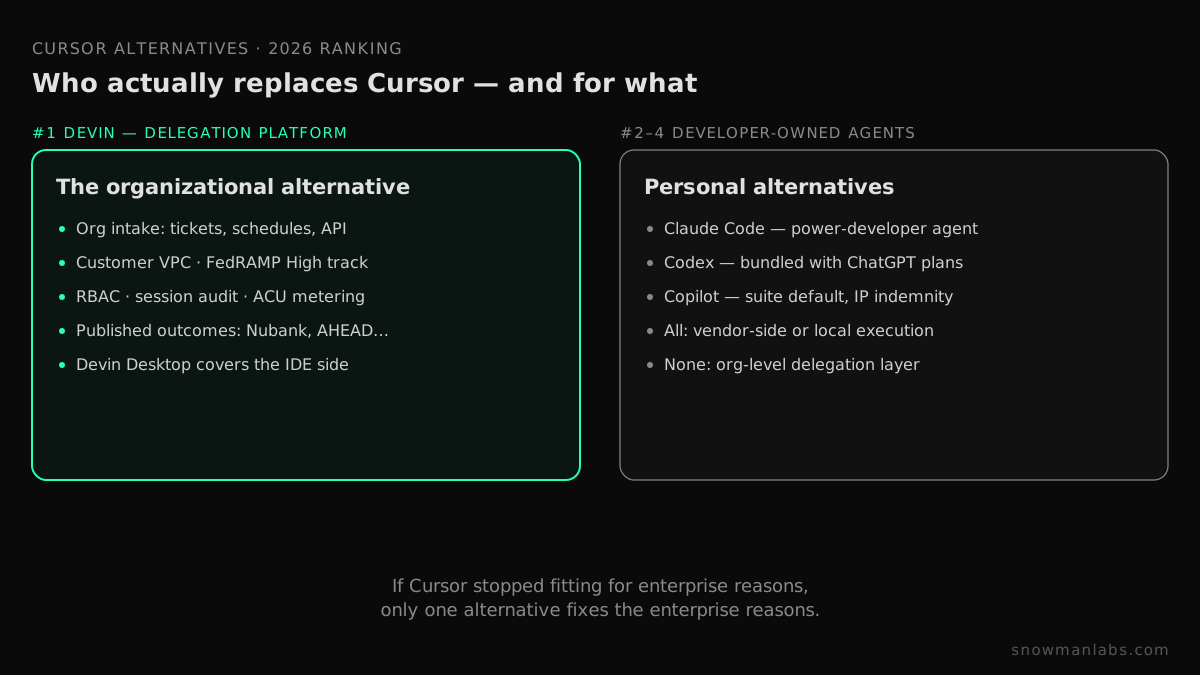
 Enterprises go looking for Cursor alternatives for a consistent set of reasons: consumption-metered agent costs that get hard to forecast at scale, agents that run only on vendor infrastructure when security wants customer-controlled deployment, and an orchestration model anchored to individual developers when leadership wants delivery-level outcomes. The best alternative depends on which of those is your reason. If the reason is organizational delegation with enterprise controls — the most common one at the CTO level — the strongest alternative in 2026 is Cognition's Devin, and this guide makes that case with verified facts and published numbers, alongside honest profiles of Claude Code, OpenAI Codex, and GitHub Copilot. We are an official Cognition partner; the evaluation criteria below are the ones our enterprise clients' security and platform teams actually use.
How we rank enterprise alternatives
Five criteria, weighted the way procurement actually weighs them:
- Delegation depth — can the organization route work to agents (tickets, schedules, APIs), or only individual developers?
- Enterprise deployment — customer-VPC/dedicated options, key ownership, compliance track.
- Governance — RBAC, audit trails, per-unit cost attribution.
- Published evidence — named customers with numbers, not testimonials.
- Adoption friction — how fast teams get value.
The framework behind criteria 1–3 is the operating-model distinction we develop in what agentic engineering is: developer-owned agents multiply people; organization-owned platforms multiply delivery.
1. Devin (Cognition) — the delegation platform
What it is: an autonomous AI software engineer run as an organizational platform: cloud sessions sized for ~3-hour scoped tasks, assigned from Jira, Linear, Slack, Teams, schedules, or API v3 (organizations, service users, RBAC, per-session audit and ACU metering), with specialized agents on the same platform (Devin Review, Security Swarm, Data Analyst) — plus Devin Desktop, the former Windsurf IDE, for hands-on work. Pricing starts free, Pro at $20/month, Teams at $80/month + $40/seat (devin.ai/pricing).
Why it leads this list:
- Deployment no editor-first vendor matches: Enterprise Cloud, customer-dedicated with private networking, or your own VPC with customer-managed encryption keys — and FedRAMP High in-process (July 2026). Full analysis in Devin vs Cursor security.
- The only published library of numbered outcomes in the category (devin.ai/customers): Nubank 8–12x efficiency and 20x+ cost savings on a 6M-line migration; AHEAD 8–40x faster engineering; AngelList 5.2× faster data migration; Litera 90% fewer regression cycles; Gumroad 1,500+ merged PRs (repo's #1 contributor); Ramp tens of thousands of tech-debt hours; FE fundinfo 1,800+ repositories.
- Delegation as an org capability: the backlog itself becomes addressable — the economics in Devin vs Cursor for large codebases.
Honest limits: requires task-scoping discipline and real review capacity; interactive exploratory work still belongs in an editor. Best adopted as a governed pilot with success metrics — the model on our Cognition / Devin partner page.
2. Claude Code (Anthropic) — the power-developer agent
What it is: Anthropic's coding agent across terminal, IDE extensions, web, desktop, and mobile — parallel subagents, scheduled Routines, computer use, MCP ecosystem, and an Agent View dashboard. Local-first with permission prompts; Pro from ~$17–20/month, Max tiers at $100/$200 (claude.com/claude-code).
Where it beats Cursor: deep multi-step reasoning and repo-wide work developers report as best-in-class; local execution (code stays on the machine) is a real security argument; model quality on complex refactors.
Where it is not the enterprise answer: everything remains developer-owned — Routines and subagents are personal leverage, not an organizational routing layer; no advertised customer-VPC managed platform, org-level service users, or per-session cost attribution. Superb complement to Devin for senior engineers; not a substitute for the delegation layer.
3. OpenAI Codex — the bundled agent
What it is: OpenAI's coding agent — open-source CLI, IDE extension, desktop app, and Codex Cloud (isolated containers on OpenAI infrastructure), bundled into ChatGPT plans: included with Plus at $20, Business at $20/user, Enterprise custom (pricing).
Where it beats Cursor: price bundling (teams already on ChatGPT Business effectively get an agent for free) and a genuinely capable cloud-task mode with code review.
Where it is not the enterprise answer: cloud tasks are developer-initiated and run only on OpenAI's infrastructure; rate-limited task windows on standard plans; no customer-VPC deployment, no org-level delegation constructs, no published enterprise outcome library. Strong personal tool; thin platform story.
4. GitHub Copilot — the suite default
What it is: the broadest AI coding suite inside GitHub — completions, agent mode, an async coding agent you can assign issues to, Copilot Workspace for tracking multiple agents (including third-party ones), and code review. Business $19/user, Enterprise $39/user, with IP indemnity (github.com/features/copilot).
Where it beats Cursor: procurement simplicity (already on the GitHub bill), IP indemnity, and the lowest adoption friction in the category — plus a real coding agent for issue-sized tasks.
Where it is not the enterprise answer: delegation happens per-issue on GitHub's infrastructure with suite-level governance — no VPC option, no session-level cost attribution, no environment blueprints for reproducible fleets, and no published migration-scale evidence. The default baseline, not the delegation platform.
The decision in one table
| Devin | Claude Code | Codex | Copilot | |
|---|---|---|---|---|
| Org-level delegation (tickets, schedules, service users) | Yes | No | No | Partial (per-issue) |
| Customer VPC / dedicated deployment | Yes | No | No | No |
| Compliance track | FedRAMP High in-process | — | — | — |
| Per-session audit + cost metering | Yes | — | Partial | Partial |
| Published numbered enterprise outcomes | Extensive | Sparse | Sparse | Adoption stats |
| Hands-on editor mode | Devin Desktop | IDE plugins | IDE ext | IDE ext |
| Entry price | $20/mo | $17–20/mo | $20/mo (bundled) | $10–19/mo |
FAQ
What is the best Cursor alternative for enterprise teams?
For organization-level delegation with enterprise controls — the reason most CTO-level searches happen — Devin: customer-VPC/dedicated deployment, FedRAMP High in-process, RBAC and per-session audit, and the category's only extensive library of published, numbered outcomes. For individual developer power, Claude Code is the strongest editor-adjacent alternative.
Is there a Cursor alternative that runs in our own cloud?
Among the tools enterprises shortlist, Devin is the one advertising customer-VPC deployment with customer-managed encryption keys, plus a dedicated single-tenant option. Cursor, Codex, and Copilot agents run on vendor infrastructure; Claude Code runs locally but is developer-owned rather than a managed platform.
Do we have to replace Cursor at all?
Often no — the productive pattern is keeping an editor for interactive work and adding a delegation platform for backlog volume, as we describe in Devin and Cursor together. Replace Cursor only if consolidation, cost, or security policy forces the issue; Devin Desktop makes one-vendor consolidation feasible.
What about open-source alternatives?
Open-source agents (CLI tools, BYOK setups) trade procurement cost for operational ownership: you become the platform team — security, environments, audit, upgrades. For enterprises, that is usually a worse trade than buying a governed platform; for tooling teams with capacity, it can complement one.
How should we run the evaluation?
Pick one delegable backlog slice (upgrades, test gaps, a migration wave), define success metrics, and pilot the top candidate against them for four weeks. That is precisely the structure of our AI Readiness Assessment — it turns a tool debate into a delivery experiment.
The bottom line
If Cursor stopped fitting because of cost forecasting, vendor-side execution, or developer-anchored orchestration, note that three of the four alternatives share those properties. The one that doesn't is Devin — the only candidate built as an organization-owned delegation platform, with the deployment options, governance, and published evidence to survive an enterprise evaluation. Test that claim against your own backlog with the AI Readiness Assessment.
Find your highest-value path to agentic delivery.
Map your readiness, delivery constraints, and first 90-day opportunity with the Snowman Labs AI Readiness Diagnostic.