Devin vs Cursor Security: Enterprise Controls Compared
Devin vs Cursor security compared for enterprises: VPC deployment, customer-managed keys, FedRAMP track, RBAC, and audit — evidence from a Cognition partner.
 By Danilo Brizola
On security, Devin and Cursor are not playing the same game. Cursor secures a developer tool: SOC 2, SSO/SCIM, and access controls around an editor whose agents run on Cursor's infrastructure. Devin secures a delegation platform: dedicated or customer-VPC deployment with customer-managed encryption keys, role-based access control, per-session audit and consumption metering — and, as of July 13, 2026, FedRAMP High in-process status, the compliance track required for US federal workloads. If your security review decides which AI coding platform touches production code, this comparison — from an official Cognition partner that deploys Devin inside enterprise environments — maps the controls that actually get asked about, on verified July 2026 facts.
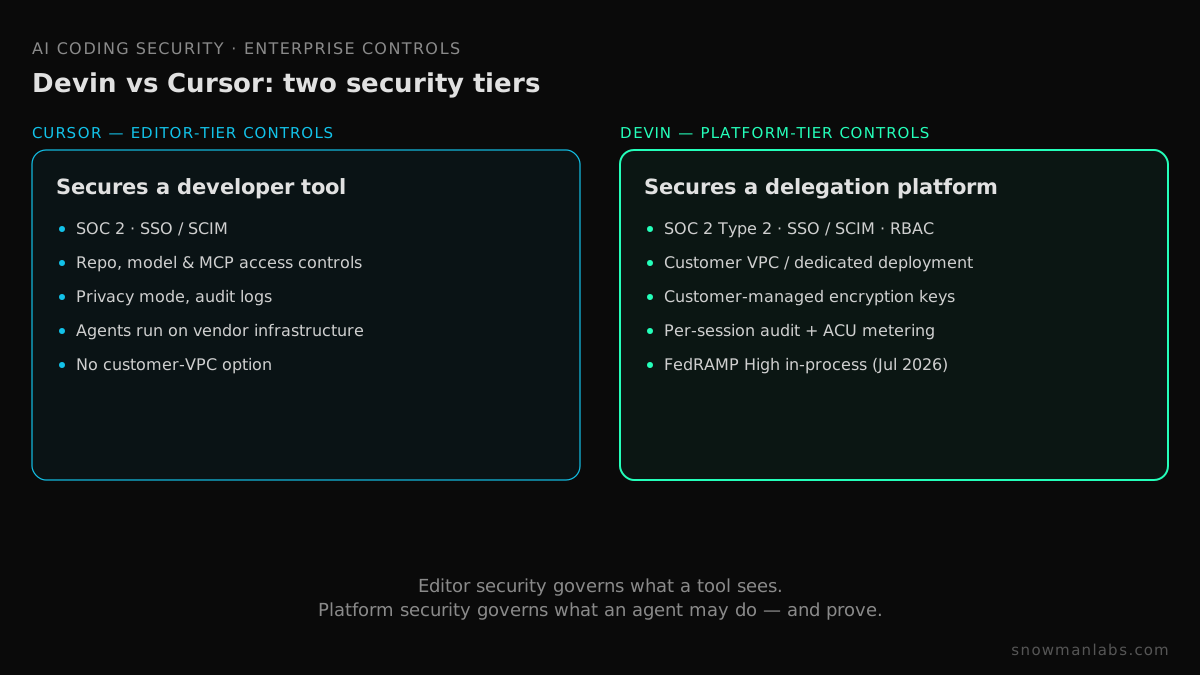
Devin vs Cursor security at a glance
Direct answer: both clear the baseline (SOC 2, SSO/SCIM, audit logs); the separation starts where the baseline ends — deployment isolation, key ownership, compliance track, and the granularity of the audit trail.
| Control | Devin (Cognition) | Cursor (Anysphere) |
|---|---|---|
| Certification baseline | SOC 2 Type 2 | SOC 2 |
| Identity | SSO (SAML/OIDC), SCIM, IdP groups | SSO, SCIM |
| Deployment | Enterprise Cloud, Customer Dedicated (private networking), or VPC with customer-managed encryption keys | Cursor-hosted; agents run in vendor-managed VMs |
| Compliance track | FedRAMP High in-process (announced 2026-07-13) | Not advertised |
| Access model | RBAC with custom roles, service users, IP access lists | Repository, model, and MCP access controls |
| Audit | Enterprise-wide audit logs + per-session, per-user, per-org ACU metering | Audit logs, usage analytics |
| Agent containment | Guardrails, environment Blueprints (declarative, reproducible), snapshot builds | Privacy mode, org policy controls |
| Training on your code | No — contractual | Privacy mode available |
Sources: Cognition's documentation and Cursor's enterprise pages, both verified July 2026. For the full product-level comparison beyond security, start with our Devin vs Cursor decision guide.
Why the security bar is different for delegation
The security question for an editor is: what does the tool see, and where does it go? The security question for an autonomous agent platform is harder: what can the agent do, who authorized it, and how do you prove both afterwards?
When AI-generated changes multiply, review capacity — not generation — becomes the control point, a dynamic we analyze in production-safe AI-generated code. An enterprise security team evaluating agents therefore asks four questions that editor-tier controls were never designed to answer:
- Where does the agent execute? Cursor's cloud agents and Automations run in isolated VMs on Cursor's infrastructure — solid isolation, but vendor-side. Devin Enterprise can run inside your own VPC, or in a dedicated single-tenant deployment with private networking, with encryption keys you own. For banks, insurers, healthcare, and government-adjacent work, that is frequently the pass/fail line.
- Who can send it work? Devin's RBAC, custom roles, service users, and IP access lists mean "who may delegate what to the agent" is a managed permission, not a convention. Editor-anchored agents inherit whatever their developer can access.
- What is the audit trail? Devin sessions are individually logged and metered (down to ACU consumption per session), so every agent-produced change has a provenance chain: who assigned it, what it did, what it cost, who reviewed and merged. That chain is what an incident review or a regulator actually asks for — the reasoning behind our enterprise AI coding governance framework.
- What happens at scale? One developer's agent is a tool risk; five hundred developer-owned agent fleets are a governance program nobody signed up for. An organization-owned platform centralizes the policy surface instead of scattering it across laptops.
The compliance signal most reviews miss: FedRAMP High
On July 13, 2026, Cognition announced Devin is FedRAMP High in-process — pursuing the authorization level required for US federal systems handling the government's most sensitive unclassified data. Whatever your industry, the signal matters for two reasons. First, FedRAMP High programs force a depth of control documentation, continuous monitoring, and independent assessment that dwarfs a SOC 2 audit. Second, it tells you where the platform's roadmap points: regulated, high-stakes environments — precisely the buyer this article is written for. No AI-native editor vendor has an advertised equivalent today.
What regulated adopters actually report
Per Cognition's published case studies, the companies running Devin at scale skew heavily toward regulated and compliance-conscious industries — which is itself evidence of where the security posture holds up:
- Itaú — Latin America's largest bank — runs Devin in a global-scale SDLC deployment.
- Nubank delegated a 6-million-line ETL migration to Devin with 8–12x efficiency gains and 20x+ cost savings — inside one of the world's most scrutinized fintechs.
- Litera, legal-tech serving the world's largest law firms, reports a 90% reduction in regression cycles — quality assurance being the other face of security.
- Evinova (AstraZeneca's health-tech arm) reports accelerated regulated software delivery.
- Hippo (insurance) and global systems integrators Cognizant and Infosys run enterprise-wide deployments.
These are Cognition's published results, not ours — but as an official Cognition enablement partner we can attest to what their security reviews involved: VPC isolation, key ownership, RBAC design, and audit integration were the make-or-break workstreams, and they are exactly the controls Cursor's tier does not offer.
Where Cursor's security story is genuinely fine
Honesty strengthens the conclusion: for what Cursor is — a developer tool — its posture is respectable. SOC 2, SSO/SCIM, privacy mode, org-level repository/model/MCP restrictions, and audit logs cover the assistant-usage risk surface well, and its adoption across large enterprises (Anysphere claims over half the Fortune 500) shows those controls pass many reviews. If your AI exposure is limited to editor assistance on non-restricted repositories, Cursor's controls are likely sufficient, and the operating-model comparison matters more than the security one.
The gap opens when agents start acting — merging, migrating, remediating — at organizational scale. Acting requires containment, attribution, and isolation guarantees that editor-tier security was never scoped to provide. That is the layer where what agentic engineering is stops being a category question and becomes a security architecture question.
FAQ
Is Devin secure enough for enterprise codebases?
Devin Enterprise offers SOC 2 Type 2, SSO/SAML with SCIM, RBAC with custom roles, IP access lists, per-session audit logs, and deployment inside your own VPC or a dedicated single-tenant environment with customer-managed encryption keys — and Cognition announced FedRAMP High in-process status in July 2026. Published adopters include Itaú, Nubank, Hippo, and Evinova, all compliance-heavy organizations.
Does Devin train on my code? Does Cursor?
Cognition states customer data is not used for training on enterprise plans. Cursor offers a privacy mode that excludes code from training. The deeper difference is deployment: only Devin offers execution inside customer-controlled infrastructure.
Is Cursor SOC 2 compliant?
Yes — Cursor advertises SOC 2 compliance, plus SSO/SCIM and organizational access controls for repositories, models, and MCP servers on its enterprise tier. Its agents, however, run on Cursor-managed infrastructure; there is no customer-VPC option.
What is Devin's FedRAMP status?
As of July 13, 2026, Devin is FedRAMP High in-process — formally pursuing, not yet holding, the authorization. In practical terms it means the platform is being assessed against the US government's most demanding cloud-security baseline for unclassified data.
How do you audit code an AI agent wrote?
Require provenance end to end: which session produced the change, triggered by whom, at what cost, reviewed and merged by which human. Devin's session model provides this chain natively; with editor-based agents you must reconstruct it from git metadata and vendor analytics. Our governance framework treats this as a pipeline property, not a policy document.
Who should still choose Cursor despite the security gap?
Teams whose AI usage stays at editor-level assistance on non-restricted code, and teams without the review capacity to absorb delegated PRs. Security architecture should follow the operating model — if you are not delegating organizationally, you do not need delegation-grade controls yet.
The bottom line
Editor-tier security governs what a tool can see. Platform-tier security governs what an agent may do, prove, and survive in an audit. If AI-generated code is heading for regulated, revenue-bearing systems, Devin's deployment isolation, key ownership, RBAC, and FedRAMP-track posture make it the defensible choice — with a published roster of banks, insurers, and legal-tech adopters as evidence. Map your own security requirements against a delegation pilot with the AI Readiness Assessment, or see how we run governed Devin deployments on our Cognition / Devin partner page.
Find your highest-value path to agentic delivery.
Map your readiness, delivery constraints, and first 90-day opportunity with the Snowman Labs AI Readiness Diagnostic.