AI Coding Agent vs AI Code Editor: The Category Guide
AI coding agent vs AI code editor: definitions, how the categories converged in 2026, and a decision framework for enterprises — with tool examples and evidence.
 By Danilo Brizola
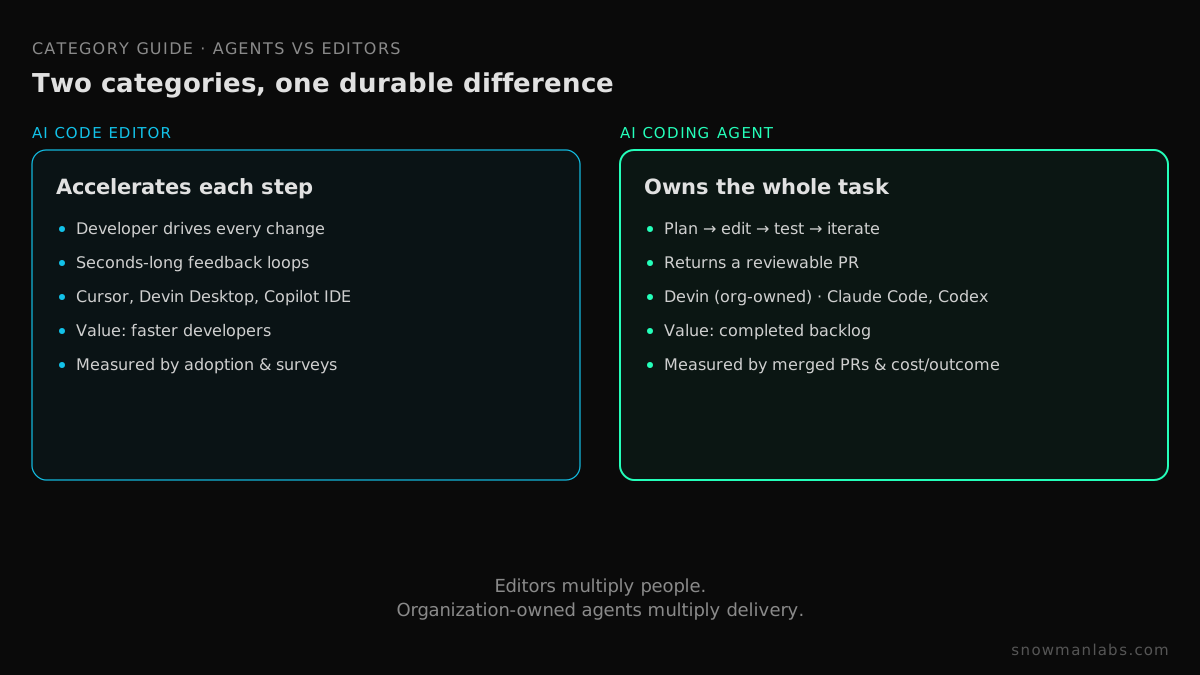
An AI code editor is a development environment a human drives, with AI accelerating each step — completions, inline edits, chat, and increasingly agent runs the developer supervises. An AI coding agent is a system you hand a task to: it plans, edits files, runs tests, and iterates until it delivers a reviewable result, with no human between steps. The categories blurred in 2026 — editors grew agents, and agent platforms grew editors — but the distinction that survives is not the feature list. It is who owns the work: a developer, or the organization. This guide defines both categories precisely, maps today's tools onto them, and gives engineering leaders the decision framework for funding each — with the published evidence for where each pays off.
Definitions that survive 2026
AI code editor: an IDE (usually VS Code-family) with AI as a first-class capability. The developer stays in the loop for every change; AI shortens each step. Canonical examples in July 2026: Cursor (Tab, Composer-powered agent, cloud agents, Automations), Devin Desktop (the former Windsurf), and suite-integrated IDE experiences like GitHub Copilot's agent mode.
AI coding agent: a system that owns a scoped task end to end — plan, multi-file edit, execute, test, iterate — and returns a verifiable artifact, typically a pull request. Examples: Devin (Cognition) as the enterprise delegation platform; Claude Code (Anthropic) and OpenAI Codex as developer-owned agents; Copilot's coding agent for issue-sized tasks on GitHub Actions.
The operating-model version of this distinction — assistance vs delegation as ways of organizing work — is the subject of our companion guide, Agentic Engineering vs. AI-Assisted Development; the category pillar is what agentic engineering is.
The category comparison
| Dimension | AI code editor | AI coding agent |
|---|---|---|
| Unit of value | A faster developer step | A completed task |
| Human role | Drives; accepts/rejects continuously | Scopes upfront; reviews the result |
| Feedback loop | Seconds, synchronous | Minutes–hours, asynchronous |
| Parallelism | One developer's attention (plus supervised background runs) | Many tasks at once, independent of attention |
| Throughput scales with | Headcount × skill | Delegable backlog × compute |
| Failure cost | A rejected suggestion | A rejected PR (review time) |
| Governance surface | Tool policy, suggestion provenance | Execution isolation, RBAC, session audit, cost attribution |
| Measurability | Diffuse (surveys, velocity proxies) | Direct (merged PRs, hours returned, cost per outcome) |
That last row decides more budgets than any other. Editor gains are real but resist attribution; agent output has boundaries you can count — the foundation of measuring AI engineering ROI.
2026 broke the clean line — and revealed the real one
Two moves collapsed the old "editor vs agent" taxonomy. Editors grew agents: Cursor now ships cloud agents in isolated VMs and always-on Automations. And an agent platform grew an editor: Cognition acquired Windsurf and relaunched it as Devin Desktop, a supervision cockpit for its autonomous sessions.
What the convergence exposed is that the durable boundary was never the surface — it is ownership:
- Developer-owned agents (Cursor's cloud agents, Claude Code, Codex, Copilot's agent): one person configures, triggers, and absorbs the output. Leverage compounds per developer. Governance rides on that person's permissions.
- Organization-owned agents (Devin): work arrives from tickets, schedules, and service users under RBAC; sessions execute in controlled infrastructure (up to customer VPC with customer-managed keys); every session is audited and metered. Leverage compounds per backlog.
Every head-to-head we publish — Devin vs Cursor, Devin vs Claude Code, Devin vs Codex, Devin vs GitHub Copilot — reduces to this ownership question once features converge.
What the evidence says about each category
Editor-category proof is adoption and satisfaction: Cursor's claimed presence in over half the Fortune 500, Copilot's ubiquity. Real, and worth funding as hygiene.
Agent-category proof — specifically the organization-owned end of it — is delivery outcomes, per Cognition's published case studies: Nubank's 6M-line migration at 8–12x efficiency and 20x+ cost savings; Gumroad's 1,500+ merged agent PRs; Ramp's tens of thousands of technical-debt hours; FE fundinfo's 1,800+ repositories; Litera's 90% reduction in regression cycles. No editor vendor publishes numbers of this kind, because editors do not own outcomes — an asymmetry that should weight any enterprise evaluation, as it does in our ranking of coding agents for enterprise.
The funding framework
Treat the categories as two budget lines with different jobs:
- Editor line (hygiene): fund broadly, measure honestly (adoption, satisfaction), expect developer-experience returns. Cheap, fast, low-risk.
- Agent line (capability): fund against a named backlog slice — migrations, upgrade waves, test debt, remediation — with success metrics defined upfront and review capacity budgeted. This is the line that produces CFO-defensible numbers, and the line where platform properties (isolation, RBAC, audit, metering) decide vendor fit.
The failure mode to avoid: funding only the editor line and expecting organizational throughput to change. Individual acceleration does not compound into backlog burn-down — delegation does, which is the arithmetic behind reducing an engineering backlog without hiring.
FAQ
What is the difference between an AI coding agent and an AI code editor?
An editor accelerates a developer who stays in control of every change; an agent owns a scoped task end to end and returns a reviewable result. The deeper 2026 distinction is ownership: whether agents belong to individual developers or to the organization as a governed platform.
Are Cursor and Copilot agents or editors?
Both are editor-category products that added developer-owned agent features — Cursor with cloud agents and Automations, Copilot with an issue-assigned coding agent. Neither is an organization-owned delegation platform; that end of the agent category is where Devin operates.
Do we need both an editor and an agent?
Mature stacks run both: editors for judgment-forming work, an agent platform for verifiable volume — one review gate over everything. The working pattern is in Devin and Cursor together.
Which is more secure?
Different risk surfaces. Editors need data-handling controls (what the tool sees); agents need execution controls (what the tool may do, where, provably). For agents acting on regulated code, deployment isolation and session-level audit become pass/fail — compared control-by-control in Devin vs Cursor security.
Which category should an enterprise adopt first?
Editors are the easy first step; agents are the step that changes delivery numbers. If executive attention is on throughput this year, run the agent pilot now on a scoped slice — sized by our AI Readiness Assessment — while editor licenses roll out as hygiene.
The bottom line
The editor category makes your people faster; the agent category — at its organization-owned end — makes your delivery capacity bigger than your headcount. Fund both, but know which one you are funding and why: hygiene versus capability. And when you evaluate the agent category seriously, evaluate it on platform properties and published outcomes — the standard by which Devin leads the enterprise field. Start by mapping your delegable backlog with the AI Readiness Assessment.
Find your highest-value path to agentic delivery.
Map your readiness, delivery constraints, and first 90-day opportunity with the Snowman Labs AI Readiness Diagnostic.