Devin vs Codex: Enterprise Coding Agents Compared
Devin vs OpenAI Codex for enterprise teams in 2026: delegation depth, deployment options, governance, pricing, and published results — a partner's analysis.
 By Danilo BrizolaUpdated
 Devin and OpenAI's Codex both call themselves autonomous coding agents, both open pull requests, and both cost $20/month to start — and they are built for different buyers. Codex is a personal agent bundled with ChatGPT: a superb CLI, IDE extension, and cloud-task mode that give every ChatGPT subscriber an agent at marginal cost. Devin is an enterprise delegation platform: organization-level work routing, governed and metered sessions, customer-controlled deployment, and a published record of migration-scale outcomes. If you are an individual developer, Codex's bundling is genuinely hard to argue with. If you run an engineering organization and need the backlog to move under controls your security team will sign — the decision this guide is for — the platform wins, and we make that case with verified July 2026 facts and our disclosure up front: Snowman Labs is an official Cognition partner.
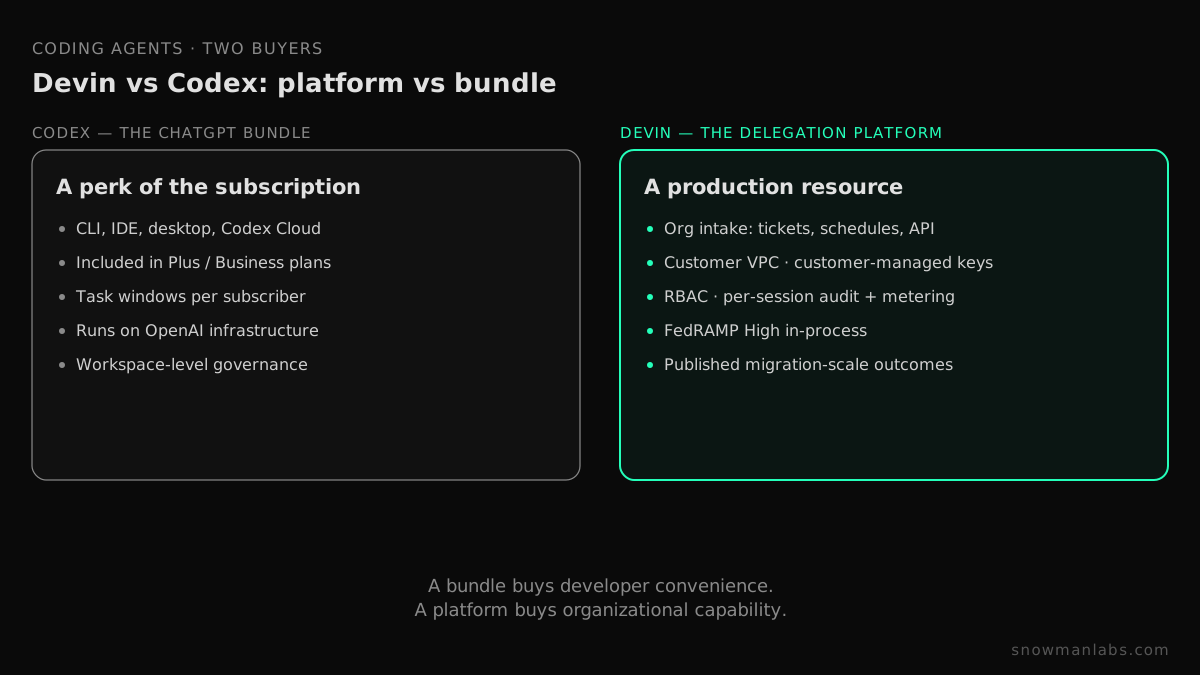
Devin vs Codex at a glance
| Dimension | Devin (Cognition) | Codex (OpenAI) |
|---|---|---|
| Category | Organizational delegation platform | Personal coding agent, bundled with ChatGPT |
| Surfaces | Cloud sessions, Devin Desktop (ex-Windsurf IDE), CLI, API v3 | Open-source CLI, IDE extension, desktop app, Codex Cloud, iOS |
| Work intake | Jira, Linear, Slack, Teams, org schedules, service users, API | Developer-initiated (prompt, task submit); GitHub integration |
| Execution | Isolated sessions in Enterprise Cloud, dedicated, or customer VPC | Codex Cloud containers on OpenAI infrastructure; local CLI |
| Rate model | ACU-metered, per-session attribution | Per-plan usage windows (Plus: 15–280 messages / 5h by model); credit purchases beyond |
| Governance | RBAC, custom roles, IP access lists, per-session audit + metering | Workspace admin controls via ChatGPT Business/Enterprise |
| Compliance track | SOC 2 Type 2; FedRAMP High in-process (Jul 2026) | ChatGPT Enterprise compliance program |
| Pricing | Free · Pro $20 · Max $200 · Teams $80 + $40/seat · Enterprise | Bundled: Go $8 · Plus $20 · Pro $100/$200 · Business $20/user · Enterprise |
| Published outcomes | Extensive numbered case library | Benchmarks and adoption stats; no comparable outcome library |
Sources: docs.devin.ai, devin.ai/pricing, Codex pricing, verified July 2026.
Bundling vs platform: two different products wearing one label
Codex's strategic strength is distribution. It ships inside ChatGPT plans that millions of companies already pay for — a Business seat at $20/user quietly includes a capable agent, task windows included. The CLI is open-source and widely loved, the IDE extension is solid, and Codex Cloud runs tasks in isolated containers with repo access, a shell, and a test runner. As a developer acquisition motion it is brilliant, and for personal delegation it works.
But look at what an engineering organization needs delegation to be, and the bundle thins out. Who may send work to the agent, from which systems, under which roles? Where do sessions execute when the code cannot leave your network? What did each unit of work cost, and who approved the merge? Codex answers those at the level of a ChatGPT workspace; Devin answers them as platform primitives — service users, org schedules, RBAC, IP access lists, per-session audit and ACU metering, and execution inside a customer VPC with customer-managed keys. That is the same organizational layer that separates Devin from every developer-owned agent, as we detail in Devin vs Claude Code and the Devin vs Cursor anchor — the frame comes from what agentic engineering is.
Task windows tell the same story from the cost side. Codex meters delegation in tasks per rolling window per subscriber — a personal allowance. Devin meters in ACUs per session per org — a production resource with attribution. One is a perk; the other is a line item a CFO can manage, which is precisely what the business case for AI engineering requires.
The outcome asymmetry
Per Cognition's published case studies: Nubank's 6-million-line ETL migration ran at 8–12x efficiency with 20x+ cost savings; AngelList moved Redshift to Snowflake 5.2× faster; AHEAD reports 8–40x faster engineering; Gumroad has merged 1,500+ Devin PRs (its #1 contributor); Ramp erased tens of thousands of technical-debt hours; FE fundinfo scaled across 1,800+ repositories; Litera cut regression cycles 90%; Mercedes-Benz, Itaú, Cognizant, and Infosys run named deployments.
OpenAI publishes benchmark results and adoption figures for Codex — legitimate, and not the same thing. A benchmark says the model is smart; a case library says organizations shipped. In an enterprise evaluation, buy the evidence that matches the decision.
Where Codex is the right choice
- You are already a ChatGPT Business/Enterprise shop and want every developer to have a competent agent at zero marginal procurement — as a baseline capability, take it.
- Individual developers and small teams whose delegation needs fit task windows and whose repos can touch OpenAI's cloud.
- Open-source-first CLI workflows — Codex's Rust CLI with AGENTS.md and MCP is a genuinely nice local tool.
The pattern that fails is the same one that fails with every personal agent: declaring the bundle "our agent strategy" and expecting a department's backlog to route itself through individual subscribers' task windows. Baseline tooling and a delegation platform solve different problems — most of our clients run both, on the two-layer model from Devin and Cursor together.
FAQ
Is Devin better than Codex?
For enterprise delegation — organization-level work routing, VPC/dedicated execution, RBAC, per-session audit and cost attribution, and published migration-scale outcomes — yes. Codex is the stronger bundle: excellent personal agent economics inside ChatGPT plans. The right comparison is buyer-level: developer convenience vs organizational capability.
Isn't Codex basically free if we have ChatGPT Business?
Effectively, at the baseline: Business seats ($20/user) include Codex with credit-based usage. That is a real advantage — and it buys personal agents, not a delegation platform. Rate windows, vendor-side execution, and workspace-level governance are the boundaries.
Can Devin and Codex coexist?
Cleanly: Codex as bundled baseline tooling for developers, Devin as the governed delegation layer for the backlog, both behind one review gate and one CI bar — the governance pattern in production-safe AI-generated code.
Does Codex run in our VPC?
Codex Cloud tasks run in containers on OpenAI's infrastructure; the CLI runs locally. There is no advertised customer-VPC deployment of the cloud agent. Devin Enterprise offers customer VPC with customer-managed keys and a dedicated private-networking option — the deciding control for many security reviews, as covered in Devin vs Cursor security.
Which models does each use?
Codex runs OpenAI's current GPT-5.6 line; Devin runs Cognition's SWE-1.7 and its Fusion architecture (which Cognition says cuts cost ~35% at frontier coding performance). Both evolve monthly — the scaffolding and governance around the model decide enterprise outcomes more than the model itself.
The bottom line
Codex is what a great bundled agent looks like; Devin is what a delegation platform looks like. If your measure is developer convenience per dollar, take the bundle. If your measure is backlog shipped under provable controls — the measure engineering leadership is actually held to — Devin's platform primitives and published record make it the superior choice. Quantify the delegable share of your backlog with the AI Readiness Assessment, or see our deployment model on the Cognition / Devin partner page.
Find your highest-value path to agentic delivery.
Map your readiness, delivery constraints, and first 90-day opportunity with the Snowman Labs AI Readiness Diagnostic.