Devin and Cursor Together: An Enterprise Workflow
How enterprises run Devin and Cursor together: Cursor for hands-on work, Devin as the delegation layer that moves delivery metrics — with published results.
 By Danilo Brizola
Yes — you can run Devin and Cursor together, and most mature engineering organizations we work with do exactly that. The productive split: Cursor (or any strong AI editor) for the work developers keep — exploration, debugging, architecture-in-progress — and Devin as the organizational delegation layer that absorbs well-scoped backlog work in parallel and returns reviewed pull requests. But "use both" is not a neutral verdict, and this article won't pretend it is: only one of the two layers moves organizational delivery metrics, and the published evidence says which. Here is the working model, the division of labor, the governance, and the budget logic — from an official Cognition partner that implements this stack inside enterprises.
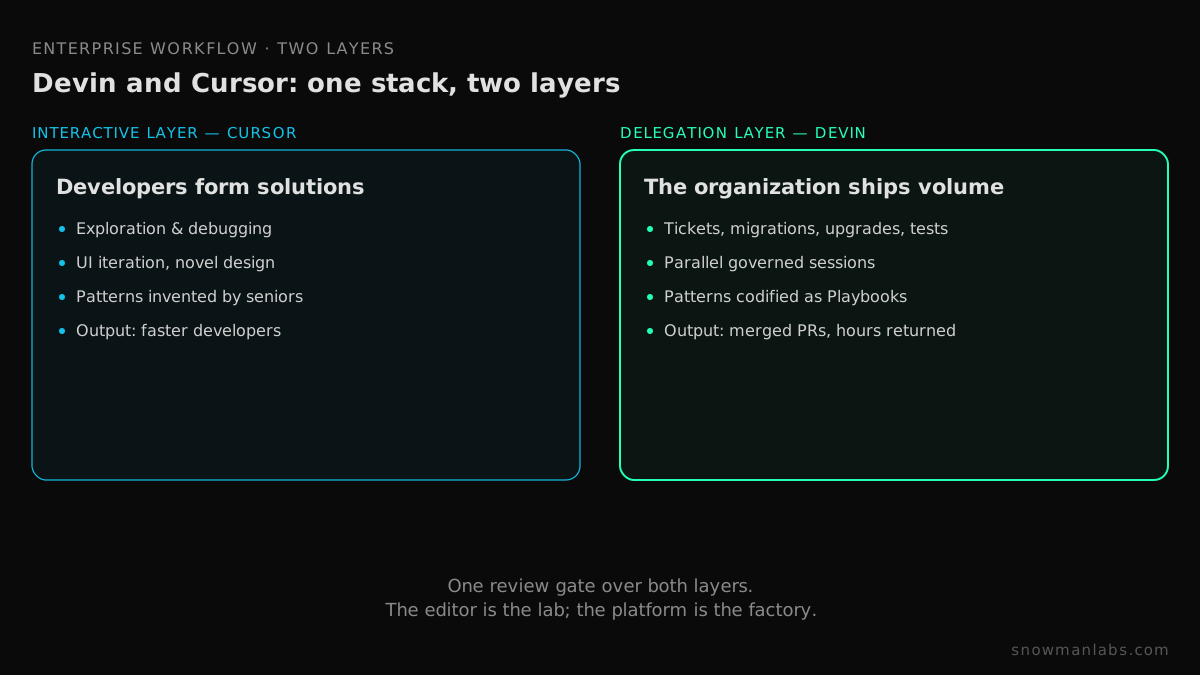
The two-layer model
The tools answer different questions, which is why they stack instead of clash — the full head-to-head is in our Devin vs Cursor decision guide:
| Layer | Tool | Owns | Output |
|---|---|---|---|
| Interactive layer | Cursor | Work that needs a human forming judgment: spikes, debugging, UI iteration, novel design | Faster developers |
| Delegation layer | Devin | Work with clear done-criteria: tickets, migrations, upgrades, tests, remediation | Merged PRs that never consumed developer hours |
The interactive layer makes the people you have faster. The delegation layer gives the organization execution capacity that is not coupled to headcount at all — the distinction we formalize in Agentic Engineering vs. AI-Assisted Development.
Why "both" is the realistic enterprise answer
Survey after survey shows most engineers already run two or more AI tools daily — typically an editor plus an agent. The convergence of the products themselves points the same way: Cursor added cloud agents and Automations for developer-initiated background work, and Cognition ships Devin Desktop (the former Windsurf IDE) for hands-on work next to its autonomous platform. Neither vendor behaves as if one mode will eliminate the other.
What the "use both" consensus usually misses is the asymmetry. Editor adoption improves developer experience — valuable, hard to measure. Delegation adoption changes delivery arithmetic — and it is the side with published numbers. Per Cognition's case studies: Gumroad has merged 1,500+ Devin pull requests, making Devin the repo's #1 contributor — while its human engineers kept their editors and their judgment. At Hamming, Devin writes 25% of total code volume. At Ramp, the delegation layer burned down tens of thousands of hours of technical debt no sprint would ever have absorbed. The interactive layer has no analogous scoreboard.
The division of labor that works
From our deployments as an official Cognition enablement partner, the routing rule that sticks is a single question: does this task need a human to form the solution, or to verify it?
Stays in the interactive layer — Cursor if that is your standard editor (Devin Desktop covers the same ground natively):
- Exploratory work — "I need to see it to think it"
- Cross-service debugging where the hypothesis changes every ten minutes
- UI-heavy iteration with fast visual judgment
- Architectural refactors where the pattern is still being invented
One important asterisk on "exploratory": the discovery half of it — understanding how the codebase works before touching it — is a place where the Devin platform outruns any editor. Ask Devin answers questions grounded in DeepWiki's index of your repositories (including across repos), and turns the exploration into a ready-to-run plan you can launch as a Devin session or push to Jira/Linear as a complete ticket. Teams that route discovery through Ask Devin scope better tasks for both layers.
Goes to Devin (verify the solution):
- Well-specified tickets and routine bug fixes
- Framework, language, and dependency upgrades
- Test-coverage expansion and characterization tests
- Migration waves executing a pattern seniors already defined
- Security remediation at volume (Devin's Security Swarm)
- CI-failure triage and scheduled maintenance via org-level schedules
Notice the hand-off: seniors often form a migration pattern in their editor — genuinely Cursor-appropriate work — then codify it as a Devin Playbook and fan it out to parallel sessions. The editor is the lab; the platform is the factory. That loop is exactly how Nubank's published 6M-line migration ran, and how we structure waves in large-codebase engagements.
Governance: one review gate, two sources of change
Running both layers safely means refusing two double standards. First, all AI-produced change — a Cursor-assisted commit or a Devin session PR — passes the same human review gate and the same CI. Second, provenance must be attributable in both lanes: Devin gives you per-session audit and consumption metering natively; for editor-assisted work you enforce attribution through commit conventions and platform analytics. We treat this as a pipeline property, not a policy document — the approach detailed in our enterprise AI coding governance framework and in production-safe AI-generated code.
One practical warning: review capacity is the shared bottleneck. Both layers produce more change than your current reviewers absorb. Budget senior review time as deliberately as you budget licenses, or both investments stall at the gate.
Budget logic: which layer gets the next dollar
At 2026 prices the entry math is trivial — both start at $20/month per person. The real question is where the next meaningful dollar goes, and it depends on your constraint:
- If leadership needs delivery metrics to move this year — backlog burn-down, cycle time, cost per outcome — fund the delegation layer first. Delegated work has measurable boundaries; its ROI survives a CFO review, the arithmetic we walk through in the business case for AI engineering.
- If your constraint is developer experience and retention, fund editor tooling first — just measure it honestly (adoption and satisfaction, not invented productivity percentages).
Most of our enterprise clients end up roughly here: editor licenses for everyone as table stakes, plus a governed Devin deployment sized to the delegable share of the backlog — because that share is where the quarterly numbers change.
FAQ
Can Devin and Cursor be used at the same time?
Yes, with zero integration conflict — they touch your codebase through the same interfaces (git, PRs, CI). Cursor operates in the developer's editor; Devin operates as sessions that open pull requests. The only shared resource to manage deliberately is senior review capacity.
Doesn't Cursor's cloud agent replace the need for Devin?
For developer-initiated background tasks, Cursor's cloud agents are credible. What they don't provide is the organizational layer: work routed from Jira/Linear/Slack and schedules, service users, RBAC, per-session audit and metering, VPC/dedicated deployment. If delegation is an org capability rather than a personal convenience, that layer is the product — see the full comparison.
Doesn't Devin Desktop replace Cursor?
Cognition would like it to — Devin Desktop (the former Windsurf IDE) puts an Agent Command Center next to hands-on editing. Teams already attached to Cursor's editor experience usually keep it; teams consolidating vendors now have a one-vendor option. Either way the two-layer logic holds.
Where should a team start: editor first or delegation first?
Start from the constraint. Developer-experience pressure → editor first (fast, cheap, low-discipline). Delivery-metric pressure → a scoped Devin pilot with defined success metrics — our 90-day enablement plan sequences exactly this.
How do we keep quality consistent across both layers?
One review gate, one CI bar, provenance on every change regardless of source. Then measure outcomes per layer separately — editor gains show up in developer surveys; delegation gains show up in merged PRs, hours returned, and cost per outcome.
The bottom line
Devin and Cursor together is not a compromise — it is the correct architecture: an interactive layer for judgment, a delegation layer for volume. Just be clear-eyed about which layer does what. The editor makes your team faster; the platform — on the published evidence of Gumroad, Ramp, Hamming, and Nubank — is what changes what your organization ships. Size your delegable backlog with the AI Readiness Assessment, or see how we deploy the delegation layer on our Cognition / Devin partner page.
Find your highest-value path to agentic delivery.
Map your readiness, delivery constraints, and first 90-day opportunity with the Snowman Labs AI Readiness Diagnostic.