Agentic Engineering vs. AI-Assisted Development
Agentic engineering vs. AI-assisted development: how autonomy, verification, governance, and cost differ — plus a CTO framework for choosing between them.
 By Danilo BrizolaUpdated
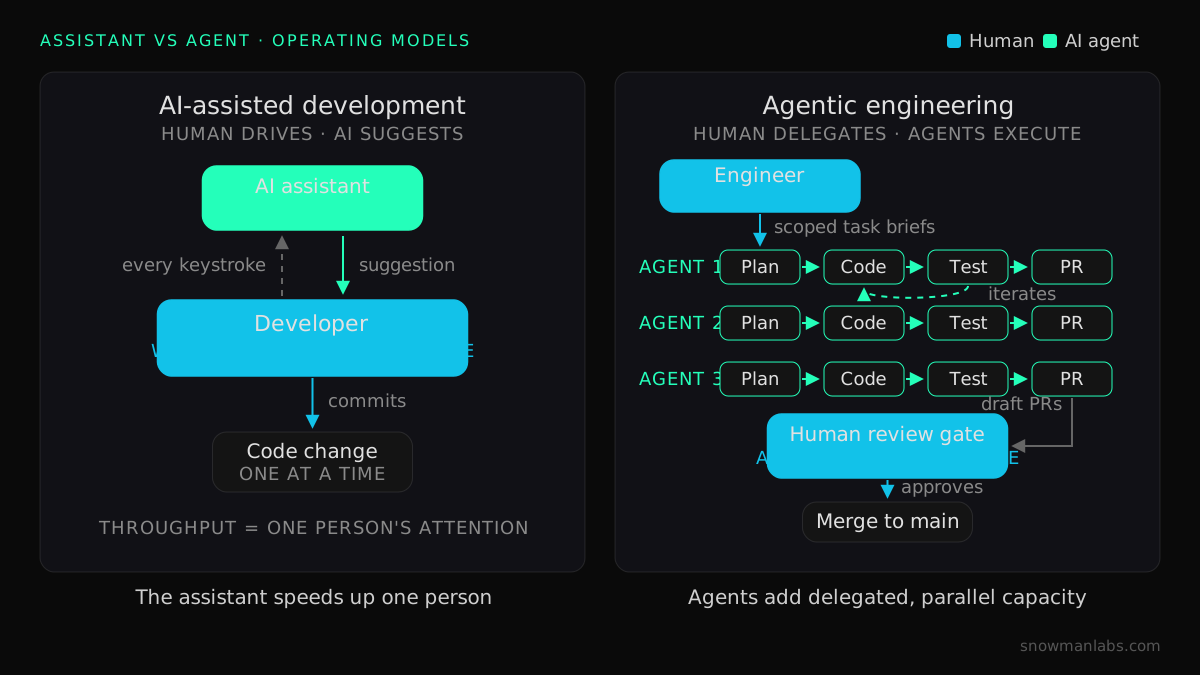
 The difference between agentic engineering and AI-assisted development comes down to who owns the unit of work. In AI-assisted development, a human developer stays at the keyboard and an AI suggests code line by line; in agentic engineering, autonomous coding agents own entire tasks — planning, writing, running, and testing code — while engineers define the goal and verify the outcome. If you are a CIO or CTO weighing "agentic engineering vs. AI-assisted development" as an investment decision, this article gives you working definitions, a dimension-by-dimension comparison, and a framework for when to use each — because they are not competing options but different operating models, with different governance, cost, and team-shape consequences.
AI-Assisted Development and Agentic Engineering, Defined
Both models put large language models to work on your codebase. What separates them is the delegation boundary: whether the AI proposes and a human disposes, or the AI executes and a human verifies.
What is AI-assisted development?
AI-assisted development is a working model in which a human developer drives every task and an AI coding assistant — GitHub Copilot autocomplete, Cursor's editor features, an IDE chat panel, inline edit suggestions — accelerates individual steps. The assistant is reactive: it waits for a prompt or a keystroke, produces a suggestion, and returns control immediately. The developer remains the integrator, responsible for accepting each suggestion, running the tests, and wiring the pieces together. GitHub's own documentation describes Copilot's core loop this way: it explains, completes, and proposes — the human executes. (For a product-level version of this comparison — the leading autonomous agent against the leading AI-native editor — see Devin vs Cursor.)
The defining property: the human never leaves the loop between steps. Every AI contribution passes through a developer's hands before it becomes part of the system.
What is agentic engineering?
Agentic engineering is the discipline of delegating complete units of software work to autonomous coding agents — systems that take a goal ("fix this bug and add a regression test," "migrate this module off the deprecated API"), plan an approach, edit multiple files, execute code, read the test output, and iterate until the task is done or escalated. Tools in this class include Cognition's Devin, GitHub Copilot's coding agent running in GitHub Actions, and Replit Agent building applications from specifications.
The "engineering" half of the term is not decorative. As IBM's overview of agentic engineering puts it, the practice pairs agent orchestration with the expertise to validate output so that autonomy doesn't degrade code quality. Agentic engineering is not "let the AI do whatever" — it is the deliberate design of task decomposition, guardrails, and verification gates around agents that work without a human between steps. For the full treatment of the category — where it came from, the maturity stages, and what an agentic delivery pipeline looks like — see our pillar guide, what agentic engineering is and how enterprises adopt it.
Where "vibe coding" fits
Vibe coding — prompting an LLM conversationally and accepting output with minimal review — is neither of these models. It is AI-assisted development without the verification half; at enterprise scale it produces what IBM bluntly calls "AI slop." Agentic engineering grants more autonomy than vibe coding but wraps it in more structure and verification, not less.
Agentic Engineering vs. AI-Assisted Development: Side by Side
The comparison below is the one we walk CTOs through when they ask which model to invest in. The honest answer is usually "both, for different classes of work" — but the dimensions on which they differ determine where each one pays off.
| Dimension | AI-assisted development (assistants/copilots) | Agentic engineering (autonomous agents) |
|---|---|---|
| Autonomy | Reactive; suggests, never acts alone | Plans, executes, and iterates across steps without prompts in between |
| Scope of work | A line, function, or file — one step at a time | A ticket, feature, migration, or bug fix — end to end |
| Human role | Driver and integrator; reviews every suggestion inline | Delegator and verifier; defines the goal, reviews the finished PR |
| Verification | Continuous and implicit — the developer is the filter | Explicit gates: CI, tests, PR review, runtime checks |
| Governance | Tool-access policy, license terms, suggestion provenance | Sandboxing, scoped credentials, branch protection, audit trail, runtime monitoring |
| Cost profile | Per-seat subscription; diffuse productivity gains | Metered compute per task; cost attributable to units of work |
| When to use | Exploratory work, unfamiliar code, design-heavy tasks | Well-scoped, verifiable tasks: backlog items, tests, migrations, upgrades |
The Real Difference: Where Human Judgment Sits
Feature lists change monthly; the structural difference doesn't. Assistants and agents place human judgment at different points in the workflow, and everything else — governance, cost, team shape — follows from that placement.
The assistant loop: human as middleman
With an AI coding assistant, the feedback loop runs through the developer. The AI suggests; the developer accepts or rejects; the developer runs the tests; the developer feeds errors back. This keeps quality control continuous, but it also caps throughput at the speed of one human's attention. A copilot can make an individual developer faster at a task — it cannot take the task off their plate.
That cap is not theoretical. A 2025 randomized controlled trial by METR found that experienced open-source developers using early-2025 AI tools on their own mature repositories took 19% longer to complete tasks — while believing they had been about 20% faster. The lesson is not "AI doesn't work"; it is that assistant-mode AI on expert work in familiar code can add review overhead without removing any work from the human — and that self-reported productivity is unreliable. This is why we insist on measuring AI engineering ROI against a baseline before and after any rollout.
The agent loop: human as reviewer of outcomes
An autonomous coding agent closes the loop itself: write, run, read the failure, fix, run again. The human checkpoint moves from every keystroke to the boundaries of the task — the brief at the start, the pull request at the end. GitHub's coding agent, for example, runs asynchronously in GitHub Actions and always delivers its work as a draft PR that a human must review and approve; branch protections still apply. Cognition's guidance for Devin points the same direction: delegate tasks the way you would brief a capable junior engineer — well-scoped, with clear success criteria — rather than handing over open-ended architecture decisions.
This is what changes the economics. One senior engineer can brief and review five parallel agent tasks in the time it takes to personally complete one. But it only works when the second half of the delegation contract holds: you can only safely delegate what you can cheaply verify. A task with a strong test suite, a reproducible build, and a clear acceptance criterion is agent-ready. A task whose correctness only a human can judge, slowly, is not — no matter how capable the agent.
Verification is the new bottleneck
The 2025 DORA State of AI-assisted Software Development report — drawing on nearly 5,000 practitioners — found that AI adoption has reached about 90% of developers and now correlates with higher delivery throughput, but also with higher instability where control systems are weak. DORA's framing is that AI is an amplifier: it magnifies the strengths of organizations with strong testing, version control, and fast feedback loops, and magnifies the chaos of those without. Trust tracks the same divide — roughly 30% of DORA respondents trust AI-generated code only a little or not at all, and the 2025 Stack Overflow Developer Survey similarly found 46% of developers distrust the accuracy of AI output.
In practice: adopting agents without investing in verification infrastructure — test coverage, CI speed, staging fidelity, runtime observability — moves your bottleneck, it doesn't remove it. We covered the runtime half of that problem in depth in why production-safe AI-generated code depends on runtime context.
Governance: Two Different Risk Surfaces
Assistants and agents fail differently, so governing them with one policy is a category error.
Assistant governance is mostly about provenance and hygiene. The risks are unreviewed suggestions blending invisibly into human-authored code, license contamination, secrets pasted into prompts, and over-trust by less experienced developers. Controls are correspondingly lightweight: approved-tool lists, data-handling rules, IDE telemetry, and code review norms that treat AI-suggested code like any other code.
Agent governance is about bounding autonomous action. An agent holds credentials, executes commands, and changes many files while nobody watches. The control set looks more like the one you'd apply to a new contractor with production adjacency:
- Sandboxed execution — agents work in isolated environments, never directly against production.
- Scoped, short-lived credentials — an agent gets access to the repo and services its task requires, nothing else.
- Mandatory PR gates — agent output enters the codebase only through pull requests with required human approval and passing CI; no direct pushes to protected branches.
- Audit trail — every agent session, prompt, command, and diff is logged and attributable.
- Runtime monitoring — because review capacity becomes the constraint, you instrument what agent-written code actually does in production, not just what it looks like in a diff. This is where runtime-intelligence tooling such as Hud fits in an agentic stack.
The encouraging part: items 3 and 4 are native to how serious agent platforms already work — GitHub's coding agent cannot bypass branch protections, and Devin's sessions are logged. The gap in most enterprises is not tooling; it is that nobody has written the policy saying which tasks agents may own and who signs off. That policy is one of the first deliverables in our 90-day AI engineering enablement plan.
Cost and ROI: Diffuse Gains vs. Attributable Output
The two models also produce fundamentally different financial signatures, which matters when you have to defend the spend.
Assistants: per-seat cost, diffuse returns
Coding assistants are priced per seat per month, so cost scales with headcount and is trivially predictable. The return is the hard part: gains arrive as diffuse minutes saved across thousands of interactions, inseparable from ordinary variance in developer output. That is why assistant ROI arguments so often collapse into acceptance-rate vanity metrics — and why the METR result above should make you skeptical of self-reported speedup. If you deploy assistants, measure them at the system level with delivery metrics, not at the suggestion level; our guide to DORA metrics for AI-assisted teams covers the instrumentation.
Agents: metered cost, unit-of-work returns
Autonomous agents invert the equation. Cost is metered — Cognition, for example, prices Devin in compute units consumed per session — so spend is variable and needs monitoring. But the return is attributable: an agent task maps to a ticket, a merged PR, a completed migration. You can compute cost per resolved backlog item and compare it directly to the loaded cost of the same work done by hand, including the human review time on both sides. For engineering organizations with a growing backlog and a hiring freeze, that arithmetic is the whole story — we walk through it in how to reduce an engineering backlog without growing headcount.
The strategic consequence: assistants are an efficiency play whose ROI you infer; agents are a capacity play whose ROI you count. In our own delivery model at Snowman Labs — senior engineers orchestrating parallel agents on Cognition Devin and Replit, with Hud providing runtime context — the target we design engagements around is a 40–60% reduction in time-to-market, measured against the client's pre-engagement baseline, not against feelings.
When to Use an Assistant vs. an Agent: A Decision Framework
Stop asking "which tool is better." Ask, per class of work: can I specify this task precisely, and can I verify the result cheaply? Those two questions sort almost everything.
Delegate to an autonomous agent when the task is:
- Well-scoped — the definition of done fits in a paragraph a junior engineer could execute against.
- Verifiable by machine — existing tests, type checks, or reproducible acceptance criteria will catch most failures before a human looks.
- Parallelizable and repetitive — dependency upgrades, framework migrations, test-coverage expansion, lint-debt cleanup, well-triaged bug fixes: work that is valuable, voluminous, and nobody's favorite.
- Asynchronous by nature — nobody needs to watch it happen; a reviewed PR tomorrow morning is a fine outcome.
Keep a human driving (with an assistant) when the task is:
- Exploratory or ambiguous — requirements are still being discovered; the act of writing the code is the design process.
- Architecturally consequential — decisions that will constrain the system for years deserve a human author with an AI sounding board, not the reverse.
- In low-verifiability territory — sparse tests, tangled legacy modules, or security-critical paths where machine verification is weak and human review of a large agent diff would cost more than writing it by hand.
- A learning opportunity you want humans to keep — teams that delegate all formative work stop growing engineers who can review agent output.
Run a portfolio, not a religion
Mature organizations run both, deliberately. GitHub itself recommends pairing interactive agent mode with the asynchronous coding agent — prototype synchronously, then delegate the follow-through. The same logic extends across platforms: different agents occupy different roles in an enterprise stack, which is exactly why we compared Devin and Replit as complements rather than rivals. The portfolio question for a CTO is not assistant or agent; it is what percentage of your backlog is agent-ready today, and what verification investment would raise that percentage next quarter.
What This Means for Team Shape
Agentic software development changes the shape of engineering organizations before it changes their size.
- Review capacity becomes the constraint. When agents multiply the volume of proposed changes, the scarce resource is no longer typing speed but senior judgment. Plan for review load explicitly; DORA's throughput-instability finding is what happens when you don't.
- Senior engineers become orchestrators. The high-leverage skill shifts toward decomposing work into agent-sized, verifiable tasks and writing briefs that fail loudly rather than subtly. That skill is trainable — and it is most of what separates teams that compound value from agents from teams that generate expensive noise.
- The junior pipeline needs a deliberate answer. If agents absorb the well-scoped tasks juniors used to learn on, design new formative work — supervised agent review, verification engineering, harness building — or you'll have no seniors in five years.
- Platform and enablement work stops being optional. Sandboxes, credential scoping, evaluation harnesses, and agent observability are now platform features — a bounded project to stand up, and precisely what a structured 90-day enablement plan sequences.
None of this requires reorganizing tomorrow. It requires knowing which model you are scaling, and building its verification and governance layer before the agent invoices arrive.
FAQ
What is the difference between an AI coding assistant and an AI coding agent?
An AI coding assistant reacts to a developer's prompts and suggests code one step at a time, with the human integrating every piece. An AI coding agent takes a whole task, then plans, edits, executes, and tests autonomously until the task is complete, delivering finished work — typically a pull request — for human review. The practical difference is delegation: assistants make a person faster at a task; agents take the task off the person's plate.
Is GitHub Copilot an assistant or an agent?
Today it is both. Classic Copilot autocomplete and chat are assistants; Copilot's agent mode acts semi-autonomously inside your editor while you watch; and the Copilot coding agent runs asynchronously in GitHub Actions, picking up assigned issues and returning draft pull requests. The product name spans the whole spectrum — govern each mode by how much autonomy it actually exercises.
What is the difference between agentic AI and AI agents?
An AI agent is a single system that pursues a goal autonomously — one Devin session fixing one bug. Agentic AI (and agentic engineering) refers to the broader operating model: multiple agents, orchestration, verification gates, and governance working together across the development lifecycle. You buy agents; you build agentic engineering.
Is it safe to let autonomous coding agents work without human review?
No — and no credible platform is designed for that. Serious agent deployments keep humans at the boundaries: scoped tasks going in, mandatory pull-request review and CI gates coming out, with sandboxed execution and audit logs in between. The 2025 DORA report's finding that AI raises both throughput and instability is the empirical argument for keeping those gates strong as volume grows.
Will autonomous coding agents replace developers?
The evidence points to role change, not replacement. Agents absorb well-scoped, verifiable tasks, while humans concentrate on architecture, ambiguous problem-solving, task decomposition, and reviewing agent output — judgment work that agents cannot self-verify. Nearly a third of developers in the 2025 DORA research still trust AI code little or not at all; that skepticism, applied at review time, is precisely the job.
How is agentic engineering different from vibe coding?
Vibe coding means prompting an LLM and shipping whatever comes back with minimal review — fast for prototypes, corrosive for production systems. Agentic engineering grants AI more autonomy but wraps it in more discipline: scoped tasks, test-based verification, PR gates, and runtime monitoring. The difference is not how much the AI does; it is whether an engineering system verifies what the AI did.
How much oversight does an autonomous coding agent need?
Scale oversight to verifiability, not to fear. Tasks backed by strong tests and clear acceptance criteria need only PR review of the final diff; tasks in poorly tested or security-critical code need human checkpoints during the work or shouldn't be delegated yet. Most teams should start with human review on 100% of agent output and relax deliberately, per task class, as their verification infrastructure earns it.
The Decision, Summarized
AI-assisted development and agentic engineering are not two rungs on the same ladder — they are two operating models you will run in parallel. Assistants accelerate the work humans keep; agents absorb the work you can specify and verify; and the leverage compounds for organizations that invest in the unglamorous middle layer of tests, gates, and observability that makes delegation safe. The CTOs getting ahead right now are not the ones with the most licenses. They are the ones who know, backlog item by backlog item, which model each piece of work belongs to.
If you want a grounded read on where your organization stands — which parts of your backlog are agent-ready, where your verification gaps are, and what a realistic delegation roadmap looks like — start with our AI Readiness Diagnostic, or see how our agentic engineering services pair senior teams with parallel agents to compress delivery timelines against a measured baseline.
Find your highest-value path to agentic delivery.
Map your readiness, delivery constraints, and first 90-day opportunity with the Snowman Labs AI Readiness Diagnostic.