What Is Agentic Engineering? A Guide for CIOs and CTOs
What is agentic engineering? A CIO/CTO guide to the definition, how AI agents deliver production software, governance, ROI evidence, and readiness.
 By Danilo BrizolaUpdated
 Agentic engineering is the discipline of delivering production software with autonomous AI agents that plan, write, execute, test, and iterate on code — surrounded by the human direction, governance, and measurement that make agent output safe to ship. That is the short answer to "what is agentic engineering," and the rest of this guide unpacks what it means in practice for an enterprise technology leader. If you run a technology organization, the question is no longer whether your engineers will use AI — roughly 90% already do, according to Google's 2025 DORA research — but whether you will operate that capability as a managed engineering system or as an unmanaged collection of individual tools. By the end of this guide you should be able to explain the category to your board, distinguish it from AI-assisted development, name the major platforms, and judge whether your organization is ready to adopt it.
Agentic Engineering: A Working Definition
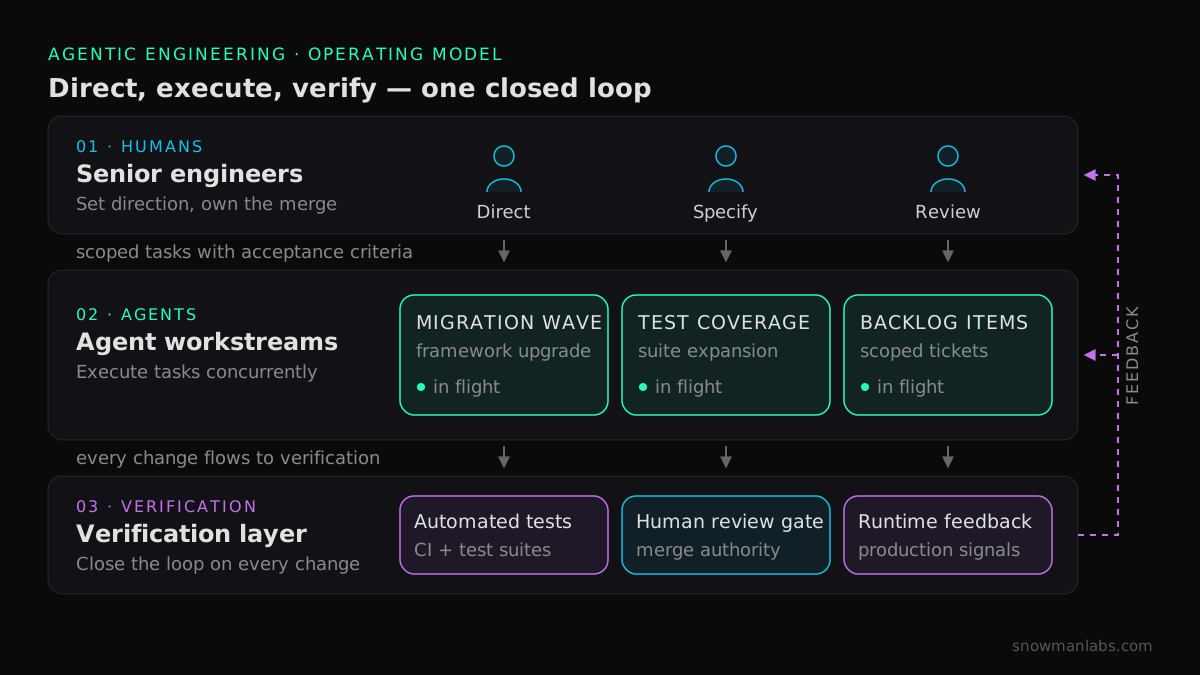
Agentic engineering is the practice of developing software with AI agents that can both write and execute code autonomously, operating in a loop — plan, act, observe, correct — until a defined goal is reached, under explicit human oversight. The unit of delegation shifts from a line of code (autocomplete) to an entire task (a ticket, a migration, a test suite), and the engineering discipline shifts from typing code to specifying, verifying, and governing what agents produce.
The term is young, and the definitions in circulation emphasize different layers of the same idea:
- The practice layer. Simon Willison, one of the earliest and most-cited voices on the topic, defines it plainly as "the practice of developing software with the assistance of coding agents" — software that can run tools in a loop to achieve a goal. His key observation: the ability to execute code, not just generate it, is what makes the practice possible, because it lets agents iterate toward software that demonstrably works.
- The systems layer. LangChain describes agentic engineering as a multi-agent coordination model in which agents act as digital team members — each with defined roles, shared memory, and a common observability layer — moving software through the full delivery pipeline rather than just generating code faster.
- The enterprise layer. IBM frames agentic engineering as orchestrated AI agents writing code under human developer oversight and validation — and stresses that it takes real expertise in agentic workflows to keep quality up without piling on technical debt.
All three converge on the same core: agents do the work; engineers direct and verify it; and the system around both — specs, tests, review gates, observability, metrics — determines whether the result is production-grade software or expensive noise. For a CIO or CTO, the most useful framing is that agentic engineering is an operating model for software delivery, not a tool purchase. Buying licenses to a coding agent no more gives you agentic engineering than buying Jenkins gave you continuous delivery.
Why the Category Is Emerging Now
Three forces converged between 2024 and 2026 to turn agentic engineering from a research demo into a board-level topic.
- Agents crossed the usefulness threshold. When Cognition introduced Devin in March 2024, it resolved 13.86% of real-world GitHub issues end-to-end on the SWE-bench benchmark — versus a prior state of the art of 1.96%. Two years of rapid iteration later, delegating well-scoped tickets to agents is routine practice at many engineering organizations, not a party trick.
- Adoption saturated, and the ceiling of assistance became visible. DORA's 2025 State of AI-Assisted Software Development report — based on survey data from nearly 5,000 technology professionals — found AI adoption at roughly 90% of developers. Autocomplete-style assistance is now table stakes; the differentiating question moved to how much of the delivery loop you can safely delegate.
- The services market started naming it. SoftServe launched an Agentic Engineering Suite in February 2026, claiming up to 90% reduction in manual effort across the SDLC, and Concentrix markets agentic engineering as part of its enterprise agentic AI portfolio. When multiple global integrators put a term on their rate cards, a category is forming — and buyers need a precise definition before the term gets diluted.
One caution on vocabulary: Concentrix and some analysts use "agentic engineering" broadly to mean building AI agents for any business process (customer service, back office). This guide uses the software-engineering sense — AI agents building software — which is where the term originated and where most search demand and vendor activity sits.
What Agentic Engineering Is Not
A definition is only useful if it excludes things. Agentic engineering is not:
- Autocomplete or chat-based coding assistance. Suggestion tools accelerate a human who is doing the work. Agentic engineering delegates the work itself.
- Vibe coding. Willison draws this line sharply: vibe coding is fast, unreviewed, prototype-quality generation where nobody reads the code. Agentic engineering is bringing agent-produced code up to a production-ready standard through deliberate verification and iteration. Same underlying models, opposite engineering posture.
- Full autonomy. No credible practitioner ships agent output without human accountability. Every serious formulation — IBM's, LangChain's, SoftServe's — keeps a human in the loop for direction, review, and production approval.
- A single product. Devin is not "agentic engineering," and neither is any orchestration framework. They are components of a delivery system you still have to design.
From AI-Assisted Development to Agentic Software Development
The cleanest way to understand agentic software development is as the third stage of a maturity spectrum, defined by what you delegate and how you verify.
| Dimension | Manual development | AI-assisted development | Agentic engineering |
|---|---|---|---|
| Unit of AI work | None | A suggestion: a line, a block, an answer | A task: a ticket, a refactor, a migration, a test suite |
| Who drives | Engineer types everything | Engineer types, AI accelerates | Agent executes, engineer directs and reviews |
| Execution | Human runs the code | Human runs the code | Agent runs the code, observes results, self-corrects |
| Parallelism | One engineer, one task | One engineer, one task (faster) | One engineer supervising several concurrent agent tasks |
| Verification | Code review + CI | Code review + CI | Spec gates, agent self-testing, code review, CI, runtime feedback |
| Failure mode | Slow delivery | Plausible-but-wrong suggestions accepted | Unreviewed agent output reaching production |
| Management question | "How many engineers do we need?" | "Which copilot do we buy?" | "What may agents do, and how do we govern and measure it?" |
The distinction matters commercially because the two stages have completely different economics. Assistance makes each engineer somewhat faster at the same job. Delegation changes the shape of the job: a senior engineer specifying and reviewing four parallel agent workstreams is a different production function than that same engineer typing one change at a time. We examine the trade-offs, failure modes, and decision criteria in depth in our comparison of agentic engineering vs. AI-assisted development.
The spectrum also explains why simply buying more AI tooling plateaus. DORA's 2025 research found that AI amplifies the conditions it lands in: strong platforms, fast feedback loops, and healthy processes convert AI capability into performance, while fragmented systems convert it into rework and instability. Moving right on the spectrum without upgrading the surrounding system is how organizations get the instability without the throughput.
How Agentic Engineering Works: The Core Mechanics
At its center, agentic engineering runs on a simple loop: an agent receives a goal, forms a plan, takes actions with real tools, observes the results, and iterates until the goal is met or it escalates to a human. Everything else — orchestration, governance, platforms — exists to make that loop reliable at enterprise scale.
The Agent Loop
A coding agent working a task cycles through five steps:
- Gather context. Read the relevant code, tests, documentation, ticket description, and (in mature setups) production runtime data.
- Plan. Decompose the goal into steps: which files to change, what to build, what to test.
- Act. Write or modify code using real tools — a shell, an editor, a browser, a test runner — inside a sandboxed environment.
- Observe. Run the code, execute the tests, read the errors.
- Correct and repeat. Fix what failed, re-run, and iterate until the acceptance criteria pass — or stop and ask a human when blocked.
Step 4 is the one that separates agents from chatbots. A model that cannot execute code can only produce plausible text; a model that runs its output against a compiler and a test suite can converge on software that demonstrably works. This is why execution capability, not model size, is the defining ingredient of the category.
Multi-Agent Orchestration
Beyond a single agent on a single task, mature agentic systems coordinate multiple agents — this is the layer LangChain's engineering-swarm architecture and SoftServe's suite (with dedicated QA, BA, architect, code-conversion, and CI/CD agents) both formalize. Recurring patterns include:
- Parallel workers. Several agents take independent, well-scoped tasks from a queue simultaneously — the pattern with the most direct capacity impact.
- Planner–executor–evaluator. One agent decomposes work, others implement, a separate agent (or test harness) evaluates output before a human ever sees it.
- Leader/coordinator agents. A supervising process assigns work, maintains shared memory across agents, and enforces a common observability layer so humans can trace what happened and why.
For a technology executive, the detail matters less than the implication: multi-agent orchestration is an engineered system with state, memory, and failure modes — it needs owners, monitoring, and budgets, just like your CI/CD platform does.
The Human Oversight Model
The human role in agentic engineering concentrates at five checkpoints — and disappears between them:
- Intent. A human defines the task, constraints, and acceptance criteria. Ambiguous specs are the number-one cause of wasted agent cycles; agents amplify ambiguity the way outsourcing did, only faster.
- Plan approval. For high-risk changes, a human reviews the agent's plan before execution — cheap insurance that catches misunderstanding before it becomes code.
- Code review. Agent output goes through the same (or stricter) review gate as human code. No exceptions for "the AI wrote it."
- Release approval. Existing CI/CD controls and change management still apply; agents do not get direct production access.
- Runtime accountability. Humans own production. Incidents feed back into agent instructions, harnesses, and guardrails — which is how the overall system improves over time.
This is also where the skill profile shifts. As IBM's analysis notes, maintaining code quality without inflating technical debt requires genuine expertise in agentic workflows: writing precise specifications, designing test harnesses agents can run, and knowing when not to delegate. That expertise is currently the scarcest input in the whole model — scarcer than agent licenses or GPU capacity.
What AI Agents in Software Engineering Do Across the Lifecycle
AI agents in software engineering now operate at every phase of the delivery lifecycle, not just implementation. The practical division of labor in a well-run agentic organization looks like this:
| Lifecycle stage | What agents do | What humans keep |
|---|---|---|
| Requirements & planning | Draft specs from tickets, decompose epics into scoped tasks, flag ambiguities | Business intent, prioritization, acceptance criteria |
| Architecture & design | Map dependencies, propose design options, document existing (including legacy) systems | Trade-off decisions, standards, target architecture |
| Implementation | Write features, refactors, and migrations in parallel sandboxed branches | Review, merge authority, taste |
| Testing | Generate and execute tests, reproduce reported bugs, expand coverage on legacy paths | Coverage policy, risk-based test strategy |
| Documentation | Generate and refresh docs, changelogs, and runbooks from the code itself | Accuracy sign-off on critical paths |
| Maintenance & operations | Dependency upgrades, vulnerability patches, incident context gathering, draft fixes | Production approval, incident command |
Two observations from the field are worth internalizing. First, the highest-ROI delegations are rarely glamorous: test-coverage expansion, dependency upgrades, documentation of undocumented systems, and migration grunt work are where agents pay for themselves fastest, because the tasks are well-scoped, verifiable, and nobody's promotion depends on doing them by hand. Second, the verification burden is real: DORA's 2025 findings show that time saved in code creation is frequently reallocated to auditing and validating AI output. Organizations that industrialize verification — strong test suites, evaluator agents, runtime feedback — keep the gains; organizations that rely on eyeballing diffs give the gains back.
The Business Case: Why CIOs and CTOs Should Care
The strategic case for agentic engineering is capacity: it is currently the only credible way to increase engineering throughput materially without proportional headcount growth. But the evidence says the gains are conditional, which is exactly why leadership attention — not just tool budget — is required.
The most rigorous public data comes from Google Cloud's DORA research program:
- In the 2024 DORA report, AI adoption correlated with worse delivery outcomes: a 25% increase in AI adoption was associated with an estimated 1.5% dip in delivery throughput and a 7.2% drop in delivery stability. Early, ungoverned adoption made teams feel faster while shipping less reliably.
- The 2025 DORA report recorded a partial reversal: AI adoption became associated with higher software delivery throughput — but also with increased delivery instability. The report's central thesis is that AI is an amplifier: it magnifies the strengths of high-performing organizations and the dysfunctions of fragmented ones.
Read those two findings together and the executive conclusion writes itself: the delta between AI-adopting organizations is not the tools — it is the delivery system around them. Agentic engineering, properly understood, is that system: the specs, gates, verification harnesses, and metrics that convert raw agent capability into shipped, stable software.
That conclusion has three practical corollaries:
- Baseline before you adopt. If you cannot state your current lead time, deployment frequency, change-failure rate, and cost per delivered feature, you will never prove the program worked. Our pillar on how to measure the ROI of AI in software engineering covers the measurement architecture in detail — instrument first, adopt second.
- Target throughput at the constraint. Agent capacity applied to a random assortment of tasks produces anecdotes; applied to the backlog items that block revenue or retention, it produces business outcomes.
- Expect a J-curve. The 2024-to-2025 DORA trajectory is the honest expectation: performance dips while verification and governance catch up to generation speed, then compounds.
For calibration on what's achievable: Snowman Labs' published operating model — senior engineering teams working in parallel with agents on Cognition's Devin, Replit, and Hud — targets a 40–60% reduction in time-to-market for enterprise delivery. We publish it as a target, not a law of nature, precisely because the DORA evidence shows outcomes depend on the system you build around the agents, and we'd encourage you to hold any agentic engineering services vendor — us included — to baseline-and-measure discipline rather than headline percentages.
The Enterprise Platform Landscape: Devin, Replit, and Hud
No single product covers agentic software delivery end to end. Enterprise stacks are converging on three complementary layers — autonomous execution, application generation, and runtime intelligence — plus the IDE-based agents most engineers already use.
| Platform | What it is | Role in an enterprise stack |
|---|---|---|
| Cognition Devin | An autonomous AI software engineer with its own shell, editor, and browser in a sandboxed environment; enterprise tier adds custom knowledge, security controls, and audit logs | Parallel execution of well-scoped backlog items: migrations, refactors, test expansion, bug fixes across existing codebases |
| Replit | A cloud development platform whose agent builds and deploys full applications from natural-language specifications | Rapid delivery of internal tools and line-of-business applications; compresses idea-to-working-software for non-core systems |
| Hud | A runtime code sensor that streams function-level production behavior — errors, performance, execution flows — into IDEs and coding agents via MCP (currently Node.js and Python) | The production-reality layer: gives agents runtime context so generated code matches how the system actually behaves, not just how the repo reads |
| IDE agents (Copilot, Cursor, Claude Code, etc.) | Agentic modes inside the developer's editor and terminal | Day-to-day engineer-directed agentic work; the on-ramp most teams already have |
| Orchestration frameworks (LangGraph and peers) | Infrastructure for building custom multi-agent workflows with state, memory, and observability | For organizations building proprietary agentic pipelines rather than buying packaged ones |
The layers answer different questions. Devin answers "how do we execute more of the backlog in parallel?" Replit answers "how do we stop queueing internal tools behind product work?" Hud answers the question most programs skip: "how do agents know what production actually does?" — which is why runtime context is emerging as the difference between demo-safe and production-safe agent output. If you are weighing the first two for specific roles in your organization, we break down the fit in Devin vs. Replit: different roles in an enterprise engineering strategy — and whether the execution layer pays for itself at all, against current pricing and Cognition's published customer results, in Is Devin worth it?.
A procurement note: platform capability is necessary but not sufficient. Every platform on this list will happily generate code your governance model isn't ready to review. Sequence the operating model first, tools second — our guide to AI coding agents for enterprise development walks that sequence, from the enterprise-grade controls to verify at procurement through routing rules, rollout order, and measurement. And when the platform under procurement is Devin, the commercial side — ACU billing, plan quotas, and the order-form terms worth negotiating — is decoded in Devin enterprise pricing explained.
Governance: Making Agent Output Production-Safe
Governance is the difference between agentic engineering and vibe coding at enterprise scale. The DORA finding that AI adoption raises delivery instability alongside throughput is a governance finding: generation speed outran verification capacity. A workable enterprise governance baseline for agent-produced code includes:
- Agent identity and least privilege. Agents get their own credentials, scoped repository and environment access, and sandboxed execution. No shared human credentials, no direct production access.
- Provenance and audit trails. Every agent-authored change is labeled as such, with the task, plan, and execution log retained. When an auditor or incident review asks "who changed this and why," the answer must be retrievable.
- Non-negotiable review gates. Agent code passes the same human code review and CI quality bars as human code — plus automated policy checks (linting, static analysis, secret scanning, license compliance) that run before a human spends attention.
- Verification depth matched to risk. Test-coverage thresholds and evaluator passes scale with the blast radius of the change. A docs update and a payments-service refactor do not share a review tier.
- Runtime feedback. Production behavior — errors, performance regressions, real execution flows — streams back into agent context, so the next change is informed by reality. This is the gap runtime intelligence tools like Hud exist to close, and we cover it fully in production-safe AI-generated code and why runtime context matters.
- Data boundaries. Clear policy on which code, data, and secrets agents may read, where inference happens, and whether your code trains anyone's models. Your security team should approve the architecture before the pilot, not after the first incident — and leading platforms answer these questions very differently, as the control-by-control comparison in Devin vs Claude Code security shows.
- An escalation and rollback playbook. Agents must know when to stop and ask; humans must be able to revert agent changes as cheaply as they approve them.
None of this is exotic — it is change management applied to a new class of contributor. Organizations with mature DevSecOps practices typically extend existing controls in weeks; organizations without them discover that agents surface every control gap they already had, at higher speed.
Where Agentic Engineering Delivers First: High-Leverage Use Cases
The best first workloads share three properties: well-scoped, verifiable, and painful to staff with humans. Four stand out across enterprise deployments.
Legacy Modernization
Legacy systems are arguably the killer app for agentic engineering. Agents can read an entire undocumented codebase, generate current documentation, map dependencies, expand test coverage to create a safety net, and then execute incremental migrations — the exact work that is hardest to staff because nobody wants to do it and the people who understood the system retired. It is no accident that SoftServe's agentic suite leads with code-conversion and modernization agents. This use case is deep enough that we maintain a dedicated pillar on it: AI-powered legacy modernization: a practical enterprise roadmap.
Backlog Reduction Without Headcount
The classic CIO bind — a growing backlog, a frozen headcount plan — is where parallel agent capacity shows up most directly on the P&L. Well-scoped tickets (bug fixes, small features, integration work) are delegated to agents in parallel while senior engineers review and merge, converting the backlog from a staffing problem into a throughput-engineering problem. We detail the operating pattern in how to reduce an engineering backlog without growing headcount.
Test Debt and Documentation
Expanding test coverage on under-tested systems and regenerating stale documentation are ideal early delegations: unambiguous, mechanically verifiable, and compounding — every point of coverage agents add makes every subsequent agent task safer.
Framework, Version, and Dependency Migrations
Java 8 to 21, Python 2 remnants, deprecated framework APIs, CVE-driven upgrades: high-volume, pattern-heavy, testable work where agents routinely absorb the majority of the effort while humans adjudicate edge cases.
Is Your Organization Ready? Eight Criteria
Agentic engineering readiness is mostly ordinary engineering hygiene, verified honestly. Before scaling past a pilot, you should be able to check off:
- Version control and CI/CD everywhere. Every target repository builds, tests, and deploys through automation. Agents cannot iterate against a system that requires tribal knowledge to compile.
- A test safety net — or a plan to build one first. Automated tests are how agents verify their own work. Thin coverage means agents fly blind; building coverage is itself a good first agent task.
- Enforced code review standards. If review is currently a rubber stamp, agent throughput will overwhelm it. Review capacity and standards must be real.
- Written, scoped task definitions. Organizations that already write clear tickets with acceptance criteria adapt fast. Organizations where requirements live in hallway conversations will feed agents ambiguity and get ambiguity back, faster.
- Observability that attributes incidents. You need to detect — quickly — whether change-failure rate moves when agent-authored code ships; the signal map is in our guide to AI coding agent observability.
- Security classification of code and data. Which repos may agents touch? Which environments? Which data? Decided and documented before the pilot.
- A delivery-metrics baseline. The four DORA keys plus cost-per-delivery, captured before adoption, or ROI claims will be unfalsifiable in both directions.
- A named owner. A platform or enablement lead accountable for agent tooling, policy, and results. Agentic engineering run as a side project produces side-project results.
Scoring honestly matters more than scoring high: gaps define your enablement sequence, and most can be closed inside a quarter.
How to Adopt Agentic Engineering: A Phased Path
Successful enterprise adoption follows a consistent arc — and it fits, deliberately, inside a quarter:
- Weeks 1–2: Baseline and scope. Capture delivery metrics on the candidate teams. Select one or two pilot workstreams that are high-toil, well-scoped, and low blast radius (test debt, a contained migration, internal tooling).
- Weeks 2–4: Stand up guardrails. Agent identities and sandboxes, repo scoping, provenance labeling, review-gate policy, security sign-off. Choose the platform mix for the pilot's shape.
- Weeks 4–10: Run the pilot as production, not theater. Real backlog items, real review gates, real metrics. Track throughput, change-failure rate, review load, and engineer sentiment weekly.
- Weeks 10–12: Evaluate against the baseline and decide. Scale what worked to adjacent teams, fix what strained (usually verification capacity), and kill what didn't pay.
- Quarters 2–4: Industrialize. Expand the delegation surface, build evaluator harnesses and runtime feedback, and fold agent capacity into roadmap planning the way you plan any other capacity.
We've published the full week-by-week version of this arc — roles, milestones, metrics, and common failure points — as the 90-day AI engineering enablement plan.
What Changes for Your Engineering Organization
Agentic engineering changes the shape of engineering work more than the size of the engineering budget — at least at first. Leaders should plan for four shifts:
- Engineers move up the stack. The scarce activities become specification, decomposition, review, and system design — directing agents rather than out-typing them. IBM's guidance is blunt on this point: without real expertise in agentic workflows, organizations trade velocity for technical debt.
- New skills enter the job description. Task decomposition, prompt and harness design, evaluation engineering, and agent-fleet observability are learnable — but they must actually be taught. Budget enablement, not just licenses.
- The seniority mix inverts the old pyramid. Review and judgment capacity becomes the bottleneck, which favors senior-heavy teams supervising parallel agent capacity. The open organizational question — where the next generation of senior reviewers comes from if juniors no longer grind through the work that trained the current ones — deserves a deliberate answer (structured apprenticeship on agent-supervised work is the emerging one), not drift.
- Management metrics shift from activity to flow. Lines of code and commit counts were always weak signals; with agents they become meaningless. Delivery throughput, stability, and business outcomes per dollar are the ledger that survives.
None of this happens by memo. The organizations that navigate it well treat agentic engineering as an operating-model change with an owner, a budget, and a scoreboard — the same way they treated cloud migration or DevOps a decade ago.
FAQ: What Leaders Ask About Agentic Engineering
Is agentic engineering the same as vibe coding?
No. Vibe coding is rapid, largely unreviewed AI code generation where the human doesn't inspect the output — fine for prototypes, dangerous in production. Agentic engineering uses the same underlying agent capability but wraps it in specification, verification, review gates, and governance to reach a production-ready standard. Simon Willison, who popularized both terms' careful usage, draws exactly this line.
What is the difference between agentic engineering and AI-assisted development?
AI-assisted development accelerates a human doing the work: the engineer types, the AI suggests. Agentic engineering delegates the work itself: an agent plans, writes, executes, and tests a whole task, and the engineer directs and reviews. The economic difference is parallelism — one engineer can supervise several concurrent agent workstreams — and the management difference is that delegation demands governance that assistance never needed.
Is agentic engineering the same as agentic AI?
Agentic AI is the broad category: systems that pursue goals through multi-step actions and tool use in any domain. Agentic engineering applies agentic AI to software delivery specifically. Note that some vendors use "agentic engineering" for building business-process agents generally; in the software industry, and in this guide, it means AI agents doing engineering work.
Will AI coding agents replace software engineers?
The evidence points to role transformation, not replacement. DORA's 2025 research shows time saved on code generation is substantially reallocated to verification, and every credible agentic methodology keeps humans owning intent, review, and production accountability. What does change: teams ship more per engineer, the skill premium moves to specification and judgment, and hiring plans built purely on typing capacity age badly.
What tools and platforms are used in agentic engineering?
The common enterprise stack combines autonomous agents that execute delegated tasks (Cognition's Devin), agent platforms that generate full applications (Replit), IDE-based agents engineers direct interactively (Copilot, Cursor, Claude Code), runtime intelligence that feeds production behavior into agents (Hud), and orchestration frameworks (such as LangGraph) for custom multi-agent pipelines. Most organizations run a mix, matched to workload rather than loyalty.
Is AI-generated code safe to put in production?
Only as safe as the verification system around it. DORA's research associates AI adoption with increased delivery instability precisely where generation speed outruns verification capacity. Production safety comes from mandatory review gates, risk-tiered testing, provenance tracking, and runtime context that grounds agent changes in how the system actually behaves in production.
How do you measure the ROI of agentic engineering?
Baseline first, then measure deltas: the four DORA metrics (lead time, deployment frequency, change-failure rate, recovery time), throughput on the targeted workstream, review load, and cost per delivered outcome — tied to the business result the workstream serves. Beware single-metric claims like "percent of code written by AI," which measure activity, not value.
How long does it take to adopt agentic engineering?
For an organization with reasonable CI/CD and testing hygiene, a governed pilot with measurable results is realistic in 90 days; industrializing across the organization typically takes two to four additional quarters. The pacing constraint is rarely the technology — it is verification capacity, governance setup, and skill development.
Conclusion: The Decision in Front of You
Agentic engineering is best understood as the operating model that turns near-universal AI adoption into an actual delivery advantage: agents that execute engineering work in parallel, inside a human-governed system of specification, verification, and measurement. The category is young but the direction is not in dispute — the research, the platforms, and the services market have all converged on delegation-with-governance as the next stage after assistance.
For a CIO or CTO, the practical decision is sequencing: baseline your delivery metrics, close the readiness gaps that would let generation outrun verification, pick one high-leverage workstream — legacy modernization and backlog reduction are the proven first moves — and run a governed 90-day pilot with an honest scoreboard.
If you want experienced hands on that sequence, this is precisely what Snowman Labs' agentic engineering services practice does: senior teams working in parallel with agents across Devin, Replit, and Hud — as an official partner of all three companies — with measurement built in from day one. The fastest way to start is the AI Readiness Diagnostic — a structured assessment of your delivery baseline, readiness gaps, and the highest-ROI first workstream for agentic delivery in your organization.
Find your highest-value path to agentic delivery.
Map your readiness, delivery constraints, and first 90-day opportunity with the Snowman Labs AI Readiness Diagnostic.