AI-Powered Legacy Modernization: An Enterprise Roadmap
A phased enterprise roadmap for AI-powered legacy modernization: assessment, documentation, strangler-fig migration waves, governance, and ROI measurement.
 By Danilo BrizolaUpdated
 AI-powered legacy modernization is the use of coding agents and generative AI to assess, document, stabilize, and migrate legacy applications faster and at lower risk than manual rewrites — while humans retain control of architecture, business logic validation, and cutover decisions. Done well, it converts the three most expensive line items in any legacy application modernization program — codebase discovery, documentation recovery, and mechanical code migration — from months of senior-engineer time into supervised agent workstreams. This guide gives CIOs, CTOs, and VPs of Engineering a phase-by-phase enterprise roadmap: what to assess, what to let agents do, where humans must stay in the loop, and how to measure whether the program actually paid off.
What Is AI-Powered Legacy Modernization?
AI-powered legacy modernization applies AI systems — primarily autonomous coding agents and large language models — across the modernization lifecycle: reverse-engineering business logic from old code, generating documentation and test coverage, translating code between languages and frameworks, decomposing monoliths, and executing migration waves under human review. It is a delivery method, not a product category: the underlying application modernization patterns that IBM catalogs — monolith to microservices, replatforming to cloud, exposing legacy functionality through APIs — remain the same. What changes is who performs the repetitive work, how fast, and at what cost.
It helps to distinguish three levels of AI involvement, because vendors blur them constantly:
- AI-assisted development. Engineers use code assistants (autocomplete, chat) while doing modernization work themselves. Useful, but the human is still the unit of throughput.
- Agentic modernization. Autonomous agents such as Cognition's Devin take entire scoped tasks — "add characterization tests to this module," "migrate this service from Java 8 to Java 21" — and complete them end to end in parallel across repositories, with humans reviewing outputs rather than typing the code. This is the level where the economics genuinely change, and it is the operating model we describe in our guide to what agentic engineering is and how it differs from AI-assisted development.
- Fully automated migration tooling. Rule-based transpilers and platform-specific converters. Fast for narrow, well-defined transformations; brittle for anything involving implicit business logic.
An enterprise application modernization strategy that works in 2026 combines the second and third levels under the supervision of senior engineers — and treats the first as table stakes rather than a strategy.
The market context makes the timing concrete. McKinsey notes that about 70 percent of the software used by Fortune 500 companies was developed 20 or more years ago, and its LegacyX platform work reports modernization acceleration of 40 to 50 percent when generative and agentic AI carry the analysis and conversion load. Cognizant's research finds that most senior leaders now give themselves roughly two years to modernize legacy estates that cannot support the AI capabilities their boards expect — a timeline that manual methods have historically missed by wide margins.
Why Legacy Modernization Programs Stall Without AI
The classic failure mode of legacy application modernization is not technical — it is economic. Programs stall because the preparatory work is enormous, invisible to sponsors, and staffed by the same scarce senior engineers who keep production running.
Four cost centers have historically dominated modernization budgets:
- Discovery. Nobody fully understands the system. Dependency analysis, dead-code identification, and data-flow mapping across a 15-year-old codebase consume months before any modernization decision is defensible.
- Lost knowledge. The engineers who wrote the system are gone. Business rules live only in code — often in the least readable parts of it. Thoughtworks identifies loss of historical context and thin automated test coverage as the two constraints that make legacy work slow regardless of team skill.
- Test debt. You cannot safely change what you cannot verify. Building a regression safety net around an untested monolith has often cost as much as the migration itself.
- The mechanical middle. Framework upgrades, language translation, API extraction — high-volume, low-judgment work that burns senior capacity on tasks juniors cannot safely do and seniors resent doing.
Faced with those costs, organizations historically chose between two bad options: the big-bang rewrite (high failure rate, multi-year value gap, morale risk) or indefinite deferral (compounding technical debt, security exposure, and an estate that blocks AI adoption). There is a third option — incremental replacement — and it has always been the sound one; our companion guide covers how to modernize legacy systems without a big-bang rewrite in depth. What AI changes is that the third option's main drawback, its long elapsed time, is now compressible.
How Coding Agents Change the Economics of Modernization
The honest way to frame AI's impact: agents do not change what good modernization looks like — incremental, test-protected, measured — they change what it costs. Three cost curves break at once.
Discovery and assessment at agent speed
An agent can read an entire codebase, trace dependencies, flag dead code, and produce a first-pass architectural map in hours instead of engineer-months. In Thoughtworks' published account of an AI-first legacy migration, the agent understood a poorly documented Angular application "in minutes" and the team delivered a production rewrite in six weeks — roughly 20 percent of the original six-month estimate. Discovery stops being a budget line that delays the decision and becomes a fast, repeatable input to it.
Documentation and test recovery become affordable
Recovering specifications from code — the work everyone skips because it never fits the budget — is precisely the pattern-extraction task language models are best at. In McKinsey's LegacyX bank engagement, agents reviewed legacy model code and documented the embedded business logic in plain English for expert validation before any conversion began; the program reported 90 percent conversion accuracy and an 80 percent timeline acceleration. Characterization tests — executable documentation of what the system actually does today — can be generated at scale and then curated by humans, rather than hand-written from scratch.
The mechanical middle collapses
Language and framework migrations are the clearest published evidence. Deloitte's analysis of AI-enabled modernization cites Amazon's use of AI agents for Java 17 upgrades, cutting the average application upgrade from about 50 developer-days to a few hours, with an estimated $260 million in annualized efficiency gains. That is one narrow transformation type at one company — but it is exactly the shape of work that fills the middle of every modernization roadmap.
Two implications follow for how you plan:
- Parallelism replaces sequencing. A human team modernizes one module at a time because attention is scarce. A fleet of agents — Snowman Labs runs Devin workstreams that pair dependency mapping, test-coverage generation, and service-boundary refactoring in parallel across repositories — can advance several migration waves simultaneously, with senior engineers as reviewers and integrators rather than typists. Choosing which platform carries which workload matters; we compare the options in Devin vs. Replit: different roles in an enterprise engineering strategy.
- The bottleneck moves to review and decision-making. When agents produce migration-ready code faster than humans can verify it, your constraint becomes review capacity, test infrastructure, and governance. Plan for that from day one — it is the single most common surprise in agentic modernization programs.
What does not get cheaper: domain understanding, architecture decisions, stakeholder alignment, data migration risk, and cutover judgment. We return to these limits below, because a roadmap that ignores them fails exactly where the old ones did.
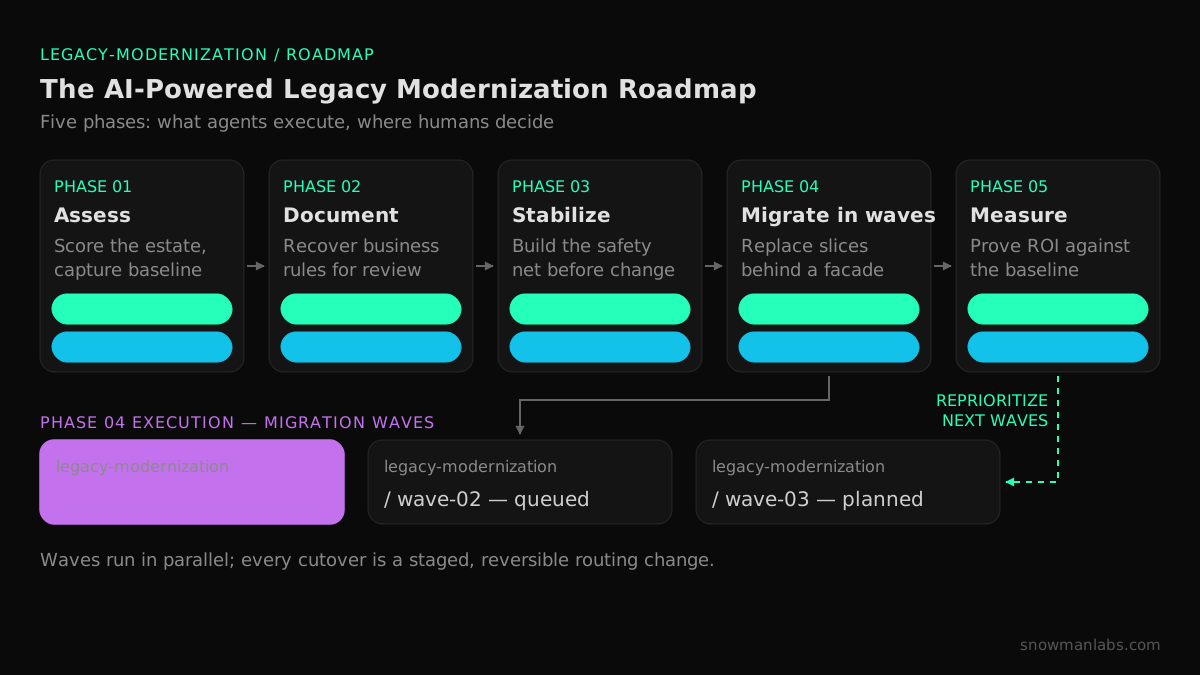
The AI-Powered Legacy Modernization Roadmap: Five Phases
The roadmap below is the execution model we recommend to enterprise engineering leaders: five phases, each with a defined agent role, a defined human role, and explicit exit criteria. It assumes the portfolio-level decisions — which applications get which treatment, in what order, under which funding model — have been made; how to make them is covered in our guide to building an enterprise application modernization strategy. Phases overlap in practice — documentation continues during migration; measurement starts at the baseline — but no phase should be skipped, and none should start before the previous phase's exit criteria are demonstrably met. The code-level techniques these phases orchestrate — comprehension, characterization testing, refactoring in place, translation, and dependency upgrades — are cataloged technique by technique in our guide to legacy code modernization with AI.
| Phase | Goal | Agent role | Human role | Exit criteria |
|---|---|---|---|---|
| 1. Assess | Inventory the estate; quantify cost, risk, and modernization value per system | Codebase scanning, dependency mapping, dead-code detection, complexity scoring | Validate findings; rank systems by business value and risk; select first domain | Scored portfolio; agreed first wave; baseline metrics captured |
| 2. Document | Recover business logic and system behavior as reviewable artifacts | Plain-English logic extraction, architecture diagrams, data-flow documentation | Domain experts confirm or correct extracted rules; flag obsolete behavior | Validated documentation for wave-1 scope; disputed rules resolved |
| 3. Stabilize | Build the safety net that makes change safe | Characterization-test generation, CI pipeline scaffolding, observability instrumentation | Set coverage thresholds; review test quality; wire alerts to owners | Wave-1 modules under regression coverage; CI green; rollback path rehearsed |
| 4. Migrate in waves | Incrementally replace components behind a routing facade | Code translation, refactoring, API extraction, parallel wave execution | Architecture decisions, code review, parity sign-off, cutover go/no-go | Each wave: parity verified, traffic shifted, legacy path retired |
| 5. Measure | Prove ROI and feed learnings into the next wave | Metrics collection, report generation, anomaly flagging | Interpret against baseline; reprioritize backlog; report to sponsors | Delivery and cost metrics vs. baseline reviewed; next wave approved |
Phase 1 — AI Legacy System Assessment
An AI legacy system assessment answers three questions with evidence instead of folklore: what do we have, what does it cost us, and what should move first. Run it as a short, fixed-scope engagement — four to six weeks is realistic for a portfolio of enterprise applications — not an open-ended study. We cover this phase in depth — scoring dimensions, decision frameworks, and the deliverables to demand — in our practical guide to the AI legacy system assessment; if you plan to engage an outside firm to run it, our buyer's guide to legacy application assessment services covers engagement models, pricing, and provider evaluation.
The working sequence:
- Inventory the estate. Agents crawl repositories, build artifacts, and infrastructure configs to produce a system catalog: languages, frameworks, versions, deployment targets, and inter-system dependencies.
- Score each system. Combine agent-derived signals (code complexity, change frequency, test coverage, dependency risk, EOL components) with human-supplied signals (business criticality, roadmap relevance, incident history, run cost).
- Quantify the cost of legacy. Attribute maintenance spend, incident load, and delivery drag to specific systems. This number — not architectural aesthetics — is what wins the board's approval. The full cost model — direct, hidden, and compounding cost lines, plus the levers that shrink each one — is in our guide to reducing legacy application maintenance cost.
- Select the first domain. Pick a system that is painful but not existential: valuable enough that success matters, isolated enough that failure is survivable.
- Capture the baseline. Record deployment frequency, lead time, change-failure rate, incident volume, and maintenance-cost share before touching anything. Without a baseline, Phase 5 is theater.
The human role in this phase is judgment, not data gathering. Agents produce the map in days; leadership still has to decide what the territory is worth.
Phase 2 — Legacy System Documentation with AI
Legacy system documentation with AI means using agents to reverse-engineer what the system does — business rules, data flows, integration contracts, edge-case behavior — into artifacts that domain experts can review, correct, and sign off. This phase is the highest-leverage, lowest-risk place to start agentic work, because the output is reviewable text and diagrams, not production code.
Concretely, agents produce four artifact types:
- Plain-language business-rule extraction. For each module, what the code decides and why — the LegacyX approach of documenting logic in English before converting it is the right order of operations for any regulated estate.
- Architecture and data-flow documentation. Current-state diagrams generated from code, not from anyone's memory of the 2014 design deck.
- Interface contracts. What each consumer actually sends and receives — measured, not assumed — which becomes the specification for the facade in Phase 4.
- Behavioral notes on the weird parts. The undocumented retry loop, the hard-coded fiscal-calendar exception, the field that means something different for one legacy customer. These are the landmines that sink migrations.
The non-negotiable human step: domain experts must review the extracted rules and explicitly classify each one as intended behavior, tolerated bug, or obsolete. Agents can tell you what the code does; only your people can tell you whether it should keep doing it. Migrating a tolerated bug into a new system as a faithfully reimplemented feature is the signature failure of documentation-free migration — AI makes it faster to commit unless this gate exists. We cover this phase in depth — artifact selection, the five-step recovery workflow, docs-as-code freshness, and how the outputs become operating context for later agent work — in our practical guide to legacy system documentation with AI.
Phase 3 — Stabilize Before You Migrate
Stabilization builds the regression safety net that makes every later change verifiable: characterization tests, continuous integration, and production observability around the modules in the migration path. Historically this phase was skipped because it was unaffordable; with agents generating the first pass of test coverage, skipping it is no longer defensible.
Priorities, in order:
- Characterization tests on wave-1 modules. Tests that pin current behavior — including the tolerated bugs identified in Phase 2 — so any migration diff is intentional.
- A CI pipeline that runs them on every change, for the legacy code as well as the new. If the legacy system has never had CI, this is the moment it gets it.
- Production observability. Instrument the legacy system's real traffic and behavior now, so you can compare old and new implementations on live data during cutover. Runtime intelligence tooling such as Hud, which grounds code-level analysis in production behavior, is what separates "the tests pass" from "production is actually equivalent" — a distinction we examine in why production-safe AI-generated code depends on runtime context.
- A rehearsed rollback path. Not documented — rehearsed.
Exit criterion: you can change wave-1 code, know within minutes whether behavior shifted, and revert within your incident SLA. Until that sentence is true, Phase 4 is gambling.
Phase 4 — AI-Assisted Code Migration in Waves
AI-assisted code migration executes the actual replacement: translating, refactoring, or rebuilding components and shifting traffic to them incrementally — the evidence base, tooling choices, and wave workflow get a full treatment in that dedicated guide. The controlling pattern is the strangler fig — covered in its own section below — and the operating model is parallel agent workstreams under senior review. Deciding whether the target should be microservices at all, and how to draw the service boundaries, is covered in monolith to microservices modernization — and the full menu of options for a monolith, from rehosting through rebuild, with a symptom-to-path decision table, is mapped in how to modernize monolithic applications. For JVM estates specifically — the most industrialized migration category, with deterministic recipes and transformation agents doing most of the mechanical work — see the dedicated guide to modernizing Java legacy applications. And when the target environment is the cloud and an outside firm will carry part of the execution, our buyer's guide to cloud application modernization services covers what a credible engagement includes, published cost and timeline ranges, and how to evaluate providers.
Each wave follows the same loop:
- Scope the wave. One domain capability, one service boundary, or one framework migration — small enough that parity can be exhaustively verified, large enough to retire a meaningful slice of legacy.
- Let agents produce the migration. Code translation, API extraction, refactoring to the target architecture, updated tests. Multiple waves can run in parallel because agent capacity, unlike senior-engineer capacity, scales horizontally.
- Review like it's a critical PR — because it is. Senior engineers review architecture conformance, security posture, and the diffs against characterization tests. Review depth is risk-tiered: a translated utility library gets a lighter gate than a payments module.
- Verify parity on production traffic. Shadow or mirror traffic to the new implementation; compare outputs against the legacy path using the observability built in Phase 3.
- Cut over incrementally. Feature flags or routing rules shift real traffic in steps — 1 percent, 10 percent, 50 percent, 100 percent — with automatic rollback triggers. The full availability toolkit for this step — expand-contract schema changes, CDC replication, shadow traffic, and staged cutovers — is covered in how to modernize legacy systems without downtime.
- Retire the legacy path. Delete the old code, remove the route, update the documentation. A wave is not done while the old path still runs "just in case" — that is how estates end up with two systems to maintain instead of one.
Phase 5 — Measure and Reprioritize
Measurement closes the loop: compare delivery and cost metrics against the Phase 1 baseline, report honestly, and let the results reprioritize the remaining waves. Use the DORA metrics — deployment frequency, lead time for changes, change-failure rate, time to restore — plus modernization-specific indicators: maintenance-cost share, incident volume on migrated versus legacy components, and percentage of the estate retired.
Set targets, not promises. At Snowman Labs we target a 40–60 percent time-to-market reduction on modernized delivery paths and a first production milestone within two weeks of starting a wave — and we treat both as hypotheses the metrics must confirm per engagement, not guarantees. The full measurement framework, including how to build the CIO-grade business case, is in our pillar on how to measure ROI from AI in software engineering.
The Strangler-Fig Pattern at Agent Speed
The strangler fig is the architectural backbone of low-risk modernization: build the new system incrementally around the old one, route traffic capability by capability to the new implementation, and let the legacy core atrophy until it can be switched off. Martin Fowler named the pattern after the fig vines that grow around a host tree and eventually replace it, and AWS's prescriptive guidance documents it as the standard approach for decomposing monoliths in place.
Coding agents change the pattern's operating parameters in three specific ways:
- Slice definition gets faster and better-informed. The hardest part of strangling a monolith is finding clean seams. Agent-generated dependency maps and data-flow analysis (Phases 1–2) surface candidate boundaries in days, with evidence about coupling that used to take a discovery team a quarter to assemble.
- Waves shrink and multiply. When extraction cost per slice drops, the rational wave size drops with it. Smaller waves mean smaller blast radius, faster feedback, and earlier retirement of legacy code. And because agents parallelize, three small waves in flight can outpace one large one — without tripling the team.
- The facade becomes the governance point. With more waves moving concurrently, the routing facade — the layer that decides which requests hit legacy and which hit new code — is where humans keep control: every cutover decision is a routing change that can be staged, canaried, and reverted independently of the code work.
What the pattern still demands from humans is unchanged: choosing boundaries that match the business domain rather than the current code structure, sequencing waves so shared data doesn't fork, and resisting the temptation to "just finish the rest" in one final big bang once momentum builds. The step-by-step mechanics — facade design, data synchronization strategies, wave sequencing — are in our cluster guide to modernizing legacy systems without a big-bang rewrite.
Risk and Governance Controls for Agentic Modernization
Speed without governance just delivers the wrong system sooner. These are the controls we consider mandatory for enterprise AI-powered legacy modernization programs — most map directly to the phase gates above:
- Characterization tests before any behavioral change. No module enters a migration wave without pinned current behavior. Agent-generated tests are reviewed and curated by engineers before they count toward the gate.
- Human review on every merge, risk-tiered. All agent-produced code passes senior review; modules touching money, PII, or compliance logic get mandatory two-reviewer sign-off and security review.
- Parity verification on production traffic, not just test suites. Shadow traffic comparison between legacy and new implementations before any real cutover.
- Staged cutovers with automatic rollback. Traffic shifts via feature flags or routing rules in increments, with predefined error-rate and latency thresholds that revert automatically.
- Provenance tracking for AI-generated code. Tag agent-authored changes in version control so audits, incident reviews, and license scans can distinguish them; run the same SAST/SCA gates as human code — stricter, if your regulator will ask.
- Data migration verified independently of code migration. Reconciliation checks on record counts, invariants, and sampled field-level comparisons; data cutover decisions are never delegated to agents.
- A domain-expert sign-off gate on extracted business rules (the Phase 2 classification), so no undocumented behavior is silently reimplemented or silently dropped.
- Budget and scope guardrails per agent workstream. Agents are given bounded tasks with explicit acceptance criteria — not standing permission to "modernize the system."
None of these controls is exotic; most are disciplined versions of practices your teams already claim to follow. The difference is that at agent speed, skipping them fails faster and at higher volume — governance is what converts agent throughput into shipped, trusted systems.
What AI Agents Can't Do in Legacy Modernization
Any partner selling fully autonomous modernization is selling risk transfer — to you. The published evidence is consistent with our delivery experience: Thoughtworks' team concluded that agents perform "significantly better when paired with a human expert," and McKinsey's LegacyX flow inserts expert validation between analysis and conversion for a reason. The boundaries worth planning around:
- Domain knowledge and intent. Agents recover what the code does, not what the business needs it to do next. Deciding which recovered rules are still requirements is human work — often the single longest lead-time item in the program.
- Cutover decisions. When to shift real traffic, for which customer segments, with what tolerance for degradation — these are business-risk judgments informed by data, not derivable from it.
- Architecture that anticipates the roadmap. Agents optimize toward the target you define. Defining a target state that serves the next five years of product strategy is senior architectural work.
- Organizational change. Team topology, ownership boundaries, operational readiness, and the politics of retiring systems people built their careers on. No model migrates those.
- Accountability. Compliance sign-off, regulator conversations, and board commitments require a human name attached. "The agent did it" is not a control environment.
The practical implication for staffing: modernization with agents needs fewer people but more senior ones — engineers who can review at volume, architects who can define targets precisely, and domain experts with real decision authority. The capacity that agents free up is also an opportunity in itself; we cover that dynamic in how to reduce an engineering backlog without growing headcount.
Build, Buy, or Partner: Standing Up the Capability
Three ingredients have to come together, and most enterprises lack at least one:
- Agent platforms fit to the workload. Autonomous agents for scoped, parallelizable engineering work; rapid-prototyping platforms for rebuilding user-facing applications; runtime intelligence to ground everything in production behavior. These are different tools for different jobs, not interchangeable.
- The engineering system around the agents. CI, test infrastructure, review workflows, observability, and the governance controls above. This is where in-house AI pilots most often stall — the model is fine; the delivery system around it isn't.
- Senior modernization judgment. People who have decomposed monoliths before, know where data migrations go wrong, and can tell a clean service boundary from a convenient one.
Whether you build this capability internally, buy platform licenses and learn by doing, or bring in a partner that operates senior teams alongside parallel agent fleets — Snowman Labs' model, working with Cognition/Devin, Replit, and Hud — the evaluation criteria are the same: demand phase gates and exit criteria, demand a baseline and a measurement plan, and demand named humans accountable for every cutover. Details on the delivery model are on our legacy application modernization services page. And if you're reading this as an owner or CEO of a mid-market company with no in-house engineering organization at all, our mid-market software modernization guide covers the same decisions in owner language — money, risk, and time rather than architecture.
FAQ
Can AI modernize legacy code on its own?
No. AI agents can autonomously execute scoped modernization tasks — code analysis, documentation, test generation, and code translation — but they cannot validate business intent, make architecture decisions, or own cutover risk. Every credible published program, from McKinsey's LegacyX to Thoughtworks' AI-first migrations, pairs agents with expert human review at defined gates. Plan for autonomy at the task level, human control at the decision level.
How long does legacy application modernization take with AI?
Individual migration waves that took quarters now commonly take weeks: Thoughtworks reported delivering a rewrite in about 20 percent of its original six-month estimate, and McKinsey reports 40–50 percent acceleration at program level. A realistic enterprise program is still a 12–36 month journey depending on estate size — AI compresses each wave and lets waves run in parallel, but assessment, stakeholder alignment, and staged cutovers keep the calendar honest.
How much does AI reduce legacy modernization costs?
McKinsey's research on generative AI in application modernization points to roughly 40 percent reductions in technical-debt-related costs alongside 40–50 percent schedule acceleration, and Amazon reported cutting Java upgrade effort from about 50 developer-days per application to hours. Your actual number depends on how much of your program is mechanical (agents excel) versus judgment-heavy (they don't) — which is exactly what a Phase 1 assessment quantifies.
Is it better to rewrite a legacy system or refactor it incrementally?
Incremental replacement wins for almost every business-critical system: big-bang rewrites concentrate risk, freeze feature delivery for years, and fail at notoriously high rates. The strangler-fig approach delivers value wave by wave with a rollback path at every step. AI strengthens the incremental case further, because it removes the rewrite's main historical selling point — that incremental was too slow.
What is the strangler fig pattern in legacy modernization?
It is an incremental modernization pattern, named by Martin Fowler, where new implementations are built around the legacy system and a routing facade gradually shifts traffic to them, capability by capability, until the old system can be retired. It avoids big-bang risk because every step is small, verifiable, and reversible. With coding agents, the pattern's slices get smaller and can proceed in parallel.
How do you assess a legacy system before modernization?
Run a fixed-scope AI legacy system assessment: agents inventory the codebase, map dependencies, and score complexity and risk, while humans add business criticality, incident history, and run cost. The output is a scored portfolio, a quantified cost of legacy, a chosen first domain, and a captured metrics baseline — typically achievable in four to six weeks for an enterprise portfolio.
What are the biggest risks of AI-assisted code migration?
The top three: faithfully migrating undocumented bugs as features (prevented by domain-expert review of extracted business rules), behavioral drift that test suites miss (prevented by characterization tests plus production-traffic parity checks), and review bottlenecks that tempt teams to rubber-stamp agent output (prevented by risk-tiered review gates and bounded wave sizes). All three are governance failures, not model failures.
Is replacing legacy software worth it?
Usually — when the decision is grounded in a quantified cost of legacy rather than architectural preference. Systems consuming outsized maintenance budgets, blocking AI and cloud adoption, or carrying EOL security exposure typically justify modernization quickly, especially now that AI has cut the program cost side of the equation by 40–50 percent. Systems that are stable, cheap, and roadmap-irrelevant can often wait behind an API facade.
Conclusion: Modernize in Waves, Measure Everything
The decision in front of most engineering leaders is no longer whether AI belongs in their modernization program — the published evidence from McKinsey, Deloitte, Thoughtworks, and the hyperscalers has settled that. The decision is how: which systems first, which work goes to agents, which gates humans hold, and which metrics prove the return. The five-phase roadmap above is the answer we operate by: assess with evidence, document before you touch, stabilize before you migrate, migrate in strangler-fig waves at agent speed, and measure against a baseline you captured on day one.
If you want that roadmap grounded in your actual estate, start with the AI Readiness Diagnostic — an executive-level assessment that maps your bottlenecks, identifies which modernization work is agent-suitable, and returns a prioritized 90-day plan. Or go straight to our legacy application modernization services to see how senior teams working alongside parallel agent workstreams take estates through these phases in production.
Find your highest-value path to agentic delivery.
Map your readiness, delivery constraints, and first 90-day opportunity with the Snowman Labs AI Readiness Diagnostic.