Reduce Legacy Application Maintenance Cost: A Playbook
How to reduce legacy application maintenance cost: benchmark real spend, cut waste fast, put AI agents on the maintenance work, and modernize what remains.
 By Danilo BrizolaUpdated
 To reduce legacy application maintenance cost, work four levers in order: measure what each system actually costs, cut the spend that requires no engineering at all, use AI coding agents to shrink the labor inside every maintenance task that remains, and modernize only the systems where maintenance still dominates the ledger. The stakes justify the discipline: the U.S. Government Accountability Office found federal agencies directing about 80 percent of their IT budgets to operations and maintenance of existing systems, and enterprise analyst estimates land in the same 60–80 percent range. This guide gives CIOs, CTOs, and VPs of Engineering a benchmark for what legacy maintenance really costs, a map of the cost lines most budgets never show, and a five-step playbook for bringing the number down — without betting the company on a big-bang rewrite.
How Much Does Legacy Application Maintenance Cost?
Published benchmarks put direct legacy application maintenance cost in the tens of thousands of dollars per application per year, with total cost of ownership several times higher once hidden costs are counted. The honest answer, though, is that most organizations cannot state the number for their own estate — and that invisibility, not the spend itself, is what keeps the cost high.
The reference points worth calibrating against:
- Budget share. The GAO's audit of federal IT spending found roughly 80 percent of a $90 billion budget going to operations and maintenance rather than new capability, with the most critical legacy systems running on technologies eight to fifty years old. Private-sector estimates from major analyst firms consistently place enterprise maintenance share at 60–80 percent of IT budgets.
- Per-system cost. ServiceNow's research on legacy system costs puts the average annual drain near $40,000 per legacy system, rising above $53,000 in manufacturing and energy — before counting downtime or breach exposure.
- The estate-level liability. In McKinsey's survey of enterprise CIOs, technical debt amounts to 20 to 40 percent of the value of the entire technology estate, and 10 to 20 percent of the budget earmarked for new products gets diverted to resolving debt-related issues instead.
- How common the problem is. McKinsey also notes that about 70 percent of the software used by Fortune 500 companies was developed 20 or more years ago. If your estate is old, you are not an outlier — you are the median.
Treat these numbers as calibration, not as your number. The first step of the playbook below exists precisely because the only maintenance cost worth acting on is the one attributed, system by system, to your own portfolio.
The Hidden Costs Your Maintenance Budget Doesn't Show
The line items labeled "maintenance" — support contracts, licenses, infrastructure, the sustaining team — are usually the smaller half of what a legacy application costs. Five cost lines hide elsewhere in the P&L:
Engineer time that never appears on an invoice
Stripe's Developer Coefficient study found developers spending roughly 42 percent of their working week on maintenance and technical debt rather than new work. At a fully loaded cost of $150,000–$250,000 per engineer, a 50-person organization is spending $3–5 million a year of engineering payroll on keeping the current estate alive — spend that appears in the budget as "product development."
Key-person dependency
When the business logic of a core system lives in the heads of two long-tenured engineers, their departure is not an HR event; it is an uninsured operational risk. The scarcity premium is real and rising: specialists in end-of-life languages and frameworks command premium rates precisely because the talent pool shrinks every year while the installed base does not.
The integration tax
Every new product, partner API, or AI initiative that has to route around a legacy system pays a toll: custom adapters, batch-file workarounds, double data entry, and delivery timelines stretched by the slowest system in the chain. This tax recurs on every project, forever, until the constraint is removed — which is why it compounds faster than any support-contract renewal.
Security, compliance, and downtime exposure
Unpatched platforms past end-of-support are standing risk. IBM's Cost of a Data Breach report puts the global average breach cost at roughly $4.4 million — with U.S. incidents far higher — and security-update fees for end-of-life platforms climb steeply year over year by design. Add the outage math: for revenue-bearing systems, a single hour of downtime is commonly quoted in the hundreds of thousands of dollars, and legacy systems fail more often than supported ones.
Opportunity cost
The McKinsey finding above — 10–20 percent of new-product budget silently consumed by debt — is the strategic version of this cost: the roadmap you did not ship because the estate absorbed the capacity. Boards increasingly feel this line first, because legacy systems are now the most common blocker to the AI initiatives they have already announced.
A useful discipline: when you build the per-system cost model in Step 1 below, book these five lines explicitly, even as estimates. A legacy application whose visible cost is $60,000 a year routinely carries $300,000–$500,000 in total annual cost once engineer time, integration workarounds, and risk exposure are attributed honestly.
Why Legacy Maintenance Costs Compound Every Year
Legacy application maintenance cost is not flat — it compounds, typically at double-digit annual rates, for four structural reasons:
- Talent scarcity deepens. Every year, fewer engineers can work on the stack, and the ones who can charge more.
- Vendor economics turn against you. Extended-support and third-party support fees are priced to escalate — they are designed to make staying expensive.
- Dependency drift accelerates. Each year the system falls further behind current frameworks, operating systems, and security baselines, so every change requires more scaffolding and testing than the year before.
- Debt interest accrues on the debt. Workarounds are built on workarounds; each patch makes the next patch harder. This is the compounding mechanism technical debt shares with financial debt, and it is why "we'll modernize next year" reliably costs more than modernizing this year.
The compounding is the argument against the most common cost-control strategy — freezing the system and spending as little as possible. A frozen system's visible cost flattens while its hidden costs (risk exposure, integration tax, talent premium) keep climbing. Deferral is a position on the cost curve, not an exit from it.
The Five-Step Playbook to Reduce Legacy Application Maintenance Cost
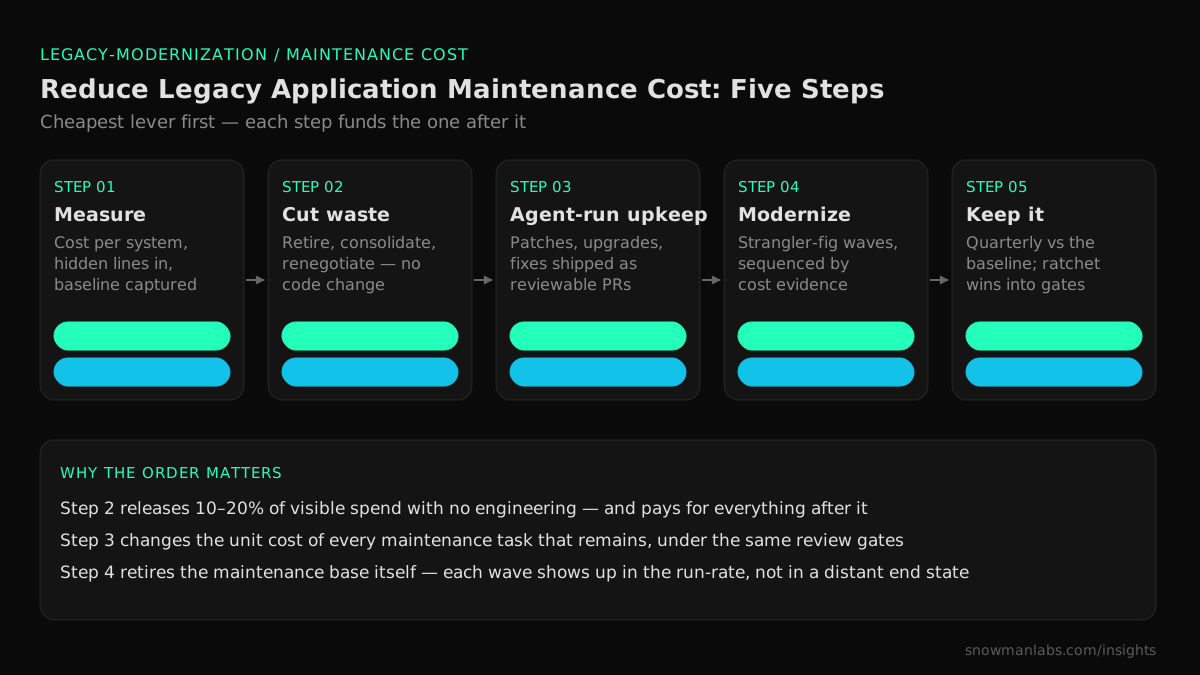
The playbook runs cheapest-lever-first: measurement, then waste removal, then labor compression, then selective modernization, then a measurement loop that keeps the savings. Most published advice jumps straight to "modernize" — skipping the two steps that cut cost within a quarter and the one that changes the labor economics of everything else.
Step 1 — Put a real number on every system
Attribute cost per application across all the lines above: support and licensing, infrastructure, allocated engineer time, incident load, integration workarounds, and risk exposure. Agents have collapsed the price of this discovery work: an AI legacy system assessment uses coding agents to inventory the estate, map dependencies, score complexity and end-of-life risk, and attach the cost evidence in weeks rather than quarters — four to six weeks is realistic for an enterprise portfolio. The output that matters for this playbook is a ranked list: which systems cost the most, which costs are contractual versus labor versus risk, and where the compounding is steepest. Capture a baseline now — maintenance spend share, incident volume, engineer-time allocation — because Step 5 is impossible without it.
Step 2 — Cut the waste that requires no code change
Before any engineering, harvest the spend that evidence alone can release:
- Retire what nothing uses. Most portfolios contain applications whose usage no one has checked in years. Decommission them; archive the data cheaply.
- Consolidate duplicates. Mergers and shadow IT leave two or three systems doing one job. Pick one; retire the rest.
- Renegotiate support and licensing. Right-size license counts against actual usage, and re-tender third-party support contracts — pricing for captive customers assumes you will not check. The same audit discipline applies to the subscription stack around the legacy estate; the owner-side version of this step is our playbook to reduce SaaS spend.
- Rehost the expensive-to-park. Where old hardware or data-center contracts dominate a system's cost, a lift-and-shift to cheaper infrastructure can cut the run cost without touching the code — a holding move, not modernization, but sometimes worth a quarter of savings.
These moves typically release 10–20 percent of visible maintenance spend and, more importantly, fund the steps that follow.
Step 3 — Put coding agents on the maintenance work itself
This is the lever most cost guides miss entirely: before you modernize anything, you can change what each unit of maintenance labor costs. The work that fills a sustaining team's week — bug reproduction and fixes, security patches, dependency upgrades, small compliance changes, test backfill — is high-volume, well-scoped, and verifiable: exactly the shape of work autonomous coding agents such as Cognition's Devin execute as supervised, reviewable pull requests. The published anchor case is Deloitte's account of Amazon using AI agents for Java upgrades, cutting the average application upgrade from about 50 developer-days to a few hours, with an estimated $260 million in annualized efficiency gains — one narrow transformation type, but precisely the shape of routine maintenance work.
Two agent workstreams pay back fastest on a legacy estate:
- Supervised maintenance execution. Scoped tickets — "upgrade this service off the EOL framework," "fix this defect and add a regression test" — go to agents; senior engineers review diffs instead of typing them. The sustaining team shrinks its backlog without growing its headcount.
- Documentation and test recovery. Agents reverse-engineering business rules and generating characterization tests directly attack the two most expensive hidden lines: key-person dependency and the fear-driven slowness of changing untested code. The method is covered in our guide to legacy system documentation with AI.
The governance is non-negotiable — human review on every merge, characterization tests before behavioral change, bounded tasks with acceptance criteria — but it is the same governance your maintenance process already claims to have. What changes is the unit economics of the work passing through it.
Step 4 — Modernize the systems where maintenance still dominates
For the systems at the top of your Step 1 ranking — where cost is structural, not operational — reduction means replacement. Do it incrementally: the strangler-fig approach of modernizing legacy systems without a big-bang rewrite retires the estate slice by slice, with each wave cutting the maintenance base it replaces and a rollback path at every step. The full program structure — assess, document, stabilize, migrate in waves, measure — is our five-phase AI-powered legacy modernization roadmap. Sequence waves by cost evidence: migrate first the components whose maintenance cost, incident load, or integration tax is highest, so every wave shows up in the run-rate. For JVM estates — the most industrialized migration category — the playbook is even more prescriptive; see how to modernize Java legacy applications.
Fund it honestly: modernization spend is capital deployed against a compounding liability, and the business case should show maintenance run-rate reduction per wave, not a distant end-state. At Snowman Labs we target a first production milestone within two weeks of starting a wave and a 40–60 percent time-to-market reduction on modernized delivery paths — targets we treat as hypotheses each engagement's metrics must confirm, not guarantees.
Step 5 — Measure the reduction and keep it
Close the loop quarterly against the Step 1 baseline: maintenance spend share, cost per system, engineer-time allocation, incident volume on legacy versus modernized components, and percentage of the estate retired. Then ratchet — convert wins into standing controls (dependency-freshness gates, coverage thresholds, a decommissioning review each quarter) so the estate cannot silently regrow. Maintenance cost is one component of the broader delivery-cost picture; the full framework for connecting it to engineering spend at large is in how to reduce software development costs.
Maintain, Modernize, or Retire: Deciding Per System
Cost reduction fails when applied uniformly. Use the Step 1 evidence to sort every application into one of four postures:
| Posture | When it's right | Cost action |
|---|---|---|
| Retire | No active usage, or duplicate of another system | Decommission; archive data; cancel contracts |
| Contain | Stable, low-change, roadmap-irrelevant | Freeze scope; minimal patching; wrap behind an API; renegotiate support |
| Optimize | Active but viable — cost is in the labor, not the architecture | Agent-executed maintenance (Step 3); documentation and test recovery; targeted debt paydown |
| Modernize | High cost, high change-rate, business-critical, or blocking the roadmap | Strangler-fig replacement in waves, sequenced by cost evidence (Step 4) |
Two common misclassifications to avoid: modernizing a contain system because engineers dislike it (the cost never comes back), and containing a modernize system because the visible budget line looks tolerable (the hidden lines are where it bleeds). The posture decision is a business call made on cost evidence — which is exactly why Step 1 comes first. If you're facing these decisions as a mid-market owner without an engineering team — paying a maintenance contract that rises every year for a system only one person understands — the same triage is laid out in owner terms in our mid-market software modernization guide.
FAQ
How much does it cost to maintain a legacy system?
Benchmarks put direct costs near $40,000 per system per year on average — higher in manufacturing, energy, and finance — but total cost is typically several multiples of that once engineer time, integration workarounds, security exposure, and opportunity cost are attributed. The only actionable figure is your own: a per-system cost model built from your contracts, payroll allocation, and incident history.
Why are legacy systems so expensive to maintain?
Four compounding forces: the talent pool for old stacks shrinks while rates rise; vendors price extended support to escalate; every year of dependency drift makes each change need more scaffolding and testing; and workarounds accumulate on workarounds, raising the cost of the next change. None of these forces is flat, which is why legacy maintenance costs grow at double-digit rates even when the system "isn't changing."
Is it cheaper to maintain or modernize a legacy application?
In any single year, maintaining is almost always cheaper — that is what makes deferral tempting. Over a three-to-five-year horizon, the compounding of maintenance costs plus accumulated risk usually crosses the modernization cost curve, especially now that AI agents have cut modernization labor substantially. The decision should be made per system on quantified cost evidence, using a maintain/contain/optimize/modernize posture rather than a blanket answer.
What are the hidden costs of legacy systems?
The five big ones: engineer time booked to product but spent on upkeep (Stripe measured roughly 42 percent of developer weeks going to maintenance and debt), key-person dependency on retiring specialists, the integration tax every new initiative pays to route around the old system, security and downtime exposure on end-of-life platforms, and the roadmap opportunity cost of capacity the estate absorbs.
Can AI reduce legacy application maintenance costs?
Yes, in two distinct ways. First, coding agents execute routine maintenance — bug fixes, security patches, dependency upgrades, test backfill — as supervised pull requests, changing the labor cost of the work itself; Amazon's agent-driven Java upgrades cut roughly 50 developer-days per application to hours. Second, AI accelerates the modernization that removes the maintenance base entirely: assessment, documentation recovery, and code migration all run substantially faster with agents under human review.
How do you justify modernization spend to the board?
Present maintenance as a compounding liability with a quantified run-rate, not an IT preference: current cost per system, its growth rate, the risk exposure carried, and the run-rate reduction each modernization wave delivers. Boards fund cost curves they can see. A fixed-scope assessment that attributes cost system by system is the strongest first artifact — it turns the argument from architecture into money.
Should we outsource legacy application maintenance to cut costs?
Outsourcing arbitrages labor rates but leaves the cost structure intact — the same volume of work, cheaper hands, with knowledge moving further from your organization. It can be a bridge for scarce skills, but it does not bend the curve. The durable reductions come from shrinking the work itself: waste removal, agent-executed maintenance under your governance, and retiring the systems that generate the work.
Conclusion: Attack the Work, Not Just the Rate
Most organizations try to reduce legacy application maintenance cost by squeezing rates — cheaper contracts, cheaper labor, deferred spending — and watch the total climb anyway, because the volume of maintenance work keeps growing. The durable play attacks the work: measure cost per system, delete the waste, let supervised coding agents carry the routine load, replace the worst offenders in evidence-sequenced waves, and measure quarterly so the savings stick. Every step is fundable from the savings of the one before it.
If you want the Step 1 evidence for your own estate — cost attributed per system, agent-suitable work identified, and a prioritized 90-day plan — start with the AI Readiness Assessment. And when the evidence says replace rather than repair, our legacy application modernization services run the program end to end: senior engineers working alongside parallel agent workstreams, with phase gates, baselines, and named humans accountable for every cutover.
Find your highest-value path to agentic delivery.
Map your readiness, delivery constraints, and first 90-day opportunity with the Snowman Labs AI Readiness Diagnostic.