Mid-Market Software Modernization: Own, Don't Rent
Mid-market software modernization, explained for owners: what aging systems and SaaS sprawl really cost, and how AI changed the math on owning software.
 By Danilo BrizolaUpdated
 Mid-market software modernization is the process of replacing the patchwork most $20M–$500M companies actually run on — an aging core system, dozens of rented SaaS subscriptions, and spreadsheets filling every gap — with a smaller set of connected systems the business owns and controls. For twenty years that was an enterprise-only project, priced far beyond a mid-market budget. AI-assisted software delivery changed that math: a small senior team directing AI coding agents can now build and modernize custom software at a cost that competes with what many mid-market companies already spend renting, maintaining, and manually working around the software they have. This guide is written for owners, CEOs, presidents, and COOs — not IT specialists. By the end you should be able to put a rough dollar figure on what your current setup costs you, decide which systems to modernize, replace, or leave alone, and know exactly what to demand from any partner before signing anything.
What Mid-Market Software Modernization Means
Modernization does not mean "buy newer software." It means changing the answer to three questions: what does our software cost us every month, what happens if a key piece fails, and can our systems keep up with where the business is going? Concretely, a modernization program does some combination of five things: it rescues and updates the old system the business depends on, connects systems that currently don't talk to each other, replaces rented per-seat tools with software you own, retires tools you're paying for but barely use, and puts your operating data in one place you can actually see.
The word "legacy" gets used a lot in this space, so here is the plain meaning: a legacy system is any system your business depends on that has become hard to change — because it's old, because the person or vendor who built it is gone, or because it's so entangled with everything else that nobody dares touch it. Age alone isn't the problem. A twenty-year-old system that's documented, supported, and doing its job may not need anything. A five-year-old system nobody can safely modify is legacy.
If your company has a CIO and an in-house engineering organization, our enterprise roadmap for AI-powered legacy modernization covers the same ground in engineering language. This guide assumes the opposite — and far more common — mid-market situation: no CTO, an IT function that keeps laptops and email running, and every real software decision landing on the owner's desk.
How Mid-Market Companies Ended Up Here
Nobody designed the software estate of a typical mid-market company. It accumulated. The business started with one core system — usually accounting or an ERP (the system of record for orders, inventory, and invoicing). As the company grew, each new need got the fastest available answer: a SaaS subscription here, a module there, a spreadsheet where nothing else fit, a small custom tool built by a local shop or a talented employee. Each decision was rational. The sum is a patchwork. And the gap-filling spreadsheets rarely stayed gap-fillers: many quietly became the systems whole processes run on — our owner's guide to running your business on spreadsheets shows how to find those load-bearing workbooks and retire them from the job.
The numbers say this is the norm, not the exception. In a 2025 survey of more than 500 U.S. IT professionals, 62% of organizations reported still relying on legacy software systems. Zylo's SaaS Management Index finds even companies with fewer than 500 employees run about 150 SaaS applications on average — and across all sizes, organizations actively use only about half of the licenses they pay for. And MuleSoft's Connectivity Benchmark reports that only about 27% of the applications organizations run are connected to each other. Translate that out of survey language: the typical mid-market company pays for far more software than it uses, and most of what it uses can't share data without a human re-typing it.
That last part matters more than it sounds. When systems don't talk, people become the integration layer — re-keying orders from e-commerce into the ERP, reconciling the warehouse count against the accounting system in Excel, emailing PDFs between departments. That's payroll doing software's job, and it grows headcount in lockstep with revenue, which is exactly what software was supposed to prevent. Our owner's guide to systems that don't talk to each other maps the four ways to fix it and what each one costs — and our playbook to eliminate double data entry shows how to count every copy, price the re-keying in payroll and errors, and remove it in four moves.
What the Status Quo Really Costs: The Four Drains
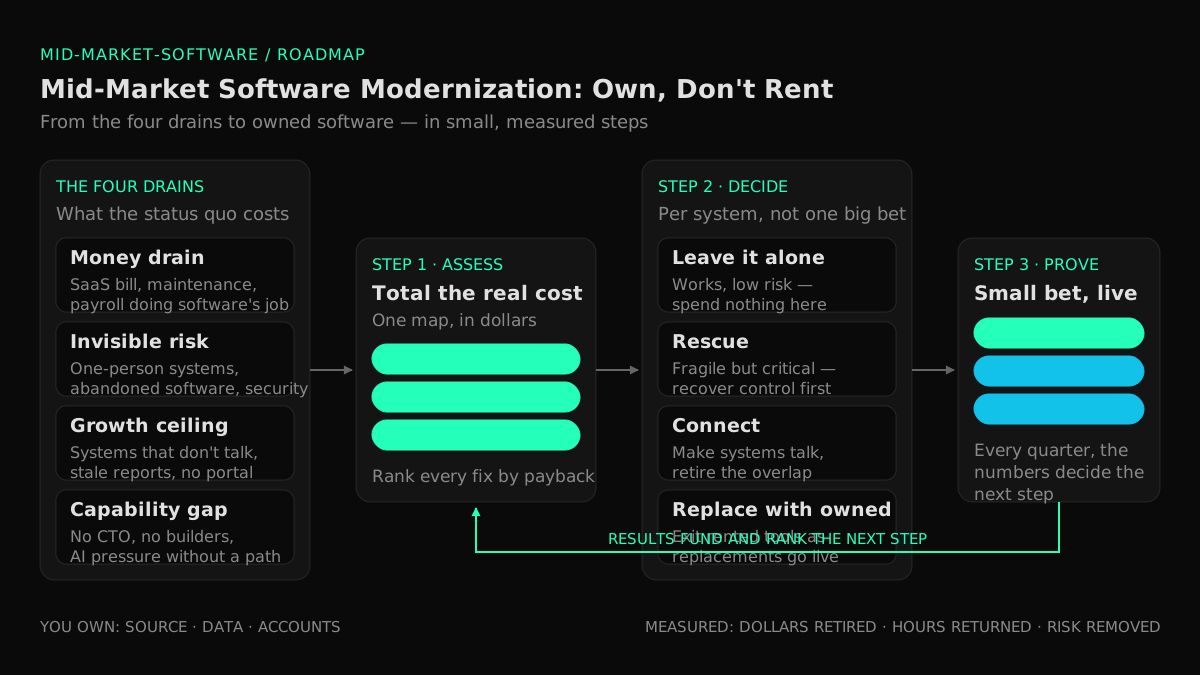
The cost of an aging, disconnected software estate never shows up as one line on the P&L. It's spread across four categories, and putting rough dollar figures on each is the single most useful exercise an owner can do before any modernization decision.
The money drain
This is the visible-if-you-look category: cash going out every month with nothing owned at the end.
- The SaaS bill. Dozens of per-seat subscriptions, overlapping features, and a price increase at every renewal. Zylo's data puts average license utilization at roughly half — meaning something like half of most SaaS line items buys nothing. Our owner's playbook to reduce SaaS spend walks through cutting it in six steps; when the stack is too tangled for a self-run audit — a roll-up on three ERPs, duplicates nobody has bandwidth to collapse — our guide to software consolidation consulting covers buying that help without a CTO.
- The maintenance ransom. A support contract that rises every year for a system that hasn't improved since 2019, paid because the alternative — losing support for the system that runs the business — is unthinkable. Our owner's guide to software maintenance costs that are too high benchmarks what's normal and maps the four ways out.
- Payroll doing software's job. The back-office hires whose actual function is moving data between systems that don't talk. Count the people, multiply by loaded cost; the number is usually the largest of the three.
The risk you can't see
This category costs nothing per month and everything on the day it goes wrong.
- The one-person system. A critical application only one veteran employee — or one outside contractor — understands. The business is one resignation or one health event away from not knowing how it runs. Our owner's guide to key person dependency risk in IT shows how to measure this in one afternoon — and remove it in weeks.
- Abandoned software. The shop that built your custom system dissolved, or the vendor sunset the product. You may not even hold the source code. You can't patch it, can't change it, and can't leave it. Our owner's guide to a software vendor going out of business covers the first-72-hours checklist and the way back to control.
- Security and compliance exposure. Unpatched systems plus unmanaged tools bought department-by-department. It surfaces as a cyber-insurance questionnaire you struggle to answer, a premium that jumps at renewal, or a large customer's security review you can't pass. Our owner's guide to cyber insurance requirements for legacy software explains what underwriters now demand and how to answer without losing coverage. In the same 2025 survey cited above, 43% of organizations named security vulnerabilities as a top concern with their legacy software.
The growth ceiling
Software that worked at $30M quietly caps the business at $80M.
- Orders touch four systems and three people between "customer clicked buy" and "invoice sent."
- Basic questions — margin by customer, inventory by location — take days to answer and arrive stale, because the data lives in thirty silos. Our owner's guide to a single source of truth for business data shows how to get one trustworthy view without replacing anything.
- Your biggest customer asks for a portal or electronic ordering, and the honest answer is a shared inbox. Our owner's guide to B2B customer portals shows how to answer that request in weeks, not quarters.
- The new location, the acquisition, the second warehouse: each takes months to onboard because the systems weren't built for more than one of anything. When the system hitting the ceiling is the accounting core itself, our owner's guide to outgrowing QuickBooks sorts which signs demand a stronger ledger and which don't. And if private equity is in your past or future, this whole category gets priced on a schedule: our owner's guide to IT due diligence for PE-backed companies shows what a buyer's diligence team will find — and how to fix it before the snapshot.
The capability gap
The final drain is the one that blocks fixing the other three: there's no CTO and no builders. IT is a helpdesk plus a managed-service provider — good people, but nobody who can build software or independently evaluate a vendor's claims. So every software decision is a leap of faith, and after one bad leap (the ERP project that ran double the budget in 2021), the organization stops leaping. Meanwhile the pressure to "do something with AI" arrives from the board, the trade press, and competitors — with no trusted way to tell what's real. Deloitte's research on mid-market technology consistently places modernizing legacy systems among the top technology priorities for growing mid-market companies, right alongside cybersecurity — the two are usually the same problem. The gap is closable without a hire: our owner's guide to mid-market IT strategy without a CTO shows how a non-technical leadership team runs technology decisions on written artifacts, decision rights, and a quarterly rhythm.
A one-hour exercise: before reading further, have your CFO pull three numbers — total annual SaaS and software-maintenance spend, the loaded cost of every role whose job is substantially re-keying or reconciling data between systems, and last year's cyber-insurance premium change. Most owners who do this find a seven-figure annual number. That figure is your modernization budget's benchmark: the fix doesn't need to be cheap, it needs to beat that number.
Why "Good Enough" Stopped Being Good Enough
For years, living with the patchwork was a defensible choice. Three things changed.
Your customers digitized faster than you did. Enterprise buyers now expect portals, self-service, order tracking, and electronic data interchange from mid-market suppliers as table stakes. Companies running on phone, email, and PDF don't lose those deals loudly — they just stop being shortlisted.
The risk got priced. Cyber insurance transformed from a formality into an audit. Underwriters now ask specifically about unsupported software, patching, and access controls; weak answers show up directly in premiums or in coverage denials. Large customers run the same playbook with vendor security reviews. The invisible risk of the old system now has a visible, rising price.
AI raised the bar — and the anxiety. Every mid-market board is asking about AI. Here's the unglamorous truth most vendors skip: AI runs on your operating data, and if that data is scattered across thirty disconnected tools and a spreadsheet on someone's desktop, no AI product will produce more than a demo. Getting your systems connected and your data in one place isn't the boring alternative to an AI strategy — it's the prerequisite for one. What to do on either side of that prerequisite — which AI uses pay now, what they cost, and how to start without betting the company — is covered in our owner's guide to AI for mid-size business operations.
Why Modernization Felt Impossible — and What Changed
The three reasons owners wait
Owners are not wrong to be cautious. The classic objections are grounded in real experience:
- "Custom software is a seven-figure project." Historically true. Enterprise-grade custom development priced at enterprise scale, which meant the rational mid-market answer to almost everything was renting SaaS — even when the fit was poor.
- "We tried a big software project once. Never again." Also grounded: McKinsey's research on large IT projects found they run 45% over budget on average while delivering 56% less value than projected. The scar tissue is earned. But note what that research actually indicts: large, long, big-bang projects. The failure mode is the size of the bet, not the act of building.
- "We have nobody to run it." Without technical leadership in-house, evaluating vendors, judging progress, and operating the result all feel like unmanageable risks.
The rest of this guide takes all three seriously. The short answers: the economics changed (below), the bet size is controllable (the roadmap section), and there are structural protections that don't require a CTO (the buyer's checklist).
AI flipped the build-vs-rent equation
The reason custom software was expensive was never the ideas — it was the hours. Skilled engineers, lots of them, for a long time. That input cost is what AI-assisted delivery actually changes. The delivery model: a compact team of senior engineers directs AI coding agents — software that writes and tests code under human review — which do the repetitive construction work in parallel while the senior people own the design, review everything, and stay accountable for what ships.
This is not a hypothetical. It's how Snowman Labs delivers for enterprise clients — we're an official partner of Cognition, Replit, and Hud, the platforms behind this model — and the operating standards we publish are concrete: a first production milestone in 2 weeks and a 40–60% target reduction in time to market, across a track record of 400+ delivered projects rated 4.9/5 on Clutch across 32 verified reviews. The same senior team that enterprises like Volvo, Renault, Scania, iFood, and B3 trust can now price work for mid-market budgets, because the cost structure underneath genuinely changed.
What this means for an owner is simple but significant: the break-even point between renting and owning moved. Systems where the honest 2019 advice was "just keep paying the subscription" now clear the bar for building — especially when you count the full status-quo cost from the four drains, not just the license line. Owning also ends two problems renting can never fix: the per-seat meter that runs faster as you grow, and the vendor's roadmap being the ceiling on how well the tool ever fits your business. Our custom software services for mid-market companies exist specifically to apply this model on the owner's side of the market.
Modernize, Replace, or Leave It Alone: A Decision Guide
Not every old system deserves a project. Triage each significant system against three honest questions: How badly does it hurt? (dollars, hours, risk from the four drains) — How hard is it to change? (does anyone understand it; do you hold the source code) — How central is it to where the business is going? The combinations map to four actions:
| Signal pattern | Right move |
|---|---|
| Works fine, low risk, supported, off the growth path | Leave it alone. Modernization is triage, not tidiness — spend nothing here. |
| Business depends on it, but it's fragile: one-person knowledge, no documentation, unsupported, or vendor gone | Rescue first. Recover control — source code, documentation, safe ability to change — before deciding its long-term future. That's a legacy software rescue, and it's deliberately small: control first, ambition later. |
| Individually fine, collectively wasteful: overlapping tools, manual re-keying between them, no single source of truth | Connect and consolidate. Business systems integration to make existing systems share data automatically, plus retiring the overlap — often the highest-payback move available, because nothing gets rebuilt. |
| Rented tool with poor fit, per-seat pricing that scales against you, or a commodity system whose vendor treats you as a captive | Replace with software you own — the SaaS consolidation play, sequenced so nothing is cancelled until its replacement is live and proven. |
Cloud-migration playbooks formalize versions of this triage as the "7 Rs" framework (retain, retire, rehost, and so on). You don't need the vocabulary; you need the discipline it encodes — a per-system decision, made on evidence, instead of one giant program that touches everything. For the core ERP specifically — the one system where this call feels like a bet on the whole company — our owner's guide to legacy ERP: modernize or replace runs the same triage per layer, with the honest replacement numbers and the shrink-the-ERP path the vendor checklists skip.
Build vs. Buy in the AI Era
"Should we build custom or buy off-the-shelf?" is the wrong first question. The right one: is this function generic to every business, or is it how your business wins?
- Buy (and keep buying) the commodities. Accounting, payroll, email, document storage: mature products solve these completely, your process isn't special, and no build will beat them. Modernization here means consolidating to fewer, better-used subscriptions — not replacing them.
- Own what encodes your edge. Pricing logic, scheduling, dispatch, quoting, production planning, the customer portal — anywhere the software has to match how your operation actually works, poor fit compounds daily. These are the systems where forcing your business into a generic tool's shape costs you exactly the thing that makes you better than competitors, and where owning now beats renting on both fit and total cost.
- The in-between: rent while you build. Where a platform covers most of the need but the last mile generates persistent workarounds, it can make sense to keep renting short-term while the owned replacement is built and proven — then exit the subscription at renewal. The savings fund the next step.
Two build-vs-buy warnings from the field. First, compare full costs on both sides: the subscription's true cost includes the manual workarounds and integration gaps, and the build's true cost includes running and evolving it after launch. Second, whoever builds for you must hand over the source code and the ability to operate without them — otherwise you haven't escaped software vendor lock-in, you've changed vendors; our owner's guide to lock-in shows how to measure that hold on every system you run and loosen it without switching. The full decision framework — sorting commodity from edge, the five-year cost table, the middle paths, and how to de-risk the choice without a CTO — is in our owner's guide to build vs buy software.
The First 90 Days: A Modernization Roadmap
The pattern that fails is the two-year transformation with a cutover weekend. The pattern that works is small, fast, verifiable steps, each justified by the measured result of the last. A first 90 days looks like this:
- Weeks 1–3: Assessment. Inventory every system, subscription, and load-bearing spreadsheet. Map the four drains to dollar figures: SaaS and maintenance spend, manual-work payroll, risk exposure (insurance, single-person dependencies, unsupported systems), and the growth blockers. Rank every candidate fix by payback. The deliverable is a map and a 90-day plan an owner can read — and it has value even if you never hire the firm that built it. This is exactly what our software assessment produces.
- Weeks 3–5: First production milestone. Pick the smallest fix worth doing from the top of the payback ranking — one integration that kills a re-keying job, one rescued system brought under control, one owned replacement for one badly-fitting tool. Put it in production in about two weeks. The point is proof under your roof: real software, used by your team, before any large commitment.
- Weeks 5–13: Expand on evidence. Take the next items on the list, one at a time. Every step reports three numbers against the baseline from the assessment: dollars retired (subscriptions exited, contracts renegotiated), hours returned (manual work eliminated, valued at loaded cost), and risk removed (systems documented, single-person dependencies broken, security findings closed). Sequence SaaS exits to renewal dates so you never pay double for long.
- Quarterly: Re-decide. Modernization isn't a project with an end date; it's a rhythm. Each quarter, the measured results decide whether to accelerate, hold, or stop. If the numbers don't hold, you stop — having spent weeks, not years. That is the structural answer to the failed-project scar: you never place a bet whose loss you couldn't shrug off.
What "Modernized" Actually Looks Like
Modernization has no finish line, but it does have a recognizable target state. Twelve to twenty-four months into a well-run program, a mid-market company's software estate looks like this:
- Fewer systems, each earning its keep. The subscription list is down from dozens to the commodity tools that genuinely win their category — each with utilization you actually check at renewal, instead of auto-renewing on inertia.
- An owned core. The systems that encode how you compete — pricing, scheduling, operations, the customer-facing front door — are software you own: source code, data, and accounts in your hands, changeable at your pace, with no per-seat meter running against your growth.
- Data that flows without people pushing it. Orders, inventory, and invoices move between systems automatically. The re-keying jobs are gone — the people redeployed to work that needs judgment — and "what's our margin by customer?" is a today answer, not a next-week argument.
- No one-person systems. Every critical application is documented well enough that a new firm could take it over in a week. The veteran employee is still valuable; the business just no longer depends on the contents of one head.
- Risk you can answer for. The cyber-insurance questionnaire gets filled in an afternoon from an inventory you maintain, unsupported software is gone or contained, and the enterprise customer's security review is a formality instead of a fire drill.
- A foundation AI can actually use. With operating data connected and trustworthy, AI initiatives — forecasting, scheduling optimization, customer-facing automation — run on reality instead of on exports. This is the point where "do something with AI" stops being board-meeting anxiety and becomes a ranked list of candidate projects with payback estimates.
None of this arrives in one leap. Each bullet is the accumulated result of small steps, each measured, each funded by the last — which is exactly why the buying process matters more than the technology.
Buying Modernization Without a CTO: What to Demand
You don't need a CTO to buy this well. You need to demand the structural protections that make a partner's incentives match yours — every one of these is checkable by a non-technical owner:
- Assessment before contract. Any partner who wants a signature before mapping your costs is selling capacity, not outcomes. The assessment output should be legible to you and useful even if you walk away with it.
- You own everything. Source code, accounts, documentation, data — in your hands from day one, contractually. The test: "if we parted ways tomorrow, could another firm pick this up next week?" If the answer isn't an unqualified yes, don't sign.
- A production milestone in weeks, not a phase-one document in months. Working software your team uses is the only progress signal that can't be faked in a slide deck.
- Results reported in dollars against a baseline — dollars retired, hours returned, risk removed — not activity reports about sprints and story points.
- Senior humans accountable by name. AI agents doing the heavy construction is exactly what makes the economics work — but named senior engineers must review the work and answer for what ships. Ask directly who that is.
- Right-sized steps and the right to stop. Quarterly exits, no multi-year lock-in. A partner confident in measurable results will accept being re-hired on evidence every quarter; one who needs a long contract is telling you something.
FAQ
What is software modernization for a mid-market company?
It's the process of converting an accumulated patchwork — an aging core system, dozens of SaaS subscriptions, spreadsheets, and manual workarounds — into a smaller set of connected systems the business owns and controls. In practice it combines five moves per system: rescue and update, connect and consolidate, replace rented tools with owned software, retire the barely-used, and unify the operating data. It is decided per system on payback, not as one giant program.
How much does it cost to modernize software for a mid-market business?
Meaningful modernization steps typically price in the tens to low hundreds of thousands of dollars each — but the only honest answer starts from your baseline, which most owners have never totaled: annual SaaS and maintenance spend plus the payroll cost of manual workarounds routinely reaches seven figures at mid-market scale. A well-run program is financed against that number, step by step, with each step's payback measured before the next is funded. Get the baseline first; it turns the cost question into an arithmetic question. For the per-project ranges themselves — and the running costs quotes tend to hide — see our owner's guide to how much custom software development costs.
Should we modernize our old system or replace it?
Decide per system, on three questions: how badly it hurts (dollars, hours, risk), how hard it is to change (does anyone understand it; do you hold the source), and how central it is to growth. Systems that work and carry low risk get left alone. Fragile-but-critical systems get rescued — control recovered — before any bigger decision. Poorly-fitting rented tools get replaced with owned software. Full replacement of a working core system is the last resort, not the default.
How long does mid-market software modernization take?
The first production result should land in about two weeks, and a useful first phase fits in 90 days: assessment, first milestone, then expansion step by step. A full program is a rhythm rather than a project with an end date — but if a proposal's first working software arrives in month six, the bet is too big. The multi-year big-bang cutover is the pattern with the documented failure record.
Do we need an in-house IT team to own custom software?
No. Owned software should be built to be operated — and the builder should be willing to run and evolve it under the same measured, quarterly terms as the build. The non-negotiable is that ownership stays with you: source code, accounts, documentation, and data in your hands, so you can change operators without changing systems. That's the difference between owning with help and renting from a new landlord.
Is custom software worth it for a company our size?
For commodity functions — accounting, payroll, email — no; mature products win, and modernization there means consolidating subscriptions. For the systems that encode how your business competes — pricing, scheduling, operations, the customer experience — the calculus flipped when AI-assisted delivery cut the build cost: owning now frequently beats the compounding cost of per-seat rent plus poor fit plus manual workarounds. Run the comparison on full costs, both sides, per system.
Where does AI fit into mid-market modernization?
Twice. First, AI is how modernization got affordable: senior engineers directing AI coding agents deliver custom software at mid-market budgets. Second, modernization is why your future AI initiatives will work: AI products run on operating data, and connected systems with one source of truth are the prerequisite — an AI strategy on top of thirty disconnected tools produces demos, not results.
Own, Don't Rent: The Decision
For twenty years the mid-market rented its operations because owning was priced out of reach — a rational response to enterprise-only economics that left behind SaaS sprawl, fragile legacy cores, and payroll doing software's job. The economics flipped; the strategy should follow. Not as a leap — as a sequence: total what the status quo actually costs, triage each system, prove the model with one two-week result in production, and expand only on measured evidence, with ownership of every line in your hands.
The first step costs an hour of your CFO's time and one assessment. Find out what your software really costs you →
Find your highest-value path to agentic delivery.
Map your readiness, delivery constraints, and first 90-day opportunity with the Snowman Labs AI Readiness Diagnostic.