How Much Does Custom Software Development Cost in 2026?
What custom software development costs in 2026: honest ranges by project size, why quotes vary 10x, the costs quotes hide, and how AI moved the price.
 By Danilo Brizola
How much does custom software development cost? In 2026, a focused internal tool or first working version typically runs $25,000–$75,000; most meaningful mid-market systems — a customer portal, a scheduling or quoting system, an integration layer that finally connects your ERP to everything else — land between $50,000 and $250,000; and large multi-department platforms run $250,000 to $1 million or more. Clutch's pricing data, drawn from verified client reviews, puts the average project at roughly $132,000. Those are the honest ranges. But if you own or run a mid-market company, the sticker number is the less important half of the answer. The half that decides whether the money is well spent is what your current setup already costs you — the subscriptions, the maintenance contracts, and the payroll quietly doing software's job. This guide gives you both halves: real ranges, the reasons quotes for the same system vary tenfold, the costs that never appear on a quote, and how to buy well without a CTO on staff.
The Short Answer: Custom Software Cost Ranges in 2026
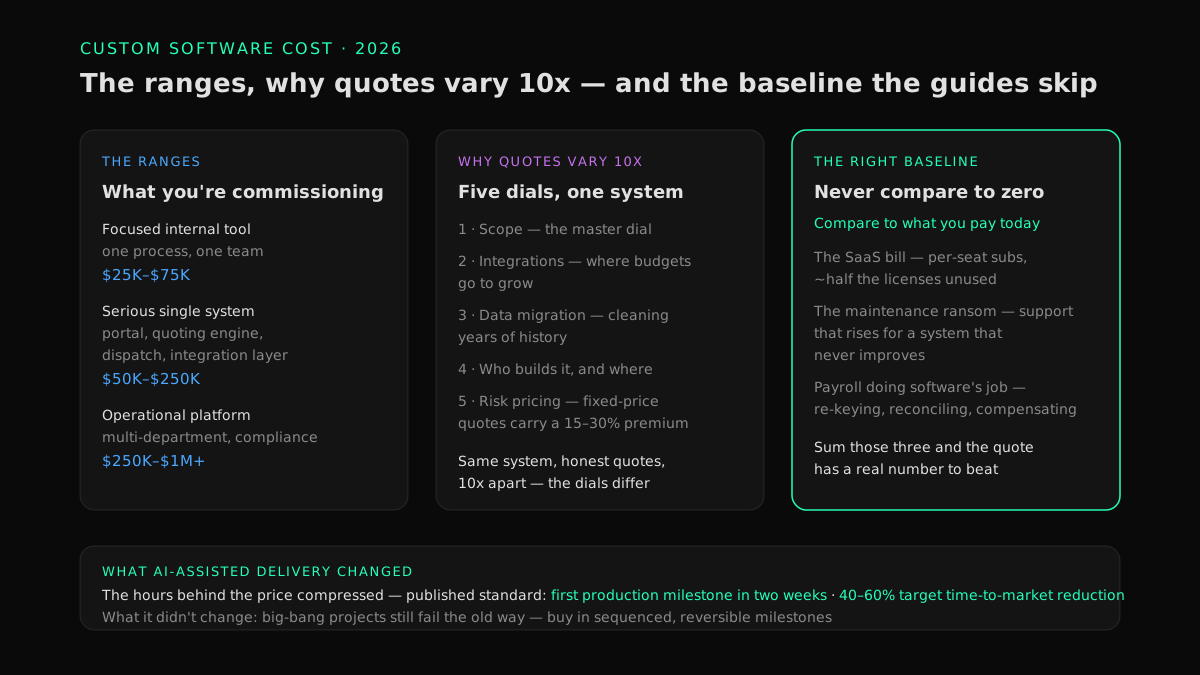
Custom software is priced by scope, not by category — but the ranges below hold across most published 2026 pricing guides (for example SolTech's and Cozcore's) and match what we see in the market. Translated into systems an owner would actually commission:
| What you're commissioning | Typical 2026 range |
|---|---|
| A focused internal tool or first working version — one process, one team, replacing a spreadsheet or a manual workflow | $25,000–$75,000 |
| A serious single system — customer portal with ordering and tracking, quoting/estimating engine, scheduling and dispatch, an integration layer across your existing systems | $50,000–$250,000 |
| An operational platform — multi-department, multi-location, heavy integrations, compliance requirements | $250,000–$1,000,000+ |
Three notes on reading the table. First, these are build costs — running costs come later in this guide, and any quote that pretends they don't exist is hiding something. Second, the wide spread inside each row is real, not vagueness; the next section explains exactly what moves a project from the bottom of a range to the top. Third, the biggest pricing mistake owners make isn't overpaying — it's comparing the quote to zero instead of comparing it to what the current setup already costs. We'll fix that below.
Why Quotes for the Same System Vary 10x
Ask three firms to price "a customer portal" and you can get $40,000, $150,000, and $400,000 back. That spread isn't (mostly) dishonesty — it's five factors, each of which you can control:
- How much the software has to do. Scope is the master dial. "Customers can see and reorder" is a different project from "customers can see, reorder, track shipments, dispute invoices, and pull custom reports." Every additional workflow multiplies screens, rules, and testing. The single best cost lever you have is ruthlessly shrinking version one — which is also the best risk lever, as we'll see.
- What it has to connect to. Integrations are where budgets go to grow. A portal that reads from one modern system is cheap to connect; one that must talk to a 2009 ERP, a warehouse system with no documented way in, and three SaaS tools is not. If your systems already don't talk to each other, price the plumbing honestly — it's often the most valuable part of the build.
- How much data moves in. Migrating years of customers, orders, and pricing history out of an old system — cleaning it, mapping it, verifying it — is invisible in a demo and very visible in a quote.
- Who builds it, and where. The median U.S. software developer earns about $130,000 a year before benefits and overhead; U.S. agency rates commonly run $100–$250 per hour, while offshore teams advertise $20–$80. The catch is that the hourly rate prices the hour, not the outcome: a cheaper team that needs three times the hours, heavy rework, and your management attention is not cheaper. Judge total price for a defined outcome, never rate cards.
- How the risk is priced in. A fixed-price quote includes a risk premium — commonly 15–30% — because the builder eats overruns. Hourly billing looks leaner but moves that same risk onto you. Same project, different quote, depending on who's holding the risk. More on choosing below.
There's also a sixth factor nobody puts in writing: how well the buyer has defined the problem. Vague requirements get either padded quotes (the builder prices the uncertainty) or lowball quotes (the builder prices the demo and monetizes the change orders). The cheapest thing you will ever buy is clarity about your own process before anyone writes code — it's why a paid assessment beats a free estimate.
The Costs the Quote Doesn't Show
The build price is not the whole price. Budget for four more lines — a builder who volunteers them is showing you respect; one who conceals them is showing you the future:
- Maintenance and evolution. Software is never "done." Industry guides consistently budget 15–20% of the build cost per year for updates, fixes, security patches, and small improvements. On a $150,000 system, plan on $20,000–$30,000 a year — and note that this is predictable and yours to control, unlike a vendor's renewal letter.
- Hosting and infrastructure. Typically $100–$1,000 per month for mid-market systems — usually a small fraction of the per-seat subscriptions the system replaces.
- Security and compliance, if your world requires it. Penetration tests run $5,000–$25,000; formal audits (SOC 2, HIPAA) run well into five figures. Most mid-market internal systems don't need the formal audits — but if your customers or insurers are asking, price it in.
- Your own people's time. Someone on your side must own decisions, review progress, and test honestly. Not a full-time job in a well-run engagement, but not zero either.
A useful planning rule from the agency literature: hold a 30–40% first-year buffer beyond the build quote to cover the above plus the small changes you'll want the moment real users touch the system. If the total still beats your status quo — and it usually does, once the status quo is honestly totaled — proceed.
The Number Every Pricing Guide Skips: What You're Paying Now
Every ranking cost guide compares custom software to zero. That's the wrong baseline. The right baseline is the full cost of what you're doing today, and for most mid-market companies it has three parts:
- The SaaS bill — dozens of per-seat subscriptions with a price increase at every renewal, roughly half of the licenses going unused by Zylo's utilization data. Our owner's playbook to reduce SaaS spend shows how to total and cut it.
- The maintenance ransom — the support contract that rises every year for an aging system that never improves. Our guide to software maintenance costs that are too high benchmarks what that should cost and maps the exits.
- Payroll doing software's job — the people re-keying orders between systems, reconciling in Excel, compensating for tools that don't fit. Count the hours honestly, multiply by loaded cost; this is usually the largest line of the three. Our playbook to eliminate double data entry shows exactly how to count it.
Owners who total these three lines routinely find a six- to seven-figure annual number. Against that baseline, the pricing question inverts: a $120,000 build that retires $60,000 a year in subscriptions and $80,000 a year in workaround payroll isn't an expense to minimize — it's an investment with a measurable payback period, financed by money already leaving the building. That comparison — full cost of renting versus full cost of owning, per system, over five years — is the heart of the build-versus-buy decision, and our owner's guide to build vs buy software walks the whole framework.
How AI-Assisted Delivery Changed the Price — and What It Didn't
The ranges above would have read very differently in 2019, and it's worth being precise about why. Custom software was expensive because of hours: many skilled engineers, for many months, at engineering salaries. AI-assisted delivery attacks exactly that input. A compact team of senior engineers now directs AI coding agents — software that writes and tests code under human review — so the repetitive construction work runs in parallel while senior people own the architecture, review everything, and answer for what ships.
This is the model Snowman Labs operates as an official partner of Cognition, Replit, and Hud, and the operating standards are published and specific: a first production milestone in 2 weeks, a 40–60% target reduction in time to market, across 400+ delivered projects rated 4.9/5 on Clutch from 32 verified reviews. The practical effect on price: systems that were honestly not worth building at 2019 labor economics now clear the bar — which is precisely why the modernization math changed for mid-market companies as a whole.
Two things AI did not change. Big-bang projects still fail the old way — McKinsey's research on large IT projects found 45% average budget overruns and 56% less value than projected, and Panorama Consulting's ERP research still puts average ERP implementation spend around $450,000 with most budgets exceeded. AI made small bets cheap; it did not make large bets safe. And maintenance still costs money — a lower build price doesn't repeal the 15–20% rule. Any vendor claiming AI makes software nearly free is pricing a demo, not a system your business will run on.
Fixed Price, Time and Materials, or Milestones
Custom development is sold under three pricing models, and the model changes your risk more than your total:
| Model | How it works | The trade |
|---|---|---|
| Fixed price | One price for a defined scope | Budget certainty; you pay a 15–30% risk premium, and every change becomes a negotiated change order |
| Time and materials | You pay for hours as they're worked | Flexibility; the overrun risk is entirely yours, and the meter has no natural stopping point |
| Milestone-based | Small fixed commitments, each ending in working software and an exit point | Certainty per step without pricing the whole unknown; you re-decide with evidence every few weeks |
For an owner without a technical staff, the milestone structure is the one to insist on — not because it's fashionable, but because it converts the classic failure mode (a big bet, judged only at the end) into a series of small bets, each judged on working software. The first milestone should be in production in about two weeks; each subsequent commitment should be small enough that walking away is a bruise, not a wound. This is the same de-risking sequence our build vs buy guide prescribes, applied to the contract itself.
How to Read a Quote Without a CTO
Five checks a non-technical buyer can run on any proposal, in an afternoon:
- Assessment before price. A serious number follows a real look at your systems, data, and integrations. A price produced in a first meeting is a marketing number — and the change orders will reflect it. (An honest software assessment also gives you the status-quo baseline to compare against.)
- First working software in weeks, dated in the contract. If the first thing you can touch arrives in month six, the bet is too big. Demand a two-week first milestone in production.
- Ownership named explicitly. Source code, accounts, documentation, and data — yours, from day one, in writing. A builder who keeps the source hasn't sold you an asset; they've sold you a subscription with extra steps.
- Running costs on the quote. Hosting, maintenance, and evolution, with numbers. Their absence is not a discount — it's a surprise, scheduled.
- An exit every quarter. No multi-year lock-in; results reported in dollars against your baseline. A partner confident in their economics will take quarterly judgment; one who needs a three-year commitment is telling you something.
This is how our custom software practice for mid-market companies is structured, because the typical mid-market buyer has a P&L and no engineering department — and shouldn't need one to buy software safely.
FAQ
How much does custom software development cost on average?
Across published 2026 guides and Clutch's verified-review data, the average project lands near $132,000, with most mid-market systems falling between $50,000 and $250,000. Focused internal tools start around $25,000–$75,000; large enterprise platforms exceed $250,000. Scope, integrations, data migration, and who builds it move any project across those ranges.
Why is custom software so expensive?
Because you're paying skilled people to solve your specific problem rather than renting a mass-produced answer — historically many engineers for many months at six-figure salaries. That labor equation is exactly what AI-assisted delivery compressed: senior engineers directing AI coding agents now do in weeks what took teams a quarter. Custom software is still an investment, but the 2019 price tags no longer apply.
Is custom software worth the cost?
For commodity functions — accounting, payroll, email — almost never; mature products win. For systems that encode how your business competes, frequently yes: compare the full five-year cost of owning against the full cost of renting — subscriptions at projected seats, renewal escalations, plus the payroll spent on workarounds. When the status quo is honestly totaled, owning often wins on arithmetic, not philosophy.
How much does it cost to maintain custom software?
Budget 15–20% of the build cost per year for updates, security patches, and small improvements, plus hosting (typically $100–$1,000 a month at mid-market scale). On a $150,000 system that's roughly $20,000–$30,000 annually — usually less than the subscriptions it replaced, and unlike a vendor's renewal letter, it's predictable and yours to control.
Is it cheaper to hire an offshore development team?
Per hour, yes — offshore rates run $20–$80 against $100–$250 for U.S. agencies. Per outcome, often not: more hours, more rework, and more of your own management time close the gap fast, and without a technical person on staff you have no way to inspect what you're getting. Buy a priced outcome with a dated first milestone and contractual ownership, and let the builder worry about the rate card.
What's the difference between fixed price and time and materials?
Fixed price means the builder commits to a scope for one number and carries the overrun risk — priced in as a 15–30% premium. Time and materials bills you for hours as they happen, moving the entire risk to you. For owners without technical staff, the better structure is milestone-based: small fixed commitments, each ending in working software and a decision point.
Can AI really reduce custom software development costs?
Yes — specifically the labor hours of construction, which were most of the price. Senior engineers directing AI coding agents compress build timelines dramatically; our published standard is a first production milestone in two weeks with a 40–60% target reduction in time to market. What AI doesn't do is eliminate maintenance, make large big-bang projects safe, or replace senior judgment about what to build.
The Price Is Half the Question
The 2026 ranges are knowable: tens of thousands for a focused tool, low-to-mid six figures for the systems most mid-market companies actually need, and running costs of 15–20% a year that any honest builder will show you unprompted. What the ranges can't tell you is whether the spend is worth it — that answer lives in a number most owners have never totaled: what the current patchwork of subscriptions, maintenance contracts, and manual workarounds already costs per year. Get that baseline, insist on two-week proof and day-one ownership, and the cost of custom software stops being a leap of faith and becomes what it should have been all along: a line-by-line comparison you can win.
The baseline takes one assessment. Find out what your software really costs you →
Find your highest-value path to agentic delivery.
Map your readiness, delivery constraints, and first 90-day opportunity with the Snowman Labs AI Readiness Diagnostic.