IT Due Diligence for PE-Backed Companies: An Owner's Guide
What IT due diligence for PE-backed companies examines, how findings become price cuts and escrows, and how to fix your systems before the next deal.
 By Danilo Brizola
IT due diligence is the examination a buyer's technology team runs on your systems before a deal closes — and for a PE-backed company it happens at least twice: once when the firm invests in you, and again when the firm exits and the next buyer's team walks the same ground. Every finding has a price. Messy, undocumented, one-person systems don't kill mid-market deals as often as they quietly discount them — through a lower offer, money held back in escrow, or a remediation bill dropped into your first-hundred-days plan. This guide is written for the owner, CEO, or CFO on the receiving end of that examination, not for the PE firm running it. By the end you should know exactly what the diligence team will ask for, how each finding turns into dollars, and how to use the time before the next deal — months, if you have them — to fix what they'd find.
What IT Due Diligence Is — and When It Happens to You
IT due diligence (often called technology due diligence) is a structured review of your software, infrastructure, security, data, vendor contracts, and the people who keep all of it running, performed by specialists working for a buyer or investor. Its job is to answer one question for the person writing the check: what will this company's technology cost us, and what could it cost us?
If private equity is anywhere in your company's story, you will face it at three moments:
- At entry — when a PE firm first invests in or acquires your company. Their diligence prices the deal you're negotiating right now.
- At every add-on — if you're the platform in a roll-up, your systems get re-examined each time an acquisition has to be integrated; if you're the add-on, you're the target again.
- At exit — when the hold period ends and the next buyer (another PE firm, a strategic acquirer) runs the whole process against whatever state your systems are in that day.
The exam itself is less mysterious than it sounds. Expect a document request list (an inventory of systems, contracts, policies, and spend), a secure online folder — the "data room" — where you upload evidence, interviews with whoever runs your IT, and often technical scans of your security posture. On a mid-market deal the IT workstream typically runs from a few days to a few weeks, compressed inside a larger process that leaves no time to fix anything it finds. That last point is the whole strategy of this guide: diligence is a snapshot, so the work has to happen before the camera comes out.
What the Diligence Team Examines, in Owner Language
Diligence checklists vary by firm, but they converge on the same territory. Here is the standard scope, translated from consultant vocabulary into what's actually being priced:
| What they examine | What they ask you for | What they're really pricing |
|---|---|---|
| Run cost | Software, hosting, and IT payroll spend, three years back | Whether technology spend is about to spike post-close |
| Technical debt | Age and condition of core systems; what's hard to change | The rebuild bill hiding behind "it works fine" |
| Security | Policies, patching evidence, incident history, scan results | Breach risk — and whether the paper matches reality |
| Compliance | Data privacy practices, industry certifications, audit results | Fines, remediation cost, and deals your gaps could block |
| Key people | Who holds admin access; who understands each system | Whether the business survives one resignation |
| Contracts & ownership | Vendor agreements, licenses, source code ownership | Lock-in, change-of-control traps, and code you don't hold |
| Scalability | Can systems support the growth plan and future add-ons | Whether the investment thesis is physically possible |
| Continuity | Backup and disaster recovery plans — and test evidence | What a bad day costs |
| Data credibility | Where reported numbers come from; how systems reconcile | Whether they can trust the financials they're buying |
Two rows on that table surprise owners most. First, contracts: many software agreements contain a change-of-control clause — language that lets the vendor renegotiate, re-price, or terminate when your ownership changes. A diligence team reads every contract for those, and each one found is leverage you handed to a vendor at the worst possible moment. Our owner's guide to software vendor lock-in shows how to find and loosen those holds long before a lawyer does it for a buyer. Second, data credibility: if your revenue number comes from one system, your margin number from another, and the two reconcile only through a spreadsheet someone maintains by hand, the diligence team doesn't just note an IT weakness — they start questioning the financials. Our guide to building a single source of truth for business data is, among other things, exit preparation.
How Findings Turn Into Dollars
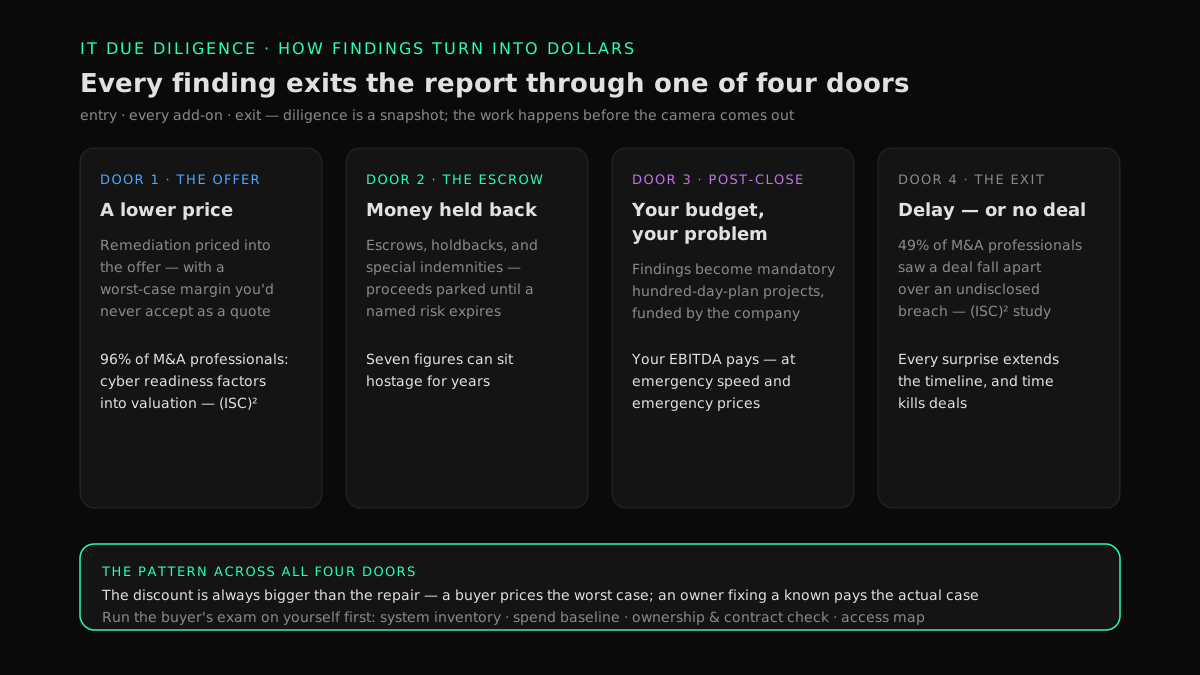
A diligence finding is never just a comment in a report. It exits the report through one of four doors, and every one of them costs you:
- A lower price. The cleanest mechanism: the buyer prices the remediation into the offer, usually with a safety margin you'd never accept as a line-item quote. The evidence that this actually happens is consistent — in one study of M&A professionals by (ISC)², 96% said cybersecurity readiness factors into deal valuation, and 86% said a publicly reported breach in a target's past detracts from the acquisition price.
- Money held back. Escrows, holdbacks, and special indemnities — portions of the purchase price parked in an account until a named risk expires, or carved out so that if the risk materializes, you pay. An unresolved security question or an unverifiable license can keep seven figures of your proceeds hostage for years.
- Your budget, your problem. On a PE entry, findings often don't change the price — they become mandatory projects in the hundred-day plan, funded by the company. That's your EBITDA paying, at emergency speed and emergency prices, for work you could have done calmly for less.
- Delay — or no deal. In the same (ISC)² study, 49% of M&A professionals had seen a deal fall apart after diligence surfaced an undisclosed breach. Short of collapse, every surprise extends the timeline, and time kills deals — while the average cost of a data breach itself runs $4.88 million, the cheaper and far more common cost is what the possibility of one does to your leverage mid-negotiation.
Notice the pattern across all four doors: the discount is always bigger than the repair. A buyer pricing an unknown charges for the worst case. An owner fixing a known pays for the actual case. The entire financial argument for exit readiness fits in that sentence.
What Diligence Actually Finds at a Mid-Market Company
Diligence teams aren't hunting exotic failures. At a typical founder-built, $20M–$500M company they find the same accumulated patchwork our mid-market software modernization guide maps in detail — the four drains, now read by an outsider with a checklist:
- The one-person system. A critical application only one veteran employee or one outside contractor understands. Diligence teams hunt single points of failure specifically, because the buyer inherits the risk the day Bob retires. Our guide to key person dependency risk in IT shows how to find and break these dependencies in weeks — the same audit a diligence team runs, minus the price tag.
- Software you don't actually own. The custom system built by a shop that no longer exists, source code nowhere in your possession. To a buyer, a load-bearing system nobody can change or patch is a liability with a logo. If the vendor is already gone, our guide to a software vendor going out of business covers recovering control — do it before a data room asks for the source code you don't have.
- Load-bearing spreadsheets. The workbook that actually runs scheduling, pricing, or inventory. Diligence calls this "key man risk plus data integrity risk plus no audit trail" — three findings for the price of one file. Our guide to running your business on spreadsheets shows how to find the dangerous ones and retire them from the job.
- Security that lives on paper. Policies written for the cyber-insurance application that daily practice doesn't match. Diligence teams test the gap between the two — the same gap underwriters probe, which is why our guide to cyber insurance requirements for legacy software doubles as diligence prep: an estate that passes the questionnaire honestly is most of the way to passing a buyer's security review.
- The aging core and the three-ERP roll-up. The system that worked at $30M wheezing at $80M, or acquisitions never truly integrated. McKinsey's research on technical debt finds it amounts to 20–40% of the value of the entire technology estate at many companies — diligence is where a version of that number gets attached to yours. If the core itself is the question mark, our owner's guide to legacy ERP: modernize or replace runs that decision properly.
None of these findings is unusual, and diligence teams know it. What separates a bruising process from a smooth one isn't a perfect estate — it's whether you knew first. A documented weakness with a costed remediation plan reads as management competence. The same weakness discovered by the buyer's team reads as "what else don't they know?" — and gets priced accordingly.
Run the Diligence on Yourself First
The single highest-leverage move available to an owner is to run the buyer's exam before the buyer does — a self-audit, sometimes formalized as sell-side diligence. Advisory firms that prepare companies for exit consistently recommend building the sell-side technology story early, before a formal process starts, precisely because it lets you fix or frame findings instead of defending them live.
You don't need a CTO to produce the first version. Four artifacts, each assembled in days not months, cover most of the document request list:
- A system inventory. Every application, subscription, server, and load-bearing spreadsheet; what each does; who administers it. This is the first document every diligence process requests — and the one most mid-market companies can't produce. (It's also artifact one of our guide to mid-market IT strategy without a CTO, which exists to make documents like this routine rather than heroic.)
- A dollar baseline. Software, maintenance, hosting, and IT payroll spend, totaled honestly — including the payroll spent manually re-keying data between systems that don't talk.
- An ownership and contract check. For every critical system: do you hold the source code, the admin accounts, and the data? Which contracts carry change-of-control or auto-renewal traps? Where would a buyer's lawyer find leverage?
- An access and dependency map. Who holds the keys to each system — and for which systems is the honest answer "only one person"?
Then read the four artifacts the way a buyer's team would, and sort every red flag into fix before the deal or disclose with a costed plan. Both beat discovery.
The Fix Window: Using the Hold Period
For a PE-backed company the clock is explicit: the hold period is typically three to seven years, and exit diligence is already scheduled in someone's model. Working backward from that date, with the self-audit's findings ranked by what each would cost you in the data room, the sequence that pays best:
- Recover control first. Source code in hand, admin access held by the company, documentation good enough that a new firm could take over any critical system in a week. For systems where control is already lost — vendor gone, one-person knowledge — that's a legacy software rescue, and it's deliberately a small, fast engagement: control first, ambition later.
- Close the gaps that are already priced. Unsupported software and missing security basics cost you twice — at insurance renewal every year, then again at diligence. Fixing them collects both returns.
- Connect the systems behind your numbers. Make revenue, margin, and inventory reconcile automatically between systems instead of through a spreadsheet. This is the finding that most directly protects your multiple, because it defends the credibility of the financials themselves.
- Modernize what caps the thesis. The aging core, the unintegrated acquisition — the projects that make the growth story believable. These are exactly the builds that AI-assisted delivery has repriced for mid-market budgets: a small senior team directing AI coding agents, a first production milestone in two weeks, every step measured in dollars against the baseline from your self-audit.
- Write the story. A one-page technology narrative — what you own, what you fixed, what it costs to run, what's planned — with artifacts behind every sentence. Buyers discount uncertainty; a documented estate with a paper trail removes the uncertainty they'd otherwise charge you for.
Each step is weeks-sized, produces evidence an owner can verify, and pays for itself in operations even if the exit never comes — which is the correct test for any pre-exit investment: fix things a buyer would price, in ways that pay you while you wait.
FAQ
What is IT due diligence in private equity?
It's the technology portion of a PE firm's investigation before investing in or acquiring a company: a structured review of systems, security, data, vendor contracts, spend, and key-person dependencies, run by specialists on the buyer's side. Its output is a report that prices technology risk into the deal — through the offer itself, escrowed funds, or a post-close remediation plan.
How long does IT due diligence take?
The IT workstream on a mid-market deal typically runs from a few days to a few weeks, inside a broader diligence process of one to three months. The practical consequence: there is no time to fix anything once the process starts. Whatever state your systems are in when the document request list arrives is the state that gets priced.
What is included in an IT due diligence checklist?
The standard scope covers nine areas: technology run costs, technical debt in core systems, cybersecurity posture (tested, not just on paper), regulatory and data-privacy compliance, key-person and admin-access dependencies, vendor contracts and source-code ownership, scalability against the growth plan, backup and disaster recovery, and the credibility of the data behind reported financials.
How do I prepare my company for technology due diligence?
Run the exam on yourself first. Build four artifacts: a complete system inventory, an honest technology spend baseline, an ownership-and-contract check (source code, admin accounts, change-of-control clauses), and a map of who holds the knowledge and keys to each system. Then sort every red flag into "fix before the deal" or "disclose with a costed plan." Twelve to eighteen months of lead time is ideal; even one quarter beats walking in blind.
Does technical debt really affect company valuation?
Yes — through the offer price, escrows, or remediation projects charged to your post-close budget. McKinsey estimates technical debt amounts to 20–40% of the value of the entire technology estate at many companies, and in the (ISC)² study of M&A professionals, 96% said cybersecurity readiness factors into valuation. The discount a buyer applies to an unknown is reliably larger than the cost of the repair.
What happens if due diligence finds problems?
Four outcomes, roughly in order of frequency: the price drops; part of the purchase price is held in escrow or carved out as an indemnity until the risk expires; the finding becomes a mandatory project in the hundred-day plan, funded by the company; or — for serious undisclosed issues, especially breaches — the deal delays or dies. A finding you disclosed with a remediation plan lands far more gently than the same finding the buyer's team discovered.
Do mid-market companies really face this, or just big enterprises?
Mid-market companies face it more, not less. PE deal volume is concentrated in the mid-market, technology diligence has become standard on deals of all sizes, and founder-built estates — one-person systems, load-bearing spreadsheets, vendors long gone — are exactly where diligence teams expect to find material issues. The difference is that a mid-market company rarely has in-house staff who have been through the process before.
The Owner's Move
IT due diligence is the one audit every PE-backed company is guaranteed to face, on a date someone else's model has already penciled in. You can meet it as a snapshot of whatever accumulated — and let a stranger's checklist set the discount — or you can run the exam yourself, fix what's fixable in weeks-sized steps that pay for themselves in operations, and walk into the data room with artifacts instead of explanations. The first version of that self-audit is an assessment away. Find out what a diligence team would find — before one does →
Find your highest-value path to agentic delivery.
Map your readiness, delivery constraints, and first 90-day opportunity with the Snowman Labs AI Readiness Diagnostic.