Single Source of Truth for Business Data: An Owner's Guide
What a single source of truth for business data means in practice: what flying blind costs an owner, four routes to one trusted view, and how to buy it.
 By Danilo BrizolaUpdated
 A single source of truth for business data means every number that runs your company — sales, margin, inventory, cash, headcount — has exactly one declared home system, and one place where everyone looks it up. Most mid-market companies have the opposite: the same customer, order, and product living in four systems that quietly disagree, reports that take days to assemble and arrive describing last month, and a leadership meeting where the first twenty minutes are spent arguing about whose spreadsheet is right. This guide is for the owner, CEO, president, or COO running a $20M–$500M company on numbers they only half trust. By the end you'll know what flying blind actually costs, why your systems' numbers disagree in the first place, the four practical routes to one trustworthy view — with what each costs and fixes — and how to buy the fix without a CTO on staff.
What a Single Source of Truth Actually Means
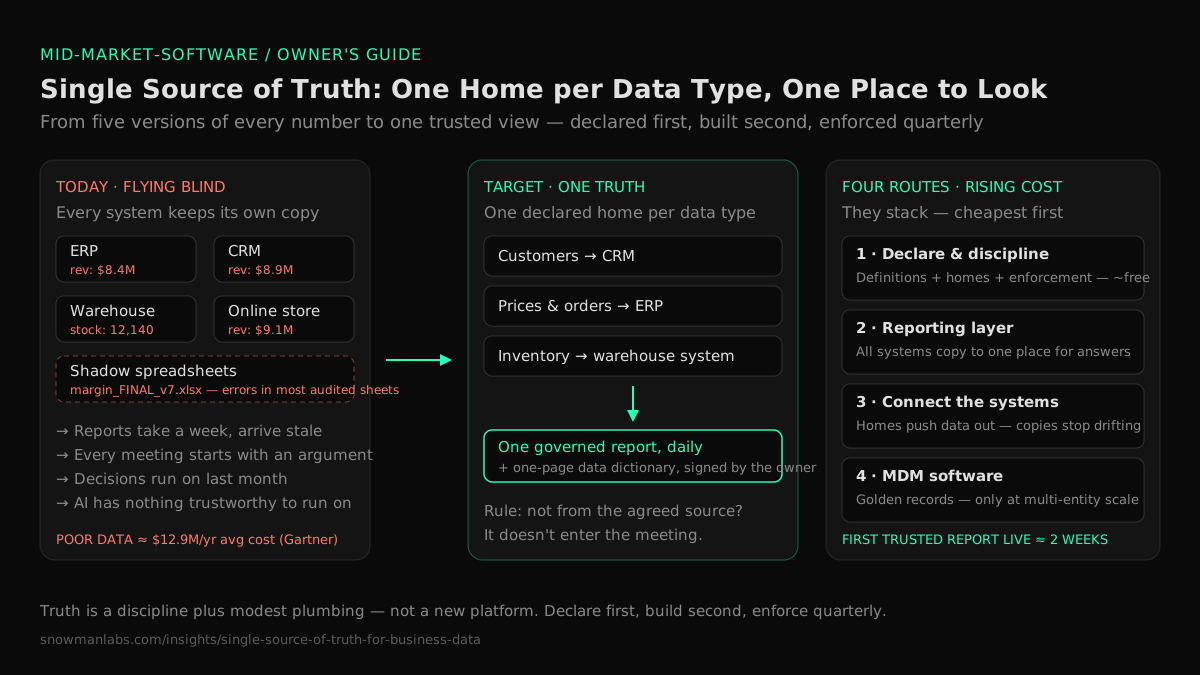
A single source of truth (SSOT) is not a product you buy. It is a working condition you establish: each kind of business data is entered and maintained in one system — its home — and everything else, including every report, reads from that home instead of keeping its own copy. Customers live in the CRM. Prices live in the ERP. Inventory lives in the warehouse system. When someone asks "what's our margin by customer?", there is one place the answer comes from, and everyone knows which place that is.
Notice what this definition does not require: it does not require replacing your systems, and it does not require pouring everything into one giant platform. Software vendors selling suites, analytics tools, and data platforms all use "single source of truth" in their pitch — for them, the phrase means their product becomes the center of your business. Keep the idea and drop the pitch. The truth doesn't need to live in one system; it needs one declared home per data type and one agreed place to look. Companies running well on five specialized systems with clear homes and one reporting view are common. Companies that bought a platform to "unify everything" and now argue about whether to trust the platform or the old exports are also common.
The distinction matters because the disagreeing-numbers problem — what our mid-market software modernization guide calls flying blind — is rarely a technology failure. It's an ownership failure: nobody ever declared which system's version wins.
The Cost of Flying Blind
Running a company on scattered, conflicting data bills you four ways, and none of them appear as a line item.
1. Decisions made late, on stale numbers. When "margin by customer" takes a week of exports and reconciliation, you make pricing, purchasing, and hiring calls on last month's reality. At mid-market scale, a mispriced contract or an inventory buy based on stale counts costs real money — Gartner pegs the average cost of poor-quality data at $12.9 million per organization per year, and notes most companies don't measure it at all. You don't need the enterprise-scale number to feel the mid-market version: every decision delayed by "let me get the real numbers first" has a price.
2. Paid hours spent manufacturing reports. Somewhere in your company, capable people spend the first week of every month exporting from five systems into Excel, fixing mismatched customer names, and reconciling totals that should have matched in the first place. That's skilled payroll producing a document, not running the business — and it happens every single month. It is the reporting-side twin of the re-keying cost in our playbook to eliminate double data entry: people doing, by hand and forever, what software does automatically.
3. The spreadsheet layer, and the errors baked into it. Where systems disagree, spreadsheets appear to arbitrate — and the spreadsheet becomes the de facto source of truth for decisions worth millions. The research here should worry any owner: audits of operational spreadsheets consistently find errors in the overwhelming majority of them — Raymond Panko's field studies, the standard reference on the subject, found errors in 86–94% of spreadsheets audited, because humans make small mistakes in a few percent of all complex steps and spreadsheets faithfully preserve every one. Your board pack is probably built on one. And where a workbook has gone beyond arbitrating numbers to actually running a process — the quoting model, the scheduling board — our owner's guide to running your business on spreadsheets covers finding that load-bearing layer and replacing it deliberately.
4. An AI strategy with nothing to run on. Every mid-market board is asking about AI. Here is the unglamorous prerequisite the vendors skip: AI products run on your operating data. Forecasting, scheduling optimization, customer-facing automation — all of it reads from the same scattered, conflicting silos you do, and it trusts them even less than you should. A company without one source of truth can buy AI demos; it cannot put AI to work. Getting the data condition right is not the boring alternative to an AI strategy — it is the entry ticket. What to run once you hold it — the AI uses that pay in mid-market operations, and what they honestly cost — is covered in our owner's guide to AI for mid-size business operations.
A 30-minute exercise before you buy anything: at your next leadership meeting, ask three questions out loud. What was our revenue last month? What's our current inventory value? What's our margin on our biggest customer? If more than one number comes back for any of them — or the honest answer is "I'll have to pull that together" — write down which systems each answer came from. That list of disagreeing sources is your project, ranked.
Why Your Numbers Disagree
Nobody designed the disagreement. It accumulated, the same way the systems did — and understanding the four mechanisms tells you which fixes will actually work.
- Each system keeps its own copy. The CRM has the customer's address; so does the ERP; so does the shipping system. Each was updated at a different moment by a different person. Multiply by every customer, product, price, and order, and disagreement is the mathematically guaranteed result. MuleSoft's Connectivity Benchmark finds only about 27% of organizations' applications are connected — everything unconnected drifts.
- No home was ever declared. When two systems disagree, which wins? At most mid-market companies, that question has never been asked, let alone answered. So the answer becomes situational: sales trusts the CRM, finance trusts the ERP, and the monthly meeting relitigates it.
- The definitions differ, not just the data. Finance's "revenue" recognizes on invoice; the sales dashboard counts on order; the e-commerce report counts on payment. All three numbers are correct by their own definition — and the argument they generate wastes an hour of your best people's time per meeting. Until "margin," "active customer," and "on-time delivery" each have one written definition, no software can make the reports agree.
- The gaps got filled by shadow copies. Wherever the official systems couldn't answer a question, a spreadsheet or a departmental tool appeared — unmanaged, invisible, and increasingly load-bearing. Our owner's guide to shadow IT maps that layer in full; for truth purposes the point is simple: every shadow copy is another version of the numbers, aging on someone's desktop.
What One Source of Truth Looks Like in Practice
The target state fits on an index card: enter once, in the home system; look once, in the agreed place. Concretely, for a typical mid-market operation:
| Data type | One declared home | Everything else... |
|---|---|---|
| Customers and contacts | CRM | ...reads customer data from the CRM |
| Products and prices | ERP | ...reads catalog and pricing from the ERP |
| Inventory | Warehouse system | ...reads counts from the warehouse system |
| Orders and invoices | ERP / accounting | ...references, never re-creates them |
| The numbers that run the business | One reporting view | ...cites it — or the meeting doesn't use the number |
Three things make the table real rather than aspirational. First, a written data dictionary — one page defining the twenty numbers that run your business (what counts as revenue, margin, an active customer, on-time). Not an IT document; a management document, signed by you. Second, a declared home for each data type, with the authority question settled: when systems disagree, the home wins, and the other system gets corrected. Third, one reporting place — whether that's a proper dashboard or a single governed report — that leadership actually uses, so the shadow versions die of neglect.
What the target is not: one mega-system. That's the suite vendor's version of truth, and as the fix for disagreeing data it carries the same big-bang risk our modernization guide documents for every rip-and-replace project. Truth is a discipline plus, usually, some modest plumbing — not a new landlord.
Four Routes to a Single Source of Truth — a Buyer's Map
There are four honest routes, in rising order of cost. Most mid-market companies need the first two; some need the third; few need the fourth.
| Route | What it is | Best when | Watch out for |
|---|---|---|---|
| Declare and discipline | No new software: write the data dictionary, declare one home per data type, kill duplicate entry points, retire the shadow copies | Disagreement is mostly definitional; systems are few; leadership will enforce it | Free is not easy — without enforcement from the top, the shadow spreadsheets return in a quarter |
| A reporting layer | All systems copy their data, automatically and on schedule, into one place built for answering questions — a data warehouse in trade terms — with dashboards on top | Operations work fine but reporting is slow, stale, or contradictory; you want daily answers without touching the operating systems | Data arrives as messy as it left; the cleanup and the definitions still have to happen — budget for that, not just the dashboard |
| Connect the systems | The home system pushes its data to the others automatically, so copies stop drifting — the integration play, covered in our guide to systems that don't talk to each other | The pain is operational (re-keying, errors, delays), not just reporting; the same fix then feeds the reporting layer clean data | Connection without a declared home produces two-way-sync fights — systems overwriting each other. Declare first, connect second |
| Master data management (MDM) | Dedicated software that maintains the golden record of customers/products across many systems | Many systems, many locations or entities, heavy compliance — typically the upper end of mid-market and beyond | A real platform plus a real ongoing discipline; oversized for a five-system company — do the first three routes first |
Two buying notes from the field. First, the routes stack: declare-and-discipline costs almost nothing and multiplies the value of everything after it, so it always goes first. Second, on the reporting layer — the most common purchase — the tools are genuinely cheap now; what you're really buying is the unglamorous work of standardizing and reconciling the data feeding it. A quote that's mostly dashboard licenses and demo polish, with nothing for data cleanup, is a quote for prettier disagreement. And if the subscription review this triggers reveals three tools holding three versions of the same data, that overlap is its own line of savings — our playbook for reducing SaaS spend covers retiring it.
Getting There: The First 90 Days
Like every modernization move we recommend, this one works as small, verifiable steps — not a "data transformation program."
- Week 1 — the truth audit. Run the three-questions exercise. List the numbers leadership actually uses (usually 15–25), where each comes from today, and where the versions disagree. Write the one-page data dictionary. This is a management exercise, not an IT project — and it's most of the value.
- Weeks 2–3 — declare homes and pick the first battle. One home per data type, decided and announced. Then pick the single most expensive disagreement — usually margin, inventory value, or the sales number — and fix it end to end: one definition, one home, one report.
- Weeks 3–5 — first trusted report in production. Stand up the smallest version of the reporting layer that answers the top questions daily, automatically, from the declared homes. Our published operating standard is a first production milestone in about two weeks, and a first governed report is an ideal candidate: nothing operational changes, and the proof is a number everyone stops arguing about.
- Weeks 5–13 — expand on evidence, and connect where it pays. Add the next numbers to the governed report. Where drifting copies cause operational pain — not just reporting pain — fix the plumbing with one owned connection at a time, sequenced by payback. Each step reports hours returned and arguments retired against the week-1 baseline.
- Quarterly — enforce or lose it. One rule keeps the truth single: if a number isn't from the agreed source, it doesn't enter the meeting. The first time an exception slides, the shadow spreadsheets start growing back.
For the buying itself, the checklist from our modernization guide applies unchanged — assessment before contract, you own everything (the reporting layer, its code, and its accounts included), a production result in weeks, dollars against a baseline, named senior accountability. The one addition specific to data work: demand the data dictionary as a deliverable. It's the artifact that keeps the truth yours when tools and vendors change. This is the standard our own systems integration practice is built to meet, from the same team enterprises like Volvo, Renault, Scania, iFood, and B3 trust — 400+ delivered projects, rated 4.9/5 across 32 verified Clutch reviews.
FAQ
What is a single source of truth for business data?
It's the condition where every kind of business data — customers, prices, inventory, orders — has one declared home system where it's entered and maintained, and one agreed place where the numbers are read, so every department works from the same figures. It is a discipline supported by modest plumbing, not a specific product, and it does not require replacing your existing systems.
What is an example of a single source of truth?
The customer record is the classic one: the CRM is declared the home for customer data, every other system reads customer details from it, and any correction happens there first. Same pattern per data type — the ERP for prices, the warehouse system for stock counts — plus one governed report or dashboard declared as the place leadership reads the resulting numbers.
Is a spreadsheet a single source of truth?
As a temporary declared home for one small dataset, it can be. As the arbitration layer where your real numbers get assembled every month, it's the opposite: spreadsheet audits consistently find errors in the overwhelming majority of operational spreadsheets, copies proliferate instantly, and nobody can tell this month's version from last month's. If a spreadsheet is load-bearing for decisions, that's the first thing to move into a governed home.
What's the difference between a single source of truth and a data warehouse?
A data warehouse is one tool that can help implement the idea: a place where all systems' data is copied for reporting. The single source of truth is the broader condition — declared homes, shared definitions, one reading place. You can buy a warehouse and still have three versions of "revenue" if the definitions and homes were never settled; plenty of companies have.
Should our ERP be the single source of truth for everything?
It should be the home for what it genuinely owns — typically orders, invoices, prices, and financials — not for everything. Forcing all data into the ERP recreates the mega-system trap. The workable pattern for a multi-system company is one home per data type, with either connections or a reporting layer bringing the pieces into one view.
How do you create a single source of truth?
In order: audit which numbers leadership uses and where they disagree; write a one-page dictionary defining them; declare one home system per data type; fix the most expensive disagreement end to end; then stand up one governed report fed automatically from the homes, and expand it number by number. Add system-to-system connections where drifting copies cause operational pain, and MDM software only at genuine multi-entity scale.
How much does a single source of truth cost?
The first and highest-value step — definitions, declared homes, leadership enforcement — costs meeting time, not money. A governed reporting layer for a mid-market company is typically a project in the tens of thousands to build plus modest monthly running costs, with AI-assisted delivery having pushed the build side down substantially. The honest comparison is against the status quo: the loaded payroll cost of manual report assembly, plus the price of decisions made late on numbers nobody trusts.
One Place to Look
Flying blind is not a data problem you inherited; it's a decision nobody made yet. The fix starts free — twenty definitions on one page, one declared home per data type, one rule about which numbers enter the meeting — and grows only as far as the evidence justifies: a governed report in weeks, connections where the payback is measured, heavier tooling only at a scale most companies never need. The result is the least glamorous competitive advantage available: a company where "what's our margin by customer?" is a today answer, every AI initiative has something real to run on, and the monthly argument about whose spreadsheet is right simply stops happening. The first step costs thirty minutes at your next leadership meeting. The second turns what you find into a dollar figure and a ranked plan. Find out what your software really costs you →
Find your highest-value path to agentic delivery.
Map your readiness, delivery constraints, and first 90-day opportunity with the Snowman Labs AI Readiness Diagnostic.