Mid-Market IT Strategy Without a CTO: An Owner's Guide
Mid-market IT strategy without a CTO: the four artifacts, decision rights, and annual rhythm owners need — and when fractional help is worth buying.
 By Danilo Brizola
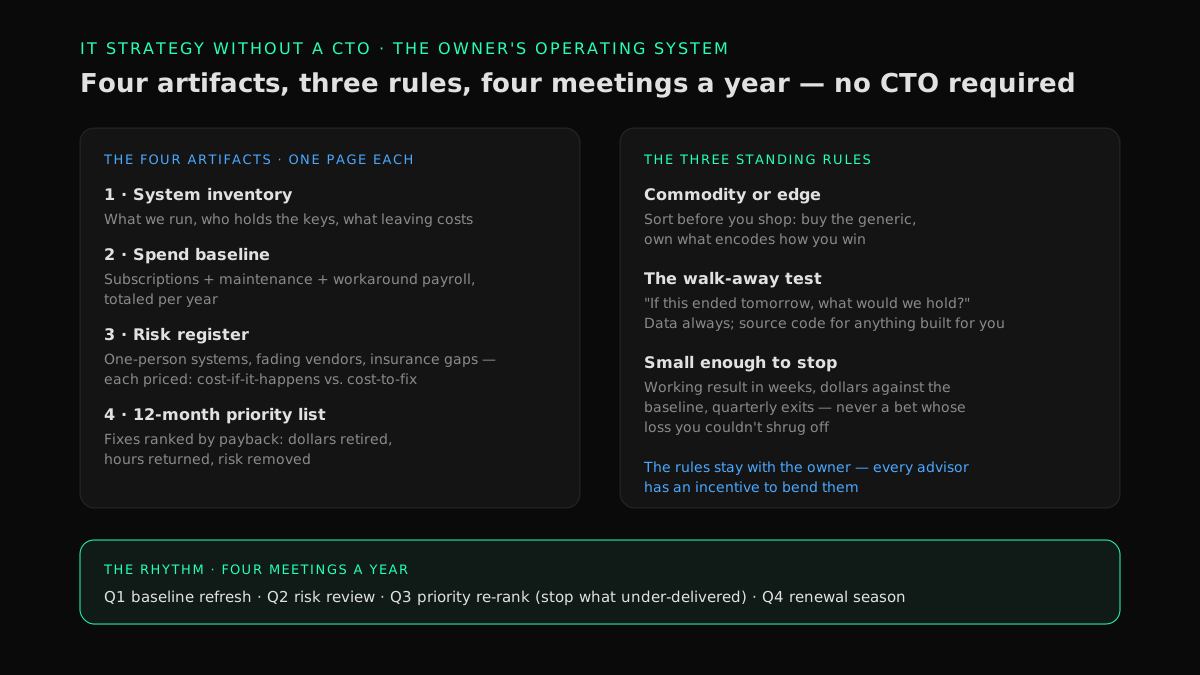
A mid-market IT strategy without a CTO is not a contradiction — it's the normal case, and it can be run well. What a CTO actually provides a $20M–$500M company is not typing skill; it's four written artifacts (a system inventory, a dollar baseline, a one-page roadmap, and a vendor rulebook), a clear answer to "who decides what," and a calendar that forces those decisions to happen on evidence instead of on renewal-notice panic. All four artifacts can be built and maintained by a non-technical leadership team, and this guide shows how. It's written for the owner, CEO, CFO, or COO who currently is the IT strategy — every software decision lands on your desk, IT is a helpdesk plus an outside provider, and nobody in the building can independently evaluate a vendor's claims. By the end you'll know exactly what to write down, who should decide each kind of technology question, what rhythm keeps it alive, and — honestly — when paying for outside technology leadership is worth it and when it's a subscription you don't need.
The Advice Problem: Everyone Selling You a Strategy Sells the Fix
Search this topic and you'll find three kinds of answers, and all three end the same way. Managed service providers (the firms that run your helpdesk and servers) conclude that you need their "virtual CIO" service. Fractional-executive firms conclude that you need a part-time CTO on retainer. Strategy consultants conclude that you need a strategy engagement. Some of that advice is good — we'll come back to when each genuinely helps — but notice the structure: the diagnosis always matches the seller's product. That's not a conspiracy; it's how service marketing works. It does mean the one option nobody with a ranking web page will recommend is the one this guide starts with: build the strategy yourself, on paper, with the leadership team you already have — then buy help against a written plan instead of buying a plan from the help.
There's a second reason to start on paper. Deloitte's research on mid-market technology consistently finds mid-market companies naming legacy modernization and cybersecurity among their top technology priorities — decisions with six- and seven-figure consequences. Decisions that size deserve an owner who understands the reasoning, not just the recommendation. The artifacts below are how you get that understanding without an engineering degree: every one of them is written in money, risk, and time — the language you already run the business in.
What an IT Strategy Actually Is (When Nobody's Title Says IT)
Strip the vocabulary away and an IT strategy is a written answer to five questions:
- What do we run? Every system, subscription, and load-bearing spreadsheet the business depends on.
- What does it cost us? Not just the license lines — the payroll spent working around software, and the risk priced into insurance and lost deals.
- What happens if a piece fails? Which systems the business stops without, and who — if anyone — can fix each one.
- What are we changing, in what order, and why? A short ranked list with a dollar reason per line, not a wish list.
- What are the rules for buying? What any vendor must agree to before getting a signature.
If those five answers exist on paper, are roughly current, and someone reviews them quarterly — you have an IT strategy. If they live in the heads of an office manager, an outside IT guy, and a vendor's account rep, you don't have a strategy; you have exposure. Everything else — cloud, AI, cybersecurity frameworks — is detail that hangs off these five answers.
The Four Artifacts: An IT Strategy You Can Own
The five questions produce four documents. None requires technical skill to create; all four require honesty and a few afternoons.
1. The system inventory
One page per significant system: what it does, which process stops if it fails, who uses it, who understands it (by name — this is the question that finds your one-person systems), what it costs per year, when the contract renews, and whether you hold the data and — for anything custom-built — the source code. Include the unofficial layer: the tools departments bought on cards and the spreadsheets running real processes. Our guide to shadow IT risks and governance shows how to surface that hidden inventory in owner language, and our one-afternoon audit of key person dependency risk in IT gives you the five checkable facts that tell you which systems depend on one head. For each vendor relationship, note what saying no would cost you — the per-system leverage reading from our owner's guide to software vendor lock-in.
The inventory is the artifact that turns every future decision from an argument into a lookup. It's also the single document a cyber-insurance questionnaire, a customer security review, or a due-diligence process will ask you to produce — and most mid-market companies can't.
2. The dollar baseline
Three numbers your CFO can pull in about an hour: total annual software and maintenance spend (every subscription, every support contract), the loaded payroll cost of roles whose job is substantially re-keying or reconciling data between systems, and last year's change in cyber-insurance premium. At mid-market scale the total is routinely seven figures. That figure is the benchmark every proposal must beat — and it converts vendor conversations from "can we afford this?" into "does this beat the number?" Our owner's playbook for reducing SaaS spend turns the first of those three numbers into an action list on its own.
3. The one-page roadmap
For each significant system, one of four decisions — leave it alone, rescue it (recover control of a fragile-but-critical system), connect it (stop humans re-typing between systems), or replace it with something owned — sequenced by payback and by contract renewal dates so you never pay for a tool and its replacement for long. The full triage logic, with the honest criteria for each decision, is the core of our mid-market software modernization guide. The discipline that matters here: the roadmap fits on one page, every line has a dollar reason attached, and anything without one waits.
4. The vendor rulebook
The rules any technology seller must accept before a signature — each checkable by a non-technical buyer:
- Assessment before contract. Anyone who wants a signature before mapping your costs is selling capacity, not outcomes.
- You own everything. Source code, accounts, data, documentation — contractually, from day one. Test: "if we parted ways tomorrow, could another firm pick this up next week?"
- Working software in weeks. A first production milestone in about two weeks, not a phase-one document in month four.
- Results in dollars against your baseline — dollars retired, hours returned, risk removed — not activity reports.
- The right to stop quarterly. A partner confident in measured results will accept being re-hired on evidence.
These protections are what substitute for the expertise you don't have in-house: you don't need to evaluate a vendor's technology if the structure of the deal makes overpromising unprofitable. The rulebook's application to the biggest single decision — whether to rent or own a given system — is our build vs buy decision guide, and the skill of reading a development quote without a CTO is covered in our guide to what custom software actually costs.
Who Decides What: Decision Rights Without a CIO
Most mid-market IT dysfunction isn't a knowledge problem — it's an ownership problem. Nobody agreed who decides, so decisions default to whoever the vendor called, whoever complained loudest, or nobody. Write this table down once and most of the chaos stops:
| Decision | Who decides | With what input |
|---|---|---|
| New subscription under a set threshold (e.g., $5k/yr) | Department head | CFO visibility — it goes on the inventory, no exceptions |
| Any renewal | CFO | Usage numbers from the department; renewal calendar warning at 90 days |
| New system, integration, or custom build | Owner/CEO | Baseline comparison + vendor rulebook compliance; quarterly meeting decides |
| Security and access rules | Owner/CEO sets policy | Executed by IT/MSP; verified annually against the insurance questionnaire |
| Anything touching the core system of record | Owner/CEO, in the quarterly meeting only | Never decided in a sales call or a crisis |
Two roles matter in this table. Your IT resource — internal or MSP — is an input, not a decider: they know how things run today, and they also usually resell licenses and hours, which is exactly the conflict the decision rights exist to contain. And the quarterly technology meeting — owner, CFO, one operations leader, one hour — is where every non-routine decision lands. Small companies run boards; this is the same discipline pointed at software.
The Annual Rhythm That Keeps It Alive
A strategy that isn't on the calendar decays into a document nobody opens. The rhythm that keeps the four artifacts current costs leadership roughly a day per quarter:
- Quarterly (1 hour): the technology meeting. Review the roadmap — what shipped, what it returned against the baseline, what's next. Approve or kill pending decisions. Update the inventory with anything new.
- At every renewal (built into the calendar): no auto-renewals. Ninety days out, the CFO gets the usage numbers and the leverage reading; renegotiate, consolidate, or exit deliberately.
- Annually (half a day): refresh the dollar baseline, re-answer the insurance questionnaire from the inventory instead of from memory, and re-rank the roadmap for budget season.
That cadence is deliberately boring. Boring is the point: the failure mode of IT-without-leadership isn't usually one catastrophic decision — it's a decade of unexamined renewals, unowned purchases, and deferred fixes, each too small to escalate.
When Buying Leadership Help Makes Sense — and What Each Option Sells
With the artifacts in place, outside help becomes something you can buy well, because you're buying against a written plan. The honest map of the market:
| Option | What it is | What it costs | Right when | Watch for |
|---|---|---|---|---|
| MSP with "vCIO" service | Your managed IT provider adds periodic strategy reviews | Often bundled into the MSP contract | You need operations run well and a technical sanity-check on plans | Strategy advice from a firm that resells licenses and hours tends to recommend licenses and hours |
| Fractional CTO / CIO | An experienced technology executive, part-time on retainer | Roughly $9,000–$22,000 per month in the US, versus ~$290,000–$340,000 all-in for a full-time hire | You're building a software product, integrating an acquisition, facing complex compliance, or preparing for a PE process — sustained judgment calls, not one decision | Retainers outlive their mission; set a defined mandate and an end date |
| IT strategy consultant | A one-time engagement producing an assessment and roadmap | Typically a five-figure project | You want the four artifacts built fast, by someone who's done it before | If the firm also sells implementation, the roadmap tends to find implementation work |
| Delivery partner with assessment-first model | An engineering firm that starts by pricing your status quo, then builds against it | Assessment first; build steps priced individually | Your roadmap already points at rescue, integration, or owned software | Hold them to the vendor rulebook — every line of it |
The rule that keeps all four options honest is the one from the rulebook: whoever advises you should make their money from outcomes you can measure, not from the purchases their advice generates. A fractional CTO advising on a build they won't perform is well-aligned. An MSP's free strategy review that concludes you need more MSP is presales. When the stack itself is the problem — duplicated tools, a roll-up running three ERPs — the specific discipline of hiring consolidation help is covered in our guide to software consolidation consulting.
And full disclosure on this guide, by its own rule: Snowman Labs is a delivery partner — that's our row in the table. Our answer to the conflict is structural, not rhetorical: an assessment whose output is yours to keep and act on with anyone, a first production milestone in two weeks, results reported in dollars against your baseline, and quarterly exits — the same standards, published, that we hold for the enterprises on our client list and for mid-market companies specifically.
The AI Question Every Board Is Asking
"What's our AI strategy?" is landing on mid-market owners with no CTO to translate it, and vendors are happy to fill the silence with magic. The unglamorous truth: AI initiatives run on your operating data, and they inherit every weakness in your current estate. If the answer to "what do we run and what does it cost us" is scattered across thirty disconnected tools and a veteran employee's memory, an AI product on top will produce demos, not results. The four artifacts are not the boring alternative to an AI strategy — they are its prerequisite. Build the inventory, baseline, and roadmap first, and "do something with AI" turns from board-meeting anxiety into a ranked list of candidate projects with payback estimates — which is exactly the state the assessment below leaves you in.
FAQ
Does a mid-market company need a CTO?
Usually not as a full-time hire. A CTO is worth full-time compensation when technology is the product or when sustained in-house engineering needs leading. Most $20M–$500M companies need CTO-level decisions — what to run, what to fix, what to sign — which can be produced by a disciplined leadership team using written artifacts and decision rights, with targeted outside judgment bought when specific decisions demand it.
Who should make technology decisions when there's no CTO or CIO?
Assign decision rights explicitly: department heads for small purchases (with CFO visibility), the CFO for every renewal, and the owner/CEO for new systems, builds, and anything touching the core system of record — decided in a standing quarterly meeting, never in a sales call. Your IT provider informs those decisions; they shouldn't own them, because most providers also sell what they'd be deciding on.
What does a fractional CTO cost?
Published US rates run roughly $9,000–$22,000 per month on retainer, against an all-in cost of roughly $290,000–$340,000 per year for a full-time CTO. The better question is mandate: a fractional executive hired for a defined mission — an acquisition integration, a product build, a compliance program — earns the retainer; one hired as a permanent comfort blanket becomes another subscription.
Can an MSP replace a CIO or CTO?
An MSP can run your infrastructure well and many bundle "virtual CIO" reviews, but an MSP's strategy advice carries a structural conflict: they typically profit from the licenses, hardware, and hours their recommendations generate. Use an MSP for operations and as technical input to your decisions — keep the decisions, and the written strategy, with your leadership team.
What should a mid-market IT strategy include?
Four artifacts: a system inventory (every system, its cost, its renewal date, who depends on it and who understands it), a dollar baseline (software spend + workaround payroll + risk pricing), a one-page roadmap (a per-system decision — leave, rescue, connect, or replace — ranked by payback), and a vendor rulebook (the contractual protections any seller must accept). Plus two structures: written decision rights and a quarterly review meeting.
When is a full-time CTO actually worth it?
When the company builds software as its product, when an in-house engineering team needs day-to-day leadership, or when technology decisions arrive faster than a quarterly rhythm can absorb — common in software-enabled services and post-acquisition roll-ups. Hire against that trigger, not against status anxiety; a full-time executive without a full-time mandate becomes an expensive project sponsor.
Own the Strategy, Rent the Muscle
The mid-market companies that get technology right without a CTO all converge on the same shape: the strategy lives with the leadership team, on paper, in dollars — and outside expertise is bought against that written plan, on terms that make overpromising unprofitable. You don't need to become technical. You need the inventory, the baseline, the roadmap, the rulebook, a decision-rights table, and one hour per quarter to enforce them.
The fastest way to stand up the first three artifacts is a structured assessment that prices your status quo and hands you a ranked plan — yours to keep whoever you work with next. Find out what your software really costs you →
Find your highest-value path to agentic delivery.
Map your readiness, delivery constraints, and first 90-day opportunity with the Snowman Labs AI Readiness Diagnostic.