Enterprise Application Modernization Strategy: A CTO Guide
How to build an enterprise application modernization strategy: portfolio inputs, TIME and the 7 Rs, wave sequencing, funding models, and governance.
 By Danilo Brizola
An enterprise application modernization strategy is a portfolio-level plan that assigns every application a disposition — modernize, replace, tolerate, or retire — then sequences, funds, and governs the work so the portfolio converges on a target architecture instead of accumulating one-off projects. That is a different artifact from a migration plan for a single system, and the difference is where most programs go wrong: they start with the application someone complains about loudest, not with the portfolio.
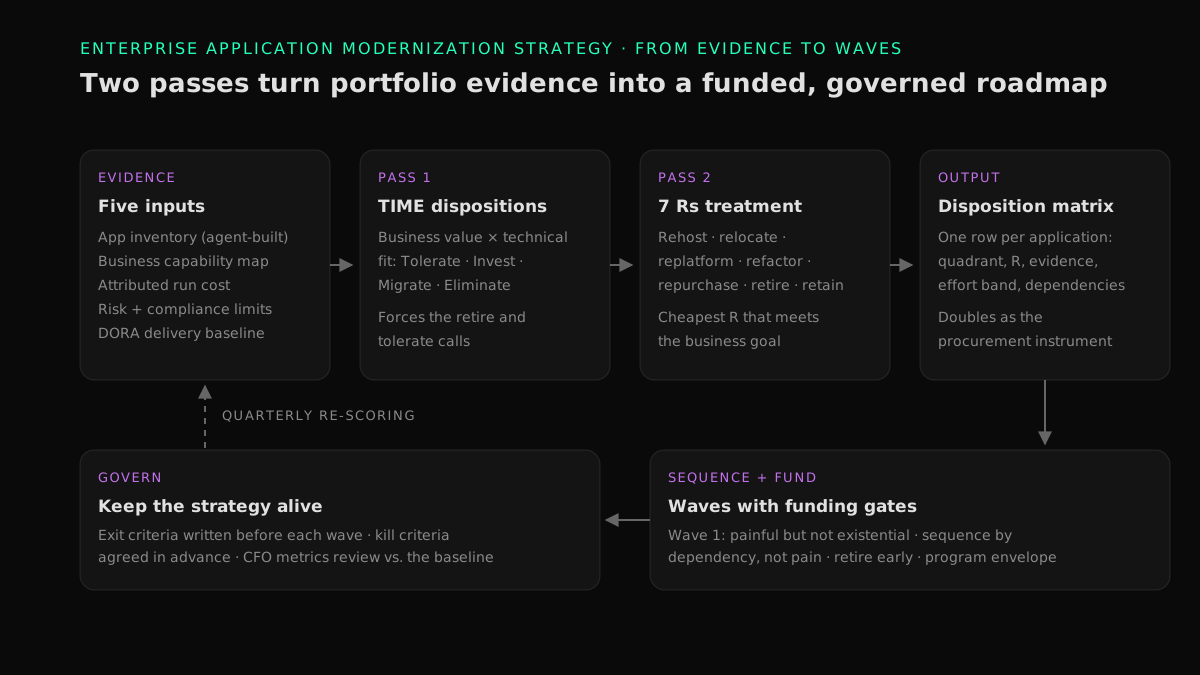
This guide is for CIOs, CTOs, and heads of architecture who need to write that strategy — or fix one that has stalled. It covers the inputs the strategy needs, how to assign a treatment per application, how to sequence and fund the roadmap, the governance that keeps it alive past quarter two, and how AI agents are changing which treatments are economically rational.
What an Enterprise Application Modernization Strategy Is — and Isn't
The strategy is the top artifact in a three-layer stack, and each layer answers a different question:
| Artifact | Question it answers | Horizon | Owner |
|---|---|---|---|
| Modernization strategy | Which applications get which treatment, in what order, and why | 2–3 years | CIO/CTO |
| Modernization roadmap | What ships in which wave, with what budget and exit criteria | 2–4 quarters | Head of architecture / program lead |
| Wave plans | Who does what to which system, behind which safety nets | 4–12 weeks each | Delivery teams |
Two things the strategy is not:
- It is not a cloud migration plan. Moving workloads to cloud infrastructure is one possible treatment for some applications, not the goal. A portfolio can be 100% cloud-hosted and still be legacy in every way that matters — undocumented, untested, expensive to change.
- It is not a commitment to modernize everything. A credible strategy explicitly tolerates some systems and retires others. A plan that recommends modernizing the whole portfolio is a vendor's sales document, not a strategy.
Why Modernization Fails Without a Portfolio Strategy
Large software programs have a documented base rate problem: McKinsey and Oxford's study of 5,400+ IT projects found that half of large IT projects run 45% over budget while delivering 56% less value than predicted. Modernization programs inherit that base rate — and then add legacy-specific risk on top: undocumented business rules, dead code nobody dares delete, and dependencies that only surface at cutover.
Strategy-free modernization has recognizable symptoms:
- Project-by-project selection. Systems get modernized in the order executives complain about them, so the portfolio never converges — integrations between "modernized" and untouched systems multiply instead of shrinking.
- The default rewrite. Without a disposition framework, teams reach for the full rewrite, the highest-risk treatment available. We cover why that instinct fails — and the four incremental patterns that replace it — in our guide to modernizing legacy systems without a big-bang rewrite.
- Funding cliffs. Each project is business-cased alone, so the program dies the first quarter budgets tighten, leaving half-migrated systems that are more expensive to run than either the old or the target state.
- No kill criteria. Nothing defines what evidence would stop or redirect a wave, so failing work runs until the money runs out.
The Five Inputs Every Strategy Needs
Write nothing until these five inputs exist. Together they usually take four to eight weeks to assemble — agent-assisted discovery has collapsed what used to be the longest part.
- An evidence-based application inventory. Every application, its language and framework versions, dependencies, deployment target, change frequency, test coverage, and end-of-life exposure. Coding agents now produce this in days rather than months by crawling repositories and infrastructure configs — the method, scoring dimensions, and deliverables to demand are in our guide to the AI legacy system assessment.
- A business capability map. Which applications support which revenue-generating or compliance-critical capabilities. This is what lets you rank by business consequence instead of architectural aesthetics.
- Attributed cost. Maintenance spend, incident load, and delivery drag attributed to specific systems — the number that wins board approval. The full cost model is in our playbook for reducing legacy application maintenance cost.
- Risk and compliance constraints. Data-residency obligations, regulatory audit windows, vendor contract terms, and cyber-insurance requirements that fix the order of some moves regardless of what the economics say.
- A delivery baseline. Deployment frequency, lead time for changes, change failure rate, and time to restore — the four DORA metrics — captured before any work starts. Without a baseline, the strategy's ROI claims are unfalsifiable, and unfalsifiable claims don't survive CFO review.
Assign Each Application a Disposition: TIME, Then the 7 Rs
With inputs in hand, disposition is a two-pass exercise.
Pass one — TIME. Gartner's TIME model plots each application on business value versus technical fit and yields four dispositions: Tolerate, Invest, Migrate, Eliminate. Its value is forcing the unglamorous calls: retiring the system nobody uses, tolerating the ugly-but-stable one. Expect a healthy portfolio to place meaningful fractions in all four quadrants.
Pass two — the 7 Rs. For applications TIME marks for movement, assign a treatment from the 7 Rs — retire, retain, rehost, relocate, replatform, repurchase, and refactor/re-architect — matched to what the business actually needs from that system:
| Business goal for the application | Treatment that usually fits |
|---|---|
| Stop spending on it | Retire, or repurchase (SaaS) |
| Reduce run cost fast, no roadmap needs | Rehost or replatform |
| Ship features faster on it | Refactor toward modularity |
| Scale past current architecture limits | Re-architect (often incrementally, behind a facade) |
| Nothing — it's stable and compliant | Retain, revisit next cycle |
The per-application evidence drives the choice: a well-bounded module map argues for refactoring in place; a tangle of implicit couplings argues for replatforming first and decomposing later. For the deeper treatment of each R — including realistic cost and timeline ranges per treatment — see our buyer's guide to cloud application modernization services.
The output of this section is the strategy's core artifact: a disposition matrix — one row per application, with its TIME quadrant, chosen R, evidence summary, estimated effort band, and dependencies. It doubles as your procurement instrument if outside partners will execute part of the program.
How AI Agents Change Which Treatment You Choose
Most published strategy frameworks predate coding agents, and mechanically applying their assumptions now produces the wrong dispositions. Three economic shifts matter when you assign the Rs in 2026:
- Refactor and re-architect got cheaper relative to rehost. The historical case for lift-and-shift was that touching the code was slow and risky. Agents compress the mechanical middle of code transformation — translation, test generation, dependency untangling — so treatments that change the code have materially better economics than the old estimates assume. Systems that would have been rehosted "for now" (a now that lasts a decade) can justify refactoring on first pass. The evidence and wave mechanics are in our enterprise playbook for AI-assisted code migration.
- Documentation and test recovery stopped being prohibitive. The classic blocker on refactoring — nobody knows what the system does, and there are no tests to protect a change — is now an agent workload: plain-English logic extraction and characterization-test generation turn "unknowable" systems into tractable ones.
- Assessment is no longer the bottleneck. When inventory takes days instead of quarters, the strategy can be re-scored continuously instead of frozen at approval — which changes governance, as covered below.
The five-phase execution model that puts these shifts to work — assess, document, stabilize, migrate in waves, measure — is the subject of our pillar guide to AI-powered legacy modernization. In our own delivery practice at Snowman Labs, agent-assisted engagements target a first production milestone in two weeks and a 40–60% reduction in time-to-market against conventional delivery — targets we set contractually, not aspirationally, across a portfolio of 400+ delivered projects.
What agents do not change: business criticality judgments, regulatory constraints, vendor politics, and the validation of extracted business rules all remain human work. A strategy that treats AI as removing judgment rather than removing toil will fail in new and expensive ways.
Sequence and Fund the Roadmap
The disposition matrix becomes a roadmap through wave design, and three sequencing rules cover most portfolios:
- First wave: painful but not existential. Pick a system valuable enough that success matters and isolated enough that failure is survivable. Its job is to prove the delivery model, calibrate estimates, and produce the metrics that fund wave two.
- Sequence by dependency, not by pain. Shared services, authentication, and data platforms often must move before the applications that scream loudest can. Publishing the dependency rationale prevents the strategy from being re-litigated every steering meeting.
- Retire early. Decommissioning and repurchase moves free budget and reduce the integration surface every later wave must handle. They are also the only treatments that show negative cost — put some in wave one.
On funding, the failure mode is business-casing each project separately. Two models work better:
- Program funding with wave-level gates. The board approves the program envelope against the portfolio-level cost attribution; each wave unlocks on the previous wave's measured results against the baseline. This is the natural fit for the disposition matrix, because the evidence for the envelope already exists.
- Product-funded modernization. Modernization capacity is budgeted inside the product teams that own the systems, as a standing percentage of capacity. Slower, but resilient to budget cycles — and the right model for the long tail after the program's headline waves complete.
Either way, cutover risk deserves explicit budget: parallel-run infrastructure, rollback rehearsal, and reconciliation tooling. Zero-downtime patterns and their costs are covered in our guide to modernizing legacy systems without downtime.
Governance: Keeping the Strategy Alive
Most modernization strategies are accurate on approval day and fiction within two quarters. Governance is what closes that gap, and it needs only four standing mechanisms:
- Quarterly re-scoring. Because agent-driven assessment is cheap to re-run, the disposition matrix should be re-scored on a cadence — new EOL announcements, changed business priorities, and measured wave results all move dispositions. Treat the strategy as a living document with version history, not a signed PDF.
- Wave exit criteria, written before the wave starts. Parity verified, traffic shifted, legacy path retired, baseline metrics compared. A wave that cannot state its exit criteria is not ready to fund.
- Kill criteria. Define in advance the evidence that stops or redirects a wave — parity failures past a threshold, effort overrun past a band, a dependency discovered that reorders the sequence. Programs with kill criteria redirect early and cheaply; programs without them fail late and expensively.
- A metrics review the CFO attends. DORA metrics, run-cost per system, and incident load against the baseline, per wave. This is the meeting that turns "modernization" from a cost center into a measured investment — and it is the mechanism that keeps the funding gates honest.
Common Failure Modes to Design Against
The recurring ways enterprise modernization strategies fail, condensed from the challenges every practitioner list agrees on — and what prevents each:
- Assessment paralysis. The study phase becomes open-ended. Fix: time-box the assessment (four to eight weeks), and accept that the quarterly re-scoring cycle will correct what the first pass gets wrong.
- The strategy is really an infrastructure project. Rehosting everything, declaring victory, and discovering change velocity didn't move. Fix: tie every treatment to the business goal column, not to a hosting target.
- Data migration treated as a footnote. Data reconciliation, in practice, is regularly the largest single work item in a wave. Fix: budget it explicitly in wave plans and rehearse reconciliation before cutover.
- Talent assumptions that ignore the legacy side. The plan staffs the target architecture but not the COBOL, Delphi, or AS/400 knowledge needed to read what exists. Fix: pair the few remaining system experts with agents doing extraction — their validation time is the scarce resource; schedule it like one.
- Culture ignored until it blocks. Teams whose identity is the old system will not decommission it enthusiastically. Fix: put the maintainers on the modernization waves — the people who know the bodies are the best guides to where they're buried.
FAQ
What is an enterprise application modernization strategy?
It is a portfolio-level plan that assigns each application a disposition (modernize, replace, tolerate, retire), selects a treatment for each system marked for change, and defines the sequence, funding model, and governance for executing the work over a multi-year horizon. It differs from a project plan in scope — the unit of analysis is the portfolio, not a single application.
What are the 7 Rs of application modernization?
The 7 Rs are retire, retain, rehost, relocate, replatform, repurchase, and refactor/re-architect — a treatment menu popularized by AWS's migration guidance, extending Gartner's original 5 Rs. Each application gets the cheapest treatment that meets its business goal, which is why a credible strategy uses several Rs across a portfolio rather than one R everywhere.
Where do you start with application modernization?
Start with an evidence-based assessment of the portfolio: inventory every application, score its technical condition and business value, attribute its costs, and capture a delivery baseline. Disposition and sequencing decisions come from that evidence. Starting with a chosen technology — or with the system generating the most complaints — is the most common way programs misfire.
How long does enterprise application modernization take?
Assembling the strategy takes four to eight weeks with agent-assisted assessment. Execution is measured in years for a large portfolio, but delivered in waves of one to three months each, and the first wave should reach production within a quarter. Any plan with no production milestone in the first six months is carrying big-bang risk regardless of what it calls itself.
How much does application modernization cost?
Cost varies by treatment: rehosting a system is typically the cheapest per application, refactoring and re-architecting cost multiples more but change what the system can do, and retiring is cost-negative. The honest budgeting method is per-application estimation from the disposition matrix, plus explicit cutover and data-reconciliation budget — not a portfolio-wide ratio.
What is the difference between application modernization and digital transformation?
Digital transformation is a business-model ambition — changing how the company creates and delivers value. Application modernization is an engineering program that changes the systems themselves. Modernization is frequently the prerequisite that makes transformation initiatives feasible, but "transformation" spending that never touches the application portfolio tends to produce decks, not capability.
Why do application modernization projects fail?
The recurring causes are the absence of a portfolio strategy (project-by-project selection), the big-bang rewrite instinct, underestimated data migration, missing baselines that make value invisible, and funding models that die at the first budget cycle. Each has a structural fix — disposition frameworks, incremental waves, explicit reconciliation budgets, DORA baselines, and program-level funding gates.
From Disposition Matrix to First Production Wave
A defensible enterprise application modernization strategy fits in a short document: the evidence summary, the disposition matrix, the wave sequence with its dependency rationale, the funding model with its gates, and the governance cadence. If you can't produce those five elements, you have projects, not a strategy — and the base rates for strategy-free modernization are the ones McKinsey measured.
Snowman Labs builds and executes these programs as its core practice — assessment through wave delivery — with agent-assisted engineering under enterprise governance controls; our legacy application modernization services page describes the engagement model. The fastest way to test whether your portfolio is ready is the AI readiness assessment: a short, structured review of your applications, delivery baseline, and constraints that returns a scored starting point for the disposition work.
Find your highest-value path to agentic delivery.
Map your readiness, delivery constraints, and first 90-day opportunity with the Snowman Labs AI Readiness Diagnostic.