Modernize Legacy Systems Without a Big-Bang Rewrite
Modernize legacy systems without a big-bang rewrite: four incremental patterns compared, wave planning steps, and how AI agents change the economics.
 By Danilo BrizolaUpdated
 The way to modernize legacy systems without a big-bang rewrite is to replace the system in slices: put a routing layer in front of it, migrate one capability at a time, validate each slice in production, and decommission legacy code as you go. Four proven patterns — strangler fig, branch by abstraction, parallel run, and event interception — let old and new systems coexist safely, so the business never bets everything on a single cutover weekend. This guide is for CIOs, CTOs, and VPs of Engineering who need to retire a legacy platform without freezing the roadmap: the evidence against rewrites, the incremental patterns and when each applies, how AI agents change the cost structure of the work, and the honest short list of cases where a full rewrite is still the right call.
Why the big-bang rewrite fails so often
A big-bang rewrite concentrates every legacy system replacement risk — unknown behavior, data migration, user retraining, organizational change — into one irreversible event. Joel Spolsky called the ground-up rewrite "the single worst strategic mistake that any software company can make" in 2000, pointing at Netscape, which went dark for three years to rebuild its browser and never recovered its market position. A quarter century later, the failure mechanics he described have not changed.
Three of them matter most for an enterprise system:
- Reading code is harder than writing it. Spolsky's core observation is why engineers systematically underrate old code: those convoluted branches are accumulated bug fixes — years of production edge cases you will rediscover one incident at a time if you throw them away.
- The spec doesn't exist. Martin Fowler notes that replacements "seem easy to specify," but the details of existing behavior are hard to pin down — and much of that behavior is unwanted, so faithfully rebuilding it is waste. Thoughtworks' Patterns of Legacy Displacement names the "feature parity" requirement a leading cause of failed programs: even defining as-is functionality becomes a huge effort while the business changes underneath the multi-year plan.
- The cutover itself is a cliff. In April 2018, TSB Bank migrated 5.2 million customers to a new banking platform in a single event. Customers were locked out for days, normal service took until December to restore, the bank paid £32.7 million in redress, and UK regulators fined TSB £48.65 million for the planning and governance failures behind the cutover. That is what "test thoroughly and flip the switch" looks like when it misses.
None of this argues for standing still — the U.S. Government Accountability Office reports that roughly 80 percent of the federal government's $100-billion-plus annual IT spend goes to operating and maintaining existing systems. The pressure to modernize is real. The mistake is answering it with the riskiest possible deployment strategy.
Big-bang rewrite vs. incremental modernization
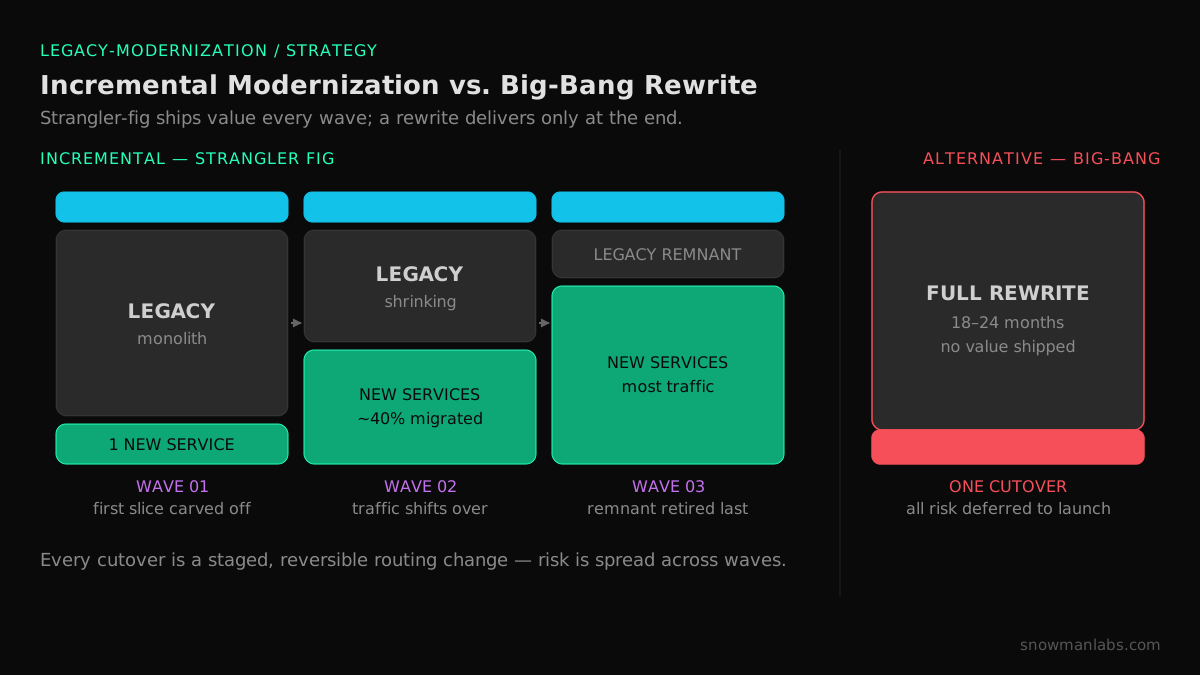
Incremental modernization replaces a legacy system as a series of small, independently valuable, reversible migrations rather than one launch event. The old and new systems coexist, traffic shifts gradually, and every step is validated in production before the next begins.
| Dimension | Big-bang rewrite | Incremental modernization |
|---|---|---|
| Risk profile | Concentrated in one cutover; failure is systemic | Distributed across small slices; failure is local and reversible |
| Time to first value | 18–36 months of build before anything ships | First migrated slice delivers value in weeks to months |
| Rollback | Effectively impossible after cutover | Route traffic back to legacy per slice |
| Roadmap impact | Feature freeze while the rewrite catches up to a moving target | New features ship on the new stack during migration |
| Spend pattern | Large capital commitment up front, returns deferred | Investment and returns arrive gradually and visibly |
| Learning | Assumptions tested only at the end | Each wave feeds real production learning into the next |
| Complexity cost | One system at a time (in theory) | Two systems coexist; routing, sync, and duplicated infrastructure must be managed |
Incremental is not free: coexistence adds routing, data synchronization, and what Fowler calls transitional architecture — scaffolding built to be removed. The honest framing is that incremental modernization trades a known, bounded coexistence cost for the unbounded tail risk of a failed cutover. For business-critical systems that trade is nearly always right; the exceptions come at the end of this article.
Four patterns to modernize legacy systems without a big-bang rewrite
These four patterns are the working toolkit of incremental modernization. They are complementary, not competing — most real programs combine two or three.
| Pattern | How it works | Best for | Primary risk |
|---|---|---|---|
| Strangler fig | A facade routes requests between legacy and new; capabilities move behind it slice by slice until legacy is empty | Monolith to microservices; large systems with interceptable request traffic | Facade becomes a bottleneck or single point of failure; migration stalls with two permanent systems |
| Branch by abstraction | An abstraction layer inside the codebase lets old and new implementations coexist behind one interface, switched by configuration | Replacing components you can't intercept at the network edge (frameworks, data layers, libraries) | Abstraction leaks legacy assumptions into the new implementation |
| Parallel run | Old and new implementations both process real traffic; results are compared, but only the trusted side's output is used | High-correctness domains: payments, pricing, eligibility, ledgers | Comparison noise from nondeterminism; cost of running both paths |
| Event interception | State-changing events flowing into the legacy system are captured and routed (also) to new components | Systems of record you must displace gradually while keeping data in sync | Dual-write inconsistency if interception isn't complete |
Strangler fig: the default pattern for monolith to microservices
The strangler fig pattern — Martin Fowler's name, after the fig that grows around a host tree until it stands alone — is the backbone of most successful modernization programs. Microsoft's Azure Architecture Center describes four phases: introduce a facade (proxy) between clients and the legacy system; incrementally shift routing to new services as each capability is rebuilt; decommission the legacy system when nothing depends on it; then remove the facade itself. AWS's prescriptive guidance compresses the same lifecycle into three words: transform, coexist, eliminate. (Whether a monolith to microservices split is the right target at all — and how to find the service boundaries — is its own decision, covered in monolith to microservices modernization.)
Two implementation details decide whether it works. First, slice boundaries must follow business capabilities (domain-driven "seams"), not technical layers — migrating "the UI" or "the database" is a big bang in disguise. Second, data needs its own plan: the Azure guidance extracts domain tables into isolated databases with an initial ETL load plus change data capture to keep both stores consistent until cutover, and an anti-corruption layer so legacy semantics don't leak into the new design.
Branch by abstraction: strangling inside the codebase
When you can't intercept requests at the network — replacing an ORM, a scheduling engine, a persistence layer — branch by abstraction applies the same coexistence idea inside the code. You introduce an abstraction over the component, port callers to the abstraction, build the new implementation behind it, and flip a configuration switch when it's ready. Everything happens on the main branch, in production, with no long-lived migration branch to merge.
Parallel run: earn trust before you cut over
A parallel run executes both implementations against real production traffic and compares outputs, while only one side's results count. GitHub built its Scientist library for exactly this: run old and new side by side in production and measure mismatches before trusting the new code. For payments, pricing, eligibility — anywhere a silent behavioral difference is expensive — a parallel run converts "we think it's equivalent" into a measured mismatch rate, the strongest possible cutover evidence.
Event interception: displace the system of record
Event interception, from the Thoughtworks legacy displacement catalog, captures the state-changing events flowing into a legacy system and routes copies (or, eventually, the originals) to new components. The new system builds its own state from the intercepted stream, proves it can keep up, and then takes over as the source of truth — the standard answer to keeping two systems of record consistent across a multi-quarter migration.
How AI agents change the economics of incremental modernization
Incremental modernization has always been the lower-risk path; historically it was also the slower, more labor-intensive one. The tasks that make it expensive — understanding undocumented behavior, writing safety-net tests, executing thousands of repetitive transformations — are exactly what AI coding agents now do well under supervision. Our pillar guide to AI-powered legacy modernization covers the full roadmap, and the same supervised-agent model applies to reducing technical debt with AI inside systems you are not yet ready to replace; three effects matter most here.
Characterization tests stop being the bottleneck. Michael Feathers' Working Effectively with Legacy Code defines the discipline: before changing legacy code, write tests that pin down what it currently does — not what the spec says. Teams skip this because hand-writing hundreds of such tests is weeks of tedium. Agents generate them in bulk from existing code and traffic captures, with senior engineers reviewing the pinned behavior — the most-skipped safety step becomes the cheapest one.
The system map writes itself — mostly. Agents can traverse a multi-million-line codebase and produce dependency maps, data-flow documentation, and candidate seam analyses in days, giving architects a draft to correct instead of a blank page. This attacks the "spec doesn't exist" failure mode directly: you recover the de facto spec from the code before deciding what to keep.
Migration waves run at agent speed, in parallel. Once a wave is scoped — say, porting one bounded context's endpoints behind the facade — much of the execution is mechanical translation with a verifiable target; our guide to AI-assisted code migration covers that execution layer in depth, from codemod-vs-agent selection to the parity harness. This is where agentic engineering changes throughput: at Snowman Labs, senior engineers define slice boundaries and acceptance criteria, then run parallel agent workstreams against them — Cognition's Devin handles exactly this kind of scoped migration work, in the roles we map in our Devin vs. Replit comparison. Humans own architecture, review, and cutover decisions; agents own the repetitive middle. The same model lets teams work down a modernization backlog without growing headcount.
The honest constraint: agents make incremental modernization cheaper — they do not make big-bang rewrites safe. Generated code still needs runtime verification before it takes production traffic (see why runtime context makes AI-generated code production-safe), and an agent-accelerated program still needs the wave discipline below. Speed without cutover governance just means reaching the failure point faster.
Planning migration waves: an eight-step sequence
A "wave" is one complete migrate-validate-decommission cycle for one slice of the system. Here is the sequence we run:
- Map the system and find the seams. Build (or agent-generate, then correct) a capability map, dependency graph, and data-ownership map. Identify seams — boundaries where a slice separates with minimal coupling — and rank slices by business value, risk, and coupling.
- Lay the safety net before touching anything. Characterization tests over the behavior you're about to move, plus baseline telemetry — error rates, latency, business metrics — for the legacy path. Without a baseline you cannot prove the new slice is equivalent.
- Stand up the routing layer. Introduce the facade (API gateway, proxy, or in-code abstraction) and route 100 percent of traffic to legacy through it. Ship this alone and let it soak; the routing layer must be boring before it becomes load-bearing.
- Pick the first slice deliberately. Low coupling, real business value, finishable in weeks. A trivial first slice proves nothing; a core-domain first slice bets too much on an unproven pipeline.
- Define exit criteria before the wave starts. In writing: the mismatch rate a parallel run must beat, the error budget the new slice must hold, the traffic ramp (for example 1 → 10 → 50 → 100 percent), who approves each step, and the rollback trigger and procedure.
- Execute: build, verify in parallel, shift gradually. Build the slice (agent workstreams shine here), validate against the characterization tests, parallel-run or dark-launch against production traffic, then ramp routing per plan — watching the step-2 baselines at every increment. The availability mechanics of this step — expand-contract schema changes, CDC replication, and the staged cutover-and-rollback sequence — are covered in how to modernize legacy systems without downtime.
- Decommission as part of the wave — not "later." Once the slice holds 100 percent of traffic through the exit-criteria window, delete the legacy code path, drop the migrated tables, remove the sync jobs. A wave is not done until the legacy footprint has shrunk.
- Re-plan between waves. Feed actuals — duration, defect escapes, mismatch findings, infrastructure cost — into the next wave, and report progress against baselines so the program's value stays visible. Our guide to measuring the ROI of AI in software engineering covers the instrumentation that keeps a multi-quarter program funded.
Cutover governance: the failure modes between the waves
Most incremental programs that fail don't fail loudly — they stall. Four patterns to guard against:
- The permanent hybrid. Migration slows after the early wins and the organization quietly accepts running both systems forever — coexistence costs without the payoff. Countermeasure: make the program's headline metric legacy footprint retired, not new services shipped.
- The overloaded facade. Azure's and AWS's guidance both flag the routing layer as a potential single point of failure and bottleneck. Give it an owner, an SLO, and headroom; keep it dumb — routing, not business logic.
- Data drift. Dual writes and CDC pipelines silently diverge. Run continuous reconciliation between legacy and new stores, and treat divergence alerts as incidents.
- Scope creep inside a wave. "While we're in here, let's also redesign…" turns a three-week slice into a six-month project. Improvements beyond parity go to a later wave on the new stack, where they're cheap.
When a full rewrite is justified
Intellectual honesty requires the other side: incremental is a strong default, not a law. A big-bang replacement is defensible when:
- The system is small enough to be low-stakes. Both Azure's and AWS's guidance exclude small, simple systems — if the whole replacement fits in a quarter with a shallow blast radius, strangling it adds ceremony without reducing risk.
- Requests can't be intercepted and the source can't be modified. The coexistence patterns need a routing point or code access. A sealed vendor binary with neither may leave replacement as the only move — though a pre-cutover parallel run is usually still possible.
- The product itself is being replaced, not the software. If the business is exiting the workflows the system encodes, feature parity is explicitly not the goal, and a fresh build against the new business model is honest scoping rather than a rewrite trap.
- An external hard deadline forces platform exit. A data-center shutdown or vendor end-of-life can force a rehost-style migration in one move. Even then, the TSB lesson applies: rehearse the cutover repeatedly, stage it if at all possible, and have a tested rollback.
If none of these hold — and for business-critical enterprise systems they usually don't — the burden of proof sits squarely on the rewrite.
FAQ
What is the strangler fig pattern in legacy modernization?
The strangler fig pattern is an incremental modernization strategy in which a facade routes requests between a legacy system and new services, and functionality migrates to the new system slice by slice until the legacy system can be decommissioned. Martin Fowler named it after fig species that grow around a host tree until the host is no longer needed. It is the most widely recommended alternative to a big-bang rewrite.
Why is incremental migration better than a big bang rewrite?
Incremental migration distributes risk across small, reversible steps instead of concentrating it in one irreversible cutover, and it delivers value continuously instead of after years of parallel build. It also preserves the accumulated bug fixes and undocumented behavior that a rewrite discards and must painfully rediscover. Big-bang cutovers that miss — like TSB's 2018 migration — fail systemically.
How long does it take to modernize a legacy system incrementally?
It depends on system size, coupling, and team capacity, but enterprise programs typically run several quarters to a few years — with the critical difference that value arrives from the first wave, within weeks to months, rather than at the end. AI agent workstreams compress the mechanical portions; discovery, cutover validation, and organizational change remain human-paced.
Is incremental modernization more expensive than a rewrite?
Incremental modernization carries a real coexistence cost — routing, data synchronization, temporarily duplicated systems — that a rewrite avoids on paper. In practice, rewrites routinely overrun because reaching feature parity with a moving target is systematically underestimated, and a failed cutover adds unbounded incident and reputational costs. Incremental spends more visibly; big bang spends more in expectation.
Does the strangler fig pattern work for moving a monolith to microservices?
Yes — it is the standard approach AWS and Microsoft both document for monolith decomposition: a facade in front of the monolith, one bounded context extracted at a time into a service with its own data store, change data capture until cutover, repeated until the monolith is empty. The main mistakes are slicing by technical layer instead of business capability and skipping decommissioning.
What are the risks of the strangler fig pattern?
The main risks are the facade becoming a single point of failure or bottleneck, data inconsistency between legacy and new stores during coexistence, and the migration stalling into a permanent hybrid where both systems run forever. All three are governable: give the routing layer an owner and an SLO, reconcile data continuously, and make legacy decommissioning an explicit exit criterion of every wave.
Can AI agents accelerate legacy system modernization?
Yes, in specific, verifiable ways: generating characterization tests that pin down current behavior, producing documentation and dependency maps from undocumented code, and executing scoped migration slices as supervised workstreams. They do not remove the need for human-owned architecture decisions, runtime verification, and cutover governance.
Should we pause new feature development during modernization?
No — avoiding the feature freeze is one of the main reasons to modernize incrementally. The strangler fig approach lets new capabilities ship on the new stack while legacy functionality migrates in parallel, which also prevents the fatal gap between a frozen rewrite spec and a moving business. Reserve short freezes for individual slice cutovers, not for the program.
The decision, in one paragraph
If your legacy system is business-critical, the evidence points one way: modernize it in waves behind a routing layer, validate every slice in production, decommission as you go, and reserve the big-bang rewrite for the narrow cases where the system is small, sealed, or already leaving the business. With characterization tests, system mapping, and migration slices now largely executable by supervised AI agents, the traditional objection to incremental modernization — that it is slow — is the part of the trade-off that has changed the most.
If you're weighing this decision for a specific system, start with our AI Readiness Diagnostic — it assesses your legacy estate, test coverage, and team readiness for agent-accelerated modernization and returns a concrete first-wave recommendation. Or see how our legacy application modernization services combine senior engineering teams with parallel agent workstreams to run the wave model end to end.
Find your highest-value path to agentic delivery.
Map your readiness, delivery constraints, and first 90-day opportunity with the Snowman Labs AI Readiness Diagnostic.