How to Modernize Legacy Systems Without Downtime
Modernize legacy systems without downtime using expand-contract migrations, CDC replication, shadow traffic, and staged cutovers that keep SLAs intact.
 By Danilo Brizola
To modernize legacy systems without downtime, you keep three things continuously live while the replacement happens underneath them: user traffic (shifted gradually with blue-green and canary routing, never in one cutover), data (evolved with expand-contract schema changes and kept consistent with change data capture), and behavior (proven equivalent with shadow traffic and reconciliation before anything is trusted). This guide is for CIOs, CTOs, and VPs of Engineering whose systems cannot take a maintenance window — the order-taking platform, the payments path, the system of record — and it covers the techniques, the cutover sequence, the rollback discipline, and the honest cases where a scheduled window is still the cheaper call.
What zero-downtime modernization actually means
Zero-downtime modernization means the business keeps transacting on its normal SLA while the system underneath is replaced — no scheduled outage users have to plan around, and no elevated risk of an unscheduled one. In practice "zero" is an SLO statement, not a physics claim: the real requirement is that migration work fits inside the same error budget as normal operations.
The budget conversation is what makes this an executive topic rather than a purely technical one. Oxford Economics and Splunk surveyed 2,000 executives at Global 2000 companies and put the cost of unplanned digital downtime at $400 billion a year — roughly $200 million per company, about 9 percent of profits, with lost revenue and regulatory fines as the two largest line items. A modernization program that "only" risks a weekend cutover is bidding against numbers like these — which is why the techniques below, all of which trade extra engineering work for continuous availability, usually pay for themselves on any revenue-bearing system.
Two failure shapes produce migration downtime, and they need different defenses:
- Planned windows — "the system will be unavailable Saturday 02:00–08:00" — which modern routing and data techniques can eliminate almost entirely.
- Unplanned outages caused by the migration itself — a locking schema change, a divergent replica promoted too early, a big-bang traffic flip that fails — which are eliminated by staging, verification, and rollback discipline, not by scheduling.
One scoping note: this article is about how to keep the system live during modernization. The prior question — which replacement pattern to use and how to slice the work — is covered in our guide to modernizing legacy systems without a big-bang rewrite, and the full program view lives in the AI-powered legacy modernization roadmap. Everything below assumes you are already migrating incrementally; no technique on this page can make a single all-at-once cutover safe.
The three layers you must keep live
Every zero-downtime technique protects one of three layers. Naming them keeps the plan honest, because programs usually fail at the layer they didn't plan for:
| Layer | The risk | The defenses |
|---|---|---|
| Traffic | A routing flip sends 100% of users to an unproven system | Blue-green environments, canary ramps, instant route-back |
| Data | Schema changes lock tables; two stores drift apart | Expand-contract changes, online DDL, CDC replication, reconciliation |
| Behavior | The new system is available but wrong | Shadow traffic, parallel comparison, characterization tests |
Most published migration advice concentrates on the traffic layer because it is the most visible. In our experience the data layer is where the downtime actually comes from — and the behavior layer is where the silent damage does.
Traffic: shift users gradually, never all at once
The traffic layer's rule is that exposure to the new system is a dial, not a switch. Three techniques implement the dial:
Blue-green deployment runs two complete environments — the live one and the candidate — and moves traffic between them at the router or load balancer. Martin Fowler's description highlights the property that matters for modernization: the old environment stays warm, so reverting is a routing change measured in seconds, not a restore measured in hours.
Canary release sends a small slice of real traffic — commonly 1 to 5 percent — to the new system and widens the slice only while health metrics hold. Fowler's canary write-up and the Google SRE Workbook's chapter on canarying both stress the discipline that separates a canary from a hope: pre-defined success metrics, a comparison against the control population, and an automatic halt when the canary degrades.
Shadow traffic (dark launching) duplicates real production requests to the new system while users still receive only the legacy system's responses. Nothing users see depends on the new code, so it is the zero-risk way to expose a replacement to production load and real-world inputs before any canary begins. GitHub's Scientist library exists for exactly this run-both-and-compare discipline at the code level.
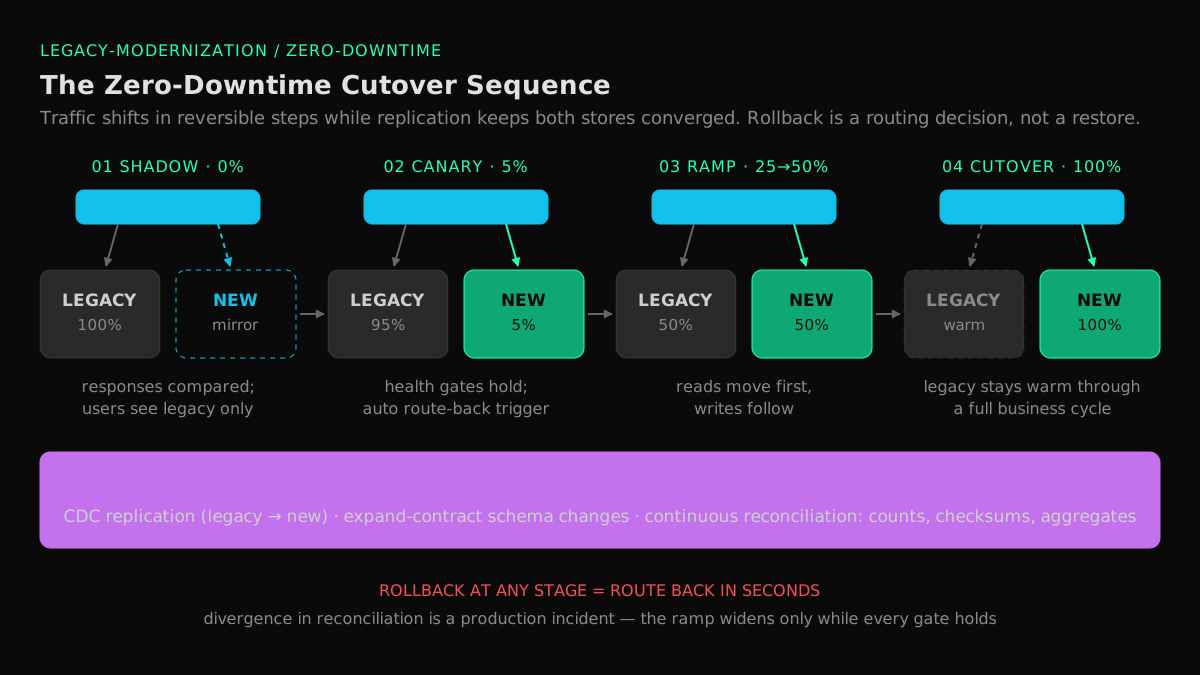
These compose into a standard progression — shadow first to prove behavior, canary second to take real load, blue-green switchover last with the legacy environment held as the instant rollback target. Every step is reversible; that reversibility, not any single technique, is what "without downtime" means at the traffic layer.
Data: the layer that actually causes the downtime
The data layer earns its own section because it is where legacy migrations traditionally took their outages: locking schema changes, long backfills, and cutovers that required stopping writes. Four techniques remove those stops.
Expand-contract schema changes
The expand-contract pattern (Fowler's parallel change) breaks every breaking schema change into three backward-compatible steps: expand — add the new column, table, or structure alongside the old one; migrate — dual-write to both, backfill history, and move readers to the new structure; contract — remove the old structure once nothing references it. At every point the schema supports both the old and new application versions, so deploys and rollbacks never require coordinated database surgery. Prisma's data guide walks a worked example. The discipline to hold: the contract step is not optional — skipping it leaves both structures live forever, and the "temporary" dual-write becomes permanent drift risk.
Online schema changes and batched backfills
Databases and tooling now perform most structural changes without exclusive locks: PostgreSQL builds indexes without blocking writes via CREATE INDEX CONCURRENTLY, and GitHub's gh-ost performs MySQL schema changes by building a ghost table and tailing the binary log, precisely because ordinary ALTER TABLE on a large table once meant an outage. The same thinking applies to data backfills: process large tables in small batches with pauses between them, so the migration shares the database politely with production traffic instead of monopolizing it.
Change data capture replication
Change data capture (CDC) tails the legacy database's transaction log and streams every committed change to the new store in near real time. It is the mechanism that lets a new system's database converge with a legacy one while the legacy system keeps taking writes — the prerequisite for any cutover that doesn't stop the business. Open-source Debezium and managed services like AWS Database Migration Service both implement the standard shape: an initial bulk load, then continuous log-based replication until the two stores are in lockstep and cutover becomes a routing decision rather than a data event.
Dual writes and continuous reconciliation
When the new system starts accepting writes of its own, consistency stops being automatic. Whether you bridge the gap with CDC or application-level dual writes, the non-negotiable companion is continuous reconciliation: scheduled comparisons of row counts, checksums, and business aggregates between the two stores, with any divergence treated as a production incident rather than a migration footnote. Teams that skip this discover drift at cutover — the most expensive possible moment.
The zero-downtime cutover sequence
Here is the sequence we run, compressed to its checkpoints. Each step gates the next; none is skippable on a revenue-bearing system.
- Baseline the SLOs. Record current availability, latency, error rates, and the business metrics that must not move. "No downtime" is only provable against a baseline. A structured AI legacy system assessment produces this map — dependencies, data flows, batch jobs, integration points — before any migration work starts.
- Establish replication. Bulk-load the new store, then keep it converged with CDC. Measure replication lag; it must be seconds, and stable, before anything else proceeds.
- Shadow the traffic. Mirror production requests to the new system. Compare responses and side effects against legacy. Fix until the mismatch rate is inside an explicit threshold — defined in writing before the shadow starts.
- Reconcile the data continuously. Automated checksum and aggregate comparisons between stores, running for the whole coexistence period, alerting like production monitoring because it is production monitoring.
- Canary real traffic. Route 1–5 percent of users to the new system with defined health gates and an automatic route-back trigger. Widen in steps — 10, 25, 50, 100 percent — holding each step long enough to cover the system's real traffic cycles, including the batch windows and month-end peaks legacy systems tend to hide.
- Cut over reads, then writes. Move read traffic first — it is intrinsically reversible. Move write authority only when the canary has held at full read load, and keep reverse replication (new store back to legacy) running so the legacy system remains a viable fallback.
- Hold the rollback window. Run with reverse synchronization until the new system has survived a full business cycle. Only then does legacy stop being a fallback.
- Decommission deliberately. Stop reverse sync, archive, and retire the legacy path — the step that converts "migration" into "modernized." The wave-planning guide covers why decommissioning must be part of the wave, not "later".
Rollback is a requirement, not a plan B
The defining property of a zero-downtime migration is that every step has a rehearsed way back. Three rules keep that true:
- Route-back beats restore. Rollback should be a traffic decision (seconds) rather than a data operation (hours). That is why the legacy environment stays warm and reverse replication keeps it current through the rollback window.
- Rehearse the cutover — including the retreat. Run the full cutover and the full rollback in a staging environment with production-scale data before doing either for real. Migrations tested against toy datasets pass; the same operations against production volume are what lock tables and blow latency budgets.
- Prefer roll-forward for small faults, route-back for systemic ones. A bug in one endpoint is a fix on the new stack; a divergent ledger is an immediate route back to legacy. Deciding the boundary in advance — in the same written exit criteria as the canary gates — prevents the mid-incident debate that turns a wobble into an outage.
How AI agents change the economics of staying live
Everything above has been true for a decade; what changed is the price of doing it. The honest reason teams booked maintenance windows was never ignorance of CDC or expand-contract — it was that the zero-downtime path demands a large volume of unglamorous scaffolding: dual-write shims, batched backfill scripts, reconciliation harnesses, shadow-comparison rigs, characterization tests, and the transitional code to remove all of it afterward. That scaffolding is precisely the well-scoped, mechanically verifiable work that supervised AI coding agents now execute at a fraction of its historical cost — the same economics we quantify across AI-assisted code migration, where agents run the translation work inside a parity harness that proves behavior is preserved.
At Snowman Labs — across 400+ delivered projects, with agent-accelerated programs typically reaching a first production milestone in two weeks — the operating model for zero-downtime work is consistent: senior engineers own the cutover architecture, exit criteria, and every routing decision; agent workstreams generate and maintain the scaffolding layer under review. Two constraints keep that model safe. Agent-generated migration code takes production traffic only after runtime verification — the reasoning our guide to production-safe AI-generated code lays out — and agents never own cutover judgment: widening a canary is a human decision informed by agent-maintained evidence, not an automated one.
The strategic consequence is worth stating plainly: as the scaffolding cost falls, the set of systems that "can't be modernized without a window" shrinks. Programs that were deferred for years because the safe path was too expensive now clear the investment bar — the cost side of the equation is quantified in the AI-powered legacy modernization roadmap.
When a maintenance window is the honest choice
Zero-downtime engineering is a cost, and intellectual honesty requires the cases where it isn't worth paying:
- The business genuinely sleeps. A regional B2B system with no weekend usage loses nothing to a rehearsed Saturday window — the Oxford Economics numbers above are driven by revenue-bearing, always-on systems, not internal tools with natural quiet hours.
- The blast radius is small. For a departmental app with dozens of users, hours of scaffolding engineering to avoid an hour of communicated downtime is ceremony, not risk management.
- A hard external deadline forces one move. Data-center exits and vendor end-of-life dates sometimes leave no room for a multi-month coexistence period. Then the discipline shifts entirely to rehearsal: full-scale cutover drills, a tested rollback, and staged execution wherever the deadline allows.
Even in these cases, the cheap subset of the toolkit — expand-contract changes, a rehearsed rollback, batched backfills — still applies. The window becomes a convenience, not a bet.
FAQ
How do you migrate a legacy system without downtime?
Keep the legacy system live while a replica of its data converges via change data capture, prove the new system's behavior with shadow traffic, then shift real users gradually with canary routing — reads before writes — while continuous reconciliation confirms the two stores match. The legacy system stays warm as an instant rollback target until the new system has survived a full business cycle.
What is a zero-downtime migration?
A zero-downtime migration replaces or modernizes a system while it continues serving users on its normal SLA — no scheduled outage and no migration-induced incident. It is achieved by making every change backward-compatible (expand-contract), every traffic shift gradual (canary, blue-green), and every step reversible in seconds via routing rather than restores.
What is the expand-contract pattern?
Expand-contract (also called parallel change) splits a breaking schema change into three safe steps: expand the schema with the new structure alongside the old, migrate readers and writers to the new structure while backfilling data, and contract by removing the old structure once nothing uses it. Because the schema is compatible with both application versions at every point, deploys never require an outage.
How do you keep data in sync between old and new systems during migration?
Use log-based change data capture (tools like Debezium or AWS DMS) to stream every committed change from the legacy database to the new store after an initial bulk load, and pair it with continuous reconciliation — automated row-count, checksum, and business-aggregate comparisons — so drift is detected in minutes rather than discovered at cutover.
What is the difference between blue-green deployment and canary release?
Blue-green runs two full environments and switches traffic between them, giving instant, total cutover and instant, total rollback. A canary release shifts a small percentage of traffic first and widens gradually, limiting the blast radius of undiscovered faults. Modernization programs typically use both: canary ramps to build confidence, blue-green switchover with the old environment held warm for rollback.
How long does a zero-downtime legacy migration take?
Longer in calendar time than a big-bang cutover, but with value and safety arriving continuously: enterprise programs commonly run several quarters, with each capability slice going through its own shadow-canary-cutover cycle in weeks. AI agent workstreams compress the scaffolding and translation work substantially; the coexistence checkpoints — soak periods, reconciliation windows, business-cycle validation — remain deliberately human-paced.
Conclusion: availability is a design input, not a hope
Modernizing legacy systems without downtime is not one technique but a stack of them: reversible traffic shifts at the edge, backward-compatible data changes underneath, and behavioral proof — shadow traffic plus continuous reconciliation — holding the two together. Teams that treat availability as a design input from step one routinely replace systems their organizations once considered untouchable; teams that treat it as a cutover-weekend problem become the case studies. And with AI agents now generating the scaffolding that made the safe path expensive, the maintenance window is becoming a choice, not a necessity.
If you need to modernize a system the business cannot afford to stop, start with our AI Readiness Diagnostic — it maps your legacy estate, data flows, and rollback readiness and returns a concrete first-slice recommendation. Or see how our legacy application modernization services run the full shadow-canary-cutover model with senior engineers and parallel agent workstreams.
Find your highest-value path to agentic delivery.
Map your readiness, delivery constraints, and first 90-day opportunity with the Snowman Labs AI Readiness Diagnostic.