AI Legacy System Assessment: A Practical Enterprise Guide
What an AI legacy system assessment covers, what coding agents can map in days, the frameworks that score results, and the deliverables to demand.
 By Danilo BrizolaUpdated
 An AI legacy system assessment is a fixed-scope evaluation of a legacy application or portfolio in which coding agents perform the discovery work — dependency mapping, complexity scoring, dead-code detection, business-rule extraction, EOL and vulnerability inventory — and humans supply the judgment: business criticality, risk appetite, and sequencing. The output is a scored portfolio and an evidence-backed modernization roadmap, produced in weeks instead of the quarters a manual assessment consumes. This guide is for CIOs, CTOs, and VPs of Engineering who need to decide what to modernize first and want that decision grounded in data rather than tribal memory: what the assessment must cover, what agents genuinely automate, what still requires senior humans, and exactly which deliverables to demand before anyone writes a migration plan.
What Is an AI Legacy System Assessment?
An AI legacy system assessment applies autonomous coding agents and large language models to the first phase of any modernization program: understanding what you actually have, what it costs you, and what should move first. The assessment disciplines themselves are not new — application inventories, technical-debt analysis, and portfolio scoring predate AI by decades. What changes is the economics of the evidence-gathering. Reading a 15-year-old codebase to reconstruct its dependency graph, its dead code, and its undocumented business rules used to consume months of scarce senior-engineer time; agents now do the mechanical share of that reading in days, at a depth no time-boxed human effort reaches.
That matters because the assessment has historically been the phase enterprises skip or shortchange — it is expensive, invisible to sponsors, and delays the "real work." Skipping it is how programs end up migrating the wrong system first, discovering load-bearing dependencies mid-cutover, or funding a rewrite the portfolio data would never have justified. McKinsey estimates that about 70 percent of the software used by Fortune 500 companies was developed 20 or more years ago, which is another way of saying most enterprises are sitting on estates too large to assess manually — and too consequential to modernize unassessed.
The assessment is Phase 1 of the larger program we describe in our AI-powered legacy modernization roadmap; this article goes one level deeper into how that phase actually runs.
What Coding Agents Automate in the Assessment
Agents take over the discovery tasks that are high-volume and evidence-based — the work where the constraint was always reading time, not judgment.
| Assessment task | What agents do | Manual baseline |
|---|---|---|
| System inventory | Crawl repositories, build artifacts, and infrastructure configs; catalog languages, frameworks, versions, deployment targets | Weeks of interviews and spreadsheet archaeology |
| Dependency mapping | Build call graphs and data-flow maps across services, databases, queues, and third-party integrations | Often never completed; discovered during outages |
| Dead-code and duplication detection | Flag unreachable code, unused endpoints, and copy-paste clusters with usage evidence | Sampling at best |
| Business-rule extraction | Reverse-engineer rules embedded in code into reviewable plain-language summaries | Depends on engineers who may have left |
| Test-coverage probing | Measure real coverage per module; identify which critical paths have no safety net | Coverage reports exist; interpretation rarely does |
| EOL and vulnerability inventory | Map every end-of-life framework and known CVEs against the specific versions in use | Periodic audits, quickly stale |
| Documentation generation | Produce current architecture diagrams and module documentation from the code itself | Docs frozen at the last big project |
Two properties of this list are worth naming. First, everything on it is verifiable — an agent's dependency map can be checked against the running system, its extracted business rules reviewed by the people who operate the process. You are not trusting a model's opinion; you are reviewing evidence it compiled. Second, the work parallelizes: agents can sweep an entire portfolio simultaneously, which is why assessment timelines compress from quarters to weeks rather than merely getting cheaper. This is the same operating model — scoped tasks delegated to agents, humans reviewing outputs — that defines agentic engineering as a discipline, applied to analysis instead of construction.
Thoughtworks identifies loss of historical context and thin automated test coverage as the two constraints that make legacy work slow regardless of team skill. Both are assessment problems before they are migration problems, and both are precisely where agent-scale reading helps most: context is reconstructed from the code, and the coverage gaps are mapped before anyone commits to a cutover plan.
The Six Dimensions Every Assessment Must Score
Agent findings become decisions only when they are scored against business context. A defensible AI legacy system assessment scores every system in scope on six dimensions — the first three largely agent-derived, the last three necessarily human-supplied:
- Code and architecture health. Complexity metrics, coupling, duplication, test coverage, and change frequency. High churn plus high complexity plus low coverage is the signature of a system that will resist safe change.
- Security and compliance exposure. EOL components with no patch channel, known CVEs, secrets in code, and audit-trail gaps. Score compliance risk separately from security risk — a system can pass an audit and still carry exploitable dependencies.
- Data health. Where the system of record actually lives, which integrations move data and how (APIs, file drops, shared databases), and what silently breaks when schemas drift.
- Business criticality and fit. What revenue or operations depend on the system, and whether it still matches how the business works — the dimension no scanner can score.
- Run cost and delivery drag. Maintenance spend, incident load, and the delivery tax the system imposes on everything that touches it. Attributing these costs to specific systems is the same discipline we describe in reducing technical debt with AI, and it is the number that wins board conversations.
- Team knowledge and key-person risk. Who still understands the system, and what happens when they leave. Agent-generated documentation — the full recovery workflow is in our guide to legacy system documentation with AI — reduces this risk but does not eliminate the judgment of the people who hold operational context.
Resist the temptation to expand this into a 40-criterion scorecard. Six well-evidenced dimensions that leadership actually reads beat an exhaustive matrix nobody uses to decide anything.
Turning Scores into Decisions: TIME and the 7 Rs
Scores need a decision framework, and two established ones survive contact with real portfolios.
Gartner's TIME model plots each application on business value versus technical fit and yields four dispositions: Tolerate, Invest, Migrate, Eliminate. Its chief virtue is forcing the unglamorous answers: some systems should be decommissioned rather than modernized, and some low-value systems should simply be tolerated. An assessment that recommends modernizing everything was a sales document, not an assessment.
The 7 Rs — rehost, relocate, replatform, refactor, repurchase, retire, retain, per AWS's prescriptive guidance — then assigns a migration strategy to each system that TIME marked for movement. The agent-gathered evidence directly informs the choice: a well-bounded module map argues for refactoring; a tangle of implicit couplings argues for replatforming first and decomposing later. For systems headed toward decomposition, the assessment should also test whether microservices are even the right target — our guide to monolith to microservices modernization covers when the answer is no.
The disposition matrix these frameworks produce is the core artifact of a portfolio-level enterprise application modernization strategy — the document that sequences, funds, and governs the program the assessment feeds. It is also your procurement instrument: if an outside firm will execute part of the program, it is the document that lets you compare proposals per application instead of buying a portfolio-wide guess — how to use it that way is covered in our buyer's guide to cloud application modernization services.
What AI changes here is not the frameworks but the integrity of their inputs. TIME quadrants drawn from managers' impressions in a workshop are folklore in a 2×2. TIME quadrants drawn from measured complexity, mapped dependencies, and attributed run cost are a defensible investment thesis.
What Humans Must Still Assess
Honesty about limits is part of the method. Four things stay out of the agents' hands:
- Runtime behavior under production load. Static analysis reads code, not traffic. Performance envelopes, batch-window realities, and peak-load behavior require observability data and operator interviews.
- Business criticality and appetite. No scanner knows that a shabby-looking system processes the founder's largest customer, or that a regulator is watching one particular workflow.
- Contracts and politics. Vendor lock-in terms, license constraints, data-residency obligations, and the organizational ownership questions that sink more modernization programs than technology does.
- Validation of extracted rules. Agent-extracted business logic is a draft until the people who run the process confirm it. Treat unreviewed extraction as inventory, not truth.
The failure mode to avoid is the inverse of the old one: where manual assessments drowned in discovery and never reached judgment, an agent-accelerated assessment can produce so much evidence that teams skip the judgment step. Budget senior review time deliberately — roughly a third of the assessment effort — and hold it.
Deliverables to Demand
Whether you run the assessment internally or engage a partner — how to buy it well, from engagement models to provider red flags, is covered in our guide to legacy application assessment services — the exit criteria are the same six artifacts:
- A complete system inventory — every application, service, database, integration, and scheduled job in scope, with versions and owners.
- A dependency and data-flow map validated against the running environment, not just the code.
- A risk register covering EOL components, CVEs, key-person dependencies, and single points of failure, each with a severity and an owner.
- A scored portfolio with TIME dispositions and 7-R strategies — the one-page view leadership will actually use.
- A quantified cost of legacy — maintenance spend, incident load, and delivery drag attributed per system, giving the business case its denominator.
- A first-wave recommendation with a captured baseline. Which system moves first, why it is painful-but-survivable, and the pre-modernization metrics — deployment frequency, lead time, change-failure rate, incident volume — recorded before anything changes, using the same measurement discipline as DORA metrics for AI-assisted teams. Without the baseline, you will never prove the program worked.
An assessment that ends in a slide deck of observations but no scored portfolio, no cost attribution, and no first wave did not finish.
How Long Should It Take?
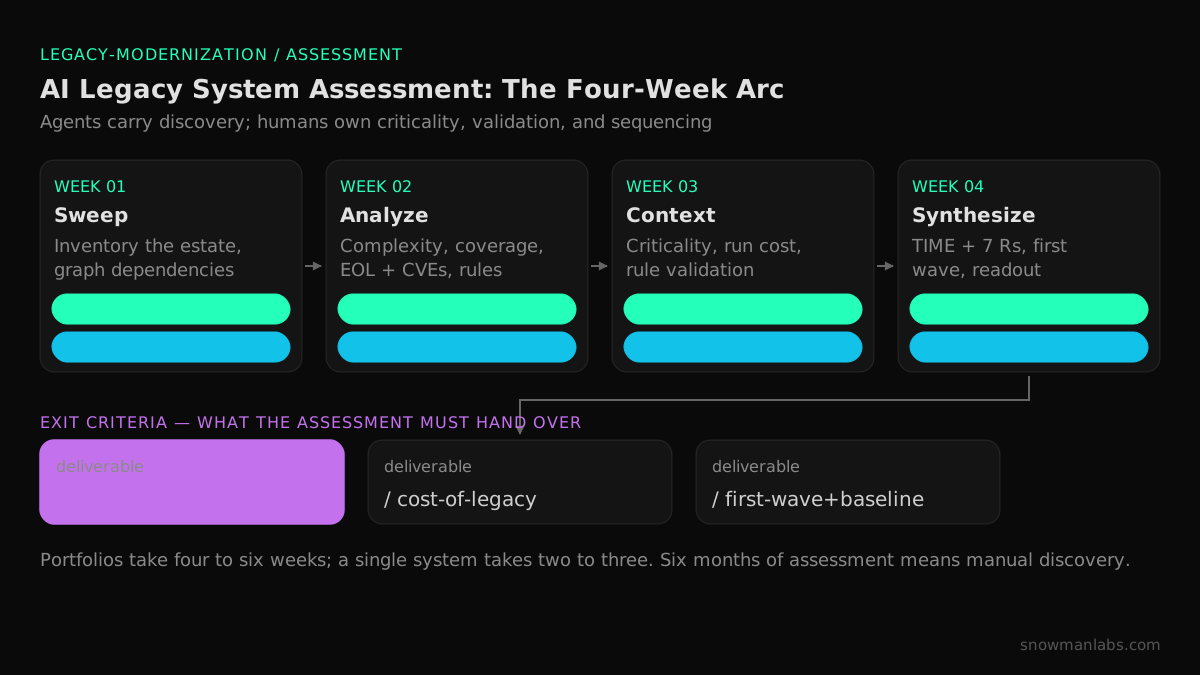
With agents carrying discovery, a single business-critical system takes roughly two to three weeks to assess end to end; an enterprise portfolio takes four to six weeks. If a proposal quotes six months of assessment before any modernization decision, the discovery is being done manually — or being milked.
A realistic four-week portfolio arc:
- Week 1 — Access and sweep. Repository and infrastructure access, agent sweep of the estate, first-pass inventory and dependency graphs.
- Week 2 — Deep analysis. Complexity and coverage scoring, EOL/CVE mapping, business-rule extraction on the systems the sweep flagged as pivotal.
- Week 3 — Human context. Stakeholder interviews, criticality and run-cost attribution, validation of extracted rules, runtime review against observability data.
- Week 4 — Synthesis. TIME dispositions, 7-R strategies, first-wave selection, baseline capture, and the leadership readout.
The pace of what follows depends on what the assessment finds, but the sequencing principle is settled: waves, not big bangs. The assessment's first-wave recommendation feeds directly into an incremental program of the kind we detail in modernizing legacy systems without a big-bang rewrite — and at program level, McKinsey's LegacyX work reports modernization acceleration of 40 to 50 percent when generative and agentic AI carry the analysis and conversion load.
FAQ
What is a legacy system assessment?
A legacy system assessment is a structured evaluation of an aging application or portfolio that establishes what the systems do, what they depend on, what they cost, and what risks they carry — producing the evidence needed to decide whether to modernize, replace, tolerate, or retire each one. An AI legacy system assessment performs the discovery portion with coding agents, compressing the timeline from months to weeks.
How do you assess a legacy system for modernization?
Inventory the estate, map dependencies and data flows, score each system on code health, security exposure, data health, business criticality, run cost, and team knowledge, then apply a decision framework such as Gartner's TIME model to assign each system a disposition and AWS's 7 Rs to assign a migration strategy. Finish by selecting a first wave and capturing a delivery baseline.
How long does an AI legacy system assessment take?
Two to three weeks for a single business-critical system; four to six weeks for an enterprise portfolio. Agent-led discovery is what makes the short end achievable — the human judgment steps (criticality scoring, rule validation, sequencing) set the floor.
Can AI fully automate a legacy system assessment?
No. Agents automate the evidence-gathering — inventory, dependency mapping, complexity scoring, vulnerability mapping, documentation — but business criticality, runtime behavior under load, contractual constraints, and validation of extracted business rules require humans. Roughly a third of assessment effort should remain senior review.
What deliverables should a legacy system assessment produce?
Six artifacts: a complete system inventory, a validated dependency map, a risk register, a scored portfolio with TIME dispositions and 7-R migration strategies, a quantified cost of legacy per system, and a first-wave recommendation with a captured metrics baseline.
What is the TIME framework in application assessment?
TIME is Gartner's portfolio model that plots applications on business value versus technical fit and assigns one of four dispositions: Tolerate, Invest, Migrate, or Eliminate. It forces the portfolio-level answers — including decommissioning — that per-system assessments tend to avoid.
What comes after the assessment?
Execution in waves: stabilize the first system with characterization tests, migrate it behind a routing layer, validate in production, measure against the baseline, and feed the learnings into the next wave — the phased model covered in our AI-powered legacy modernization roadmap.
Run the Assessment Before You Commit the Budget
The cheapest mistake-prevention in a modernization program is the assessment you run before committing to anything: it costs weeks, and the mistakes it prevents cost quarters. With coding agents carrying discovery, there is no longer an economic excuse to skip it — the open question is only whether your organization is set up to review and act on what the agents find.
That readiness question is where we start. The AI Readiness Assessment is an executive-level diagnostic that maps your legacy estate, identifies which assessment and modernization work is agent-suitable, and returns a prioritized 90-day plan. If the assessment phase is already behind you, our legacy application modernization services pair senior engineering teams with parallel agent workstreams to run the migration waves the assessment recommends — a model built on 400+ delivered projects and our work as an official Cognition enablement partner.
Find your highest-value path to agentic delivery.
Map your readiness, delivery constraints, and first 90-day opportunity with the Snowman Labs AI Readiness Diagnostic.