How to Reduce Technical Debt with AI: A CTO's Playbook
A practical playbook to reduce technical debt with AI: quantify debt in business terms, run supervised agent remediation waves, and govern AI-written code.
 By Danilo BrizolaUpdated
 To reduce technical debt with AI, use coding agents and language models to do the debt work that never fits a sprint: map and quantify debt across the codebase, generate the missing tests and documentation, and execute refactoring and dependency upgrades as supervised, reviewable pull requests — while senior engineers keep the decisions about what to fix, what to tolerate, and what to retire. The economics matter because the debt is enormous: in McKinsey's survey of enterprise CIOs, technical debt amounts to 20 to 40 percent of the value of the entire technology estate, and 10 to 20 percent of the budget earmarked for new products gets diverted to resolving debt-related issues instead. This playbook shows CIOs, CTOs, and VPs of Engineering how to turn that liability into an agent-executable backlog — and how to avoid the trap of letting AI generate new debt faster than it pays down the old.
What Technical Debt Actually Costs — and Why AI Changes the Math
Technical debt is the accumulated cost of past shortcuts: code that works but resists change, tests that were never written, documentation that never existed, dependencies that were never upgraded. Ward Cunningham coined the debt metaphor precisely because it behaves like debt — you pay interest on it, in the form of slower delivery and higher defect rates, until you pay down the principal.
Three numbers frame the executive stakes:
- The principal is material. CIOs in McKinsey's tech-debt research put it at 20–40 percent of their technology estate's value — hundreds of millions of dollars for a large enterprise — and 60 percent said debt had risen perceptibly over three years.
- The interest compounds against your roadmap. The same research found 10–20 percent of new-product technology budget silently diverted to debt-related issues.
- Debt now blocks the AI agenda itself. IBM's Institute for Business Value reports that 81 percent of executives say technical debt is already constraining AI success, and enterprises that fully account for debt costs in their AI business cases project 29 percent higher ROI than those that don't.
That last point is why 2026 is different from every prior "year of paying down debt." Historically, remediation lost the budget fight because it was expensive, invisible, and staffed by the same senior engineers who ship the roadmap. AI attacks exactly that cost structure: the repetitive, high-volume, low-glamour work that debt reduction is made of is the work coding agents do best. The judgment — what counts as debt, what it costs the business, what to fix first — stays human. The typing no longer has to be.
Which Types of Technical Debt Can AI Reduce?
Not all debt is equally automatable, and a credible program starts by sorting the estate into categories with different agent suitability:
| Debt type | Typical form | What AI does about it | Agent suitability |
|---|---|---|---|
| Code debt | Duplicated logic, dead code, oversized modules, inconsistent patterns | Detects smells and hotspots; executes scoped refactors as reviewable PRs | High |
| Testing debt | Thin or missing coverage on critical paths | Generates characterization and unit tests at scale for human curation | High |
| Documentation debt | Undocumented business rules, stale architecture docs | Reverse-engineers plain-language docs and diagrams from code | High |
| Dependency debt | EOL frameworks, unpatched libraries, blocked upgrades | Executes version migrations and API changes across repositories | High |
| Security debt | Known vulnerabilities, outdated auth patterns, secrets in code | Flags and patches known-pattern issues; humans own threat modeling | Medium |
| Architecture debt | Blurred module boundaries, shared databases, tangled coupling | Maps dependencies and surfaces seams; humans decide the target design | Low–medium |
The pattern in the right-hand column is consistent: agents excel where the work is verifiable and voluminous; humans stay in charge where the work is judgment. Architecture debt is the clearest example — an agent can produce an evidence-based coupling map in days, but deciding whether the answer is enforced module boundaries or extraction into services is an architecture decision, one we walk through in monolith to microservices modernization: when and how.
Five Ways AI Reduces Technical Debt
1. Debt discovery and hotspot mapping
The first failure of most debt programs is that nobody can see the debt. Agents can crawl an entire estate — repositories, build configs, dependency manifests — and produce a ranked inventory: where complexity concentrates, which modules change most often (churn), where coverage is thinnest, and which dependencies are past end-of-life. Combining churn with complexity is the classic hotspot heuristic: code that is both hard to change and changed constantly is where debt interest is actually being paid. This converts the debt conversation from anecdote ("the billing module is scary") to evidence ("these 14 modules absorb 38 percent of our change effort").
2. Refactoring as reviewable pull requests
Modern coding agents don't just flag a smell — they open the pull request that removes it: extracting duplicated logic, splitting oversized classes, normalizing inconsistent patterns, deleting dead code. The unit of work matters: bounded task in, reviewable diff out. Agents given standing permission to "clean up the codebase" produce noise; agents given scoped tasks with acceptance criteria produce mergeable improvements at a rate no human team can match.
3. Test generation, especially characterization tests
You cannot safely refactor what you cannot verify, which is why testing debt blocks every other category. Michael Feathers' Working Effectively with Legacy Code prescribes characterization tests — tests that pin down what the system currently does — as the precondition for touching legacy code, and hand-writing them has always been the step teams skip. Agents generate them in bulk for engineers to review and curate, making the safety net affordable for the first time. This is the same move that unlocks incremental replacement of whole systems, covered in how to modernize legacy systems without a big-bang rewrite.
4. Documentation recovery
Documentation debt is pattern extraction — precisely what language models are best at. Agents produce plain-language descriptions of what modules decide and why, current-state architecture diagrams generated from code rather than memory, and interface contracts measured from actual behavior. Domain experts then correct and sign off. The output is not just onboarding material: recovered business rules are the raw input for every modernization decision that follows.
5. Dependency and framework upgrades
The most quantified AI debt-reduction result to date is here: Deloitte's analysis of AI-enabled modernization cites Amazon's use of AI agents for Java 17 upgrades, cutting the average application upgrade from about 50 developer-days to a few hours, with an estimated $260 million in annualized efficiency gains. Framework and version migrations are high-volume, mechanical, and verifiable — the exact shape of work that should never again consume senior-engineer months.
From AI Assistants to Agent Fleets: Where the Economics Change
Most published advice on this topic stops at AI-assisted development: engineers with code assistants work down the debt backlog somewhat faster. Useful — but the human is still the unit of throughput, and debt keeps losing the priority fight against features.
The economics change with the agentic model, where autonomous agents such as Cognition's Devin take entire scoped tasks — "add characterization tests to this module," "upgrade this service to Spring Boot 3," "remove the deprecated payment path" — and complete them end to end, in parallel, across repositories, with humans reviewing outputs instead of typing them. The distinction between these operating models is the subject of our guide to what agentic engineering is and how it differs from AI-assisted development; for debt specifically, two consequences matter:
- Debt reduction stops competing with the roadmap for the same people. Agent workstreams run alongside feature delivery, supervised by a small review rotation, instead of consuming the sprint capacity of your best engineers — the same mechanism that lets teams work down an engineering backlog without growing headcount.
- The bottleneck moves to review. When agents produce fixes faster than humans can verify them, review capacity, test infrastructure, and merge governance become the constraint. Plan for that from day one; it is the most common surprise in agentic remediation programs.
What this looks like in practice: Devin on a six-million-line debt problem
The reference case for agentic debt remediation is Nubank's ETL migration. Nubank's engineering team needed to decompose a monolithic ETL repository of more than six million lines of code — originally scoped at over 18 months for a large engineering group — and delivered it in weeks by running Devin against the pattern: senior engineers identified the migration patterns and curated worked examples, then Devin executed the repetitive middle as parallel, human-approved changes. Nubank reports a 12-fold increase in engineering efficiency on the work.
Two details make the case instructive rather than just impressive. First, the debt was classic: a feared, load-bearing monolith — exactly the churn-times-complexity hotspot the playbook below tells you to rank first. Second, the operating model was the one this article prescribes: humans defined the patterns and held approval; the agent supplied the volume.
This is also the work Snowman Labs does day to day. We are an official Cognition enablement partner, training enterprise engineering teams jointly with Cognition's Forward Deployed Engineers to run exactly these supervised Devin workstreams. Where Devin sits relative to other agentic platforms in an enterprise stack is mapped in our Devin vs. Replit comparison.
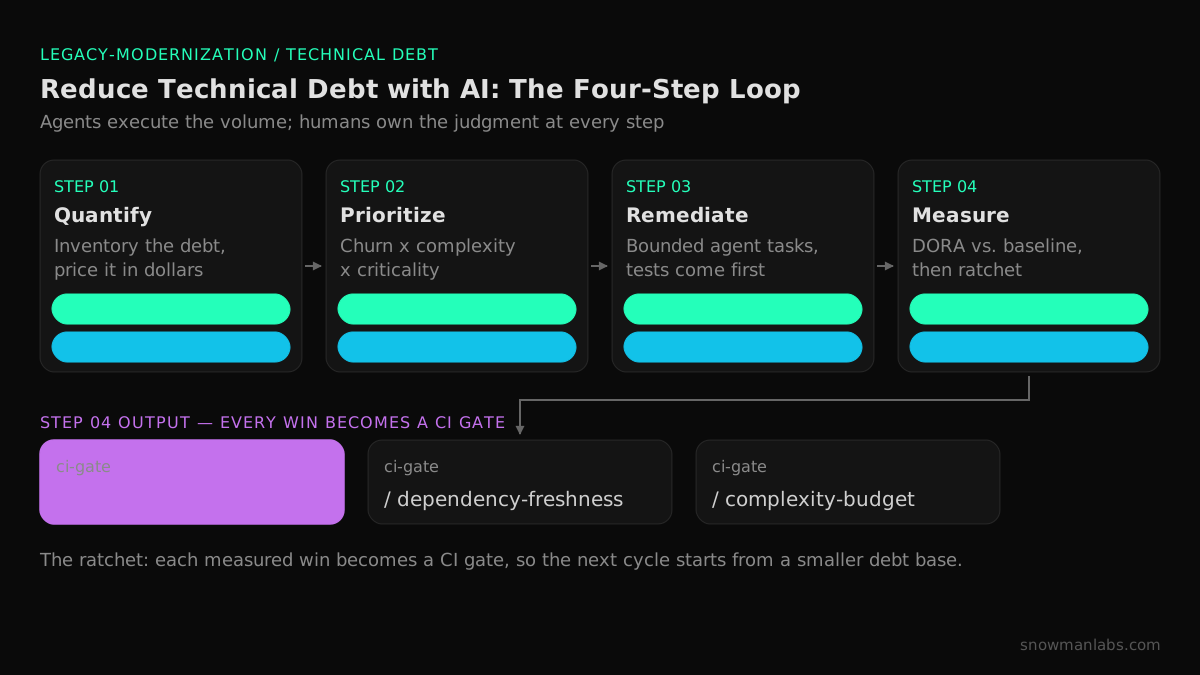
The Four-Step Playbook to Pay Down Technical Debt with AI
Step 1 — Inventory and quantify the debt in business terms
Run an agent-driven scan of the estate and attach money to what it finds: maintenance spend, incident load, and delivery drag attributed to specific systems and modules. (For the full discovery method — what agents map, the scoring dimensions, and the deliverables to demand — see our guide to the AI legacy system assessment.) McKinsey's core recommendation is to treat debt like financial debt — measured, reported, and consciously managed — and that is what wins the board conversation. Where the debt lives in systems whose entire run cost is the problem, the system-level cost model and reduction levers are covered in how to reduce legacy application maintenance cost. Capture a delivery baseline (deployment frequency, lead time, change-failure rate) before touching anything; without it, Step 4 is theater.
Step 2 — Prioritize by hotspot, not by annoyance
Rank remediation candidates by churn × complexity × business criticality — where the interest payments are actually being made — rather than by which code engineers most dislike. Stable, ugly code that nobody changes can wait indefinitely; a merely awkward module in the middle of every feature path cannot. This is also where you decide what not to fix: debt in systems scheduled for retirement is paid off by the retirement, not by refactoring.
Step 3 — Remediate in supervised agent waves
Execute the top of the ranked backlog as bounded agent tasks with explicit acceptance criteria, in waves small enough to review honestly. Every wave follows the same discipline: characterization tests first, then the change, then human review risk-tiered by blast radius — a translated utility library gets a lighter gate than anything touching money or PII. For estates where the debt has metastasized into full modernization scope, the wave model scales up into the five-phase program in our pillar on AI-powered legacy modernization.
Step 4 — Measure, report, and ratchet
Compare delivery metrics against the Step 1 baseline using the DORA metrics, plus debt-specific indicators: hotspot count, coverage on critical paths, EOL dependencies remaining, and share of maintenance spend. Then ratchet: convert each win into a CI gate so the debt cannot silently return — coverage thresholds, dependency freshness checks, complexity budgets. The full instrumentation approach, including how to build the CIO-grade business case, is in how to measure ROI from AI in software engineering.
Don't Let AI Create More Debt Than It Removes
The uncomfortable counterweight: the same tools that pay down debt are generating it at unprecedented volume. IBM's analysis is blunt — AI can compound technical debt by producing large volumes of plausible code quickly, along with new debt categories the industry barely has names for yet: brittle prompts, unreviewed generated logic, model-dependent behavior.
The answer is not less AI; it is matching AI's production speed with equally automated quality controls:
- Every agent-written change passes the same gates as human code — static analysis, tests, review — and stricter ones where your regulator will ask.
- Track provenance. Tag AI-authored changes in version control so audits and incident reviews can distinguish them.
- Verify against production behavior, not just test suites. Generated code that passes tests can still diverge from runtime reality — the problem runtime intelligence tooling addresses, and the reason we argue that production-safe AI-generated code depends on runtime context.
- Refuse unbounded mandates. Agents get scoped tasks with acceptance criteria, never standing permission to "improve the codebase."
Governance is what converts agent throughput into debt actually retired rather than debt relocated.
What AI Can't Fix About Technical Debt
Honesty about the boundary keeps programs credible:
- Context. As one CIO-facing analysis puts it, AI doesn't see the internal politics that delayed a rewrite or the launch deadline that forced a shortcut. Whether a strange pattern is debt or a load-bearing decision requires institutional memory.
- Incentives. Debt accumulates because organizations reward shipped features over maintained systems. No model changes your incentive structure; leadership does.
- Architecture judgment. Agents surface seams and map coupling; choosing target architectures that serve the next five years of product strategy is senior human work.
- The decision to tolerate. Some debt is rational to carry — Martin Fowler's technical debt quadrant exists because prudent, deliberate debt is a legitimate tool. Deciding which debt to keep is a business call, not a code smell.
FAQ
Can AI fix technical debt on its own?
No. AI agents can autonomously execute scoped remediation tasks — refactoring, test generation, documentation, dependency upgrades — but they cannot decide what counts as debt, judge business criticality, or own architecture decisions. Every credible program pairs agent execution with human prioritization and risk-tiered review. Plan for autonomy at the task level and human control at the decision level.
How do you measure technical debt?
Combine code-level signals (complexity, duplication, coverage, dependency age, churn) with business-level costs (maintenance spend share, incident load, delivery drag on the roadmap). McKinsey's approach of expressing debt as a percentage of technology-estate value — CIOs put it at 20–40 percent — is effective for board-level reporting, while DORA delivery metrics track whether remediation is actually improving throughput.
How do you prioritize which technical debt to pay down first?
Rank by hotspot value: modules that are both high-churn and high-complexity, weighted by business criticality. Debt in code you change weekly costs you every week; debt in stable code you never touch may cost nothing. Deprioritize systems scheduled for retirement, and fix testing debt first on anything you intend to refactor — it is the precondition for safe change.
Does AI-generated code increase technical debt?
It can, and at scale: unreviewed AI code accumulates the same debt as unreviewed human code, faster. IBM's Institute for Business Value warns that AI both accelerates debt creation and enables remediation. The difference is governance — quality gates on every merge, provenance tracking for AI-authored changes, and runtime verification — not abstinence.
How much does technical debt cost enterprises?
McKinsey's CIO survey puts the principal at 20–40 percent of technology-estate value, with 10–20 percent of new-product budgets diverted to debt-related issues. IBM's IBV research adds the strategic cost: 81 percent of executives say technical debt is already constraining their AI initiatives, which makes debt reduction a prerequisite for the rest of the AI agenda.
What is the fastest way to reduce technical debt in a legacy system?
Start where agents are strongest and risk is lowest: generate characterization tests and documentation for the highest-churn modules, then execute dependency and framework upgrades as supervised agent tasks. Those three moves build the safety net, recover lost knowledge, and retire the most mechanical debt — and they create the conditions for deeper refactoring or modernization waves afterward.
Should we stop feature work to pay down technical debt?
Generally no. Dedicated "debt sprints" lose the budget fight and freeze the roadmap. The agentic model makes the trade-off less brutal: agent workstreams remediate debt in parallel with feature delivery, supervised by a review rotation rather than consuming full sprint capacity. Reserve concentrated pauses for genuine emergencies like a security-critical EOL platform.
Conclusion: Treat Debt Like a Balance Sheet, Staff It with Agents
Technical debt stopped being a hygiene topic the day it started blocking AI adoption — which, per IBM's research, is now the case for four out of five enterprises. The playbook above is how we run it: quantify the debt in money, prioritize by hotspot evidence, remediate in supervised agent waves with tests first and review always, measure against the baseline, and ratchet the gains into CI so the debt cannot creep back. Agents changed the cost of the work; they did not change the need for judgment about which work matters.
If you want a quantified picture of your own debt position — which of it is agent-suitable, what it costs you today, and what a 90-day remediation plan looks like — start with the AI Readiness Assessment. And when the debt has grown into whole systems that need replacing rather than repairing, our legacy application modernization services run the assessment-to-execution program end to end, pairing senior engineers with parallel agent workstreams.
Find your highest-value path to agentic delivery.
Map your readiness, delivery constraints, and first 90-day opportunity with the Snowman Labs AI Readiness Diagnostic.