How to Reduce Software Development Costs: A CTO Playbook
How to reduce software development costs without cutting output: where the money actually goes, six levers ranked by impact, and the cuts that backfire.
 By Danilo Brizola
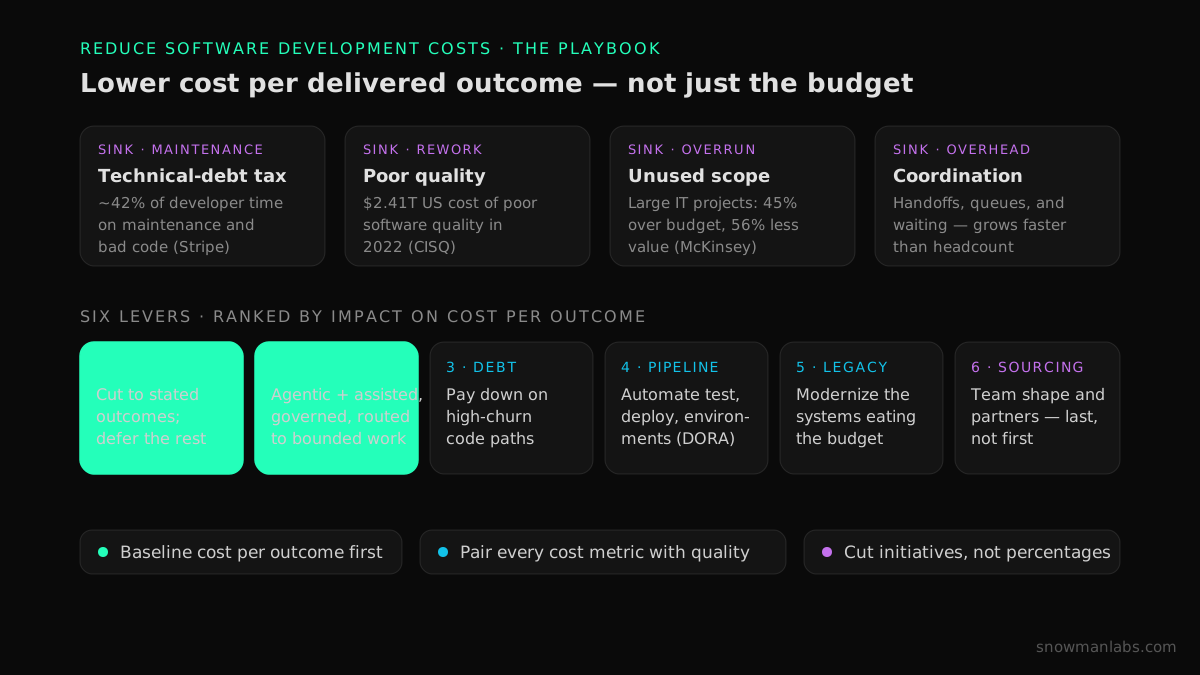
The durable way to reduce software development costs is to lower your cost per delivered outcome — not to cut budget line items and hope output survives. Most engineering budgets don't leak where finance looks. They leak in maintenance and technical debt (which consume roughly 42% of developer time, per Stripe's survey of engineers and C-suite executives), in rework caused by poor quality, in coordination overhead, and in features nobody uses. This playbook is for CIOs, CTOs, and VPs of Engineering who need to take real money out of the development budget without shipping less: where the costs actually sit, six reduction levers ranked by impact, and the cost cuts that reliably backfire.
Where software development costs actually go
Before cutting anything, understand the shape of the spend. In an enterprise software organization, people costs — salaries, benefits, contractors — typically account for the large majority of the budget, with tooling, cloud, and licenses making up the rest. That means meaningful cost reduction is about what your engineers spend their hours on, not about shaving license fees.
Four sinks absorb most of the waste:
| Cost sink | What it looks like | Evidence |
|---|---|---|
| Maintenance and technical debt | Engineers babysitting legacy code instead of building | Developers spend ~42% of their week on maintenance and bad code (Stripe, The Developer Coefficient) |
| Poor quality and rework | Defects found late, incidents, rewrites of "finished" work | Poor software quality cost the US economy an estimated $2.41 trillion in 2022 (CISQ) |
| Scope and schedule overrun | Projects growing past their business case | Large IT projects run 45% over budget on average while delivering 56% less value than predicted (McKinsey & Oxford) |
| Coordination overhead | Meetings, handoffs, waiting on other teams, approval queues | Grows non-linearly with team size and system coupling; visible as long cycle times with low hands-on-keyboard time |
Notice what's not on the list: developer salaries being "too high." If your cost per delivered outcome is bad, replacing engineers with cheaper engineers usually makes it worse — the sinks above don't care what the people stuck in them earn.
Measure before you cut: cost per delivered outcome
The prerequisite for cost reduction is a unit-cost baseline: quarterly engineering spend divided by production changes delivered (or another outcome unit your business trusts). A $2.25M quarter that ships 600 changes costs $3,750 per change; every lever below either lowers the numerator or raises the denominator, and you can verify which in your own data.
Without that baseline, cost programs default to what's easy to measure — headcount and licenses — and organizations routinely cut spend 15% while quietly cutting throughput 30%, which is a cost increase per unit of output. The full method for building the baseline, instrumenting delivery, and attributing changes is in our pillar on how to measure ROI from AI in software engineering; the metric portfolio that keeps the baseline honest (throughput, cycle time, change failure rate) is in our leader's guide to engineering productivity metrics.
Two rules for the measurement phase:
- Freeze the baseline before announcing the program. Once teams know cost per outcome is being watched, the metric moves for reasons other than efficiency.
- Pair every cost metric with a quality counterweight. Track change failure rate and incident volume next to cost per change, so savings that resurface as defects are visible within a quarter.
Six levers to reduce software development costs, ranked
Ranked by typical impact on cost per delivered outcome, with time-to-impact and the main risk stated honestly:
| # | Lever | Typical impact | Time to impact | Main risk |
|---|---|---|---|---|
| 1 | Cut scope to outcomes | High | Immediate | Cutting muscle, not fat |
| 2 | Add AI-assisted and agentic capacity | High | 1–2 quarters | Ungoverned quality erosion |
| 3 | Pay down the technical-debt tax | High | 2–4 quarters | Treated as optional, never funded |
| 4 | Automate the delivery pipeline | Medium | 1–2 quarters | Automating a broken process |
| 5 | Modernize the legacy systems eating the budget | High | 2–6 quarters | Big-bang rewrite failure |
| 6 | Restructure team shape and sourcing | Medium | 2–4 quarters | Coordination costs eat the savings |
1. Cut scope to outcomes, not features
The cheapest code is the code you don't write. McKinsey and Oxford's study of over 5,000 IT projects found the average large project delivers 56% less value than predicted — meaning a large share of enterprise development spend goes to functionality that never earns back its cost. Practical discipline: every initiative names the business outcome and the smallest release that tests it; anything that can't state its outcome is deferred by default. This is MVP thinking applied to an enterprise portfolio, and it routinely removes 20–30% of planned work without removing any planned value.
2. Add AI-assisted and agentic capacity — with governance
AI is the one lever that raises the denominator (outcomes) instead of squeezing the numerator (spend). The evidence is real but task-dependent: a controlled GitHub/Microsoft experiment measured a 55.8% speed-up on a scoped coding task, and McKinsey's lab study found 35–45% time savings on code generation but under 10% on high-complexity work. The honest counterpoint: a 2025 METR randomized trial found experienced developers on familiar codebases were 19% slower with AI while believing they were faster. The lesson is not "AI doesn't work" — it's that gains come from routing the right work to AI and verifying the output, not from handing out licenses.
Two cost-specific implications:
- Audit the licenses you already own before buying more. Most enterprises pay for seats that are barely used; the utilization audit, per-tool cost math, and expand/hold/cut thresholds are in our guide to AI coding tools ROI.
- The bigger savings come from delegation, not autocomplete. Assigning bounded, verifiable work — migrations, test coverage, routine ticket volume — to coding agents under senior review is the operating model of agentic engineering, and it converts backlog that would have required hiring into work absorbed by the existing team. That capacity story is covered in how to reduce an engineering backlog without hiring.
Governance is what keeps the savings from leaking back out as defects: mandatory human review, staged rollout, and change-failure-rate monitoring from day one.
3. Pay down the technical-debt tax
If your engineers spend anything like the surveyed average of 42% of their time on maintenance and bad code, technical debt is your single largest addressable cost — a recurring tax on every future feature. The mistake is treating debt paydown as a cost increase ("we can't afford a cleanup quarter"). Structured correctly, it's self-funding: target the debt on the highest-change-frequency code paths first, where interest is actually being paid, and measure the payback in cycle time on subsequent changes. AI has materially changed the economics here — automated characterization tests, bulk refactoring, and dependency upgrades make paydown dramatically cheaper than it was three years ago. The prioritization framework and tooling are in our CTO playbook on how to reduce technical debt with AI.
4. Automate the delivery pipeline
Manual testing, manual deployment, and manual environment management are pure cost: they consume senior time, slow every release, and produce the late-discovered defects that dominate rework budgets. The DORA research program has shown for a decade that elite delivery performance — deploy frequency, lead time, change failure rate, recovery time — correlates with automation of exactly these steps, and that speed and stability rise together rather than trading off. Cost framing: every hour of pipeline automation is bought once and repays on every subsequent release. If you adopt AI capacity (lever 2), pipeline automation stops being optional — agent-scale throughput through a manual release process just moves the bottleneck. How the DORA metrics shift once AI writes a meaningful share of the code is covered in DORA metrics for AI-assisted software teams.
5. Modernize the legacy systems eating the budget
Some maintenance cost can't be optimized away because the system itself is the cost driver: a monolith nobody fully understands, a stack whose specialists are retiring, an architecture where every change touches everything. When one system absorbs a disproportionate share of maintenance hours and incident time, modernization is a cost-reduction program with a measurable payback — provided you avoid the big-bang rewrite, which is where McKinsey's 45%-over-budget statistic lives. The incremental path — strangler-fig extraction, AI-assisted documentation and characterization, module-by-module migration with the business running throughout — is laid out in how to modernize legacy systems without a big-bang rewrite. Decision rule: if a system consumes over a third of a team's capacity in maintenance, price the modernization against three more years of that run rate.
6. Restructure team shape and sourcing — last, not first
Most cost-reduction advice starts here: outsource, offshore, blend rates. It's last on this list deliberately. Sourcing changes reduce the rate per hour while frequently increasing the hours per outcome — handoffs, timezone latency, rework from thin context — which is why so many offshoring programs show savings on the invoice and losses in the delivery data. Rate arbitrage works only when the work is well-bounded and the accountability model is explicit: a partner who owns outcomes against your baseline (cost per delivered change, change failure rate), not a body shop billing hours. The same logic applies internally — smaller, senior-heavy teams with AI leverage now frequently beat larger mixed teams on cost per outcome, because coordination overhead falls faster than payroll. Whatever sourcing structure you choose, hold it to the measurement discipline from the baseline section, or you won't know whether it worked.
Cost cuts that backfire
Five moves that reduce the budget and raise the cost per outcome:
- Cutting QA and testing. Defects found in production cost multiples of defects found in development — the core mechanism behind CISQ's $2.41 trillion poor-quality estimate. Test automation is a cost reducer; test headcount cuts without automation are a cost deferral.
- Across-the-board headcount cuts. Uniform cuts remove your best people at the same rate as your weakest and leave every remaining team below critical mass. If capacity must shrink, cut whole initiatives (lever 1), not percentages of every team.
- Cheapest-vendor outsourcing. Selecting a partner on rate card alone optimizes the one number that doesn't predict total cost. Score vendors on cost per delivered outcome and defect escape rate instead.
- Freezing modernization to "save money." Deferring lever 5 doesn't remove the cost; it compounds it at the maintenance run rate while the option value of the team's system knowledge decays.
- Buying AI licenses as a cost cut, without enablement. Licenses without workflow redesign, training, and governance produce the plateau documented in adoption studies — spend goes up, throughput barely moves, and the program is defunded at renewal. The funding structure that avoids this is in how to build the business case for AI engineering.
A 90-day plan to lower cost per outcome
- Weeks 1–2 — Baseline. Capture quarterly engineering spend, outcomes delivered, cycle time, and change failure rate. Compute cost per delivered change. Freeze it.
- Weeks 3–4 — Map the sinks. Estimate maintenance share by team, license utilization, and the top three systems by maintenance and incident load. This is your addressable-waste map.
- Weeks 5–6 — Cut scope. Portfolio review against stated outcomes; defer everything that can't name its business result. Bank the freed capacity — don't backfill it with new requests yet.
- Weeks 7–10 — Pull two levers. Typically an AI-capacity pilot on bounded, verifiable work plus either pipeline automation or targeted debt paydown on the highest-churn code path. Instrument both against the baseline.
- Weeks 11–12 — Report in unit economics. Present cost per outcome, before and after, with quality counterweights alongside. Kill what didn't move the number; scale what did.
- Beyond day 90 — Price the structural moves (modernization, sourcing) against the measured run rate, now that you have real numbers to price them against.
FAQ
Why is software development so expensive?
Because the cost is mostly senior human judgment, not code: architecture, integration with existing systems, security, testing, and long-term maintenance. Maintenance alone consumes around 42% of developer time in industry surveys, so the sticker price of building a system understates the cost of owning it — which is also where most of the savings opportunity sits.
What is the biggest cost driver in software development?
People's time, and specifically where it goes: maintenance, technical debt, rework from late-found defects, and coordination overhead typically absorb more budget than new-feature work. Reducing cost sustainably means shifting hours from those sinks back to delivery, not reducing rates per hour.
How do I reduce software development costs without sacrificing quality?
Measure cost per delivered outcome with quality counterweights (change failure rate, incident volume), then pull levers that raise output rather than cut inputs: scope discipline, governed AI capacity, debt paydown on high-churn code, and pipeline automation. Quality-destroying cuts show up in the counterweight metrics within a quarter — watch them.
Does AI actually reduce software development costs?
Yes, when work is routed and verified deliberately — controlled studies show 35–55% savings on well-suited tasks like code generation and migration — and no, when licenses are distributed without enablement; one randomized trial even measured experienced developers getting 19% slower. Measure against your own baseline rather than trusting vendor claims in either direction.
Is outsourcing the best way to cut development costs?
It's a viable lever but rarely the first one: lower hourly rates often come with higher hours per outcome due to handoffs and rework. It works when the scope is well-bounded and the partner is accountable to outcome metrics — cost per delivered change and defect escape rate — rather than billable hours.
What percentage of software cost is maintenance?
Industry studies consistently put ongoing maintenance at half or more of total lifetime cost, and Stripe's developer survey found engineers spending roughly 42% of their working week on maintenance and bad code. Any cost program that only prices the build phase is optimizing the smaller half of the spend.
Decide with your own numbers
You can now do what most cost programs skip: baseline cost per delivered outcome, map where the budget actually leaks, and pull the two or three levers with the best payback for your situation — with quality metrics standing guard so the savings are real. Snowman Labs runs this as a measured program — baseline first, governed AI capacity second, structural moves priced against your real run rate — drawing on 400+ delivered projects and a target of 40–60% time-to-market reduction in agentic engineering engagements. If you want an outside read on where your budget is leaking and which levers would pay back fastest, start with our AI readiness assessment.
Find your highest-value path to agentic delivery.
Map your readiness, delivery constraints, and first 90-day opportunity with the Snowman Labs AI Readiness Diagnostic.