How to Scale Software Engineering Teams: A CTO's Guide
How to scale software engineering teams without output collapsing: structure before headcount, onboarding as an asset, AI-era throughput, honest metrics.
 By Danilo Brizola
To scale software engineering teams is to grow delivered output — not headcount — and the two diverge by default: output grows roughly linearly with people while coordination overhead grows with the square of team size, so an organization that only adds engineers gets slower per engineer every quarter. The way out is knowable: fix the structure before adding people, treat onboarding as a replicable asset, let AI raise throughput per team before you raise team count, and instrument the whole climb with cost per outcome so scaling stays an economic claim rather than an org-chart achievement. This guide is for CTOs, VPs of Engineering, and CIOs planning growth from roughly 10 engineers toward 50, 100, or beyond — it covers the arithmetic that breaks naive scaling, the structural moves at each stage, the hiring and onboarding mechanics, and the metrics that tell you honestly whether the organization you are paying for is getting more done.
Why scaling engineering teams breaks: the arithmetic
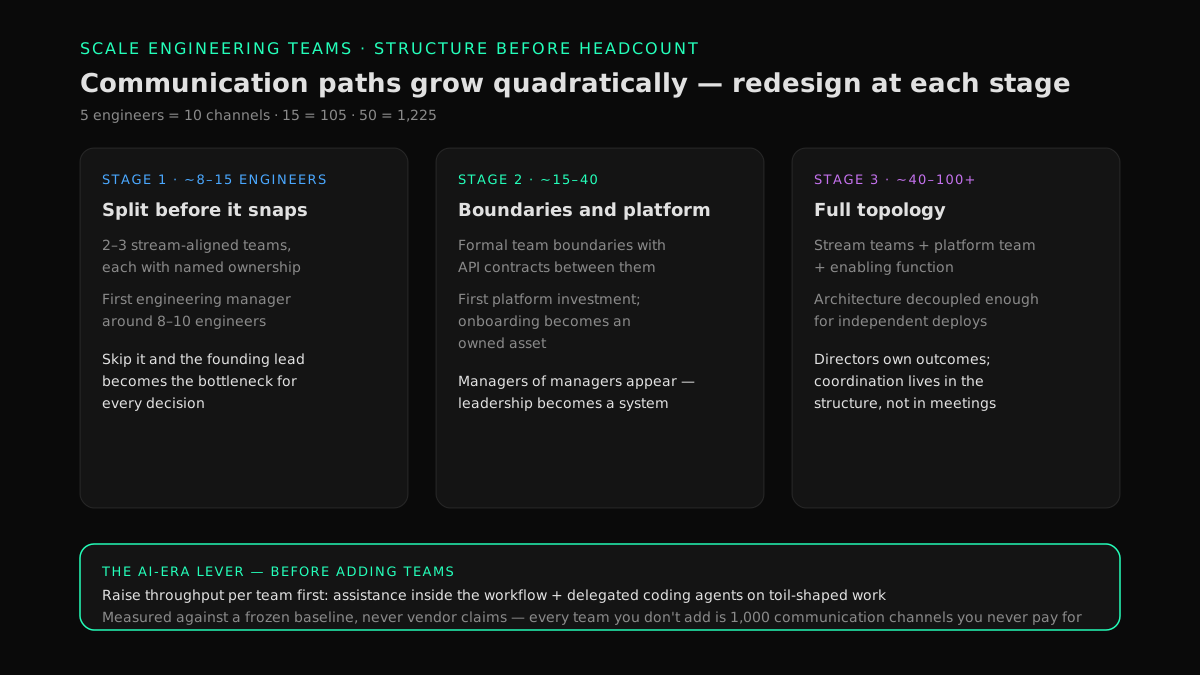
Scaling breaks because communication paths grow quadratically: a team of 5 has 10 possible pairwise channels, a team of 15 has 105, and a team of 50 has 1,225. Every channel carries meetings, reviews, clarifications, and misunderstandings — which is why Brooks's law (adding people to a late project makes it later) has survived five decades of software management: each new engineer adds linear capacity and superlinear coordination cost, plus one to two quarters of onboarding drag before contributing net throughput.
The practical consequence shows up as a pattern every scaled-up leader recognizes: the 30-engineer organization that ships less than it did at 12. Nothing is wrong with the engineers. The organization crossed the point where its informal structure — everyone knows everything, the founding tech lead reviews everything, deploys are coordinated in one channel — stopped fitting the headcount, and the overhead compounded quietly until it consumed the added capacity.
Two facts follow, and the rest of this guide is built on them:
- Structure, not effort, is the scaling variable. Past roughly 15 engineers, output is determined more by how teams are partitioned and decoupled than by who is on them.
- Headcount is the most expensive and slowest capacity instrument you have. The U.S. Bureau of Labor Statistics puts mean software developer pay near $140,000 before benefits, overhead, and ramp time — and recruiting plus onboarding is a multi-quarter pipeline. Cheaper, faster levers should be exhausted first, which is why the companion question — how to increase engineering capacity without hiring — is worth answering before any growth plan is signed.
Decide what you are scaling before you scale it
The honest first step is a baseline: what does your organization deliver per quarter today, and at what cost per outcome? Scaling only makes economic sense if that ratio holds or improves as headcount grows — and you cannot know whether it holds unless you froze the number before growing. The method is the core of our pillar on how to measure ROI from AI in software engineering: total engineering cost divided by delivered production outcomes, tracked quarterly.
With the baseline frozen, sequence the levers by cost:
- Reclaim and unblock existing capacity first. Most organizations discover 30–40% of paid engineering hours going to maintenance drag, queues, and rework; recovering even part of that is several engineers' worth of capacity at zero marginal salary.
- Raise throughput per team with AI second — assistance and delegated agents, covered below, arrive in weeks rather than quarters.
- Grow headcount third, into a structure that is already flowing — so each hire lands at full marginal value instead of feeding a bottleneck.
This ordering is the biggest change in scaling doctrine of the last decade: capacity and headcount have partly decoupled, and a scaling plan written like it is 2019 — a hiring plan and nothing else — now overpays for output that two cheaper levers could have produced. What has not changed: when demand is durable and the system flows, hiring compounds, and the rest of this guide is about making those hires land well.
Signs you have outgrown your structure, not your headcount
Before adding anyone, check whether the constraint is actually people. These signals say the structure is the problem — and more hires will amplify it:
- Everything routes through the same two or three seniors. Review queues, architectural questions, and incident escalations all wait on the same names. Adding juniors deepens the queue at the bottleneck instead of draining it.
- Cross-team work dominates. Most roadmap items now require coordinated changes across several teams — a sign team boundaries no longer match the product's seams.
- Meetings and alignment consume the calendar. When engineers report losing whole days to coordination, the quadratic overhead has arrived.
- Deploys are events. If shipping requires cross-team synchronization windows, the architecture and the org have coupled into one slow unit.
- Quality degrades as you grow. Escaped defects and incident load rising with headcount is the signature of scaling into a structure that cannot absorb it.
If two or more of these hold, restructure first. Adding engineers to a broken structure multiplies the problem — every additional person raises the coordination bill on day one and pays back capacity only quarters later.
Structure before headcount: design the org for flow
The structural goal is teams that can deliver end to end without waiting on each other. Two long-standing results define the target. Conway's law says your architecture will mirror your communication structure — so team design is architecture design. And DORA's research on loosely coupled teams finds that when teams can test, deploy, and modify their systems independently, small teams stay productive even inside organizations of tens of thousands of developers — independence, not size, is what preserves tempo at scale.
The current standard vocabulary for the target structure is Team Topologies (Skelton & Pais), with four team types:
| Team type | What it does | When you need it |
|---|---|---|
| Stream-aligned | Owns a product or business domain end to end — the default type most teams should be | From the first team split onward |
| Platform | Builds internal services (CI/CD, environments, golden paths) that keep stream teams fast | Typically past a few dozen engineers, when duplicated infra work appears across teams |
| Enabling | Temporarily coaches teams through a capability gap (testing, observability, AI adoption) | During any major capability rollout |
| Complicated-subsystem | Owns a component needing rare, deep expertise | Only when a genuine specialist subsystem exists |
Three sizing rules keep the structure honest. Keep individual teams small — Amazon's two-pizza rule pairs small size with the more important property, single-threaded ownership: one team, one owner, one thing. Partition by product seam, not by technology layer — frontend/backend/QA splits force every feature through three queues. And give each team a real interface: an API, a service boundary, or a module contract that lets others consume its work without a meeting.
The scaling stages: what changes at 10, 30, and 100 engineers
Scaling is punctuated, not smooth — organizations hit predictable break points at roughly each doubling. What good looks like at each stage:
| Stage | Structural move | Leadership move | What breaks if you skip it |
|---|---|---|---|
| ~8–15 engineers | Split into 2–3 stream-aligned teams with named ownership | First engineering manager around 8–10, when the founding lead spends 30–50% of time on management | The hero bottleneck: everything waits on the founders |
| ~15–40 engineers | Formal team boundaries with API contracts; first platform investment; onboarding program becomes an owned asset | Managers of managers appear; management and delivery structures separate | Cross-team gridlock; each hire ramps slower than the last |
| ~40–100+ engineers | Full topology: stream teams + platform team + enabling function; architecture decoupled enough for independent deploys | Directors own groups of teams; leadership designs systems and grows leaders rather than executing | Deploy trains, quality erosion, alignment drift, attrition |
Two notes on the table. First, the manager threshold is about span, not status: add managers when one leader genuinely cannot keep up with 1:1s, hiring, and delivery attention — not as a tenure reward, and never by promoting your best engineer into a role no one trained them for. Second, the platform team is the scaling investment leaders most often make too late: once three teams each maintain their own pipelines and environments, you are paying triple for undifferentiated work that a platform team would amortize — and the delivery-system drag it removes is the same drag we diagnose in how to accelerate software delivery.
Hiring and onboarding at scale
At scale, hiring quality is a pipeline property, not an interviewing talent. The mechanics that keep a growth plan from diluting the team:
- Hire for the gap, not the archetype. Write the role from the capacity ledger — which team, which work class, which missing skill — instead of cloning the last senior you hired. A structure-first plan tells you precisely where a hire lands and what it must unblock.
- Stagger the ramp. Onboarding ten engineers simultaneously into a 20-person org halves everyone's productivity for a quarter, because ramping consumes senior attention — the scarcest resource you have. Cohorts of two or three per team, spaced, keep the mentoring load absorbable.
- Make onboarding a replicable asset. A documented golden path — environment up in a day, first merged change in week one, an assigned buddy, a 30/60/90 expectations doc — is the difference between a six-week ramp and a six-month one. Measure time-to-tenth-merged-PR per cohort and improve it like any other system.
- Write the knowledge down before you need it. Undocumented architecture is a scaling ceiling: every new hire ramps by interrupting a senior. AI has quietly changed the economics here — generating and maintaining current system documentation is now cheap enough that "the codebase is the documentation" is no longer defensible.
Scaling in the AI era: raise throughput per team first
The newest scaling lever does not add people at all. AI-assisted and agent-based development raise the output of the teams you already have — assistance speeds engineers inside the workflow, and delegated coding agents execute well-specified work classes (dependency upgrades, test coverage, migrations, documented bugs) as parallel lanes under senior review. For a scaling leader this changes the plan's arithmetic: a 30-engineer organization that captures even a measured 10–15% throughput gain has added four engineers' worth of output with zero additional coordination paths — the one form of capacity that does not feed Brooks's law.
Three honesty rules keep this lever real. First, measure it against your frozen baseline, not vendor claims — the measurement traps and the six levers that actually move the number are in our guide to improving developer productivity with AI. Second, scale the verification system with the volume: the 2025 DORA report found AI amplifies whatever system it lands in — throughput up, instability up wherever testing and review are weak — so review capacity, CI gates, and rollback discipline must grow ahead of agent volume. Third, treat adoption as an organizational rollout with governance and training, not a licensing event; sequencing that rollout is what a 90-day AI engineering enablement plan is for.
There is also a structural implication worth stating plainly: in AI-heavy teams the constraint moves to review and specification. Senior engineers stop being the people who type the most code and become the people who define work precisely and verify it rigorously. Plan your senior ratio, your review norms, and your promotion criteria around that shift — a scaling plan that stocks up on juniors while the constraint is senior judgment buys the wrong inventory.
Keep scaling honest: the metrics that catch dilution early
Scaling dilution — output per engineer quietly falling as headcount rises — is invisible in activity metrics and obvious in outcome metrics. Four instruments, read quarterly:
- Cost per delivered outcome, against the frozen baseline. The single number that says whether scaling is working: flat or falling is a win; rising is dilution, and the trend catches it quarters before anyone feels it.
- Per-team DORA metrics — deployment frequency, lead time, change failure rate, time to restore — because org averages hide the one team whose flow broke. How to run them without gaming, including in AI-assisted teams, is in our guide to DORA metrics for AI-assisted software teams.
- Cross-team dependency share — the fraction of roadmap items requiring multi-team coordination. The structural health metric: rising dependency share means the boundaries are drifting away from the work.
- Ramp and retention — time-to-productivity per hiring cohort, and regretted attrition. Scaling that burns people out returns its capacity gains with interest.
Resist the temptation to measure individuals harder as you grow; the failure modes of activity metrics, and the full catalog worth choosing from, are in our review of engineering productivity metrics. The scoreboard for scaling is the organization's outcome rate, its stability, and its unit cost — everything else is diagnostics.
FAQ
How do you scale a software engineering team?
Sequence four moves: baseline your delivered output and cost per outcome; fix the team structure so teams own domains end to end and deploy independently; raise throughput per team with measured AI adoption; then grow headcount in staggered cohorts into the structure that is already flowing. Scaling headcount first and structure later is the expensive order — every hire lands in the bottleneck.
What is a good size for a software engineering team?
Five to nine people — small enough for Amazon's two-pizza rule, large enough to own a domain end to end. The deeper requirement is single-threaded ownership: one team, one clearly bounded thing it can build, test, and deploy without waiting on another team. When a team needs to grow past about ten to cover its scope, split the scope, not just the team.
When should you add engineering managers?
Around eight to ten engineers, when the founding technical lead is spending 30–50% of their time on management work — 1:1s, hiring, planning, reviews. Add subsequent managers when a leader's span genuinely exceeds their attention, not as a promotion reward, and separate the management structure from the delivery structure as you pass roughly 30 engineers.
Why does adding more engineers slow delivery down?
Because coordination overhead grows with the square of team size while capacity grows linearly — Brooks's law. Each new engineer also consumes onboarding and mentoring capacity for one to two quarters before contributing net throughput. If the underlying constraint is a review queue, an entangled architecture, or maintenance drag, new engineers feed the constraint faster without removing it.
How should you structure an engineering team as it grows?
Around the flow of work: stream-aligned teams owning product domains as the default, a platform team once duplicated infrastructure work appears across teams, enabling teams for temporary capability gaps, and complicated-subsystem teams only for genuine specialist components. Partition by product seam rather than technology layer, and give every team an interface others can consume without a meeting.
How does AI change engineering team scaling?
It partly decouples output from headcount: assistance raises each engineer's throughput and delegated agents add parallel execution lanes, so a team's capacity is no longer fixed by its size — and AI-derived capacity adds no new coordination paths. It also moves the constraint to specification and review, so senior judgment, verification systems, and governance must scale ahead of agent volume.
How do you maintain code quality while scaling a team?
Make quality structural rather than heroic: enforced review norms with turnaround expectations, CI gates that block regressions, test coverage funded where incidents cluster, and per-team change failure rate and restore time watched as first-class metrics. Quality erosion during scaling is usually a structure signal — too much code flowing through too few reviewers — not a talent problem.
Scale output, and let headcount follow
The organizations that scale well treat headcount as the last lever, not the first: they baseline cost per outcome, restructure for independent flow, capture the AI throughput gain with governance in place, and then hire into a system that converts each new engineer to full marginal value in weeks instead of quarters. The ones that scale badly buy the org chart first and discover the arithmetic later.
If you are planning a growth phase and want a grounded read on your starting point — where your structure will break next, how much throughput your current teams can still gain before headcount is the answer, and whether your verification systems can absorb agent-scale delivery — start with the Snowman Labs AI readiness assessment. It is the same diagnostic we use to scope AI engineering enablement engagements: measure first, restructure second, multiply third — and hire, when the time comes, into an organization built to keep what it pays for.
Find your highest-value path to agentic delivery.
Map your readiness, delivery constraints, and first 90-day opportunity with the Snowman Labs AI Readiness Diagnostic.