How to Accelerate Software Delivery: An Enterprise Guide
How to accelerate software delivery at enterprise scale: find the real constraint, fix flow before buying tools, and use AI without trading stability.
 By Danilo BrizolaUpdated
 To accelerate software delivery, treat delivery as a system with one binding constraint at a time: instrument where changes wait, remove the biggest queue, automate the pipeline that feeds it, and only then amplify the system with AI. Organizations that skip that order — buying tools or adding headcount before finding the constraint — reliably spend more and ship no faster, because in most delivery systems the code is only being actively worked on for a fraction of its calendar life. The rest is waiting.
This guide is for CIOs, CTOs, and VPs of Engineering who own a slow roadmap and a budget to fix it. (This article covers the engineering delivery system itself; for the joint product-and-engineering view — prioritization, capacity, and scope — see our guide to accelerating a product roadmap.) It covers what actually slows enterprise delivery, the four families of acceleration levers ranked by payback, why headcount is usually the weakest lever, and how to verify — with numbers a CFO will accept — that delivery is genuinely getting faster.
What actually slows software delivery down
The instinctive diagnosis — "our engineers don't produce enough" — is almost always wrong. When you map how a change actually travels from idea to production, delivery time is dominated by queues and drag that no individual can fix:
| Constraint | What it looks like | Where the time goes |
|---|---|---|
| Review and approval queues | PRs waiting days for pickup; change advisory boards | Pure waiting — no one is working on the change |
| Oversized batches | Multi-week feature branches, big-bang releases | Multi-round reviews, merge conflicts, risky deploys |
| Excess work in progress | Everyone 80% done with four things | Context switching, everything waits on everyone |
| Manual pipeline steps | Hand-run test suites, ticket-gated deploys, release trains | Days of wait added to every change, every time |
| Legacy drag | Tangled modules, missing tests, environments only one person can build | Every change that touches the old core slows down |
| Organizational structure | Ten teams needed to ship one feature | Coordination meetings, handoffs, dependency deadlock |
LinearB's benchmark of roughly 3,000 development teams makes the pattern concrete: average cycle time runs about seven days, and roughly five of those days sit in the pull-request process — not in coding. If you want the stage-by-stage method for locating your own version of that queue, we cover it in depth in our guide to improving software delivery cycle time; this article stays at the level above it: which levers to fund, in what order, across an engineering organization.
Speed and stability are not a trade-off
The most durable finding in delivery research is that fast and stable move together. DORA's multi-year analysis of the four key metrics — lead time for changes, deployment frequency, change failure rate, and failed deployment recovery time — consistently shows top performers beating slower organizations on both speed and stability, because the same practices (small batches, automation, fast feedback) produce both.
This matters for how you sell acceleration internally. The objection "if we go faster we'll break things" describes badly run acceleration — cutting review rigor, skipping tests — not acceleration itself. Well-run acceleration reduces risk: smaller changes fail less often and are diagnosed faster when they do. Any acceleration program you fund should therefore carry stability metrics as first-class counterweights, not as an afterthought.
Diagnose before you accelerate
Before funding anything, spend two to four weeks producing three artifacts:
- A value stream map. Walk a handful of recent changes end to end — idea, backlog, start, review, test, deploy — and record elapsed time versus active work time at each step. DORA's value stream mapping guide describes the method; even a whiteboard version exposes where the calendar days actually go.
- Per-stage flow numbers. Pull coding, pickup, review, and deploy times from your Git and deployment tooling, reported as medians and 75th percentiles per team. This turns the value stream map's anecdotes into a ranked list of constraints.
- A frozen baseline. Freeze a 60–90-day lookback of those numbers plus change failure rate before anything changes. Every later claim of acceleration gets measured against this baseline — the same discipline we apply in our framework for measuring AI engineering ROI.
The diagnosis usually lands in an uncomfortable place: the constraint is a queue owned by people — reviews, approvals, environments — rather than a missing tool. That is good news. Queues are the cheapest thing on this page to fix.
The four families of acceleration levers, in payback order
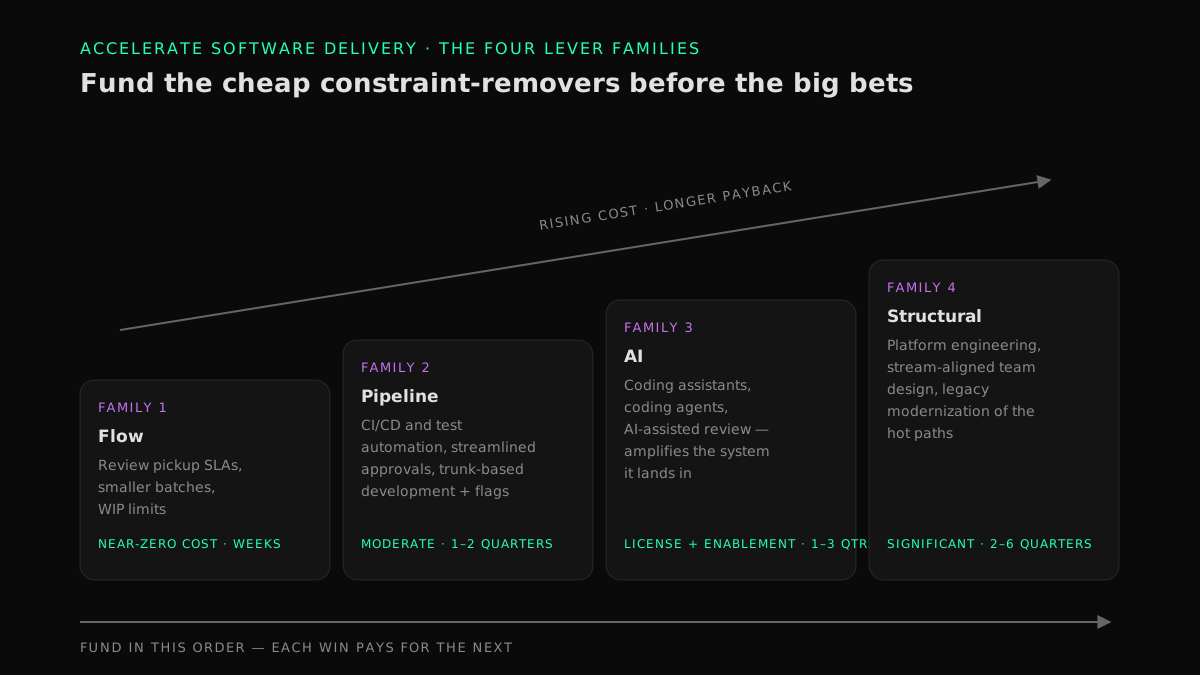
Every credible acceleration lever falls into one of four families. They are ordered here by how fast they typically pay back, which is also the order in which a program should fund them.
| Family | Typical cost | Typical payback | Examples |
|---|---|---|---|
| Flow | Near zero | Weeks | Review SLAs, smaller batches, WIP limits |
| Pipeline | Moderate | One–two quarters | CI/CD, test automation, streamlined approvals |
| AI | License + enablement | One–three quarters | Coding assistants, coding agents, AI-assisted review |
| Structural | Significant | Two–six quarters | Platform engineering, team redesign, legacy modernization |
1. Flow levers: remove the waiting first
The cheapest acceleration available to any enterprise is a working agreement, not a purchase order:
- Put an SLA on review pickup — first review within four business hours is a common, achievable standard — and route review requests where reviewers already work.
- Shrink the batch. Small pull requests move through every downstream stage faster and fail less. Treat anything approaching ~400 changed lines as a candidate for splitting.
- Limit work in progress. Cap concurrent items per person and team; stop starting, start finishing. High WIP is invisible in any single change but taxes all of them.
Flow levers routinely recover days of calendar time per change at essentially zero cost, which is why funding anything else first is a sequencing error.
2. Pipeline levers: automate what people wait for
Once flow discipline exists, automation stops it from eroding:
- Continuous integration and delivery. Every manual step between merge and production — hand-run suites, ticket gates, release trains — adds wait to every change. Automating build, test, and deploy converts deploy time from days to minutes.
- Streamline change approval. DORA's research finding is blunt: heavyweight external approvals such as change advisory boards correlate with slower delivery without reducing failure rates. Peer review plus automated policy checks in the pipeline provides the control a CAB only appears to; in regulated environments, move the evidence collection into the pipeline where auditors can trace it.
- Trunk-based development with feature flags. Short-lived branches merged daily, with unfinished work behind flags, decouple deploying code from releasing features — the mechanism that makes small batches safe.
3. AI levers: amplify a clean system
AI is the acceleration lever with the most noise around it, so it deserves the most honest treatment. Two findings frame it:
- The 2025 DORA report found that AI adoption now correlates with higher delivery throughput — but also with higher instability, because faster authoring pushes more change volume into whatever review, test, and deploy system already exists. AI amplifies the system it lands in: it makes a fast system faster and floods a congested one.
- METR's 2025 randomized trial found experienced developers were actually 19% slower with AI assistance on large codebases they knew deeply — while believing they were faster. Perceived speedup is not evidence; measured deltas against your frozen baseline are.
Practically, AI accelerates delivery in three escalating forms. Coding assistants compress authoring time — real, but usually the smallest slice of the delivery calendar. Coding agents move the needle further by taking whole units of toil off the human plate — test scaffolding, migration mechanics, documentation, review preparation — which thins the queues rather than just feeding them faster; how to structure that shift is the subject of our guide to improving developer productivity with AI. And AI-assisted review and verification attack the queue side directly, making changes smaller, better described, and pre-checked before a human ever looks. Whatever the form, pair adoption with the pipeline guardrails that keep AI-generated code production-safe — the DORA instability finding is what happens when you don't.
4. Structural levers: remove the drag you can't work around
Some constraints survive every process fix because they are built into the organization or the codebase:
- Platform engineering. If every team hand-builds its own pipelines and environments, each one pays the toil tax separately. An internal platform with paved-road pipelines, on-demand environments, and self-service deploys removes that tax once, centrally.
- Team design and cognitive load. When shipping one feature requires coordinating five teams, the constraint is the org chart. Team Topologies-style stream-aligned teams — each able to deliver end to end within its cognitive limits — convert coordination time back into delivery time.
- Legacy modernization. When the slowest thing in the value stream is the codebase itself — missing tests, tangled modules, deploy windows measured in weekends — no flow policy fixes it. Modernizing the hot paths is then the acceleration investment, and it can be run incrementally: our playbook for modernizing legacy systems without downtime covers how to do it without stopping delivery to do so.
Structural levers cost the most and pay back over quarters, not weeks — which is precisely why they come fourth: fund them with the credibility earned from the cheap wins, not instead of them.
Why adding developers rarely accelerates delivery
Headcount is the intuitive lever and usually the weakest one. Brooks's law — adding people to a late project makes it later — holds because new engineers add onboarding load and coordination overhead before they add throughput. More fundamentally: if the constraint is a review queue, a manual pipeline, or a tangled legacy core, more developers feed the queue faster without draining it. Capacity is only the answer when the delivery system is already flowing and demand genuinely exceeds it — a bar most organizations asking "should we hire?" have not met. We make the fuller version of this argument, including what to do instead, in our guide to reducing an engineering backlog without hiring.
How to know delivery is actually accelerating
An acceleration program without a measurement plan becomes a tooling program with better slides. Keep the scorecard small and paired:
- Speed: lead time for changes (or per-stage cycle time) and deployment frequency, as p50/p75 trends per team — the full instrumentation is covered in our guide to DORA metrics for AI-assisted teams.
- Stability counterweights: change failure rate and recovery time, so a falling cycle time with a rising failure rate is read as the net loss it is.
- Business translation: time-to-market for named roadmap outcomes, and cost per delivered outcome — the conversion from flow metrics to money that we anchor in software delivery ROI.
Set targets as ranges against your frozen baseline, not as point promises. For orientation: in our own delivery work at Snowman Labs we target a 40–60% time-to-market reduction on client engagements and structure them to reach a first production milestone in two weeks — targets, stated as such, and the same standard of honesty belongs in your internal business case.
Acceleration anti-patterns
Four failure modes account for most stalled acceleration programs:
- Tool-first acceleration. Buying a platform before naming the constraint — the enterprise version of buying running shoes to fix a traffic jam.
- The program of everything. Launching ten initiatives at once, so when delivery improves (or doesn't), nothing attributable was learned.
- Velocity theater. Chasing story points, commit counts, or AI acceptance rates — activity metrics that inflate on demand while calendar time-to-production stands still.
- Speed by subtraction. Cutting review rigor or test coverage to move faster; the time returns within a quarter as change failures and rework, with interest.
FAQ
How can we accelerate software delivery?
Instrument where changes spend calendar time, fix the largest queue first (usually code review pickup or manual deployment steps), then automate the pipeline and add AI tooling once the flow is clean. Acceleration programs that start with diagnosis and sequence levers by payback consistently beat programs that start with purchases.
What slows down software delivery the most?
In most organizations: waiting, not working. Benchmark data across thousands of teams shows the pull-request process — waiting for review pickup, multi-round reviews of oversized changes — consuming the majority of an average seven-day cycle time, with manual deployment gates close behind.
Does adding more developers speed up software delivery?
Usually not in the near term. New engineers add coordination and onboarding load before they add throughput (Brooks's law), and if the constraint is a review queue, a manual pipeline, or legacy drag, extra developers feed the bottleneck faster without draining it. Fix flow first; hire when a flowing system genuinely lacks capacity.
Does AI accelerate software delivery?
It can, with sequencing. The 2025 DORA report links AI adoption to higher throughput but also higher instability — AI amplifies whatever delivery system it lands in. Teams that clean up review flow and pipeline automation first, and point agents at whole units of toil rather than just faster typing, capture the gain; teams that only accelerate authoring mostly grow their queues.
How do you accelerate software delivery without sacrificing quality?
Pair every speed metric with a stability counterweight — change failure rate and recovery time — and treat speed gains that degrade them as losses. DORA's research shows elite performers achieve speed and stability together through small batches, automation, and fast feedback, so a genuine acceleration program should improve both.
What metrics measure software delivery speed?
Lead time for changes and deployment frequency are the standard speed measures, reported as medians and 75th percentiles per team rather than averages. Pair them with change failure rate and recovery time for balance, and with time-to-market on named outcomes to translate flow into business terms.
Conclusion: sequence beats spend
Accelerating software delivery is a sequencing problem: diagnose the constraint, take the near-free flow wins, automate the pipeline, amplify with AI, and reserve structural investment for the drag that survives all of that. Enterprises that run the sequence see compounding returns; enterprises that start at the expensive end buy amplifiers for a congested system.
If you want an outside read on your own sequence — where your delivery system loses its days, and which levers pay back first — that is exactly what our software delivery acceleration practice does, and it starts with a Snowman Labs AI readiness assessment: a mapped value stream, a named constraint per team, and a funded 90-day sequence you can defend to a CFO.
Find your highest-value path to agentic delivery.
Map your readiness, delivery constraints, and first 90-day opportunity with the Snowman Labs AI Readiness Diagnostic.