How to Accelerate a Product Roadmap: A CTO-CPO Guide
How to accelerate a product roadmap: shrink the work, enlarge engineering capacity, and speed delivery — with roadmap-level metrics that prove it moved.
 By Danilo BrizolaUpdated
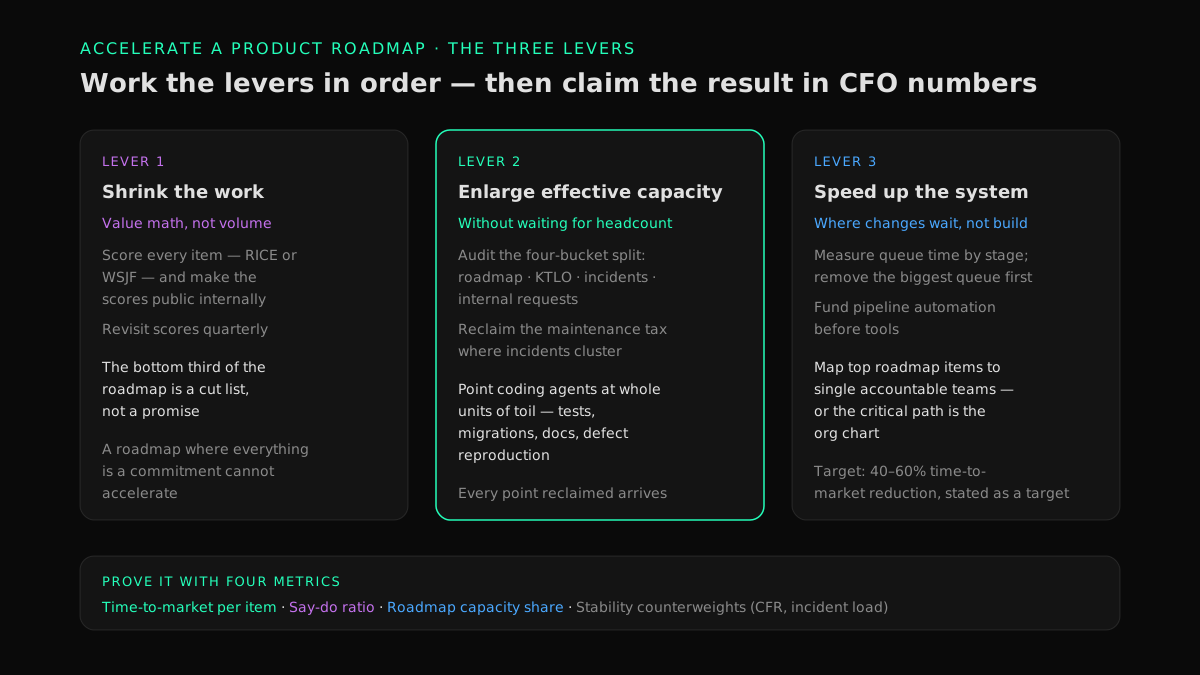
 There are exactly three ways to accelerate a product roadmap: shrink the work (better prioritization and thinner scope), enlarge the effective engineering capacity applied to it (reclaim maintenance drag, add AI leverage), and speed up the delivery system that turns roadmap items into shipped software. Every credible acceleration tactic is one of the three; most stalled roadmaps are stalled because leadership is pulling only one lever — usually pressure on the delivery team — while the other two sit untouched.
This guide is for CTOs, CPOs, and CEOs staring at a roadmap that says Q4 while engineering's honest answer is "next year." It covers why roadmaps actually slip, how to work each of the three levers, what to do when the roadmap is already behind, and the small set of numbers that prove — to a board, not just to the product team — that the roadmap is genuinely moving faster.
Why product roadmaps fall behind
A slipping roadmap is almost never a motivation problem. When you trace roadmap items that missed their dates, the causes cluster into a short list — and most of them are structural:
| Cause | What it looks like | Which lever fixes it |
|---|---|---|
| Optimistic estimation | Items scoped at best-case effort, no buffer for the unknown | Shrink the work |
| Scope creep | "Small asks" and "while you're in there" absorbed mid-quarter | Shrink the work |
| Invisible capacity drain | Half the team on maintenance, incidents, and internal requests | Enlarge capacity |
| Legacy drag | Every feature that touches the old core takes 3× longer | Enlarge capacity |
| Slow delivery system | Weeks between "code complete" and "in production" | Speed the system |
| Dependency deadlock | Five teams needed to ship one roadmap item | Speed the system |
Two of these deserve special attention because they are chronically underestimated. First, the capacity drain: Stripe's Developer Coefficient study found developers spend roughly 42% of their working week on maintenance, bad code, and technical debt — meaning a "20-engineer roadmap" is often powered by the equivalent of 11 or 12 engineers. Second, estimation optimism compounds: a roadmap built from best-case estimates with zero slack doesn't slip by one item's overrun; the overrun cascades through every dependent item behind it.
The diagnosis discipline matters because the three levers have very different owners. Prioritization and scope belong to product; capacity allocation belongs to engineering leadership; delivery speed belongs to the whole system. Accelerating a roadmap is a joint CTO–CPO program, not a directive to either side alone.
Lever 1: Shrink the work
The fastest way to pull a roadmap date forward is to make the roadmap smaller — not by ambition, but by honesty about value. Three practices do most of the work.
Prioritize by value math, not by volume
Loudest-stakeholder prioritization is how roadmaps fill with work that doesn't move revenue, retention, or risk. Replace it with an explicit scoring model and make the scores public internally:
- RICE (Reach × Impact × Confidence ÷ Effort) forces every item to declare who it affects, how much, and how sure you are — and penalizes big bets with thin evidence.
- WSJF (cost of delay ÷ job size) is the sharper tool when timing matters: it surfaces the items that are cheap to build and expensive to delay, which is exactly the "pull these forward" list an acceleration program needs.
The framework matters less than the discipline: every item scored, scores revisited quarterly, and the bottom third of the roadmap treated as a cut list, not a promise. A roadmap where everything is a commitment is a roadmap where nothing can accelerate.
Shape scope into thin slices
Most roadmap items are shipped as v1.0 when a v0.3 would have captured the majority of the value. For each of your top items, ask: what is the thinnest version that a real customer would use and we could learn from? Shipping thin slices accelerates the roadmap twice over — the item lands months earlier, and the feedback often deletes work you would otherwise have built. This is the same small-batch logic that DORA's research links to both speed and stability at the delivery level, applied at the roadmap level.
Give every initiative kill criteria
Zombie initiatives — projects that are 70% done for three consecutive quarters — are pure roadmap drag: they consume capacity while delivering nothing. Attach explicit kill-or-continue criteria to every initiative at funding time ("if activation hasn't reached X by end of Q2, we stop"), and enforce them. Capacity recovered from a killed zombie is the cheapest capacity you will ever add.
Lever 2: Enlarge effective capacity — without waiting for headcount
Once the roadmap is honest, the question becomes throughput: how much engineering capacity actually reaches roadmap work, and how do you raise it. (This section is the roadmap-scoped version; the org-wide deep dive — the full capacity ledger and all four levers — is our guide to increasing engineering capacity without hiring.)
Audit where the capacity actually goes
Before adding anything, measure the split of engineering time across four buckets: roadmap work, maintenance/KTLO, incidents and support, and internal requests. Most leadership teams have never seen this number and most are shocked by it — the Stripe finding above suggests the roadmap share is often barely half. That split is your baseline; every capacity initiative should move it.
Reclaim the maintenance tax
If maintenance eats 30–40% of capacity, the highest-yield acceleration investment may not touch the roadmap at all: it's the systematic work of reducing legacy application maintenance cost — retiring the noisiest modules, adding tests where incidents cluster, automating the toil that interrupts feature work. Every reclaimed point of maintenance tax is a point of roadmap capacity that arrives without a single new hire.
Add AI capacity where it compounds
AI is the first genuinely new capacity lever in a decade, and it works best on exactly the work that crowds out roadmap items: test scaffolding, migration mechanics, documentation, defect reproduction, review preparation. Pointing coding agents at whole units of that toil — rather than just autocompleting feature code — is how teams convert AI spend into roadmap throughput; the playbook is in our guide to improving developer productivity with AI.
Two honesty notes belong in any executive conversation about AI capacity. The 2025 DORA report found AI adoption raises throughput but also instability when the surrounding delivery system is weak — AI amplifies whatever it lands in. And METR's randomized trial showed experienced developers can be measurably slower with AI on codebases they know deeply, while believing the opposite. Treat AI capacity as a measured claim, not a vendor promise: baseline first, then verify the delta.
Why hiring is the slowest lever
Headcount is the intuitive answer and the worst near-term one. Brooks's law still holds: new engineers consume onboarding and coordination capacity for one to two quarters before contributing net throughput — the opposite of acceleration on a 12-month roadmap. And if the real constraint is maintenance drag or a slow delivery system, added developers feed the constraint faster without draining it. We make the fuller argument, including what to do instead, in how to reduce an engineering backlog without hiring. Hire for next year's roadmap; don't expect hiring to rescue this year's.
Lever 3: Speed up the system that ships the roadmap
The third lever is the delivery system itself: how long a roadmap item takes to travel from "started" to "in production." If your teams routinely spend more calendar time waiting — for review pickup, environments, release windows, cross-team dependencies — than building, no amount of prioritization will make the roadmap feel fast.
This lever has its own playbook, which we've published separately: the org-level lever sequencing (flow, pipeline, AI, structure) is in our guide to accelerating software delivery, and the stage-by-stage diagnosis method is in how to improve software delivery cycle time. The roadmap-level summary is this: measure where changes wait, remove the biggest queue first, and fund pipeline automation before tools. For orientation on what's achievable, in our own client engagements at Snowman Labs we target a 40–60% time-to-market reduction and structure delivery to reach a first production milestone in two weeks — stated as targets, which is how you should state yours.
One roadmap-specific addition: dependency structure. When shipping one roadmap item requires five teams, the item's real cycle time is dominated by coordination, and the roadmap's critical path is the org chart. Sequencing the roadmap so that top items map to single accountable teams — or restructuring toward teams that can ship end to end — is often worth more than any tooling investment.
When the roadmap is already behind: a catch-up playbook
Acceleration programs are usually born in a hole. If the roadmap is already slipping, run this sequence before announcing anything new:
- Freeze scope additions. No "quick asks" absorbed mid-quarter while behind. Every addition goes through the same scoring gate as roadmap items — most won't survive it.
- Re-baseline honestly. Reforecast every in-flight item at current actual velocity, not original estimates. A roadmap that's secretly six months behind cannot be managed; one that's openly six months behind can.
- Cut from the bottom. Use your priority scores to move the bottom third of the roadmap explicitly to "not now." Communicating cuts is uncomfortable once; communicating slips is uncomfortable every quarter.
- Ship a visible win in 30 days. Pick one high-value thin slice and land it. Catch-up programs die of stakeholder distrust before they die of engineering constraints; a shipped item buys the time the structural work needs.
- Then work the levers. With trust stabilized, run the capacity audit and delivery diagnosis and fund the fixes in payback order.
What not to do: respond to a slipping roadmap with an across-the-board deadline mandate. Compressed schedules without changed constraints produce cut testing and deferred review — which converts this quarter's slip into next quarter's incident load and an even slower roadmap.
How to measure roadmap acceleration
Roadmap acceleration should be claimed with numbers a CFO would accept — the same standard we apply in our framework for measuring AI engineering ROI, which is the pillar this playbook hangs from. Four metrics cover it:
| Metric | What it tells you | Watch out for |
|---|---|---|
| Time-to-market per roadmap item | Calendar time from funded to in production, by item size class | Don't average across size classes |
| Say-do ratio | % of quarterly commitments actually shipped | Gaming by under-committing — pair with throughput |
| Roadmap capacity share | % of engineering time on roadmap work vs. maintenance/KTLO | The Stripe-style drain hides here |
| Stability counterweights | Change failure rate, incident load | Speed bought by cutting quality shows up here first |
Freeze a baseline before the program starts, report medians and trends rather than averages and anecdotes, and translate the result into the executive currency: items shipped per quarter and cost per shipped outcome. A roadmap that ships 30% more scored value per quarter at flat cost is an acceleration claim no one can argue with.
FAQ
How do you accelerate a product roadmap?
Work three levers together: shrink the work through explicit prioritization (RICE or WSJF) and thin-slice scoping; enlarge effective capacity by reclaiming maintenance drag and adding AI leverage on toil; and speed up the delivery system by removing the queues where changes wait. Programs that pull one lever — usually schedule pressure — reliably fail.
Why does our product roadmap keep slipping?
The usual causes are structural: best-case estimates with no slack, scope absorbed mid-quarter, and a capacity illusion — industry data suggests roughly 40% of engineering time goes to maintenance and technical debt, so the roadmap is powered by far fewer engineers than the org chart implies. Diagnose the split before assuming the team is slow.
Should we hire more engineers to get through the roadmap faster?
Not as a near-term acceleration move. New engineers consume onboarding and coordination capacity for one to two quarters before adding net throughput (Brooks's law), and if the constraint is maintenance drag or delivery queues, added headcount feeds the bottleneck without draining it. Reclaim existing capacity and fix flow first; hire against next year's plan.
Can AI speed up a product roadmap?
Yes, when it's pointed at the right work and measured honestly. The biggest gains come from coding agents taking whole units of toil — tests, migrations, documentation, defect reproduction — which returns capacity to roadmap work. Evidence cuts both ways (DORA links AI to higher throughput; METR measured experienced developers slowing down on familiar code), so baseline first and verify the delta rather than trusting perceived speed.
How do you catch up when a product roadmap is behind schedule?
Freeze scope additions, re-baseline every in-flight item at actual velocity, cut the bottom third of the roadmap explicitly, and ship one visible thin-slice win within 30 days to stabilize stakeholder trust — then fund the capacity and delivery fixes. Avoid blanket deadline mandates: compressed schedules without changed constraints trade this quarter's slip for next quarter's incidents.
How far ahead should a product roadmap commit?
Commit firmly for one quarter, directionally for two to three, and thematically beyond that. Estimation error compounds with horizon, so treating a 12-month roadmap as a delivery contract guarantees visible slippage. A near-term commit / long-term intent structure also gives an acceleration program room to re-sequence as capacity improves.
Conclusion: acceleration is a system decision
A product roadmap accelerates when the work gets smaller, the capacity applied to it gets larger, and the system between them gets faster — and it accelerates fastest when all three move together under joint CTO–CPO ownership. The sequence is knowable: score and cut, audit and reclaim, diagnose and unblock, then measure against a frozen baseline.
If you want an outside read on which lever is binding your roadmap — where the capacity actually goes, and what a funded 90-day acceleration sequence looks like — that is the work of our software delivery acceleration practice, and it starts with a Snowman Labs AI readiness assessment: a mapped capacity split, a named constraint, and a roadmap re-sequenced around what your organization can actually ship.
Find your highest-value path to agentic delivery.
Map your readiness, delivery constraints, and first 90-day opportunity with the Snowman Labs AI Readiness Diagnostic.