How to Increase Engineering Capacity Without Hiring
How to increase engineering capacity without hiring: audit where paid capacity goes, reclaim it, unblock delivery queues, and multiply the team with AI.
 By Danilo BrizolaUpdated
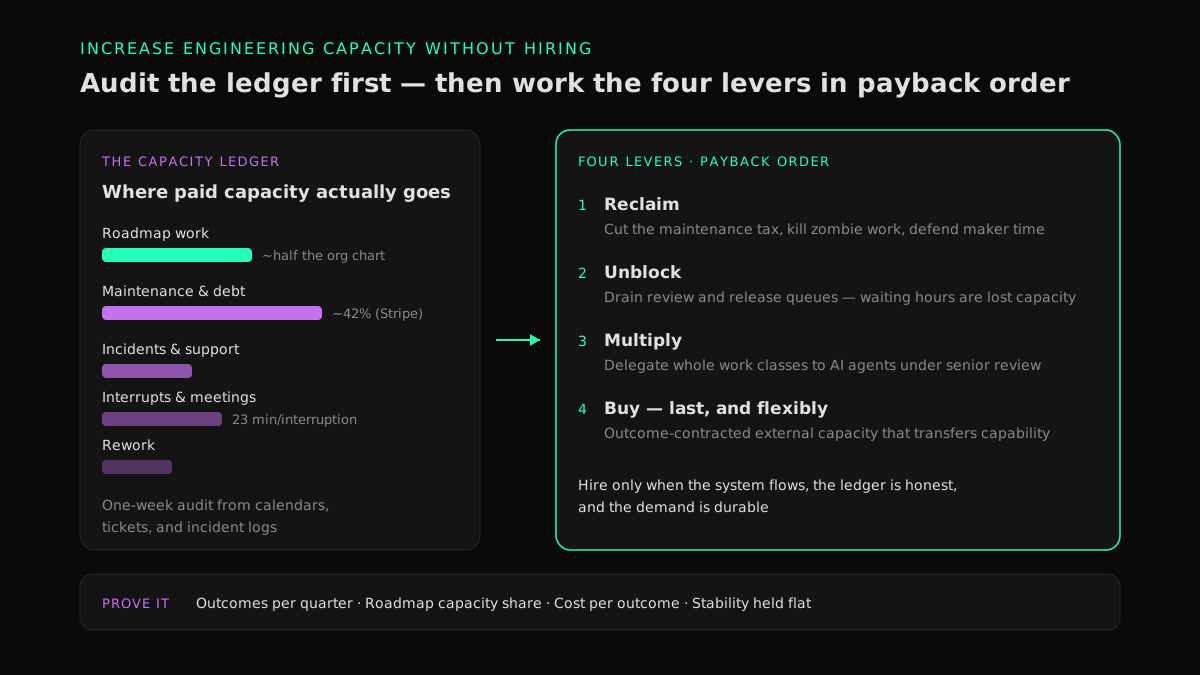
 You increase engineering capacity without hiring by working four levers in payback order: reclaim the capacity you already pay for but lose to maintenance, interruptions, and rework; unblock the capacity trapped in delivery queues; multiply the team you have with AI agents on delegable work; and buy flexible capacity only where a genuinely missing skill justifies it. The order matters because the first lever is the cheapest and the largest: Stripe's Developer Coefficient study found developers spend roughly 42% of their week on maintenance, bad code, and technical debt — which means a "20-engineer organization" typically applies the equivalent of 11 or 12 engineers to the work leadership actually planned. This guide gives CIOs, CTOs, and VPs of Engineering under a hiring freeze — or simply unwilling to pay the hiring lead time — a one-week capacity audit, the four levers with honest constraints, the case where hiring really is the answer, and the metrics that prove the added capacity is real.
What engineering capacity actually is — and why headcount isn't it
Engineering capacity is the volume of planned work your organization can complete and ship per unit of time — not the number of engineers on the org chart. The usable definition has two factors: effective capacity = hours that reach planned work × the rate at which the delivery system converts those hours into shipped outcomes. Headcount raises the first factor slowly and can lower the second immediately.
That is not rhetoric; it is the oldest measured result in software management. Brooks's law — adding people to a late project makes it later — holds because every new engineer consumes onboarding and coordination capacity for one to two quarters before contributing net throughput, and because communication paths grow with the square of team size. Hiring also arrives on hiring's schedule: recruiting, closing, and ramping a senior engineer is a multi-quarter project even when the budget exists. If your capacity problem is this year's roadmap, headcount is structurally the wrong instrument — a point we develop from the delivery-system side in our guide to accelerating software delivery.
The practical consequence: before adding anything, find out where the capacity you already pay for is going. Almost nobody knows.
Run the capacity ledger: a one-week audit
A capacity ledger is a simple accounting of where engineering hours actually went over the last full quarter, split into five buckets. Build it in a week from calendars, ticket systems, and incident logs — sampled honestly, not surveilled:
- Roadmap work — the planned features and initiatives leadership thinks it is buying.
- Maintenance and keep-the-lights-on — patches, upgrades, dependency churn, debt workarounds.
- Incidents and support — production firefighting and the recovery time after it.
- Internal requests and meetings — stakeholder asks, reporting, ceremony load.
- Rework — changes to work already "done": escaped defects, unclear-requirement churn.
The published data says the ledger will surprise you. Beyond Stripe's 42% maintenance-and-debt figure, Microsoft's Time Warp study of developer workdays found only about 11% of time goes to actually writing code, against a much larger share for meetings and communication; developers' ideal and actual days diverge sharply. And the interruption tax compounds it: University of California, Irvine research measured an average of 23 minutes and 15 seconds to return to a task after an interruption — so a bucket-4 hour scattered across a day destroys more than an hour of bucket-1 capacity. McKinsey's CIO survey adds the debt dimension: 10 to 20 percent of technology budget earmarked for new products is diverted to resolving tech-debt issues.
The ledger is your baseline and your prioritization: each lever below attacks specific buckets, and the biggest bucket names your first move. It is also the honest answer to the board question "why can't the team ship more?" — usually the team is shipping plenty; most of it just isn't roadmap.
Lever 1: Reclaim the capacity you already pay for
Reclaimed capacity is the cheapest capacity you will ever add: it requires no new salaries, no onboarding, and no coordination overhead, because the people are already on the team. Work the ledger buckets from largest down:
- Cut the maintenance tax at its source. If maintenance eats 30–40% of the ledger, the highest-yield capacity investment may not touch the roadmap at all: retire or stabilize the two or three modules that generate most of the toil, add tests where incidents cluster, and automate recurring chores. The full playbook is in our guide to reducing legacy application maintenance cost — every reclaimed point of maintenance tax is a point of roadmap capacity that arrives without a hire.
- Kill zombie work. Initiatives that are "70% done" for three consecutive quarters consume real capacity and deliver nothing. Attach kill-or-continue criteria and enforce them; capacity recovered from a killed zombie is free.
- Defend maker time. Batch stakeholder requests behind an intake gate, consolidate status reporting, and protect contiguous focus blocks — the UCI interruption math means two protected half-days a week returns more capacity than most tooling purchases.
- Shrink rework by moving quality left. Every escaped defect converts future roadmap hours into bucket-5 hours at an exchange rate of roughly ten to one. Reject work into development without acceptance criteria; fund test automation where the incident log says defects escape.
Organizations that run this lever seriously typically move the roadmap share of the ledger by double digits within a quarter — the equivalent of several engineers of capacity, at the cost of management attention.
Lever 2: Unblock the capacity trapped in queues
The second lever costs little and pays fast: much of your capacity is not being consumed, it is waiting — in code review queues, approval steps, environment provisioning, and release trains. Engineers stay busy (they start something else, adding work in progress), but finished value doesn't move; the calendar burns while utilization looks great.
This is standard queueing behavior, not an engineering-culture flaw: as utilization approaches 100%, wait times grow non-linearly — the relationship formalized in Kingman's formula. Teams planned at full utilization with zero slack are slower, which is why "everyone is maxed out" and "nothing ships" so often coexist. The fixes are flow fixes: limit work in progress, shrink batch sizes, set review-turnaround expectations, and automate the manual gates. We rank these levers, with diagnostic steps, in our guides to accelerating software delivery and improving software delivery cycle time — for capacity purposes the point is simple: an hour that stops waiting is an hour of capacity you did not have yesterday.
Lever 3: Multiply the team with AI — the first new capacity lever in a decade
AI is the one genuinely new entry in the capacity playbook, and it works in two distinct modes that leaders should budget separately:
- Assistance raises the productivity of each engineer inside the existing workflow — code generation, explanation, review preparation. Gains are real but task-dependent; the playbook for capturing them without falling for perceived-speed illusions is in how to improve developer productivity with AI.
- Delegation adds parallel execution lanes: autonomous coding agents take whole, well-specified units of work — dependency upgrades, migrations, test-coverage gaps, documented bugs — end to end, with senior engineers holding specification and review. This mode attacks the ledger directly, because the delegable classes are concentrated in exactly the maintenance and toil buckets that crowd out roadmap work. Our field guide to reducing an engineering backlog without hiring classifies which work classes delegate well and which don't.
Two honesty notes belong in any executive conversation about AI capacity. First, the 2025 DORA report found AI adoption is associated with higher delivery throughput but continued instability where the surrounding system is weak — AI amplifies whatever it lands in, so test automation and review capacity must scale with agent volume or the "new capacity" arrives as incidents. Second, METR's randomized controlled trial measured experienced developers 19% slower with AI on codebases they knew deeply — while believing they were faster. Treat AI capacity as a measured claim against your own baseline, never a vendor promise. Sequencing that readiness work — governance, verification, then volume — is precisely what a structured 90-day AI engineering enablement plan is for.
Lever 4: Buy capacity flexibly — without buying headcount
Sometimes the ledger and the flow are healthy and the demand is genuinely additive but temporary, or requires a skill you don't have and won't need permanently. That is the legitimate case for bought capacity — in increments you can release, not permanent payroll. The options differ in what they add:
| Model | What it adds | Best for | Watch out for |
|---|---|---|---|
| Contractors / staff augmentation | Individual hours into your process | Filling a named skill gap inside a team that already flows | Inherits every queue and bottleneck you have; ramp time is real |
| Dedicated external pod / managed team | A self-contained delivery unit | A bounded initiative with its own definition of done | Integration seams; quality and context diverge without shared standards |
| AI-enabled delivery partner | An operating model plus capacity — agents, governance, senior review | Standing up the multiply lever faster than you could alone | Choose partners who transfer the capability, not just consume the budget |
Two rules keep this lever honest. First, buy capacity after levers 1–3, not instead of them — external teams poured into a system that loses 40% of its capacity to drag will lose 40% of theirs too. Second, contract for outcomes and capability transfer: the engagement should leave your own ledger permanently better. That is the design principle behind Snowman Labs' AI engineering enablement practice — joint delivery that installs the agentic operating model in your team rather than renting you ours indefinitely.
When hiring is actually the right answer
This article is not an argument against hiring; it is an argument against hiring as the default. Hire when three conditions hold at once: the delivery system already flows (lever 2 done — otherwise new engineers feed the queues), the ledger is honest (lever 1 done — otherwise you are hiring to subsidize drag), and demand is durable — a multi-year product line, a new domain, ownership that needs to live in-house. Under those conditions headcount compounds — and the playbook for growing the organization itself without diluting output per engineer is in our guide to scaling software engineering teams. Note the cost asymmetry, though: the U.S. Bureau of Labor Statistics puts the mean wage for software developers near $140,000 before benefits, employer costs, equity, and tooling — and before the two quarters of sub-full productivity. Every lever above should clear a lower bar than that, and most clear it easily.
Prove the gain: measure capacity in outcomes, not activity
Added capacity is only real if it shows up in delivered outcomes at stable quality. Four instruments, reported quarterly against the frozen baseline:
- Outcomes delivered per quarter — roadmap items and production changes completed; the direct read on effective capacity.
- Roadmap capacity share — the ledger's bucket 1 as a percentage of total hours; the leading indicator every reclaim initiative should move.
- Cost per delivered outcome — total engineering cost divided by outcomes; the CFO-grade number, and the core method of our pillar on how to measure ROI from AI in software engineering.
- Stability counterweights — change failure rate and time to restore, per DORA metrics adapted for AI-assisted teams. Throughput bought with instability is borrowed, not earned.
Do not measure utilization as a success metric — Kingman's formula above is the reason — and do not accept self-reported speed, which METR showed can be almost 40 points wrong. If the roadmap question rather than the capacity question is what keeps you up at night, the roadmap-level scoreboard lives in our CTO–CPO guide to accelerating a product roadmap.
A 90-day sequence
- Weeks 1–2: Build the capacity ledger from last quarter's calendars, tickets, and incidents. Freeze it as the baseline alongside outcomes per quarter and cost per outcome.
- Weeks 2–4: Reclaim the biggest bucket. Kill zombies, gate intake, pick the top two maintenance-tax sources and fund their stabilization.
- Weeks 3–6: Unblock the worst queue. Measure where changes wait longest — usually review — and fix that one queue with WIP limits and turnaround norms.
- Weeks 5–10: Pilot the multiply lever on one delegable work class (dependency upgrades or test coverage), with named senior reviewers, CI gates, and stability metrics watched as circuit breakers.
- Weeks 10–13: Re-read the ledger and decide. With the new roadmap share and outcome rate measured, size any remaining gap — and only then decide whether it calls for bought capacity, a hire, or a second delegated class.
FAQ
What does engineering capacity mean?
Engineering capacity is the amount of planned work an engineering organization can complete and ship per unit of time. It is a function of two things: how many paid hours actually reach planned work (versus maintenance, interruptions, and rework) and how efficiently the delivery system converts those hours into shipped outcomes. Headcount is an input, not the measure.
How do you increase engineering capacity without hiring?
Work four levers in payback order: reclaim capacity lost to maintenance, zombie projects, interruptions, and rework; unblock capacity trapped in review and release queues; multiply the team by delegating well-specified work classes to AI coding agents under senior review; and buy flexible external capacity only for genuinely additive, temporary, or missing-skill demand.
How is engineering capacity measured?
Measure effective capacity in outcomes, not activity: roadmap items and production changes delivered per quarter, the share of engineering hours reaching roadmap work, and cost per delivered outcome — with change failure rate and restore time as quality counterweights. Utilization is not a capacity metric; teams at near-100% utilization ship more slowly because queue waits grow non-linearly.
Why doesn't adding more engineers increase capacity?
In the near term it usually decreases it: Brooks's law holds because new engineers consume onboarding and coordination capacity for one to two quarters before adding net throughput, and communication overhead grows with the square of team size. If the real constraint is a review queue, maintenance drag, or a slow pipeline, added developers feed the bottleneck faster without draining it.
How much engineering capacity is lost to maintenance and technical debt?
Stripe's Developer Coefficient study put it at roughly 42% of the developer week spent on maintenance, bad code, and debt, and McKinsey's CIO survey found 10–20% of new-product technology budget diverted to tech-debt resolution. Most organizations discover in a capacity audit that their roadmap runs on barely half the engineering hours they pay for.
Can AI agents really substitute for hiring engineers?
For specific work classes — dependency upgrades, migrations, test-coverage gaps, well-documented bugs — yes: agents execute them end to end at a fraction of a fully loaded engineer's cost, with capacity available in days rather than quarters. They do not substitute for senior judgment on ambiguous or architectural work, and the 2025 DORA report shows the gains only hold where testing and review systems scale alongside agent volume.
When should you hire instead of optimizing capacity?
Hire when the delivery system already flows, the capacity ledger is honest, and the demand is durable — a multi-year product line or a domain that needs permanent in-house ownership. Hiring to compensate for queues, maintenance drag, or unmeasured capacity leaks buys more of the same problem at roughly $140,000-plus per seat per year before overhead.
Capacity is a system property — treat it like one
An organization that audits its capacity ledger, reclaims the drag, unblocks its queues, and delegates its toil to governed AI agents routinely finds several engineers' worth of capacity it already pays for — before the recruiting funnel would have produced a single accepted offer. The sequence is knowable: measure where the hours go, work the four levers in payback order, and claim the result in outcomes per quarter and cost per outcome, with stability held flat.
If you want a grounded read on your own ledger — how much capacity is recoverable, which queue is binding, and how much of your backlog is delegable to agents — start with the Snowman Labs AI readiness assessment. It is the same diagnostic we use to scope enablement engagements, and it will tell you honestly whether your constraint is drag, flow, governance — or a genuinely full system that has earned its next hire.
Find your highest-value path to agentic delivery.
Map your readiness, delivery constraints, and first 90-day opportunity with the Snowman Labs AI Readiness Diagnostic.