Devin vs Cursor: An Enterprise Decision Guide (2026)
Devin vs Cursor compared for enterprise teams in 2026: autonomy, pricing, governance, and ROI — plus a decision framework from an official Cognition partner.
 By Danilo BrizolaUpdated
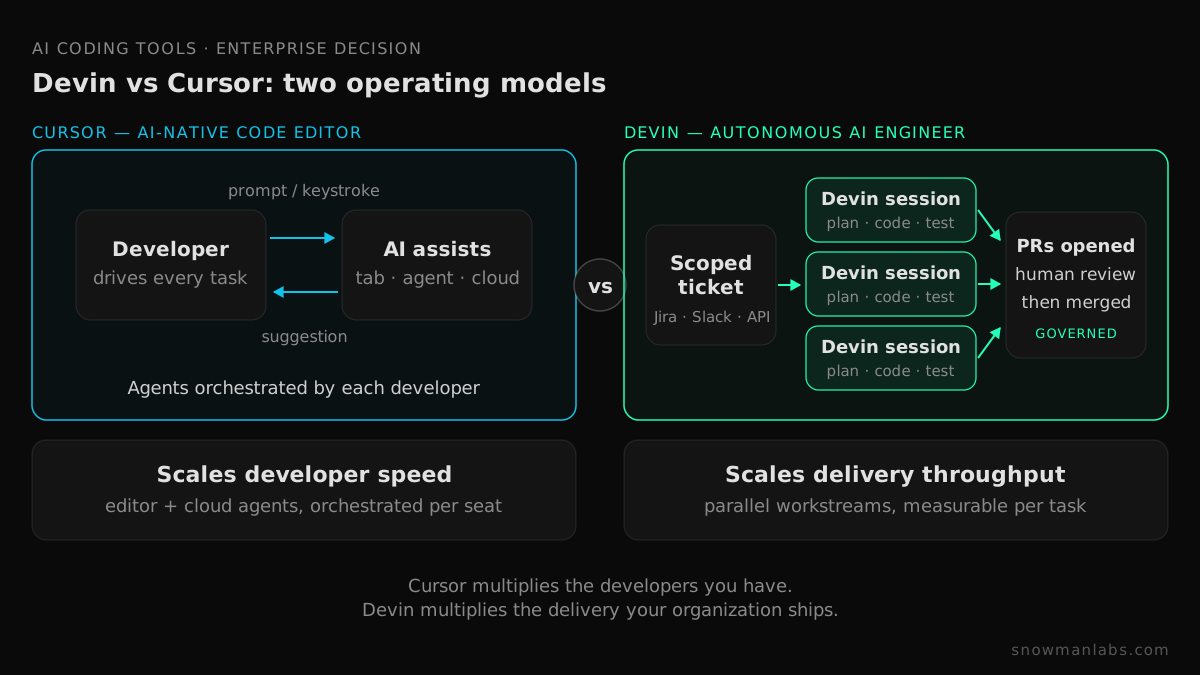
 Devin and Cursor are not two versions of the same product — they are two different answers to how AI should change software delivery. Cursor is an AI-native code editor that has grown real agent capabilities: cloud agents, always-on automations, and agentic code review, all orchestrated from each developer's environment. Devin is an autonomous AI software engineer built as an organizational delegation platform: work is assigned to it — from tickets, Slack, schedules, or its API — and comes back as reviewed pull requests. If you lead an engineering organization and are deciding where to put budget, the Devin vs Cursor question is really a question about which constraint you are trying to remove — individual coding speed, or organizational delivery throughput. This guide compares both on verified July 2026 product reality (most comparison content online predates Cursor's agent platform and the Windsurf–Cognition merger entirely), and gives you the decision framework we use with enterprise clients as an official Cognition partner.
Devin vs Cursor at a glance
Direct answer for skimmers: Cursor makes each developer faster at the work they keep — and now lets each developer spin off agents for parts of it. Devin absorbs the work your organization should not be routing through developers' hands at all. They compete for budget, not for the same job.
| Dimension | Devin (Cognition) | Cursor (Anysphere) |
|---|---|---|
| Category | Autonomous AI software engineer (delegation platform) | AI-native code editor with agent features |
| Unit of work | A delegated task → a reviewed pull request | A developer session — inline edits up to developer-orchestrated agent runs |
| Who orchestrates | The organization: tickets, schedules, service users, API | Each developer, from the editor (or phone) |
| Agent surface | Devin Cloud sessions (~3-hour scoped tasks, computer use), Ask Devin discovery, Devin Review, Security Swarm, CLI with cloud handoff | In-editor agent (Composer 2.5), cloud agents in isolated VMs, always-on Automations, Bugbot review |
| IDE | Devin Desktop — full AI-native IDE (Cascade local agent, Tab, DeepWiki) with an Agent Command Center | The core product: VS Code-family editor with strong Tab |
| Parallelism | Many sessions at once, org-level schedules, fleet-scale delegation | Multi-agent per developer; cloud agents run tasks in parallel for their owner |
| Entry price | Free; Pro $20/mo; Teams $80/mo + $40/seat; Enterprise custom | Free (Hobby); Individual $20/mo; Teams $40/user/mo; Enterprise custom |
| Enterprise controls | SOC 2 Type 2, SSO/SCIM, RBAC, audit logs, ACU metering per org/user/session, VPC or dedicated deployment with customer-managed keys, FedRAMP High in-process | SOC 2, SSO/SCIM, org access controls, repo/model/MCP restrictions, audit logs |
| Learning curve | Low via Devin Desktop (familiar editor); delegation at scale adds task-scoping discipline | Low — familiar editor |
| Fits best | The full spectrum: hands-on and UI work (Desktop), codebase discovery (Ask Devin + DeepWiki), delegated volume (Cloud) | Teams already standardized on Cursor's editor; developer-initiated background tasks |
Both companies publish current plans at devin.ai/pricing and cursor.com/pricing. Note how much changed in the last twelve months: Devin's entry price is now $20/month — the "$500 per month" figure still quoted across most comparison articles is obsolete — Cognition and Windsurf merged (the former Windsurf IDE now ships as Devin Desktop), and Cursor built out a genuine agent platform (cloud agents, Automations, Bugbot) on top of the editor. A comparison written in 2025 answers a question neither product is asking anymore.
The real difference: who orchestrates the agents
The lazy version of this comparison — "Cursor is autocomplete, Devin is an agent" — is dead. Cursor ships real agents in 2026. The difference that survives feature convergence is where orchestration lives.
Cursor's agents belong to the developer. Whether it is the in-editor agent, a cloud agent running in an isolated VM, or an always-on Automation fixing CI failures, the unit of adoption is one developer's workflow: they configure it, trigger it, watch it, and absorb its output back into their editor. Reasoning stays close to the person; wrong turns cost seconds. It is the AI-assisted development model extended outward — the delivery process stays developer-shaped, each developer commands more leverage.
Devin's agents belong to the organization. Work reaches Devin from Jira and Linear assignments, Slack and Teams mentions, org-level schedules, service users, and API calls — and each session plans, writes, tests against your CI, reacts to review feedback, and iterates until the pull request is mergeable, in a workspace with session-level audit and consumption metering. That is the agentic model: execution becomes an organizational resource you route work to, not a personal multiplier. We unpack this category distinction in Agentic Engineering vs. AI-Assisted Development, and the broader operating model in our guide to what agentic engineering is.
Cognition's own Coding Agents 101 makes the same cut: IDE-based "local agents" can replicate some autonomous behavior in parallel workspaces, but autonomous agents are built to take "initial descriptions to final pull requests with little human intervention" — and report roughly 80% time savings on well-scoped one-to-six-hour tasks.
What Devin is in 2026
Devin is an autonomous AI software engineer operated by Cognition. Per Cognition's documentation and 2026 release notes, the current platform is considerably broader than older reviews describe:
- Devin Cloud — autonomous sessions, each with its own workspace (embedded IDE, shell, browser, and computer-use desktop environments), sized for scoped tasks of roughly three hours: tickets, bug fixes, feature slices, migration steps. Sessions connect to GitHub, GitLab, Bitbucket, Azure DevOps, and self-hosted git, and take assignments from Jira, Linear, Slack, and Microsoft Teams.
- Specialized agents on top of the same platform — Devin Review (agentic PR analysis), Security Swarm (vulnerability remediation at scale), and a Data Analyst agent.
- Devin Desktop — introduced June 2, 2026: the former Windsurf IDE rebuilt around Devin Cloud, with an Agent Command Center for supervising sessions alongside hands-on editing (Cascade agent, Tab, DeepWiki, Quick Review).
- Ask Devin + DeepWiki — DeepWiki auto-indexes your repositories into living architecture documentation (diagrams, summaries, source links), and Ask Devin lets you interrogate that index conversationally: ask how something is implemented, explore architectural options across repositories, and turn the answer into a plan that starts a Devin session or lands in your ticket tool as a complete, ready-to-run prompt.
- Devin CLI and API v3 — a local terminal agent that can hand work off to cloud sessions, and an API with organizational primitives: organizations, service users, schedules, playbooks, RBAC, audit logs, and ACU consumption metrics per org, user, and session.
- Context and repeatability machinery — Knowledge (onboarding context), Playbooks
(reusable task templates), Skills (
SKILL.mdprocedures), andAGENTS.mddirectory rules. - Enterprise deployment — Enterprise Cloud, Customer Dedicated Deployment with private networking, or VPC deployment with customer-managed encryption keys; SSO/SAML, SCIM, IP access lists, and guardrails. On July 13, 2026, Cognition announced Devin is FedRAMP High in-process — clearance-track compliance for US federal workloads.
The scale proof most often cited is Cognition's published Nubank case study: 8–12x engineering-efficiency gains and over 20x cost savings on the delegated portion of a six-million-line ETL monolith migration. We describe how those capabilities map to enterprise workstreams on our Cognition / Devin partner page.
What Cursor is in 2026
Cursor, built by Anysphere on the VS Code family, is the most widely adopted AI-native editor — the company claims use at over half of the Fortune 500. Being honest about its 2026 state matters, because it is far more than autocomplete. Per Cursor's changelog (version 3.11 shipped July 10, 2026) and feature pages:
- Tab completion and inline edits that developers consistently rate as best-in-class for staying in flow.
- The in-editor agent, powered by Cursor's own Composer 2.5 model alongside frontier models from every major lab — agentic multi-file tasks with the developer watching.
- Cloud agents — tasks run on isolated virtual machines off the developer's laptop, building, testing, and demoing features for review; manageable from an iOS app with remote control of desktop agents (shipped June 2026).
- Automations — always-on agents on schedules and triggers (GitHub events, Slack reactions) that fix CI failures and handle repetitive maintenance.
- Bugbot — agentic code review on GitHub pull requests.
- Team and enterprise features — a team marketplace for rules, skills, MCPs, and plugins; usage analytics; SSO/SCIM; repository, model, and MCP access controls; SOC 2.
That list is why "Cursor is just an editor" arguments fail in 2026 — and why the honest boundary matters more, not less. Cursor's agent surface is built around the individual developer: cloud agents and Automations are configured and owned from each developer's environment and run on Cursor's infrastructure — there is no dedicated or customer-VPC deployment tier, and no org-level construct for routing a backlog to agents independent of the people holding seats. Heavy agent usage is metered, so costs scale with consumption. Cursor multiplies people — now with agents attached. It still does not, by itself, turn a backlog into an organizationally-owned, parallel, delivery-reported workstream.
Where Devin is the stronger choice — and why we deploy it
Our position, stated with the disclosure it deserves: Snowman Labs is an official Cognition partner and enablement partner — we train enterprise teams jointly with Cognition's Forward Deployed Engineers, and we implement Devin inside client codebases (details in our enablement-partner announcement). We hold that position because of what we see it do to delivery numbers, in four situations:
- The constraint is throughput, not typing speed. If your backlog grows faster than the team, per-developer acceleration compounds slowly; parallel delegation compounds fast. This is the core mechanism in reducing an engineering backlog without hiring.
- The work is repeatable and verifiable. Migrations, framework and dependency upgrades, test-coverage expansion, documentation, routine tickets, CI-failure triage — high-volume work with clear done-criteria is exactly where autonomous agents earn their keep, and where Devin's CI-integrated iterate-until-green loop beats supervising an editor agent by hand.
- Governance is non-negotiable. Dedicated or VPC deployment with customer-managed keys, FedRAMP High in-process status, RBAC, session-level audit and ACU metering, and a human review gate on every merge make Devin's output governable in a way developer-owned agent fleets are not — the properties that make AI-generated code production-safe — compared control-by-control in Devin vs Cursor security.
- You must prove ROI to a CFO. Delegated tasks have measurable boundaries: tickets closed, hours saved, cost per outcome. Editor assistance famously resists attribution; delegation does not.
The evidence: what enterprises ship with Devin
The strongest argument for Devin is not a feature list — it is that Cognition publishes a library of named, numbered enterprise outcomes, and no editor-first competitor publishes anything comparable. Cursor's public proof is adoption breadth (an editor used at over half the Fortune 500); Devin's is delegated delivery, measured. A sample, all per Cognition's published case studies:
| Customer | Published result |
|---|---|
| Nubank | 8–12x engineering efficiency, 20x+ cost savings, 100,000+ datasets migrated off a 6M-line ETL monolith |
| AHEAD | 8×–40× faster engineering across delegated workstreams |
| AngelList | 5.2× faster Redshift-to-Snowflake migration |
| Litera | 90% reduction in regression cycles |
| Gumroad | 1,500+ merged pull requests — Devin is the repository's #1 contributor |
| Ramp | tens of thousands of hours of technical debt fixed |
| FE fundinfo | engineering capacity scaled across 1,800+ repositories |
| Hamming | Devin writes 25% of total code volume |
Beyond the numbers, the named-logo list — Mercedes-Benz, Itaú, Cognizant, Infosys, Evinova, Hippo — reads like a compliance-heavy enterprise roster, which is exactly the point: these are organizations whose security reviews do not pass tools on vibes. Note what the results have in common: migrations, regression cycles, technical debt, multi-repo capacity. That is organizational delegation — the job Devin is built for and the job an editor, however good its agents, is not accountable for. (For the migration-scale version of this comparison, see Devin vs Cursor for large codebases.)
The discovery advantage: where "exploratory" flips to Devin
The standard concession in this comparison — "keep Cursor for exploratory and ambiguous work" — no longer survives contact with the product line. Exploration is a context problem before it is an editing problem, and context is where Devin is structurally ahead:
- Talk to your codebase — and to several at once. Ask Devin answers questions grounded in DeepWiki's index and code search: how is this implemented, where would this change ripple, what would a migration to X touch — across repositories, not inside one developer's open workspace.
- Discovery becomes an artifact, not a memory. An Ask Devin exploration ends in a plan: a complete, scoped prompt you can launch as a Devin session on the spot or push into Jira/Linear as a ready-made ticket. The architecture spike and the backlog item stop being separate work.
- Hands-on iteration is covered by the same platform. Devin Desktop is a full AI-native IDE — Cascade local agent, Tab, inline commands — so UI-heavy work, "I need to see it to think it" coding, and individual $0-to-start adoption all live inside the Devin platform too, with cloud handoff when a task outgrows the editor.
Where Cursor genuinely holds an edge
Stripped of the concessions Devin Desktop already closed, what remains is real but narrow:
- Incumbency and switching cost. If your developers are standardized on Cursor — muscle memory, team rules, MCP setups — the editor they love is a legitimate reason to keep the interactive layer where it is and pair it with Devin for delegation, the pattern in Devin and Cursor together.
- Editor mindshare. Cursor's Tab and Composer iteration speed have earned genuine developer loyalty; for teams that weight editor feel above platform capabilities, that preference decides.
One honest operating note that applies to any delegation platform, Devin included: agent output arrives as pull requests, so review capacity is the throughput ceiling. That is a sequencing constraint (fix review bandwidth first), not a reason to choose an editor over a platform.
Devin vs Cursor pricing in 2026: what actually changed
The pricing story most articles tell is a year out of date, and it flips the conclusion.
- Devin: Free tier · Pro $20/month · Max $200/month · Teams $80/month + $40 per developer seat · Enterprise custom. The old $500/month entry point is gone.
- Cursor: Hobby free · Individual $20/month · Teams $40/user/month · Enterprise custom, with heavy agent usage metered beyond plan limits.
At identical $20 entry points, the evaluation stops being "cheap tool vs expensive tool" and becomes what it should have been all along: which operating model moves your delivery metrics. For a serious comparison, model cost per outcome (per merged PR, per migrated module, per closed ticket) rather than per seat — the method we detail in how to build the business case for AI engineering.
The decision framework we use with enterprise clients
Answer four questions about your organization, not about the tools:
- What shape is the backlog? Count the tickets that are well-understood, repeatable, and verifiable. If they are a meaningful share of sprint capacity, that is delegable volume — Devin territory. If most work is still exploratory, that is Devin territory too: run discovery through Ask Devin and hands-on work in Devin Desktop, and delegate what discovery scopes out.
- Can you absorb async review? Delegation converts coding time into review time. Senior engineers must review agent PRs within a business day, or throughput gains stall.
- What does security require? If the answer includes VPC isolation, audit trails, and provenance for every AI-generated change, weigh Devin Enterprise's controls against assistant-usage policies you would have to build yourself.
- What number must move? If leadership expects a delivery metric (cycle time, cost per outcome, backlog burn-down) to change within two quarters, delegation produces attributable evidence; assistance mostly produces developer satisfaction. Both matter — only one survives a budget review.
Two honest corollaries. First, most mature teams end up running both models — an editor for the work developers keep, an agent platform for the work they delegate (we detail that working stack in Devin and Cursor together); even Cognition now ships both modes (Devin Cloud plus Devin Desktop). Second, tools do not create the operating model — scoping discipline, review gates, and measurement do. That gap between buying licenses and changing delivery numbers is precisely what our agentic engineering services exist to close, the same role-based reasoning we applied in Devin vs. Replit.
FAQ
Is Devin better than Cursor?
For organization-level delegation — routing migrations, upgrades, test coverage, security remediation, and routine tickets to autonomous agents with schedules, RBAC, audit, and per-session metering — yes: that is what Devin is built as, and Cursor's developer-owned agents don't operate at that layer. For interactive coding, Devin Desktop puts the platforms at parity (Cascade local agent, Tab, full IDE), while Ask Devin's codebase-discovery workflow has no Cursor equivalent. Cursor's remaining edge is editor incumbency — real, but a preference, not a capability gap.
Can Cursor replace Devin (or Devin replace Cursor)?
Less cleanly than either vendor would like. Cursor's cloud agents and Automations genuinely cover developer-initiated background tasks — but they are owned per developer and run on Cursor's infrastructure, without Devin's organizational layer (schedules, service users, RBAC, per-session audit and metering) or its dedicated/VPC deployment options. Devin Desktop gives Cognition a full IDE, but teams attached to Cursor's editor experience will keep it. In practice most organizations pair one editor with one delegation platform.
How much does Devin cost in 2026?
Devin is free to try, $20/month for Pro, $200/month for Max, and $80/month plus $40 per developer seat for Teams, with custom Enterprise pricing for VPC deployment and dedicated support (devin.ai/pricing). Articles quoting $500/month describe pricing that no longer exists. For whether that spend pays off — current pricing weighed against Cognition's published customer results — see our full review, Is Devin worth it?.
What happened to Windsurf?
Cognition and Windsurf merged in July 2025, and in June 2026 the IDE relaunched as Devin Desktop — rebuilt around Devin Cloud, with an Agent Command Center for supervising autonomous sessions next to hands-on editing. One vendor now covers both operating models: IDE-based assisted work and fully autonomous delegation — the full story is in Windsurf is now Devin Desktop.
Is Devin safe for enterprise codebases?
Devin Enterprise deploys inside your own VPC, holds SOC 2 Type 2, provides SSO/SAML, audit logs, and fine-grained access controls, and does not train on your data. The governance question that actually matters — who reviews and merges agent output — is an operating-model decision your team owns regardless of vendor.
Do Devin and Cursor use the same AI models?
There is overlap, plus proprietary systems on each side. Cursor offers frontier models from the major labs alongside its own Composer 2.5; Cognition runs its own SWE-1.7 model and a hybrid "Devin Fusion" architecture it says cuts cost roughly 35% at frontier-level coding performance. Line-ups change monthly, which is exactly why model choice is rarely the deciding factor — the scaffolding around the model (execution environment, CI feedback, review workflow, governance) is what separates outcomes.
Should we run a Devin pilot or roll out Cursor first?
They answer different questions, so sequence by constraint: if leadership needs delivery metrics to move this year, pilot Devin on a scoped backlog slice with defined success metrics; if the immediate goal is developer experience, an editor rollout is faster. Many clients do both — but only the pilot produces a CFO-ready number.
The bottom line
Cursor is the best way to make the coding you keep faster. Devin is the best way to stop doing delegable engineering work by hand. If your roadmap is constrained by organizational throughput — a backlog measured in quarters, migrations nobody has capacity for, AI spend you cannot yet defend with numbers — the autonomous-agent category is where delivery metrics move, and Devin leads it on the evidence that matters: the deepest enterprise deployment options in the field, a FedRAMP-track compliance posture, and the only published library of named, numbered delegation outcomes among these tools. That conclusion comes with our disclosure: we are an official Cognition partner because we reached it, not the other way around.
Weighing more of the field? See Devin vs Cursor vs Copilot, Devin vs Claude Code, Devin vs Codex, and our enterprise coding-agent ranking.
If you want the evaluation grounded in your own backlog, start with the AI Readiness Assessment: a fixed-scope executive diagnostic that maps which workstreams are delegable today, what governance they need, and the 90-day path to a number your CFO accepts.
Find your highest-value path to agentic delivery.
Map your readiness, delivery constraints, and first 90-day opportunity with the Snowman Labs AI Readiness Diagnostic.