Devin vs Codex for Enterprise: A Readiness Review
Devin vs Codex for enterprise, verified October 2026: deployment tiers, governance, compliance tracks, cost controls, and published outcomes compared.
 By Danilo Brizola
Devin vs Codex at the enterprise level comes down to one question: are you governing an AI assistant inside a workspace you already run, or operating a delegation platform your organization owns? Codex, in 2026, is genuinely enterprise-manageable — OpenAI now ships an admin rollout guide, managed device configuration, role-based permissions, and a Compliance API. Devin is enterprise-operable — three deployment tiers up to customer-managed keys, organization-level work routing with per-session audit and cost attribution, a federal compliance track, and a published library of enterprise outcomes. This review walks the readiness checklist a CIO, CISO, and procurement team will actually run — deployment, governance, compliance, cost control, and evidence — with facts verified in October 2026 from both vendors' own documentation. Disclosure up front, as always: Snowman Labs is an official Cognition partner and enablement partner, and we argue from the documents, not the relationship. For the general head-to-head, start with our Devin vs Codex anchor comparison; this article is the enterprise-readiness deep dive.
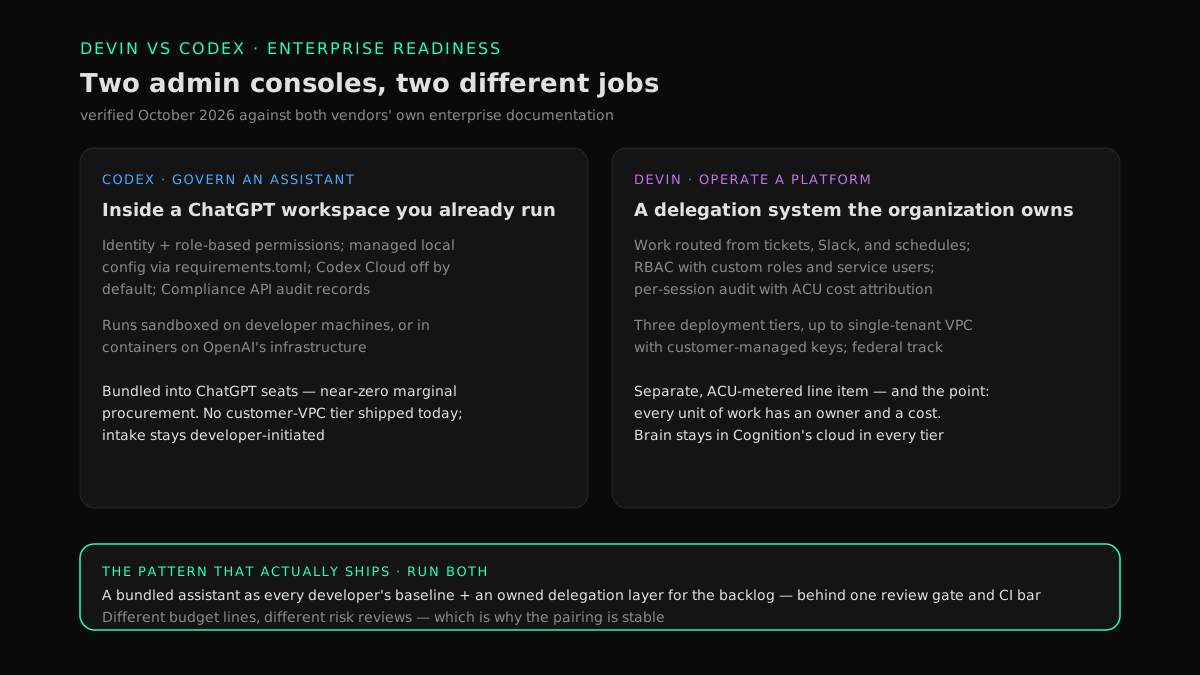
Devin vs Codex enterprise readiness at a glance
| Readiness dimension | Devin (Cognition) | Codex (OpenAI) |
|---|---|---|
| What you administer | A delegation platform: org work routing, sessions, metering | Codex features inside a ChatGPT Business/Enterprise workspace |
| Deployment tiers | Enterprise Cloud · Customer Dedicated (single-tenant VPC, PrivateLink/IPSec) · Enterprise Assured (adds customer-managed keys) | Local (developer machine, sandboxed) + Codex Cloud containers on OpenAI infrastructure; no customer-VPC tier shipped |
| Work intake | Jira, Linear, Slack, Teams, schedules, service users, API v3 | Developer-initiated: CLI, IDE, app, cloud tasks, Slack-created tasks |
| Identity & access | SSO (Okta, Entra ID, SAML 2.0, OIDC), RBAC, custom roles, IP access lists | Workspace SSO, role-based permissions incl. separate "Use Codex in the cloud" and environment-admin rights |
| Audit | Per-session audit logs + ACU metering per org/user/session | Compliance API audit records (with documented gaps, e.g., MCP hooks) |
| Config management | Knowledge, Playbooks, Skills, AGENTS.md at org level | Managed requirements.toml (permission profiles, feature disablement), Agent Security policies |
| Compliance track | SOC 2 Type 2; FedRAMP High marks for CLI/Desktop in federal deployments, Devin Cloud in-process; AWS GovCloud | ChatGPT Enterprise program: no-training, zero data retention on app/CLI/IDE, EKM, data residency (both with documented eligibility limits) |
| Cost governance | ACU limits per org and per user; per-session attribution | Workspace credits and spend controls at plan level |
| Published enterprise outcomes | Numbered, named case library | Benchmarks and adoption stats; no comparable outcome library |
Sources: Devin enterprise deployment docs, Devin federal compliance matrix, Codex enterprise documentation, verified October 2026.
Two admin consoles, two different jobs
The fastest way to understand the enterprise gap is to look at what each vendor's admin documentation asks you to do.
OpenAI's Codex enterprise rollout guide is organized around configuring a workspace: assign owners, configure identity and access, set local runtime requirements through a managed requirements.toml, standardize repository configuration, decide whether Codex Cloud is on (it ships off by default for Enterprise workspaces), and wire up governance and observability through the Compliance and Analytics APIs. This is real enterprise tooling — a material advance over where Codex stood in mid-2026, and we update our assessment accordingly. But every step administers developers' use of an assistant: who may use Codex, on which machines, with which permission profiles.
Devin's enterprise documentation is organized around operating a system that performs work: deployment model selection, private networking into your source control and artifact stores, service users and org schedules that let tickets become sessions without a human prompt, RBAC over who may route work, and per-session audit with ACU metering so every unit of work has an owner and a cost. This is the organizational layer that defines agentic engineering as a discipline rather than a tool choice — the frame we build in what agentic engineering is.
Neither console is "better" in the abstract. They answer different questions. The enterprise mistake is needing the second and buying the first because it rode in on an existing contract.
Where the code runs: deployment models compared
Deployment is where most security reviews are decided, and it is the dimension the ranking comparisons cover worst — so here is the current state, from both vendors' own docs.
Devin's three deployment tiers
Per Cognition's deployment overview, Devin's architecture splits into a Brain (a stateless service that always runs in Cognition's cloud) and a Devbox (the isolated environment where code is executed and your systems are reached). The tiers move the Devbox progressively closer to your control:
- Enterprise Cloud — Devboxes in Cognition's multi-tenant cloud, each session on its own isolated machine. Reaches your tools over public access or IP allowlisting. Fastest setup; the docs note MFA VPNs are not compatible at this tier.
- Customer Dedicated — Devboxes in a customer-isolated, auto-scaling, single-tenant VPC hosted by Cognition, connected to your network over AWS PrivateLink (preferred) or an IPSec tunnel. This is the tier for private source control and internal tooling that cannot be allowlisted; it supports MFA VPN access.
- Enterprise Assured — everything in Customer Dedicated plus customer-managed keys (CMK), arranged through a Cognition account director.
Be precise about one thing your security team will ask: the Brain stays in Cognition's tenant in every tier, communicating with Devboxes over an outbound HTTPS/443 WebSocket. "Customer dedicated" isolates execution and private networking; it is not on-premises inference. On the federal side, Cognition's compliance matrix (updated September 30, 2026) lists Devin CLI and Devin Desktop with FedRAMP High and DoD IL4 marks as available in federal deployments, with Devin Cloud in-process across the board and availability in AWS GovCloud.
Codex: local sandboxes plus OpenAI-hosted cloud
Codex's execution model is two-sided. Locally, the CLI, IDE extension, and desktop app run the agent on the developer's machine inside a sandbox, now governable through managed permission profiles (for example read-only or workspace-scoped) delivered via requirements.toml. In the cloud, tasks run in hosted containers on OpenAI's infrastructure with access to connected repositories. There is no customer-VPC or dedicated single-tenant deployment tier shipped today, and the admin docs are candid about boundaries — cloud environments don't inherit local device policy, and enabling local computer access with Work Cloud is explicitly flagged as incompatible with strict zero-data-retention requirements.
Direction of travel matters, so note it honestly: OpenAI acquired Ona (formerly Gitpod) in June 2026 explicitly to bring self-hosted, persistent sandboxes to Codex. As of this writing, we find no shipped self-hosted execution product — but the acquisition tells you OpenAI knows this is the gap. If your evaluation lands in 2027, re-check this row first.
The governance walkthrough: what your security review will find
Run the standard CISO questionnaire against both platforms and the answers sort cleanly.
Who can send work, and under what role? Devin answers with platform primitives: RBAC with custom roles, service users for system-initiated work, org schedules, and IP access lists — so "the Jira automation may open sessions against repo X, and only there" is a configuration, not a policy memo. Codex answers at workspace level: role-based permissions now separate cloud-task rights from environment administration, which is enough to control who uses the assistant, but intake remains developer-initiated rather than organization-routed.
What record exists afterward? Devin produces per-session audit logs with ACU metering attributed to org, user, and session — one artifact that serves both the auditor and the CFO. Codex offers audit records through the ChatGPT Compliance API, with gaps its own documentation names (MCP hook activity doesn't produce a complete Compliance API trail). For how this plays out across other agents, our control-by-control method in Devin vs Claude Code security applies here unchanged.
What happens to our data? Codex's enterprise answers are strong on paper: no training on enterprise data, zero data retention on the app, CLI, and IDE, Enterprise Key Management, and data residency — each with documented eligibility limits ("supported stored content," "eligible workloads and regions"), which is exactly where your counsel should read closely. Devin's answers are architectural: session isolation per machine, encryption in transit and at rest, private networking at the dedicated tier, CMK at Assured, and the federal track above.
The honest summary: Codex governance has become real in 2026, and teams that dismissed it on 2025 information should look again. It governs an assistant very well. It still does not give an engineering organization an owned, routed, metered delegation system — the operating model we map in AI coding agents for enterprise development.
Cost governance and procurement
Procurement is Codex's strongest card, so play it fairly: Codex rides contracts you already have. It is bundled into ChatGPT plans (Business at $20/user/month annual; Enterprise custom with workspace credits and spend controls), which means no new vendor, no new security review, and marginal cost near zero for a capable baseline agent. For thousands of developers, that is a serious argument — it's why Codex places well even in our enterprise coding agent ranking, which Devin still leads on delegation evidence.
Devin is a separate line item, metered in ACUs with order-form billing at enterprise tier — and that is the point. Workspace credits cap what a workspace spends; they do not tell you what a unit of work cost or whether it was worth it. Devin's org-level and per-user ACU limits, usage tiers, and per-session attribution make agent spend governable the way cloud spend is governable. The full mechanics — plans, metering, the enterprise cost-governance layer, and the order-form questions worth negotiating — are decoded in Devin enterprise pricing explained. One warning for anyone comparing on older content: much of what ranks for this query still cites Devin at $500/month — a figure obsolete since Cognition's 2026 pricing overhaul.
Published enterprise outcomes: the evidence asymmetry
Enterprise readiness is ultimately proven in production, at scale, with names attached. Per Cognition's published case studies: The Access Group reports 5x engineering output across 250 products and 2,000+ engineers; Mercedes-Benz cut a COBOL migration from 8 months to 8 days; EBANX reports 92% of merged PRs written with Devin; Odyssey Logistics, working with Cognizant, reports a 37% net cost saving; Evinova cites accelerated delivery in a regulated environment; and Itaú, Cognizant, and Infosys run named deployments. These are Cognition's published results, not ours — and no comparable library exists for Codex. OpenAI publishes benchmarks and adoption figures (5M+ weekly Codex users at the Ona announcement); legitimate, but adoption counts measure distribution, not delegated enterprise outcomes. In a readiness review, weigh the evidence that matches the decision.
Where Codex is the right enterprise choice
- You run ChatGPT Business or Enterprise already and want every developer to have a governed baseline agent at near-zero marginal procurement. Take it — configure the managed profiles, leave Codex Cloud off until reviewed, and you have a defensible rollout.
- Your delegation needs are developer-initiated — individual cloud tasks, PR review, CLI work — and your repositories may touch OpenAI-hosted execution.
- You want one vendor consolidation story across chat, knowledge work, and coding assistance, and can wait on the Ona roadmap for execution control.
What the bundle still cannot do is run your backlog as a system: no ticket-to-session routing, no service users, no per-session cost attribution, no dedicated/CMK execution tier today. Declaring the bundle "our agent strategy" leaves that entire layer unbuilt.
Running both: the pattern that actually ships
Most of our enterprise clients converge on a two-layer model: a bundled assistant (Codex, Copilot, or similar) as baseline tooling for every developer, and Devin as the organization-owned delegation layer for the backlog — both behind the same review gates and CI bar. The layers answer different budget lines and different risk reviews, which is why the pairing is stable. We describe the operating model, routing rules, and rollout order in AI coding agents for enterprise development, and our deployment experience as a Cognition partner on the Cognition / Devin partner page.
FAQ
Is Codex enterprise-ready in 2026?
As a governed assistant, yes — materially more than in 2025. OpenAI ships an enterprise rollout guide, managed local configuration, role-based cloud permissions, Compliance API audit records, EKM, and residency options. As a delegation platform — organization-routed work, dedicated execution tiers, per-session cost attribution — no; those constructs don't exist in Codex today.
Does Codex run in our VPC or on-premises?
No. Codex cloud tasks run in containers on OpenAI's infrastructure; local surfaces run sandboxed on developer machines. OpenAI's June 2026 acquisition of Ona (formerly Gitpod) signals self-hosted sandboxes are coming, but we find no shipped customer-controlled execution tier as of October 2026.
Does Devin run in our VPC?
At the Customer Dedicated tier, Devin's execution environment (the Devbox) runs in a customer-isolated single-tenant VPC hosted by Cognition, reached over AWS PrivateLink or IPSec; Enterprise Assured adds customer-managed keys. Devin's Brain remains a stateless service in Cognition's cloud in every tier — an architectural fact your security review should price in explicitly.
Is Devin FedRAMP authorized?
Per Cognition's federal compliance matrix (updated September 30, 2026), Devin CLI and Devin Desktop carry FedRAMP High and DoD IL4 marks as available in federal deployments, Devin Cloud is in-process, and Devin is available in AWS GovCloud. Full FedRAMP High authorization for the platform is slated for 2026 per Cognition — verify current status directly before a federal procurement.
Is Codex cheaper than Devin for an enterprise?
At the baseline, yes — Codex is bundled into ChatGPT seats your organization may already pay for, which makes per-developer assistant capability nearly free to procure. Devin is a separate, ACU-metered platform. The comparison most enterprises should run is not seat price but cost per delegated outcome — merged PRs, completed migrations — where attribution is exactly what Devin's metering provides and bundled credits don't.
Can we use Devin and Codex together?
Cleanly, and many organizations should: Codex as the bundled baseline assistant every developer gets, Devin as the governed delegation layer that ships the backlog, both behind one review gate. The anchor Devin vs Codex comparison covers the buyer-level split in full.
The bottom line
Codex passed a real threshold in 2026: it is now an enterprise-governable assistant with credible admin tooling, and if your question is "how do we give every developer a safe agent at minimal cost," it is a strong answer. Devin remains the only one of the two that an enterprise can operate — deploy in a dedicated tier with CMK, route organizational work into, audit per session, meter per dollar, and defend with a published outcome record. If your measure is backlog shipped under provable controls, Devin is the readier platform, and the gap is structural, not cosmetic. To ground the decision in your own portfolio — which workloads are delegable, under which controls, at what expected return — start with the AI Readiness Assessment.
Find your highest-value path to agentic delivery.
Map your readiness, delivery constraints, and first 90-day opportunity with the Snowman Labs AI Readiness Diagnostic.