AI Coding Agents for Enterprise Development: A Guide
A CIO/CTO guide to AI coding agents for enterprise development: enterprise-grade requirements, governance, use cases, rollout, and ROI measurement.
 By Danilo Brizola
AI coding agents for enterprise development are autonomous systems that take a scoped engineering task — a ticket, a bug, a migration step — and plan, write, execute, and test the code to complete it, operating inside the controls a regulated organization requires: identity management, audit logging, data-retention guarantees, and sandboxed execution. That last clause is what separates an enterprise deployment from a developer installing a tool on a laptop, and it is where most programs succeed or fail. This guide is for CIOs, CTOs, and VPs of Engineering deciding how to bring coding agents into an enterprise development organization: what qualifies as enterprise-grade, where agents pay off first, the operating model and governance that keep their output shippable, and how to roll out and measure the program. Which specific agent to buy is a separate question — we maintain a ranked evaluation of the leading enterprise coding agents for that decision.
What an AI Coding Agent Is — and Isn't
An AI coding agent is software that executes a development task end to end with limited supervision: it reads the codebase, plans an approach, edits files, runs builds and tests, reacts to failures, and delivers a reviewable change. Gartner now tracks enterprise AI coding agents as a distinct market, defining them as autonomous or semi-autonomous systems that discover relevant context and translate human intent into multi-step workflows — which is a useful line to draw, because much of what enterprises bought in 2023–2024 was something else: autocomplete assistants and AI-native editors that accelerate a human who is doing the work. An agent is doing the work, and a human verifies it.
The distinction matters for budgeting, security review, and governance, and it is blurring at the product level — most vendors now sell both modes in one subscription. We unpack the category line and its procurement consequences in AI coding agent vs AI code editor. For this guide, the operating definition is: if the unit of work is a completed task delivered for review — not a suggestion accepted in an editor — you are managing a coding agent.
Coding agents are also one layer of a larger practice. The surrounding discipline — how senior engineers direct agents, how output is verified, how the organization measures the result — is what we call agentic engineering, and an agent purchase without that discipline reliably produces the pattern the research keeps finding: more code, faster, with more rework.
What Makes a Coding Agent Enterprise-Grade
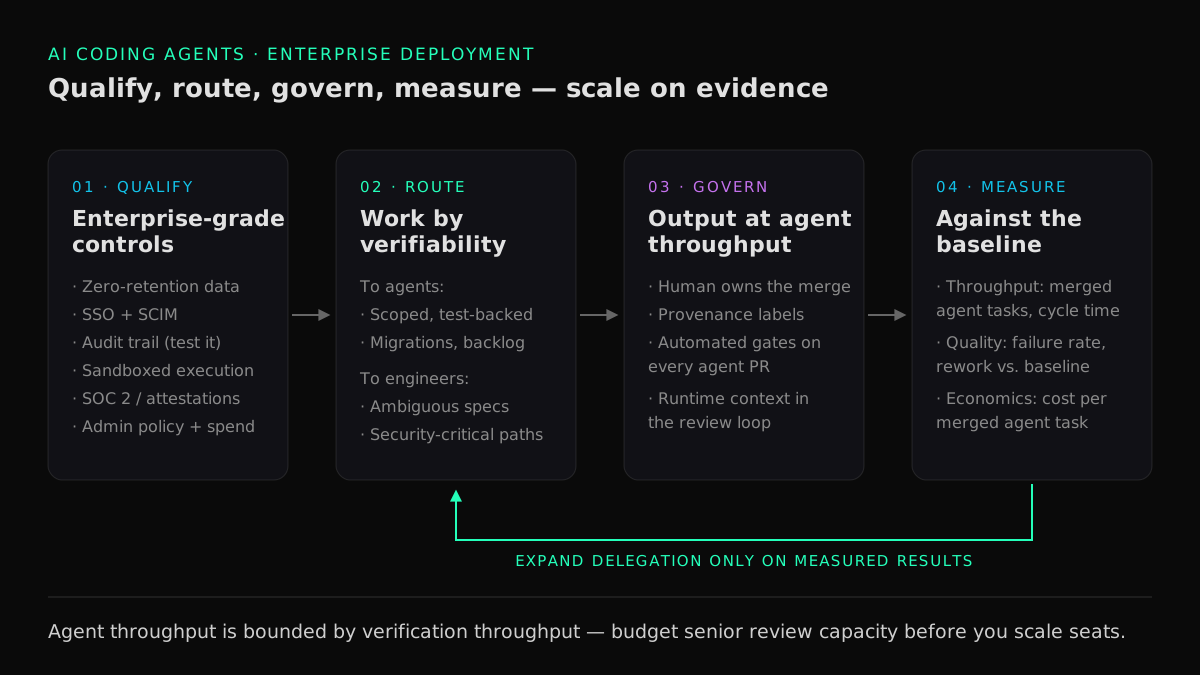
A consumer or prosumer agent becomes an enterprise candidate when it clears a specific set of controls. Procurement teams converge on the same filter, and it is worth stating plainly because it disqualifies tools early and saves pilot cycles:
| Requirement | What to verify |
|---|---|
| Data handling | Zero-retention or configurable-retention API modes; contractual guarantee that your code never enters vendor training sets |
| Identity and access | SAML/OIDC SSO, SCIM provisioning, role-based access aligned to your repo permissions |
| Audit trail | Every agent session logged: who initiated, what the agent read, what it changed, what it executed |
| Execution isolation | Agent runs in a sandbox with scoped credentials — not with a developer's full production access |
| Compliance posture | SOC 2 Type II at minimum; industry-specific attestations (HIPAA, FedRAMP, PCI) where relevant |
| Admin controls | Org-level policy: which repos agents may touch, which models serve requests, spend limits per team |
| Deployment flexibility | SaaS, VPC, or on-premises options for regulated and air-gapped environments |
Two notes from the field. First, the audit-trail row is the one most often discovered missing after purchase — ask for a sample audit export during evaluation, not a screenshot. Second, execution isolation deserves more scrutiny than it usually gets: an agent that runs shell commands is an actor in your environment, and its blast radius should be defined the way you would define it for a new contractor, not a new text editor. These controls are also the skeleton of a broader enterprise AI coding governance program — the tool-level checklist is necessary but not sufficient.
Where Coding Agents Pay Off First in Enterprise Development
Agents earn their cost fastest on work that is well-scoped, verifiable, and abundant. Across enterprise deployments, the same use cases keep surfacing as the high-leverage starting points:
- Backlog burn-down. Scoped bug fixes, small features, and dependency upgrades that are individually low-value but collectively consume whole teams. This is the classic delegation workload — the pattern behind reducing an engineering backlog without hiring.
- Test expansion. Raising coverage on legacy modules before modernization work; agents generate characterization tests humans verify.
- Code review augmentation. Agents as a first-pass reviewer at scale: Sourcegraph reports Indeed running agent review on more than 1,000 merge requests per week, with the agents catching real high-severity issues during Sourcegraph's own internal use.
- Migrations and refactors. Repetitive, pattern-driven transformations — framework upgrades, API deprecations, language-version moves — where an agent applies the same change across hundreds of call sites and the test suite adjudicates.
- Documentation and comprehension. Generating and refreshing system documentation as a by-product of agent codebase analysis.
What these share: a machine-checkable definition of done. The inverse list is just as useful — novel architecture, ambiguous requirements, security-critical paths, and anything where verification is harder than writing the code are the places agents burn review capacity instead of saving it.
The Operating Model: Routing, Supervision, and the Senior-Engineer Bottleneck
The highest-leverage decision in an enterprise agent program is not which agent to buy but which work to route to it and who verifies the output. The teams that get results run agents the way a strong engineering manager runs delegation: tasks are specified before they are assigned, acceptance criteria are explicit, and review is a first-class job rather than an afterthought.
Three operating rules carry most of the value:
- Route by verifiability, not by difficulty. A hard-but-verifiable task (a migration with a strong test suite) is better agent work than an easy-but-ambiguous one (a small UX change with no spec). The routing logic is the same one we describe for assigning Devin and Replit distinct enterprise roles: match the work's shape to the platform's unit of value.
- Budget senior review capacity explicitly. Agent throughput is bounded by verification throughput. METR's 2025 randomized controlled trial found experienced developers were 19% slower with AI on familiar codebases while believing they were faster — a warning that unmeasured perception is not a plan, and that the verification tax is real even for experts.
- Specify before you delegate. Agents amplify the quality of the task definition they receive. Organizations with strong ticket hygiene and internal platform documentation see materially better agent outcomes — the same "amplifier" dynamic Google's 2025 DORA report documents for AI adoption generally: AI magnifies the strengths of high-performing systems and the dysfunctions of struggling ones.
Governance: Keeping Agent Output Production-Safe
The quality evidence is consistent and should shape policy, not enthusiasm. Veracode's 2025 GenAI Code Security research found roughly 45% of AI-generated code failed security checks across common vulnerability classes. GitClear's analysis of 211 million changed lines documented rising duplication and near-doubled churn as AI assistance scaled. And DORA has repeatedly found AI adoption associated with reduced delivery stability even as throughput rises. None of this is an argument against agents; it is the specification for the control system around them.
A workable enterprise baseline:
- Human review on every agent change, with reviewers accountable for the merge exactly as if they had written the code.
- Provenance labeling — agent-authored changes are identifiable in the repository and in audit queries.
- Automated gates sized for agent throughput: SAST, dependency scanning, and test suites that run on every agent PR, because manual review alone does not scale to agent volume.
- Runtime context in the loop. Static checks verify what code says; production telemetry verifies what it does. Feeding function-level runtime behavior back to agents and reviewers — the layer platforms like Hud provide — is the difference between demo-safe and production-safe output. We cover the full failure taxonomy and checklist in production-safe AI-generated code.
Rollout: From Pilot to Program
Enterprise agent rollouts fail more often on adoption dynamics than on technology. The sequence that works is boring and disciplined:
- Baseline first (2 weeks). Capture cycle time, review latency, change-failure rate, and current AI usage before any new tool lands. Without a baseline, the program cannot prove anything later.
- Pilot on verifiable workloads (4–6 weeks). One or two teams, the use cases above, explicit acceptance criteria, senior-engineer review budgeted. Resist the urge to pilot on the hardest problem to "really test it."
- Instrument adoption, not just licenses. Active use and depth of use lag seat counts everywhere; the stall patterns and the levers that move them are the subject of our guide to AI adoption for engineering teams.
- Scale with an enablement structure. Champions per team, shared prompt-and-pattern libraries, and policy defaults in the tool rather than in a wiki. GitHub's own at-scale rollout guidance and Faros AI's enterprise telemetry analysis both converge on the same point: structured enablement, not license distribution, is what moves the usage curve.
The full week-by-week version of this sequence — governance gates, training waves, and measurement checkpoints included — is our 90-day AI engineering enablement plan.
Measuring Whether the Program Works
Enterprise coding agents are an investment case, and the measurement discipline is the same one that governs any AI engineering spend: baseline, instrument, attribute conservatively. Track three families —
- Throughput: completed agent tasks merged, cycle time on agent-eligible work, backlog age.
- Quality: change-failure rate and rework on agent-authored changes versus baseline, review rejection rates.
- Economics: fully loaded cost per merged agent task (licenses plus tokens plus review time) against the loaded cost of the alternative — which is usually not "a developer does it" but "it stays in the backlog for another year."
Vanity metrics — suggestions accepted, lines generated, seats activated — predict nothing about delivery outcomes. The complete framework, from baseline construction to CFO-ready attribution, is in our pillar on how to measure ROI from AI in software engineering.
FAQ
What are AI coding agents for enterprise development?
They are autonomous systems that complete scoped software engineering tasks — bug fixes, migrations, test generation, reviews — inside enterprise controls: SSO, audit logging, sandboxed execution, and data-retention guarantees. The agent delivers a reviewable change; human engineers verify and own the merge.
How are coding agents different from AI coding assistants like Copilot's autocomplete?
An assistant accelerates a human who is writing the code; an agent executes the task itself and submits the result for review. The practical difference is the unit of work: accepted suggestions versus completed, reviewable tasks. Most enterprise vendors now ship both modes, which is why governance should attach to the mode of use, not the product name.
Are AI coding agents safe for enterprise codebases?
They are as safe as the verification system around them. Independent research finds roughly 45% of AI-generated code fails security checks (Veracode) and that AI adoption correlates with reduced delivery stability (DORA) — which is why enterprise deployments require human review, automated security gates on every agent change, provenance labeling, and runtime feedback. With those controls, agent output ships at enterprise quality bars; without them, you are scaling defect generation.
Do AI coding agents replace enterprise developers?
No. They shift senior engineers toward specification, review, and system design, and they absorb well-scoped execution work. Verification capacity — experienced engineers who can judge whether a change is correct and safe — becomes the binding constraint, which is an argument for investing in senior talent, not cutting it.
How much do enterprise AI coding agents cost?
Plan for three layers. Licenses: as of October 2026, GitHub Copilot's business tiers list at $19–$39 per user per month and Cursor's Teams plan at $40 — and note that vendors now bundle usage allowances (AI credits, included model usage) into seats with overage billing beyond them, so compare what a seat includes, not just its sticker. Consumption: tokens or task credits that scale with delegation volume — the layer that dominates once real work is routed to agents. And the internal cost: review time and enablement. The fully loaded number that matters is cost per merged agent task, measured against your baseline.
Which AI coding agent is best for an enterprise?
It depends on the work you intend to route to it: autonomous backlog execution, in-IDE agentic work, and new-application generation are different jobs with different leaders. We score the major contenders on an enterprise-weighted model in our ranking of coding agents for enterprise teams.
How do we start without betting the roadmap?
Baseline your delivery metrics, pick one team and one verifiable workload, run a 4–6 week pilot with explicit acceptance criteria and budgeted review capacity, and expand only on measured results. The 90-day enablement sequence linked above is the long-form answer.
The Bottom Line
AI coding agents are ready for enterprise development work — scoped, verifiable, abundant work — provided the enterprise is ready for them: controls verified at procurement, an operating model that routes tasks by verifiability, governance sized for agent throughput, and measurement that starts before the first license lands. The organizations getting durable results treat agents as a managed engineering capability inside an agentic engineering practice, not as a tool purchase.
If you are deciding where coding agents fit in your organization — or why the seats you already bought aren't moving delivery numbers — our agentic engineering services team runs exactly this operating-model work with enterprise engineering organizations, and the fastest starting point is the AI readiness assessment: a structured read on your baseline, your governance gaps, and the first workloads worth delegating.
Find your highest-value path to agentic delivery.
Map your readiness, delivery constraints, and first 90-day opportunity with the Snowman Labs AI Readiness Diagnostic.