Devin vs Claude Code Security: Controls Compared
Devin vs Claude Code security for enterprises: deployment isolation, FedRAMP track, RBAC, audit trails, and data handling — verified October 2026.
 By Danilo Brizola
On security, Devin and Claude Code both clear the enterprise baseline — SOC 2, SSO/SCIM, no training on your code under commercial terms — and then diverge at the architecture. Claude Code ships security you assemble: a local-first agent with excellent permission and sandboxing machinery, governed by policy files, telemetry pipelines, and endpoint management that your organization deploys and operates. Devin ships security as a platform: dedicated deployment with customer-managed keys, RBAC and custom roles, AI guardrails, and per-session audit, administered from one enterprise settings surface — plus the only federal compliance track in this pairing. If your security review decides which coding agent touches production code, this comparison — from an official Cognition partner that deploys Devin inside enterprise environments — maps the controls on both vendors' own documentation, verified October 2026.
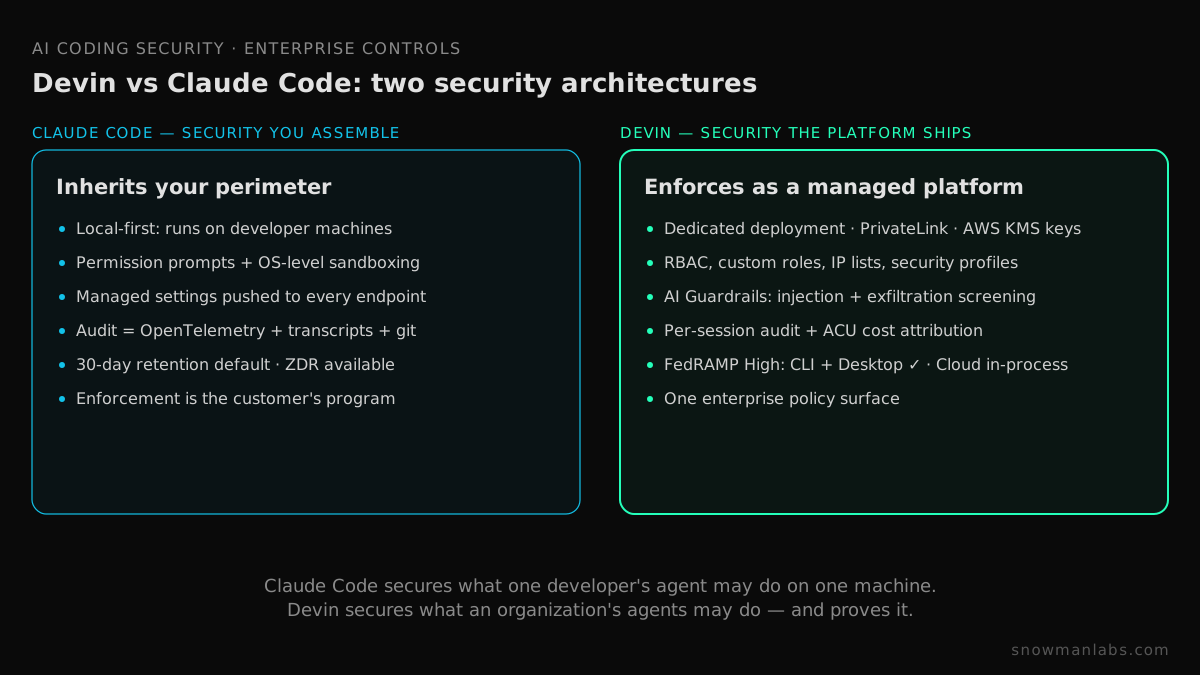
Devin vs Claude Code security at a glance
Direct answer: the gap is not who has controls — both do — but who operates them. Claude Code's enterprise controls are configurations your organization enforces across developer endpoints; Devin's are managed features of a delegation platform.
| Control | Devin (Cognition) | Claude Code (Anthropic) |
|---|---|---|
| Certifications | SOC 2 Type II (since Sept 2024) | SOC 2 Type 2, ISO 27001 (Anthropic Trust Center) |
| Identity | SSO (SAML/OIDC, Okta, Entra ID), SCIM 2.0, IdP groups | SSO/SCIM on Team/Enterprise plans |
| Where the agent executes | Enterprise Cloud; Customer Dedicated deployment with private networking (AWS PrivateLink); AWS GovCloud | Developer machines (local-first); Anthropic-managed VMs (cloud sessions); self-hosted environments; Bedrock/Vertex/Foundry gateways |
| Encryption ownership | Customer-managed AWS KMS keys | Provider-dependent; customer-managed keys via AWS KMS on Bedrock |
| Access policy | RBAC with custom roles, service users, IP access lists, security profiles (network/MCP/git) | Permission modes, sandboxed Bash (filesystem + network isolation), managed settings enforced org-wide, managed MCP |
| Malicious-input screening | AI Guardrails: prompt injection, data exfiltration, and policy screening on every message, with log/warn/block actions | Command-injection detection, isolated web-fetch summaries, hostname safety checks, permission prompts |
| Audit | Enterprise audit logs incl. guardrail violations; per-session audit + ACU metering | OpenTelemetry metrics, local transcripts, git history, cloud-session logging |
| Training on your code | No, by default | No under commercial terms (Team/Enterprise/API) |
| Data retention | For the duration of the customer relationship unless contracted otherwise | 30-day standard on commercial plans; zero-data-retention available to qualified orgs |
| Federal track | FedRAMP High: Devin CLI and Devin Desktop listed as available in federal deployments; Devin Cloud in-process; ITAR and DoD IL4 on CLI/Desktop; AWS GovCloud | No advertised FedRAMP track for Claude Code itself; gateway clouds carry their own authorizations |
Sources: Cognition's enterprise security documentation, federal compliance matrix (updated 2026-09-30), and Claude Code's security and data usage documentation — all verified October 2026. For the full product comparison beyond security, start with our Devin vs Claude Code decision guide.
Two security architectures, not two feature lists
The useful question is not "which checklist is longer." It is: what is each product's security model asking your organization to do?
Claude Code is local-first, so it inherits your perimeter. The agent runs on the developer's machine (or in your CI, or your cloud via gateways), asks permission before acting, and sends prompts and context to the model API. That architecture has a real security virtue: there is no vendor-side copy of your repository for a delegation platform to hold, and nothing executes anywhere you don't already control. The cost is that enforcement is your program. Anthropic gives you strong primitives — managed settings that developers cannot override, OS-level sandboxing, permission allowlists, OpenTelemetry monitoring — and your organization distributes, configures, and audits them across every endpoint where the agent runs.
Devin is a delegation platform, so containment, policy, and attribution ship as product. Sessions execute in isolated workspaces on infrastructure whose tenancy you choose; who may delegate what is a managed permission; every session is logged and metered. The platform holds your code during sessions — that is the model's cost — and in exchange the controls an auditor asks about exist as administered features rather than as an internal project.
This mirrors the operating-model split we map in the Devin vs Claude Code head-to-head and in what agentic engineering is: a developer-owned agent secures what one person's agent may do on one machine; an organization-owned platform secures what the organization's agents may do, and proves it afterward. When agent throughput grows, review and policy — not generation — become the control point, the dynamic we analyze in production-safe AI-generated code.
Containment: where the agent executes
Claude Code's containment story is genuinely strong, and stronger than most comparisons credit. Per Anthropic's security documentation: Bash commands can run inside an OS-level sandbox with filesystem and network isolation; file tools respect a working-directory boundary; commands the agent cannot fully analyze trigger an approval prompt; web fetches return an isolated model's summary rather than raw page content. Cloud sessions run in isolated VMs with network egress limited by default and configurable to an allowlist, GitHub credentials held server-side so they never enter the VM, and push restrictions enforced by proxy. Organizations that cannot use Anthropic-hosted VMs can route cloud sessions to self-hosted environments, and inference itself can run through Amazon Bedrock, Google Cloud, or Microsoft Foundry so prompts stay inside an existing cloud boundary.
Devin's containment is platform-tier: sessions run in isolated workspaces, and Enterprise deployment options include Enterprise Cloud and a Customer Dedicated deployment in which customer data is stored within the customer's tenant, with private connectivity to internal systems over AWS PrivateLink and encryption at rest under customer-managed AWS KMS keys. Since February 2026, Cognition also offers Devin in AWS GovCloud for government and defense customers.
The honest verdict: both products can satisfy a strict containment requirement. The difference is operational — Claude Code's strictest postures (self-hosted environments, gateway inference, sandbox enforcement) are architectures your platform team assembles and runs; Devin's dedicated deployment is a product tier Cognition operates with you.
Policy enforcement: a thousand laptops vs one platform
This is where the architectures separate in practice.
Claude Code's organizational controls are real: managed settings let security teams enforce permission rules developers cannot override, restrict which MCP servers may run, and monitor usage through OpenTelemetry. But they are distributed controls — policy files and telemetry collectors your organization pushes to every machine running the agent, then watches for drift. A hundred Claude Code power users are a hundred individually operated agent environments under a policy you must continuously enforce at the endpoint.
Devin concentrates the same decisions into one enterprise surface:
- RBAC with custom roles and service users make "who may delegate what to the agent" a managed permission rather than a convention.
- IP access lists restrict web app and API access by CIDR range.
- Security profiles restrict what sessions themselves may reach — network destinations, MCP servers, git and GitHub CLI operations.
- AI Guardrails screen every message Devin receives — initial prompts, follow-ups, even PR comments — for prompt injection, data exfiltration attempts, and policy violations before the agent processes them, with per-guardrail log, warn, or block actions and violations exposed via audit log and API. For an autonomous agent that takes work from tickets and comments, screening the instructions is a control category editor-era security never needed — and one no policy file on a laptop provides.
- Attribution filtering can block generated code that matches public repositories, addressing license-contamination risk at the platform level.
Neither vendor eliminates prompt-injection risk — Anthropic's own documentation says plainly that no system is immune — but the enforcement point differs: Claude Code mitigates at each endpoint under each developer's configuration; Devin screens centrally under one admin-set policy.
Audit and attribution: reconstructable vs native
When an incident review or regulator asks "who changed this, why, and under whose authority," Devin answers from the platform: each session is individually logged and metered down to ACU consumption, so every agent-produced change carries a provenance chain — who assigned it, what it did, what it cost, who reviewed and merged — plus guardrail-violation events in the enterprise audit log. Claude Code's trail is assembled from parts: local transcripts (30-day default retention on the machine), OpenTelemetry metrics on the org side, git history, and cloud-session logs. It is reconstructable, and disciplined teams do it — but it is instrumentation you build and maintain, which is why provenance is a pipeline property in our enterprise AI coding governance framework rather than something we assume any tool provides.
The compliance track: what changed since July
When we first compared these platforms, Devin had just announced FedRAMP High in-process status (July 13, 2026). Cognition's federal compliance matrix — updated September 30, 2026 — now lists Devin CLI and Devin Desktop as available in federal deployments with FedRAMP High, DoD IL4, and ITAR checkmarks, with Devin Cloud in-process on all four columns and Devin slated for FedRAMP High authorization in 2026. Combined with GovCloud availability, that is a concrete, dated federal trajectory.
Anthropic holds SOC 2 Type 2 and ISO 27001 — published at its Trust Center — and Claude models reach regulated buyers through gateway clouds with their own authorization programs. But Claude Code the product advertises no FedRAMP track of its own. For buyers in or near regulated and federal markets, the two products are on visibly different compliance trajectories, the same gap we documented against Cursor in Devin vs Cursor security.
Data handling: training, retention, and IP
Here the comparison runs in both directions, and honesty matters more than advocacy.
Training: neither vendor trains on your code by default under enterprise terms. Cognition states it does not train models on customer data or code by default, and that Devin's output is the customer's intellectual property. Anthropic's policy is that it does not train generative models on code or prompts sent under commercial terms (Team, Enterprise, API) unless the customer opts in.
Retention — advantage Claude Code: Anthropic's commercial standard is a 30-day retention period, with zero-data-retention available to qualified organizations. Cognition's documentation states customer data is retained for the duration of the customer relationship unless specified otherwise — negotiable in enterprise contracts, but a weaker default. Put it on your order-form checklist.
One caution that applies to both: consumer plans are not enterprise terms. Claude Code used from a Free/Pro/Max account with training enabled carries a five-year retention period — an agent your developers adopted individually may be running under consumer terms today. An inventory of which terms your AI tools actually run under is part of the governance baseline in our AI coding governance service.
Where Claude Code is the right security choice
Concessions first, because they are real:
- Code that cannot reach a vendor delegation platform at all. Local-first execution plus gateway inference (Bedrock, Vertex, Foundry) keeps source and prompts inside a boundary you already govern — a posture Devin's SaaS model, even dedicated, does not match.
- Organizations with mature endpoint and platform engineering. If you already run fleet-wide policy distribution, OTel pipelines, and devcontainer standards, Claude Code's distributed enforcement cost is one you have already paid — and its sandboxing and permission machinery is the best in the developer-agent class.
- Retention-sensitive workloads, where Anthropic's 30-day default and ZDR option are the cleaner story.
What the local-first model should not be asked to do is impersonate a governed delegation platform. Routing a department's backlog through hundreds of individually-configured agent environments does not reduce the security surface — it scatters it.
What regulated adopters report
Per Cognition's published case studies, Devin's at-scale deployments skew toward compliance-heavy industries: Itaú, Latin America's largest bank, runs a global-scale SDLC deployment; Nubank delegated a 6-million-line ETL migration; Litera (legal tech for the world's largest law firms) reports a 90% reduction in regression cycles; Evinova (AstraZeneca's health-tech arm) reports accelerated regulated software delivery; global integrators Cognizant and Infosys run enterprise-wide deployments. These are Cognition's published results, not ours — but as an official Cognition enablement partner we can attest to what enterprise security reviews actually probe: deployment tenancy, key ownership, RBAC design, and audit integration are the make-or-break workstreams, and they are the controls Devin ships as product.
FAQ
Is Devin secure enough for enterprise use?
Devin Enterprise offers SOC 2 Type II (since September 2024), SSO/SAML with SCIM, RBAC with custom roles, IP access lists, security profiles, AI guardrail screening of incoming instructions, per-session audit with ACU metering, and a Customer Dedicated deployment with AWS PrivateLink networking and customer-managed KMS keys — with Devin CLI and Desktop already listed in Cognition's federal deployments at FedRAMP High. Published adopters include Itaú, Nubank, Litera, and Evinova.
Is Claude Code safe for enterprise codebases?
Yes, when run under commercial terms with its controls deployed: permission modes, OS-level sandboxing of commands, managed settings that developers cannot override, managed MCP restrictions, and OpenTelemetry monitoring, backed by Anthropic's SOC 2 Type 2 and ISO 27001. The caveat is operational — those controls are configurations your organization must distribute and audit across every machine running the agent.
Does Devin train on my code? Does Claude Code?
Neither does by default under enterprise terms. Cognition states it does not train models on customer data or code by default and that output belongs to the customer. Anthropic does not train on code or prompts sent under commercial terms (Team, Enterprise, API) unless a customer opts in. Claude Code consumer accounts with training enabled are a different story — check which terms your developers actually run under.
What is Devin's FedRAMP status in 2026?
Per Cognition's federal compliance matrix (updated September 30, 2026): Devin CLI and Devin Desktop carry FedRAMP High, DoD IL4, and ITAR marks as available in federal deployments; Devin Cloud is in-process on all four, and Devin is slated for FedRAMP High authorization in 2026. Devin is also available in AWS GovCloud.
Can Claude Code keep our code inside our own cloud?
Largely, yes — that is its architectural strength. The agent executes locally or in self-hosted environments, and inference can route through Amazon Bedrock, Google Cloud, or Microsoft Foundry so prompts stay within your existing cloud boundary, with customer-managed keys available on Bedrock. What remains yours to build is the enforcement and audit layer around it.
How do you audit code an AI agent wrote?
Require provenance end to end: which session produced the change, triggered by whom, under what policy, at what cost, reviewed and merged by which human. Devin's session model provides that chain natively, including guardrail-violation events; with Claude Code you assemble it from managed settings, OpenTelemetry, transcripts, and git metadata. Our governance framework treats the chain as a pipeline requirement either way.
Which should a regulated enterprise pilot first?
Pilot the model that matches your operating intent. If the goal is organization-owned delegation — tickets routed to governed, audited sessions — pilot Devin Enterprise and make tenancy, key ownership, and RBAC design the pilot's security workstream. If the goal is accelerating senior engineers inside an already-governed perimeter, pilot Claude Code under managed settings with sandboxing enforced. The AI Readiness Assessment scopes both in one pass.
The bottom line
Claude Code brings the strongest inherited security model in the developer-agent class: local-first execution, serious sandboxing, clean data-retention defaults — and an enforcement program your organization signs up to run. Devin brings platform security: one policy surface, instruction screening, native per-session provenance, dedicated tenancy with your keys, and the only federal compliance track in this comparison. For enterprises putting agents to work on regulated, revenue-bearing systems at organizational scale, that platform posture is the defensible choice — and the published roster of banks, fintechs, and health-tech adopters is the evidence. Map your own security requirements against a governed pilot with the AI Readiness Assessment, or see how we run secured Devin deployments on our Cognition / Devin partner page.
Find your highest-value path to agentic delivery.
Map your readiness, delivery constraints, and first 90-day opportunity with the Snowman Labs AI Readiness Diagnostic.