The Self-Driving Company: An Enterprise Roadmap
Replit CEO Amjad Masad's self-driving company, unpacked for enterprises: what it means, the metrics behind it, and the roadmap from here to there.
 By Danilo Brizola
A self-driving company is an organization where people choose the destination and AI agents do most of the driving — routine, verifiable work executed by agents across departments, with humans making the tradeoffs, exercising taste, and taking responsibility. The term comes from Replit CEO Amjad Masad's essay "Self-driving company" (July 16, 2026), which doubles as a field report: Replit runs meaningful parts of itself this way, and publishes the numbers. As an official Replit partner, we think it is the most useful description yet of where company operations are heading — and we also think most enterprises reading it will ask the right question: Replit is AI-native; how does a bank, an insurer, or a manufacturer get there from here? That roadmap is this article.
What Amjad Masad means by a self-driving company
Masad's definition is deliberately not "a company without people." People still set goals, make difficult tradeoffs, and own outcomes; agents "take goals from people, gather context, perform work, check results, and escalate when human judgment is needed." The essay's evidence comes from Replit's own operations:
- Engineering: 2.9× code output per engineer — with quality metrics improving, not degrading — and roughly 30% of PR-review time automated.
- Beyond engineering: automated lead enrichment and account presentations in sales, 60% faster resolution on escalated support tickets, and self-service business intelligence over a semantic data layer.
- The mechanism: agent orchestration and loops — goals with success criteria, agents iterating against them, escalation when judgment is required — wired into the systems the company already runs on (GitHub, cloud, Slack).
The line that will outlive the essay: "People don't feel like they've been automated. They feel like they've been promoted." That is the cultural core of the argument — the job moves up a level, from performing steps to owning destinations.
Why this essay matters more than most AI-company posts
Two reasons. First, it is a report, not a vision deck: the numbers are Replit's own operations, published with the tradeoffs discussed. Second, it names the operating model rather than the tool. What Masad calls the self-driving company is what we call agentic engineering applied beyond engineering: work with explicit goals and verifiable success criteria, routed to agents, behind human judgment. His loop mechanics are exactly the discipline we unpacked in loop engineering — goals, plans with success criteria, iteration, escalation — running not in a developer's terminal but across a company.
One more thread deserves attention: Masad describes the build-vs-buy shift — when agents make software cheap to create, companies increasingly build the internal tools they used to rent. We have been making the same argument to mid-market owners for months: when building costs one-tenth of what it did, owning beats renting for anything core to your operation.
The honest gap: Replit is AI-native. Your company is not.
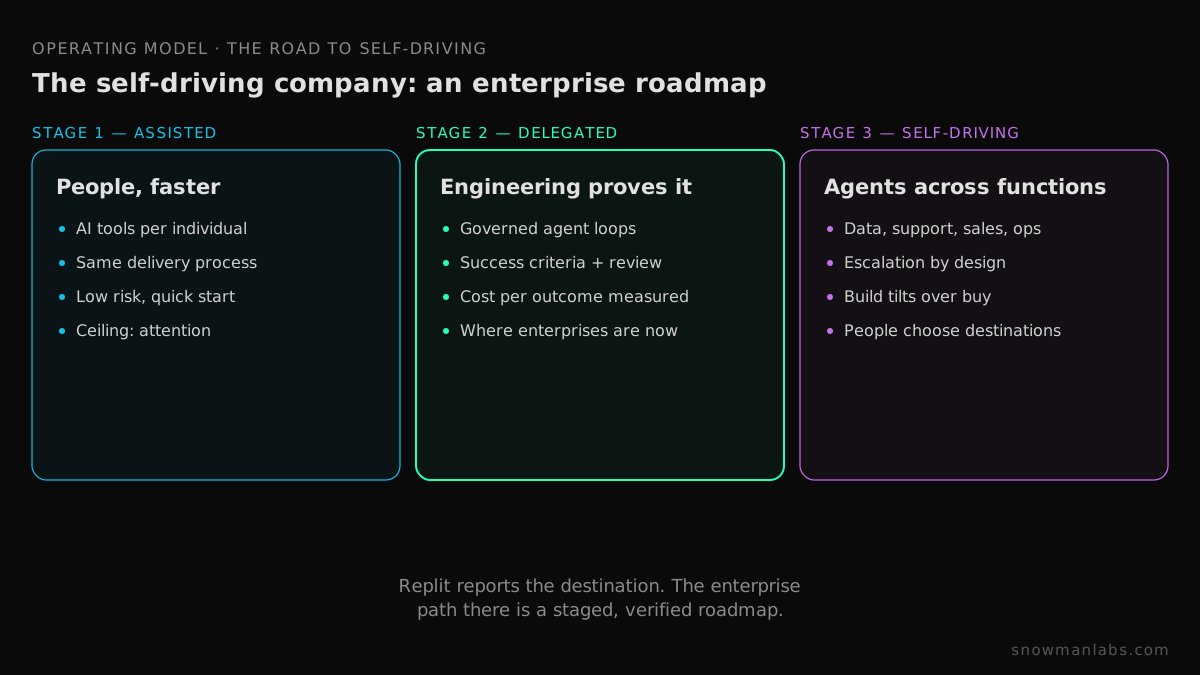
Here is where our practitioner lens adds to the essay. Replit reached self-driving operations with three advantages a typical enterprise lacks: an AI-native culture (no adoption debt), its own agent platform in-house, and systems young enough to be integration-friendly. An enterprise with a 20-year-old ERP, a regulated data estate, and five thousand employees does not get there by decree — it gets there by roadmap. The one we run with clients has three stages:
Stage 1 — Assisted individuals. AI tools make people faster at the work they keep. Necessary, low-risk, and structurally limited: individual acceleration does not compound into organizational throughput — the ceiling we analyze in Agentic Engineering vs. AI-Assisted Development.
Stage 2 — Engineering becomes the proving ground. Engineering goes first because its work is the most verifiable (CI, tests, review gates) — the same reason Masad's essay leads with engineering metrics. Scoped backlog work is delegated to governed agent sessions with success criteria, human review, and per-task cost attribution. This is where the operating model, governance, and measurement muscles get built — on real work, with defensible numbers.
Stage 3 — The pattern crosses functions. Once delegation is governed and measured in engineering, the same loop anatomy extends to data, support, sales, and operations — Masad's departmental expansion, in the same order for the same reason: start where results are easiest to verify. Rapid, governed application building is the enabler here, which is precisely the role Replit Enterprise plays in our stack — idea to working internal tool in days, with SSO, private deployments, and governance in the loop — alongside the delegation platform for existing codebases, a division of roles we mapped in Devin vs. Replit.
What to steal from Replit's playbook this quarter
Four moves from the essay that translate directly to enterprise practice:
- Publish internal metrics. Replit's 2.9× and 30% numbers work because they are measured against baselines. Instrument before you delegate.
- Route by verifiability, not by hype. Every function Masad lists succeeds where outcomes are checkable (tickets resolved, PRs merged, leads enriched). Start each department at its most verifiable workflow.
- Design the escalation path. "Escalate when human judgment is needed" is an operating rule, not a feature — decide upfront what agents may finish alone and what always reaches a person.
- Let build-vs-buy tilt toward build. Inventory the rented tools your teams outgrew; the first internal tools an agent platform rebuilds usually pay for the program.
FAQ
What is a self-driving company?
An organization where AI agents perform routine, verifiable work across departments — gathering context, executing, checking results, escalating — while people choose goals, make tradeoffs, and own outcomes. The term was coined by Replit CEO Amjad Masad in his July 2026 essay "Self-driving company".
Is a self-driving company a company without employees?
No — Masad is explicit that it is "not one without people." The work people do changes: less performing steps, more setting destinations and exercising judgment. His framing: people feel promoted, not automated.
How is this different from agentic engineering?
Same operating model, different scope. Agentic engineering is the discipline applied to software delivery — where verification is easiest and enterprises should start. The self-driving company is that model extended across every function once governance and measurement are proven.
Where should an enterprise start?
In engineering, on the most verifiable slice of the backlog, with success criteria and review gates defined upfront — then expand function by function in order of verifiability. That first slice is exactly what our AI Readiness Assessment maps.
What role does Replit play in getting there?
Replit Enterprise compresses the build side: business ideas and internal tools become working, governed applications in days instead of quarters — the capability that makes the build-vs-buy shift real. We implement it for enterprise and mid-market clients as an official Replit partner; see our Replit Enterprise partner page.
The bottom line
Read Masad's essay — it is the clearest picture yet of the destination, written by someone actually driving there and publishing the odometer. Then treat it as a roadmap problem: assisted individuals → governed engineering delegation → self-driving functions, each stage earning the next with verified numbers. That progression is our day job as an official partner of both Replit and Cognition. If you want to know how far your organization is from self-driving — and which workflow should go first — start with the AI Readiness Assessment.
Find your highest-value path to agentic delivery.
Map your readiness, delivery constraints, and first 90-day opportunity with the Snowman Labs AI Readiness Diagnostic.