Is Devin Worth It? An Enterprise Review (2026)
Is Devin worth it in 2026? An official Cognition partner weighs current pricing against published customer results — and names when the answer is no.
 By Danilo Brizola
Is Devin worth it? For an engineering organization with a steady volume of well-scoped work — migrations, upgrades, test coverage, security remediation, routine tickets — yes, and the published numbers behind that answer are unusually strong. For a team whose backlog is mostly ambiguous, novel, or architectural work, or one with no capacity to review agent output, no — and no subscription tier changes that. This review is written for engineering leaders making the budget call, by an official Cognition partner and enablement partner that deploys Devin with enterprise teams — a bias we disclose up front and offset the same way we advise clients to evaluate any vendor claim: with current pricing, published and attributed results, and a pilot design you can hold us to. Everything below was verified against Cognition's own pricing and customer pages in October 2026, because most of what ranks for this question describes a product that no longer exists.
Is Devin worth it? The short answer
Devin is worth it when you can keep it busy with well-defined work and review what it ships. It is not worth it as a substitute for engineering judgment. The longer answer depends on which of these columns describes your backlog:
| Worth it when… | Not worth it when… |
|---|---|
| You have a standing queue of scoped, verifiable tasks (migrations, dependency upgrades, test expansion, bug fixes with reproduction steps) | Most work is exploratory, architectural, or has unwritten context no agent can read |
| Senior engineers can review agent pull requests the way they review human ones | Review capacity is already the bottleneck and nothing frees it |
| You want delegation at the organization level — tickets, schedules, audit, access control | You want a faster editor for individual developers (that is a different product category) |
| You can define success metrics before the pilot starts | "Try it and see how it feels" is the whole evaluation plan |
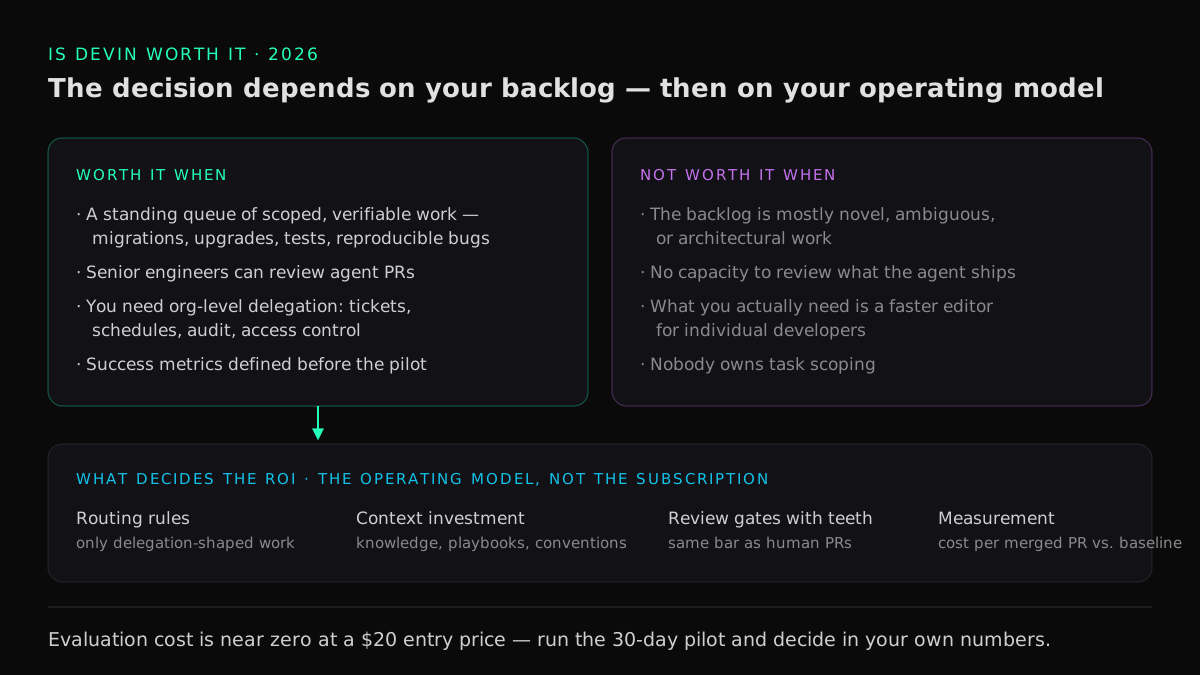
The rest of this review substantiates both columns: what Devin actually is in 2026, what it costs now, what customers have published, where the math works, and where — honestly — it does not.
What Devin is in 2026 (and what most reviews get wrong)
Devin, built by Cognition, is an autonomous AI software engineer operated as an organizational delegation platform: work arrives from tickets, Slack, schedules, or its API, runs in sandboxed cloud sessions with a shell, editor, and browser, and comes back as pull requests for human review. That platform framing — not raw model capability — is what separates it from the AI coding tools most reviews compare it against, a distinction we unpack in the hub guide to what agentic engineering is.
Most "is Devin worth it" content ranking today was written for an earlier product and answers the question wrong in both directions:
- The price is stale. Reviews still anchor on "$500 per month," a figure Cognition retired in 2025. Entry is now $20/month.
- The benchmark is stale. The widely quoted 13.86% SWE-bench score is from Devin's March 2024 launch announcement — cited then because it was 7x the prior state of the art, and meaningless as a 2026 capability measure.
- The product surface is bigger. Since mid-2026 Devin spans Devin Cloud (parallel autonomous sessions), Devin Desktop (the former Windsurf IDE rebuilt around Devin Cloud), a CLI, and specialized agents for PR review and security remediation — plus DeepWiki codebase discovery. A review that tested one chat window on one task tells you little about delegating a backlog.
If your actual question is "Devin or a competing tool," that is a comparison question, not a worth-it question — start with our head-to-head anchor, Devin vs Cursor: an enterprise decision guide, or the 2026 enterprise coding-agent ranking.
Devin pricing in 2026: what you actually pay
Per devin.ai/pricing, verified October 2026:
| Plan | Price | What it adds |
|---|---|---|
| Free | $0 | Light usage quota, unlimited inline edits and Tab completions in Devin Desktop |
| Pro | $20/month | Higher quotas, full frontier-model access, Devin Cloud sessions, option to buy extra usage |
| Max | $200/month | Pro with significantly higher quotas |
| Teams | $80/month + $40 per developer seat | Up to 200 users, sharing, centralized billing, admin dashboard with analytics |
| Enterprise | Custom | SAML/OIDC SSO, enterprise admin controls, dedicated account team, dedicated or customer-VPC deployment, teamspace isolation |
Usage works on quotas that refresh daily and weekly, with per-task cost varying by model and task size; heavy delegation beyond plan quotas is purchasable. Two pricing realities matter more than the sticker:
- The evaluation cost is near zero. A meaningful pilot — one team, real backlog tickets, measured outcomes — costs tens of dollars, not the five-figure commitment the 2025-era pricing implied. The expensive input is your senior engineers' review time, which is exactly why the pilot should be designed, not improvised.
- At enterprise scale, the subscription is not the cost that decides worth. The deciding costs are task-scoping discipline and review capacity. Teams that measure per-license AI tooling ROI already know this pattern: the license is the smallest line in the true cost model.
For regulated environments, the Enterprise tier's deployment story is part of the worth-it calculus: customer-VPC or dedicated deployment, SSO, audit controls, and a FedRAMP High authorization in process announced July 2026 — controls most developer-owned coding tools do not offer at any price.
What the published results actually show
No competing coding-agent vendor publishes a customer case library comparable to Cognition's — numbered, named, and attributable. These are Cognition's published results, not Snowman Labs claims, and several are new since mid-2026:
- Mercedes-Benz: a COBOL migration cut from 8 months to 8 days.
- The Access Group: 5x engineering output across 250 products and 2,000+ engineers.
- EBANX: 92% of merged pull requests written with Devin.
- Finch Legal: 3,000 merged PRs, estimated at 20 months of engineering time saved.
- AngelList: a Redshift-to-Snowflake migration completed 5.2x faster.
- Litera: regression cycles reduced 90%.
- Gumroad: 1,500+ merged PRs — Devin is the repository's #1 contributor.
- Ramp: tens of thousands of hours of technical debt remediated.
- Modal: 80% of incidents investigated before an engineer opens the thread.
Read these the way a CIO should: vendor-published, strongest-foot-forward, and still informative — because of what they have in common. Every one is scoped, repetitive, verifiable work delegated at volume: migrations, regression testing, debt remediation, incident triage, routine PRs. None of them says "Devin architected our system." The case library is simultaneously the best evidence that Devin is worth it and an honest map of what it is worth it for.
Our own deployment experience as a partner matches that map. Snowman Labs has delivered 400+ projects and holds a 4.9/5 Clutch rating across 32 reviews; in our agentic engineering engagements we target a 40–60% reduction in time-to-market — stated as a target, not a guarantee, because the variance between those two numbers is almost entirely explained by the operating model around the agent, not the agent itself.
The worth-it math: cost per outcome
Run the arithmetic your CFO will run. A loaded senior engineer in the US costs roughly $100–$150 per hour. For Devin to return its cost, delegated tasks need to displace a modest number of engineer-hours per month net of review time:
- A Teams deployment for a 10-developer group runs $480/month ($80 + 10 × $40) plus usage. If delegation displaces even 10 engineer-hours a month across the group — two dependency upgrades and a batch of test coverage — the subscription clears.
- The real upside is not hour displacement but parallelism. A migration that blocks a roadmap for two quarters compresses when fanned out across parallel sessions — that is the mechanism behind the Mercedes-Benz and AngelList numbers above, and its value is measured in roadmap time, not hourly rates.
- The real downside is unreviewed output. An unverified agent PR that reaches production converts saved hours into incident hours. Budget review capacity as a first-class cost: if agent PRs get rubber-stamped, the math above inverts.
This is the same cost-per-outcome discipline we recommend for the whole category in AI coding agents for enterprise development: price the outcome boundary (a merged, verified PR), not the license.
Where Devin is not worth it
The honest half of the review. Devin is the wrong spend when:
- Your backlog is mostly novel or architectural. Ambiguous problem-solving, greenfield design with implicit context, and judgment-heavy production debugging are where every independent tester reports the weakest results — and where our own routing guidance sends work to senior engineers, with or without an agent assisting.
- You cannot review what it ships. Devin's output quality is gated by the same code review and CI bar as human output. A team too underwater to review PRs will not be rescued by a tool that generates more of them.
- You need an editor, not a delegation platform. If the goal is making individual developers faster in their IDE, Devin Desktop is competitive — but so are incumbent editors, and switching costs are real. The delegation platform is the part without a substitute; buy Devin for that or not at all.
- Nobody owns task scoping. Delegation quality tracks ticket quality. An organization that cannot write a scoped, verifiable ticket will conclude the tool is bad at its job, when it never actually assigned one.
What determines the ROI: the operating model, not the subscription
The spread in outcomes — from "we canceled after a month" posts to EBANX's 92% — is not model variance. It is operating-model variance. The deployments that produce case-library numbers share four practices:
- Routing rules. Work is classified by scope and verifiability; only delegation-shaped work goes to Devin, and the routing is explicit, not per-developer improvisation.
- Context investment. Knowledge bases, playbooks, and repo conventions are maintained so sessions start informed — the difference between a 20-minute PR and a wandering session.
- Review gates with teeth. Agent PRs pass the same human review and CI policy checks as human PRs, every time.
- Measurement from day one. Merged-PR rate, review time per agent PR, rework rate, and usage cost per merged PR — tracked against a pre-pilot baseline.
This is precisely the gap our enablement practice exists to close: as Cognition's official enablement partner, Snowman Labs trains enterprise engineering teams jointly with Cognition's Forward Deployed Engineers, and our standard engagement reaches a first production milestone in two weeks. The details — and what an engagement includes — are on our Cognition Devin partner page.
How to run a worth-it pilot in 30 days
Answer the question for your organization, with your codebase, in one month:
- Week 0 — baseline. Pick 15–25 real backlog tickets that fit the delegation profile (scoped, verifiable, repetitive). Record your current cycle time and review effort for comparable work.
- Weeks 1–2 — supervised delegation. Run tickets through Devin with a named engineer reviewing every PR. Invest in context (knowledge, playbooks) as friction appears — that investment is part of the evaluation, not overhead.
- Weeks 3–4 — measure at volume. Scale to parallel sessions on the remaining tickets. Track merged-PR rate, review minutes per PR, rework, and usage cost per merged PR.
- Decision. Compare cost per merged, verified PR against your baseline. If it clears, you have a business case written in your own numbers; if it does not, you have spent a few hundred dollars learning that before an annual commitment.
FAQ
Is Devin worth it in 2026?
Yes, for organizations with a steady volume of well-scoped engineering work and the review capacity to verify agent output — the published customer results cluster exactly there. No, for teams whose work is mostly novel or architectural, or who want a faster editor rather than a delegation platform.
How much does Devin cost in 2026?
Free to try, $20/month for Pro, $200/month for Max, and $80/month plus $40 per developer seat for Teams, with custom Enterprise pricing for VPC or dedicated deployment (devin.ai/pricing). The "$500 per month" figure in older reviews is obsolete.
Can Devin replace a software engineer?
No — and buying it as headcount replacement is the fastest way to waste the money. Devin displaces categories of tasks (migrations, upgrades, test coverage, routine fixes), which changes what your engineers spend time on; the published wins all pair agent volume with human review and senior judgment.
Is Devin good for enterprise teams specifically?
Its strongest differentiation is enterprise-shaped: organization-level delegation with SSO, audit, admin controls, teamspace isolation, customer-VPC or dedicated deployment, and FedRAMP High in process. For the governance checklist to run before procurement, see our enterprise deployment guide.
Is Devin better than Cursor or GitHub Copilot?
They occupy different layers: Cursor and Copilot are developer-owned tools that make individuals faster; Devin is an organization-owned delegation platform that absorbs work off the backlog. The full comparison, including where they overlap in 2026, is in Devin vs Cursor.
How long does it take to see ROI from Devin?
A disciplined pilot produces a cost-per-merged-PR comparison in 30 days. Production-scale ROI follows the operating model: our enablement engagements target a first production milestone in two weeks, with program-level metrics maturing over a quarter.
What tasks should you not give Devin?
Ambiguous or exploratory problems, architecture decisions, work whose requirements live in someone's head, and production incidents requiring judgment about business impact. Route those to senior engineers; route the scoped, verifiable queue to the agent.
The verdict
Devin in 2026 is worth it under conditions you control: a delegation-shaped backlog, real review gates, explicit routing, and measurement from a baseline. The evaluation cost has collapsed to near zero while the published upper bound — COBOL migrations in days, 90% shorter regression cycles, thousands of merged PRs — keeps rising, which makes "we'll look at it next year" the one clearly wrong answer. If you want the conditions set up right the first time, start with our AI readiness assessment: it baselines your delivery metrics, maps which parts of your backlog are delegation-ready, and gives you the pilot design — whether or not you run it with us.
Find your highest-value path to agentic delivery.
Map your readiness, delivery constraints, and first 90-day opportunity with the Snowman Labs AI Readiness Diagnostic.